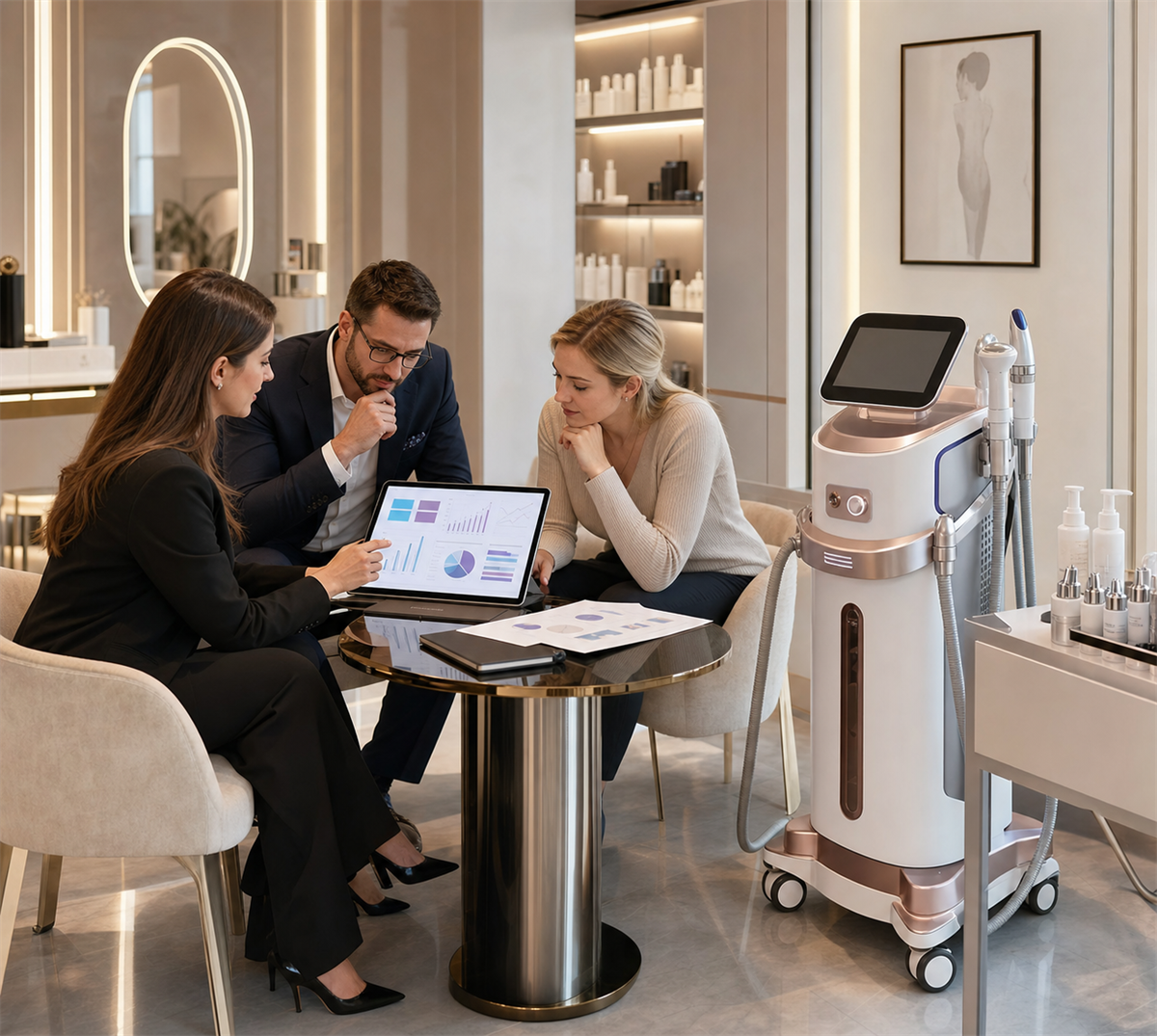
For a beauty salon, buying a new beauty device is not only a technical decision. It is also an investment decision. A device may look advanced, popular, and profitable in a supplier presentation, but the real question is whether it can generate enough cash flow for the specific salon.
To judge this correctly, salons need to calculate ROI before purchasing. ROI calculation helps the salon understand the total investment, cost per treatment, expected treatment price, break-even sessions, payback period, monthly profit contribution, and risk under conservative sales assumptions.
This article explains how beauty salons can calculate the investment return of a beauty equipment purchase in a practical way.
What ROI Means For Beauty Salon Equipment
ROI means return on investment. In beauty salon equipment purchasing, it answers this question:
How much profit can this device create compared with the money spent to buy, launch, operate, and maintain it?
Many salons only look at the machine price. This is not enough. The real investment may include shipping, tax, training, accessories, consumables, marketing, financing, maintenance, staff time, and treatment room use.
A useful ROI calculation should help the salon answer:
- How much will the device really cost to launch?
- How much profit can one treatment produce?
- How many treatments are needed to recover the investment?
- How many months will payback take?
- What happens if sales are lower than expected?
- Is the machine better than using the same money for marketing, staff, or another device?
The purpose of ROI is not to make a purchase look attractive. The purpose is to reveal whether the investment is realistic.
Step 1: Calculate The Total Investment Cost
The first step is to calculate total investment, not only equipment price.
総投資額には以下が含まれる場合があります。
- Equipment purchase price.
- 配送と貨物。.
- Import duty, customs, or tax where applicable.
- Installation fee.
- Training fee.
- Accessories and treatment heads.
- 初期消耗品。.
- Product stock used with the treatment.
- Room setup or electrical adjustment.
- マーケティング開始費用。.
- Financing interest or loan cost.
- Extended warranty or service plan.
- 予備部品の備蓄。.
式:
Total investment = machine price + shipping + tax + installation + training + accessories + initial consumables + launch marketing + other setup costs
例:
- Machine price: USD 6,000.
- Shipping and tax: USD 800.
- Training and installation: USD 500.
- Initial consumables and accessories: USD 700.
- Launch marketing: USD 1,000.
Total investment = USD 9,000.
If the salon only calculates USD 6,000, the payback estimate will be too optimistic. For ROI, the full launch cost matters.
Step 2: Calculate Variable Cost Per Treatment
Variable cost means the cost that changes every time the salon performs one treatment.
Common variable costs include:
- 使い捨てチップ。.
- カートリッジ。.
- フィルター。.
- Probes or pads.
- ゲル。.
- 美容液。.
- マスク。.
- Cotton, gloves, towels, and hygiene supplies.
- Staff commission.
- Payment processing fee.
- Treatment-specific product cost.
式:
Variable cost per treatment = consumables + product cost + staff commission + other treatment-specific cost
例:
- Gel and consumables: USD 6.
- Serum and mask: USD 8.
- Staff commission: USD 12.
- Disposable and hygiene supplies: USD 2.
Variable cost per treatment = USD 28.
This number is important because a high treatment price does not always mean high profit. A device with expensive consumables may have a weaker margin than expected.
Step 3: Calculate Gross Profit Per Treatment
Gross profit per treatment is the money left after subtracting variable cost from the selling price.
式:
1件の治療あたりの粗利益=治療価格-1件の治療あたりの変動費
例:
- Treatment price: USD 120.
- Variable cost per treatment: USD 28.
Gross profit per treatment = USD 92.
This is the most important number in the first stage of ROI calculation. If gross profit per treatment is too low, the machine will need many more sessions to recover the investment.
Step 4: Calculate Break-Even Sessions
Break-even sessions show how many treatments are needed to recover the total investment before the machine begins producing real cash return.
式:
損益分岐セッション数 = 総投資額 / 1回あたりの粗利益
例:
- Total investment: USD 9,000.
- Gross profit per treatment: USD 92.
Break-even sessions = 9,000 / 92 = about 98 sessions.
This means the salon needs about 98 profitable sessions to recover the investment. If the salon performs 10 sessions per week, payback may take around 10 weeks. If it performs only 3 sessions per week, payback may take more than 32 weeks.
This is why treatment volume is as important as treatment price.
Step 5: Estimate Weekly And Monthly Treatment Volume
Many supplier presentations assume ideal usage. A salon should use realistic local numbers.
Treatment volume depends on:
- Existing client traffic.
- Target customer demand.
- Staff sales ability.
- Treatment room availability.
- Treatment duration.
- 価格受容度。.
- パッケージ変換。.
- Marketing strength.
- Competition.
- Seasonality.
式:
Monthly sessions = weekly sessions x 4.33
例:
- Conservative case: 4 sessions per week.
- Normal case: 8 sessions per week.
- Optimistic case: 14 sessions per week.
Monthly sessions:
- Conservative: 4 x 4.33 = about 17 sessions.
- Normal: 8 x 4.33 = about 35 sessions.
- Optimistic: 14 x 4.33 = about 61 sessions.
The salon should never base the purchase only on the optimistic case. A good investment should still make sense under conservative or normal conditions.
Step 6: Calculate Monthly Gross Profit Contribution
Monthly gross profit contribution shows how much gross profit the device can produce in one month before additional fixed costs.
式:
Monthly gross profit = monthly sessions x gross profit per treatment
Example using USD 92 gross profit per treatment:
- Conservative: 17 x 92 = USD 1,564.
- Normal: 35 x 92 = USD 3,220.
- Optimistic: 61 x 92 = USD 5,612.
This gives the salon a clearer view of how much the machine may contribute each month.
Step 7: Subtract Additional Monthly Costs
Some costs are not paid per treatment, but they still affect profitability.
Additional monthly costs may include:
- Extra marketing.
- Financing payment.
- 維持管理予備費。.
- Software fee.
- Room cost allocation.
- Equipment insurance.
- Staff training refresh.
- Consumable storage loss.
- Repair reserve.
式:
Monthly net contribution = monthly gross profit – additional monthly costs
例:
- Monthly gross profit in normal case: USD 3,220.
- Monthly marketing and maintenance reserve: USD 500.
Monthly net contribution = USD 2,720.
This is a more realistic number for payback calculation than gross profit alone.
Step 8: Calculate Payback Period
Payback period shows how long it takes to recover the total investment.
式:
Payback period in months = total investment / monthly net contribution
例:
- Total investment: USD 9,000.
- Monthly net contribution: USD 2,720.
Payback period = 9,000 / 2,720 = about 3.3 months.
If the conservative case produces only USD 1,064 monthly net contribution after costs, payback becomes:
9,000 / 1,064 = about 8.5 months.
This difference is important. The same machine may look excellent in a normal case but risky in a conservative case.
Step 9: Calculate Annual ROI
Annual ROI estimates the return over one year.
式:
Annual ROI = annual net profit contribution / total investment x 100 percent
例:
- Monthly net contribution: USD 2,720.
- Annual net profit contribution: 2,720 x 12 = USD 32,640.
- Total investment: USD 9,000.
Annual ROI = 32,640 / 9,000 x 100 percent = 362.7 percent.
This number looks high, but the salon should treat it carefully. It assumes the device maintains the same monthly performance for a full year. Real results may be affected by seasonality, staff changes, competition, equipment downtime, price discounts, or declining novelty.
Step 10: Calculate Capacity Utilization
A machine can only make money when it is used. Capacity utilization measures how much of the available machine time is actually sold.
式:
Utilization rate = actual treatment hours / available treatment hours x 100 percent
例:
- The device is available 30 hours per week.
- Actual paid treatment time is 9 hours per week.
Utilization rate = 9 / 30 x 100 percent = 30 percent.
Low utilization means the machine may be idle even if the treatment has a good margin. New salons should be especially careful because they may not have enough traffic at the beginning.
Step 11: Calculate Package Conversion
Equipment ROI often depends on package sales, not only single sessions. Many aesthetic equipment treatments work best as courses or maintenance plans.
Key indicators include:
- お試し予約料金。.
- トライアル版からパッケージ版へのコンバージョン率。.
- 平均パッケージ価格。.
- コース修了率.
- 再予約料金。.
- Maintenance purchase rate.
- 紹介率.
例:
- 50 trial clients.
- 15 buy a package.
- Trial-to-package conversion rate = 15 / 50 x 100 percent = 30 percent.
If package conversion is weak, the salon may need better consultation, better pricing, better before-and-after tracking, stronger staff training, or a clearer treatment plan.
Step 12: Include Opportunity Cost
Opportunity cost means what the salon gives up by spending money on this machine instead of another use.
The same budget could be used for:
- 地域広告。.
- スタッフ研修。.
- Store renovation.
- Product inventory.
- Customer acquisition.
- A different device.
- Cash reserve.
A device with a long payback period may still be acceptable for a high-end salon if it strengthens positioning. But for a new or small salon, cash flow may matter more than brand image. The salon should compare equipment ROI with other possible uses of the same money.
Step 13: Consider Depreciation And Tax Treatment
Cash ROI and accounting ROI are not always the same. Equipment may be treated as a business asset and depreciated over time depending on the tax rules in the salon’s country.
In the United States, IRS Publication 946 explains depreciation rules for business or income-producing property. Some property may also qualify for Section 179 treatment under specific rules. Salons should consult a qualified accountant or tax advisor before relying on tax deductions in ROI calculations.
For management decisions, salons can use cash payback to judge operating pressure. For accounting and tax planning, they should use professional advice.
Step 14: Build Conservative, Normal, And Optimistic Scenarios
A professional ROI estimate should include at least three scenarios.
Conservative scenario:
- Lower treatment volume.
- Lower package conversion.
- More discounts.
- Higher marketing cost.
- Slower payback.
Normal scenario:
- Realistic treatment volume.
- Average package conversion.
- Stable pricing.
- Normal maintenance cost.
- Expected payback.
Optimistic scenario:
- Strong demand.
- High utilization.
- Strong package sales.
- Low discounting.
- Faster payback.
Example scenario table:
- Total investment: USD 9,000.
- Gross profit per treatment: USD 92.
- Monthly extra cost: USD 500.
保守的:
- 17 sessions per month.
- Monthly gross profit: USD 1,564.
- Monthly net contribution: USD 1,064.
- Payback: about 8.5 months.
普通:
- 35 sessions per month.
- Monthly gross profit: USD 3,220.
- Monthly net contribution: USD 2,720.
- Payback: about 3.3 months.
楽観的:
- 61 sessions per month.
- Monthly gross profit: USD 5,612.
- Monthly net contribution: USD 5,112.
- Payback: about 1.8 months.
This method prevents the salon from making a purchase based only on the best possible outcome.
Step 15: Test The Numbers With Local Market Research
ROI is not only a spreadsheet. The numbers must match local demand.
Before buying, salons should research:
- Whether local customers accept the treatment category.
- Competitor prices.
- Current salon customer age groups.
- Existing package purchase behavior.
- Price sensitivity.
- Local spending power.
- Similar treatment reviews.
- 季節的な需要。.
- Staff ability to sell the project.
The U.S. Small Business Administration emphasizes market research and competitive analysis as part of understanding customers and positioning a business. For salon equipment ROI, market research protects the calculation from unrealistic assumptions.
Step 16: Check Whether The Treatment Price Is Sustainable
Some salons calculate ROI using a high treatment price, but later discount heavily because customers do not accept the price. This can destroy the ROI.
購入前に、以下の点を確認してください。
- Can customers accept the planned single-session price?
- Can the salon sell packages without heavy discounts?
- Do competitors charge similar prices?
- Does the salon’s brand image support this price?
- Can staff explain the value clearly?
- Does the treatment result justify the price?
- Is the project easy to compare with cheaper alternatives?
If the salon must discount by 50 percent to sell the project, the original ROI calculation should be rebuilt with the discounted price.
Step 17: Do Not Ignore Staff Time
Staff time is a real cost. A device that produces USD 120 per session may still be inefficient if the treatment takes too long or needs two operators.
Salons should calculate:
- 治療時間。.
- Consultation time.
- Preparation time.
- Cleaning time.
- Follow-up time.
- Number of operators needed.
- Staff commission.
- Room turnover.
式:
Revenue per treatment hour = treatment price / total service time in hours
例:
- Treatment price: USD 120.
- Total service time including cleaning: 1.5 hours.
Revenue per treatment hour = USD 80.
A shorter treatment with lower price may sometimes produce better room efficiency than a longer premium project.
Step 18: Include Downtime And Repair Risk
Equipment downtime reduces ROI. If the machine cannot operate, the salon loses bookings and may damage client trust.
供給業者に問い合わせてください:
- What is the common failure rate?
- 交換部品は入手可能ですか?
- 修理にはどれくらい時間がかかりますか?
- リモートでの技術サポートは利用できますか?
- Is a replacement device available during repair?
- 保証の対象となる部品はどれですか?
- 消耗品はどの部分ですか?
- Who pays shipping for repair?
A cheaper device with poor after-sales service can produce lower ROI than a more expensive device with reliable support.
Step 19: Compare Single-Function And Multi-Function ROI
A single-function device may have stronger performance for one project. A multi-function device may support more services and reduce first purchase cost.
比較する:
- 購入費用。.
- Number of sellable projects.
- Average treatment price.
- スタッフ研修の難しさ。.
- Function quality.
- Maintenance cost.
- 顧客理解。.
- Utilization rate.
- Package design.
Multi-function devices can be a good choice for new or small salons if the functions are practical and easy to package. Single-function devices may be better for salons with clear demand for a high-value specialist project.
Step 20: Use A Simple ROI Checklist Before Purchasing
Before buying a device, the salon should confirm:
- Total investment has been calculated.
- Variable cost per treatment is known.
- Gross profit per treatment is realistic.
- Break-even sessions are acceptable.
- Monthly treatment volume is realistic.
- Conservative payback period is acceptable.
- Price has been tested with customers.
- Competitor pricing has been checked.
- Staff can sell and operate the project.
- Supplier after-sales service is clear.
- Consumables and spare parts are available.
- Compliance and advertising claims have been reviewed.
- The device fits the salon’s positioning.
- Cash flow remains safe after purchase.
If several points are unclear, the salon should not rush to buy. It should test demand, adjust pricing, or choose a lower-risk device.
Common ROI Mistakes Beauty Salons Make
よくある間違いは次のとおりです:
- Calculating only the machine price, not total investment.
- Ignoring consumables and staff commission.
- Using supplier sales examples instead of local data.
- Assuming every trial client will buy a package.
- Ignoring treatment room time.
- Forgetting marketing cost.
- Ignoring repair and downtime.
- Calculating ROI with full price but selling with discounts.
- Not testing customer price acceptance.
- Buying a device before building a treatment package.
- Ignoring compliance and claim risk.
The biggest mistake is treating ROI as a promise instead of a model. ROI is only useful when the inputs are honest.
結論
Beauty salons can calculate the ROI of a beauty equipment purchase by starting with total investment, then calculating variable cost, gross profit per treatment, break-even sessions, monthly treatment volume, monthly net contribution, payback period, annual ROI, utilization rate, and package conversion.
The most important formula is simple:
投資回収期間 = 総投資額 / 月々の純拠出額
But the quality of the calculation depends on realistic assumptions. A salon should test customer demand, competitor pricing, staff capability, supplier service, consumable cost, and compliance before purchasing.
For salon owners, a good device is not the one with the most impressive brochure. It is the one that can be sold repeatedly, operated safely, supported reliably, and paid back within a realistic time frame.
よくある質問
How do beauty salons calculate ROI for equipment?
Beauty salons calculate ROI by adding all investment costs, calculating gross profit per treatment, estimating monthly treatment volume, subtracting monthly operating costs, and comparing annual net profit contribution with the total investment.
What is the basic payback formula for beauty equipment?
The basic formula is: payback period = total investment / monthly net contribution. Monthly net contribution is monthly gross profit minus additional monthly costs such as marketing, maintenance, financing, and software fees.
How many treatments are needed to recover the cost of a machine?
Break-even sessions = total investment / gross profit per treatment. For example, if total investment is USD 9,000 and gross profit per treatment is USD 92, the salon needs about 98 treatments to recover the investment.
What costs should be included in beauty equipment ROI?
Costs should include machine price, shipping, tax, installation, training, accessories, consumables, staff commission, maintenance, marketing, financing, repair reserve, and room or workflow costs.
Why do some beauty equipment ROI estimates fail?
They fail because salons use unrealistic treatment volume, ignore discounts, forget consumables, underestimate staff time, skip local market research, or rely too much on supplier revenue examples.