







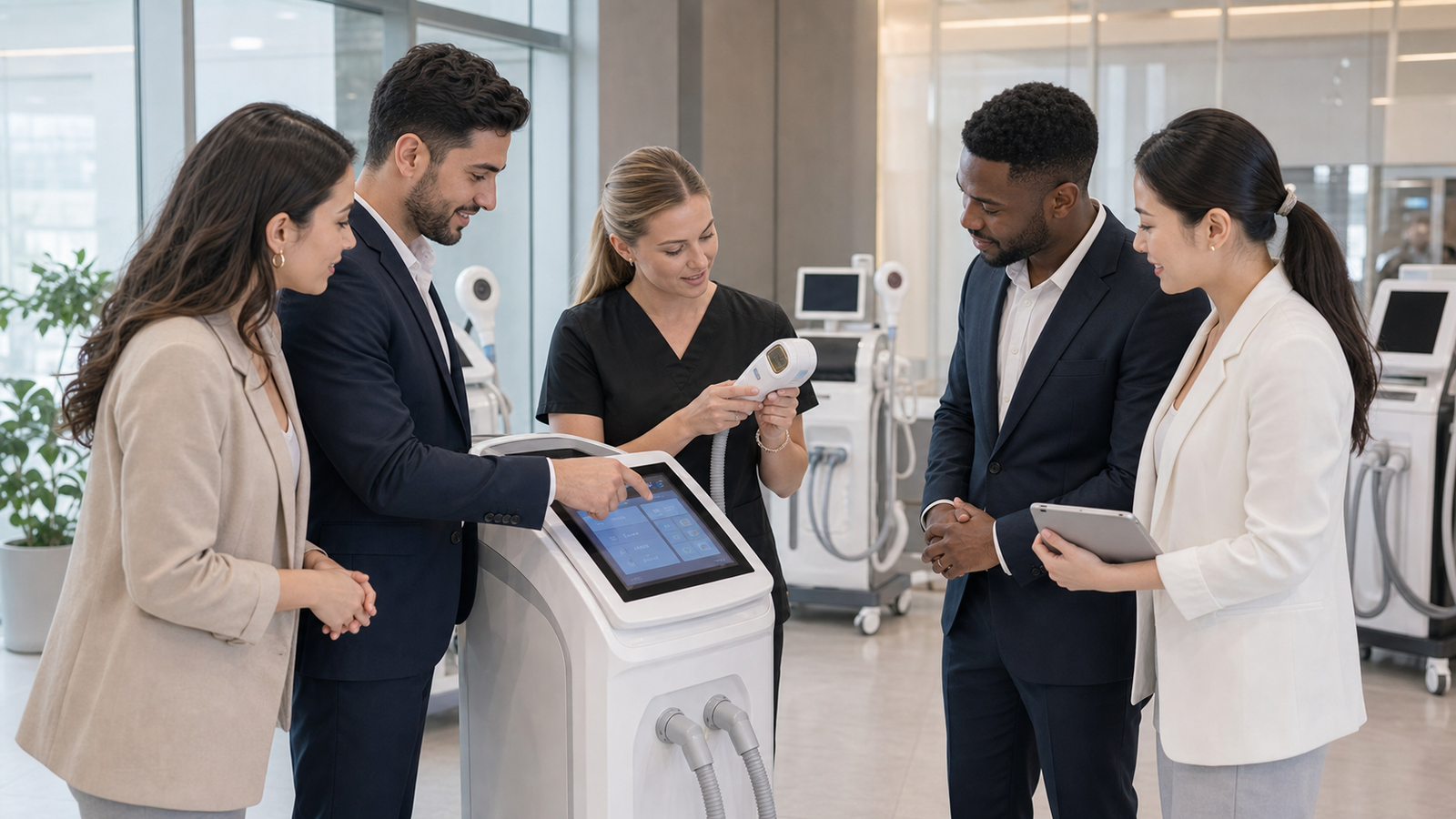
For distributors, a multi-wavelength diode laser can be easier to position than a single-wavelength system because it offers a broader product story.
Instead of presenting the machine only as an 808nm hair-removal platform, the distributor can discuss different skin tones, hair depths, treatment areas and customer profiles within one equipment category.
However, the number of wavelengths should not become the entire sales argument.
A five-wavelength label does not mean five times the treatment effect, and 808nm and 810nm are technically very close. Actual performance depends on the optical design, energy delivered at each wavelength, pulse control, spot size, cooling, operator training and client selection.
The strongest sales position is therefore:
A well-designed multi-wavelength platform can give salons more consultation flexibility and broader market positioning, while one device, one training system and one after-sales structure remain easier to manage than several separate machines.
This article explains how distributors can communicate that advantage responsibly.
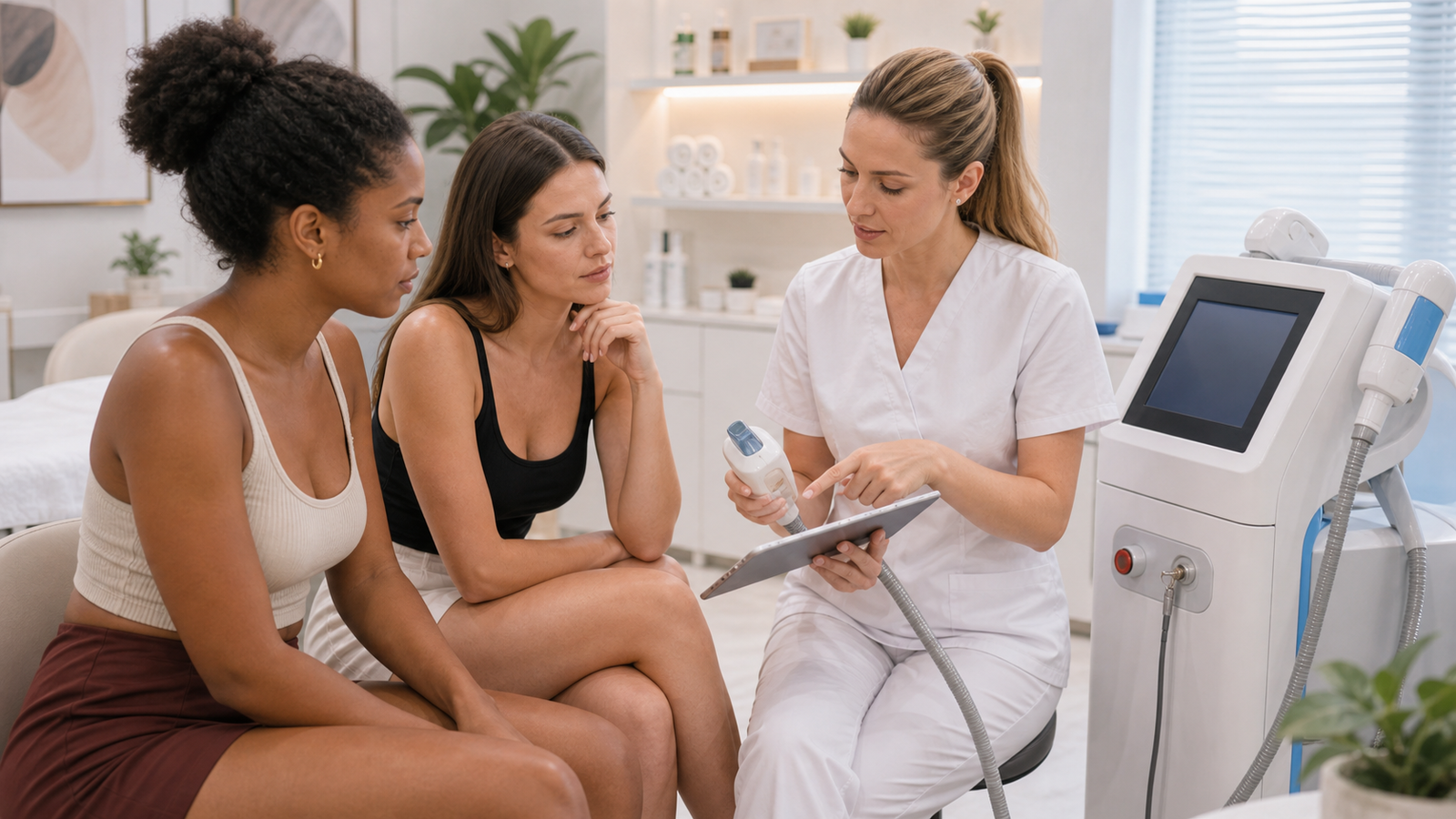
First, Understand What the Wavelength Numbers Mean
Laser hair reduction works by delivering optical energy that is absorbed by melanin in the hair structure and converted into heat. The aim is to affect the hair-growth structure while protecting surrounding skin.
Wavelength influences melanin absorption, penetration depth and the balance between hair targeting and epidermal safety.
The numbers alone do not define the complete treatment.
Two machines using the same listed wavelengths may perform differently because of:
- actual power and fluence
- energy distribution between wavelengths
- pulse width
- repetition rate
- spot size
- sapphire contact cooling
- optical losses inside the handpiece
- software control
- calibration
- operator technique
Distributors should therefore treat wavelength configuration as one part of the product evaluation, not a substitute for testing the complete system.
How 755nm Is Commonly Positioned
The 755nm range is associated with relatively strong melanin absorption and more superficial targeting than longer wavelengths.
In sales communication, it is often positioned for:
- finer or more superficial dark hair
- lighter skin types where appropriate
- smaller or more detailed treatment areas
- customers familiar with the Alexandrite wavelength story
This can help distributors answer buyers who want more flexibility than a standard 808/810nm platform.
However, stronger melanin interaction also means epidermal melanin must be considered carefully. Operators still need skin assessment, appropriate settings, cooling and responsible protocols.
Distributors should not claim that adding 755nm makes very light, white, gray or red hair easy to treat. Hair with insufficient melanin can respond poorly to laser hair reduction regardless of the number of wavelengths.
How 808nm and 810nm Are Commonly Positioned
The 808-810nm range is the established central wavelength range for many professional diode laser hair-removal platforms.
It is often presented as a balance between melanin absorption and penetration depth, making it useful for a broad range of common hair-removal services when used by trained operators.
Typical commercial positioning includes:
- legs and arms
- underarms
- back and chest
- bikini-area services
- full-body packages
- high-volume laser studios
An important technical point is that 808nm and 810nm are extremely close.
They should not be described to salon buyers as two completely different treatment technologies. In many marketing configurations, including both values may reflect the specific laser-bar design, manufacturing tolerance, spectral mix or product naming strategy.
Distributors should ask the supplier:
- Are 808nm and 810nm produced by separate laser-bar groups?
- Are both emitted simultaneously?
- What proportion of total power comes from each wavelength?
- Is the specification a nominal range rather than two independent channels?
An honest answer builds more trust than presenting two nearby values as unrelated benefits.
How 940nm Is Commonly Positioned
The role of 940nm in hair-removal marketing is less standardized than the established 755nm, 808/810nm and 1064nm wavelength stories.
Some multi-wavelength suppliers position 940nm as an additional deeper-penetrating component or as a wavelength that may contribute to heating around the follicular environment. Published clinical research also includes multi-wavelength systems combining 810, 940 and 1060/1064nm.
However, distributors should avoid making a highly specific biological claim unless the manufacturer can support it with evidence for the exact platform.
Before using 940nm as a sales point, confirm:
- why the wavelength is included
- how much power it contributes
- whether it is emitted simultaneously or selectively
- what test or clinical documentation supports the configuration
- whether treatment parameters differ from other modes
The safest commercial explanation is that 940nm adds another wavelength component to the platform’s energy profile, potentially supporting broader parameter design. It should not be promoted as a guaranteed independent result mechanism without supporting evidence.
How 1064nm Is Commonly Positioned
The 1064nm range has lower melanin absorption and deeper penetration than shorter hair-removal wavelengths.
It is commonly associated with treatment strategies for darker skin types and deeper hair structures when appropriate settings, cooling and trained operation are used.
For distributors serving diverse international markets, this can be an important positioning advantage.
The sales message should be:
The platform provides wavelength options that can help trained professionals adapt consultation and parameter selection for a more diverse customer base.
It should not be:
The machine is automatically safe for every dark-skinned client.
No wavelength eliminates the need for skin assessment, contraindication screening, patch testing where appropriate and conservative parameter selection.
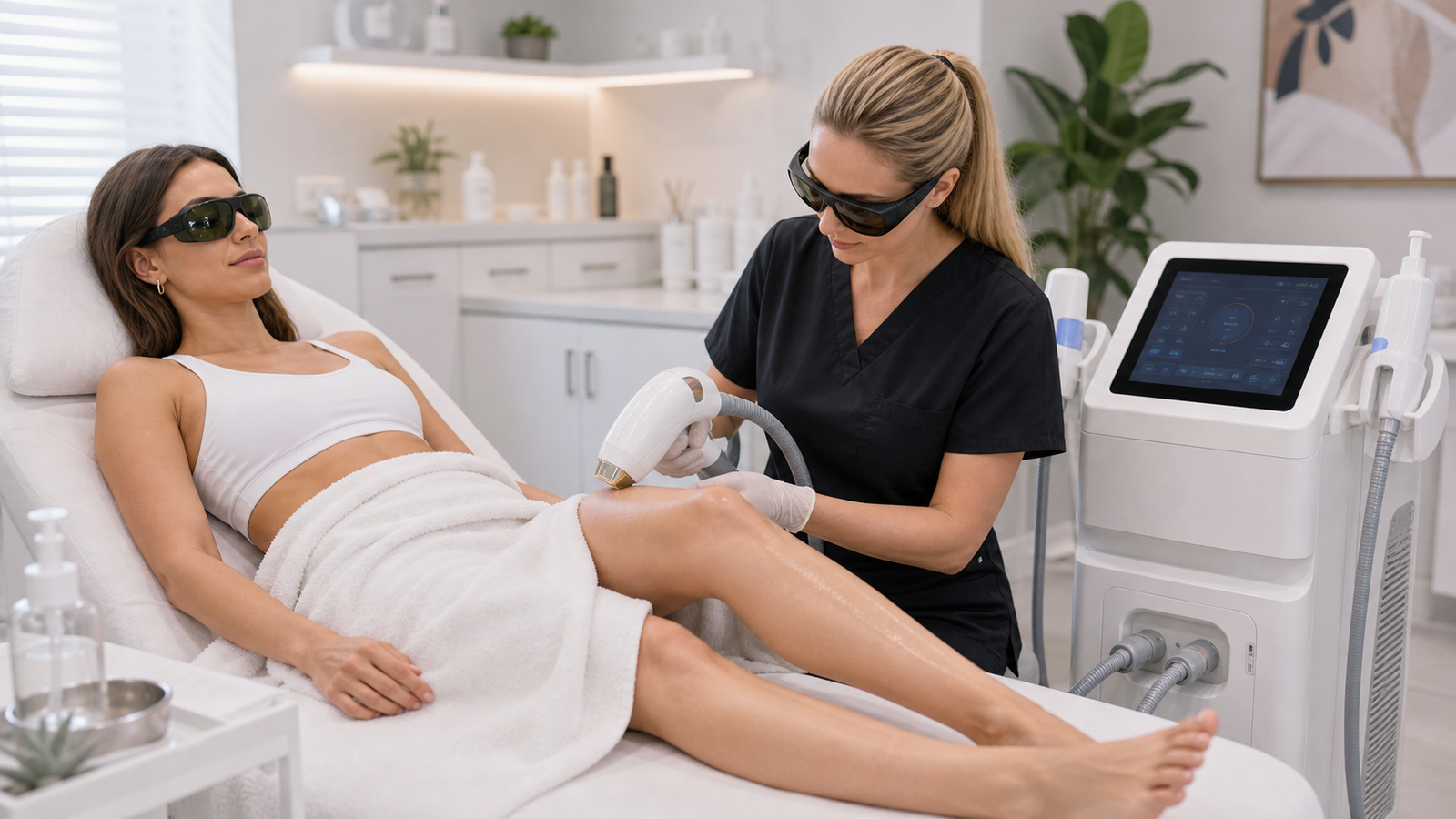
Sales Advantage 1: A Broader Customer-positioning Story
The most obvious sales advantage is the ability to discuss a wider range of customer profiles.
A single-wavelength machine may already serve many salon clients effectively. A multi-wavelength configuration gives the distributor a more complete consultation story around:
- different skin tones
- different hair depths
- different hair thicknesses
- different body areas
- different treatment speeds and modes
This can be useful in multicultural markets, international cities and salon chains serving diverse clients.
The benefit is not that every wavelength is used identically for every person. The benefit is that the salon has a platform designed with broader treatment flexibility in mind.
Sales Advantage 2: One Device Can Support More Service Packages
A multi-wavelength machine can help salons present a more complete hair-removal menu.
Possible packages include:
- facial hair-management services
- underarm packages
- arms and legs
- back and chest
- bikini-area services
- full-body plans
- male grooming packages
- maintenance sessions
The salon does not need to explain wavelength physics to every client.
Instead, it can position the service around professional assessment and customized settings.
For the distributor, this shifts the conversation from a hardware specification to a service-business opportunity.
Sales Advantage 3: Stronger Differentiation in a Mature Market
The diode laser market is highly competitive. Many machines look similar and use the same basic 808nm sales language.
A credible multi-wavelength platform can help a distributor differentiate through:
- broader wavelength configuration
- diverse-client positioning
- treatment flexibility
- modern platform perception
- premium package potential
- replacement and upgrade sales
This differentiation is valuable only when supported by real specifications.
If the machine is advertised as five wavelengths but cannot explain power allocation, optical design or treatment modes, the feature may become a marketing weakness rather than an advantage.
Buyers increasingly ask technical questions. Distributors should be ready with clear answers.
Sales Advantage 4: Easier Entry Into Diverse Overseas Markets
Skin-tone distribution and consumer needs differ by region.
A broader wavelength story can help distributors position one product family across:
- Europe
- North America
- the Middle East
- Latin America
- Asia-Pacific
- Africa
This may simplify inventory compared with purchasing separate single-purpose platforms for every market segment.
However, the same software presets and marketing claims should not automatically be used everywhere.
Local distributors still need to adapt:
- training
- client consultation
- service names
- treatment pricing
- documentation
- compliance claims
- operator requirements
The product may be global, but the commercial strategy must be local.
Sales Advantage 5: A Better Upgrade Story for Existing Salons
Many salons already own an older single-wavelength diode laser.
For these buyers, multi-wavelength equipment can be positioned as an operational upgrade rather than simply another hair-removal machine.
The upgrade conversation may include:
- broader client consultation
- improved cooling
- faster repetition rate
- larger spot size
- lighter handpiece
- updated software
- new service packages
- stronger parts and warranty support
The distributor should demonstrate measurable improvements.
Wavelength count alone may not justify replacement if the existing machine already performs well.
Sales Advantage 6: Simplified Training and After-sales Structure
If one platform covers the distributor’s main hair-removal customer segments, the business may be easier to manage.
The distributor can standardize:
- staff training
- operation manuals
- demo equipment
- handpiece inventory
- spare parts
- software support
- warranty procedures
- marketing materials
This can be more efficient than supporting several unrelated machines from different suppliers.
The advantage depends on supplier continuity. Confirm handpiece life, laser-bar replacement, cooling components, software support and long-term parts availability before building the local product line.
Sales Advantage 7: Premium Consultation Without Premium-brand Pricing
Multi-wavelength systems can help salons present a more professional consultation process.
The therapist can discuss skin tone, hair color, hair thickness, treatment area, medical history and previous hair-removal experience before selecting a treatment mode.
This supports a premium client experience even when the equipment uses a factory-direct value model.
For distributors, the message can be:
This platform helps your salon sell professional assessment and customized treatment planning, not only laser pulses.
That is a stronger value proposition than competing only on machine price.
Cooling May Matter More Than Adding Another Wavelength
Clients judge the service through comfort and safety, not through the wavelength list printed on a brochure.
Effective contact cooling can support:
- epidermal protection
- improved comfort
- operator confidence
- treatment continuity
- stronger client acceptance
Distributors should evaluate:
- sapphire cooling temperature
- cooling stability during long sessions
- handpiece contact area
- condensation management
- water-circulation design
- alarms and temperature monitoring
- performance under continuous use
A well-cooled three-wavelength platform may create more commercial value than a poorly cooled five-wavelength platform.

Questions Distributors Must Ask the Supplier
Before promoting a 755/808/810/940/1064nm system, ask:
1. Are all five wavelengths physically present in the handpiece?
2. Are they emitted simultaneously or selected by mode?
3. What is the power contribution of each wavelength?
4. Is total stated power optical output or electrical input?
5. What fluence is available at the skin?
6. What spot sizes are supported?
7. What pulse-width and repetition-rate ranges are available?
8. How is energy calibrated?
9. What cooling method and temperature range are used?
10. What is the expected handpiece or laser-bar life?
11. Can the laser bars be replaced?
12. What clinical or performance evidence supports the exact configuration?
13. Which skin and hair profiles are included in training guidance?
14. Are software presets editable by trained operators?
15. Which spare parts will remain available long term?
If the supplier cannot answer these questions, the wavelength list should not be the main reason for purchase.
How to Explain the Five-wavelength Advantage to Salon Buyers
A practical distributor sales script is:
“The value of this platform is not simply that it lists five wavelength numbers. The value is that the handpiece is designed to give trained operators a broader energy profile for different consultation needs. This can help your salon serve a more diverse client base with one device, while keeping training, maintenance and service packages within one system.”
Then explain the limitations:
“Client response still depends on skin tone, hair color, hair thickness, treatment area, settings and treatment course. Very light, white, gray or red hair may respond poorly because laser hair reduction depends on melanin.”
This balanced wording creates trust.
Claims Distributors Should Avoid
Avoid saying:
- five wavelengths provide five times better results
- the machine works equally well for every skin and hair type
- one treatment permanently removes all hair
- darker skin requires no special assessment
- 808nm and 810nm are completely different technologies
- 940nm guarantees a unique result without platform-specific evidence
- cooling removes all treatment risk
- wavelength count proves machine quality
Better wording includes:
- broader wavelength configuration
- flexible professional consultation
- long-term hair reduction
- support for diverse client profiles
- trained parameter selection
- contact-cooling support
- results vary by individual and treatment course
Training Converts the Specification Into a Sales Advantage
Without training, a multi-wavelength configuration can confuse operators rather than help them.
Training should cover:
- wavelength principles
- skin and hair assessment
- contraindications
- patch testing where appropriate
- parameter selection
- cooling and contact technique
- treatment endpoints
- client expectations
- protective eyewear
- handpiece maintenance
- incident response
The distributor should also train salon staff to explain the feature in simple language.
Clients do not need a physics lecture. They need to understand that the salon assesses them individually and uses a professional platform with suitable options.
How SHEFMON Distributors Can Position Multi-wavelength Diode Laser Equipment
SHEFMON distributors can position the platform around:
- global customer diversity
- factory-direct investment value
- wavelength configuration options
- cooling comfort
- service-menu expansion
- operator training
- OEM/ODM localization
- handpiece and spare-parts support
The exact wavelength structure, power, cooling system and documentation should be confirmed for the specific model before publication or customer quotation.
Useful pages include:
Conclusion
A 755/808/810/940/1064nm diode laser can offer real sales advantages when the configuration is technically genuine and commercially well supported.
Its strongest value is broader consultation flexibility, international-market positioning, service-menu expansion and the ability to support more customer profiles through one platform.
But five numbers on a brochure are not enough.
Distributors should verify actual wavelength output, energy distribution, cooling, handpiece life, training and parts supply.
The most persuasive sales message is not “more wavelengths always mean better results.”
It is:
“This platform gives trained salons more flexibility to assess and serve a diverse customer base within one professional hair-removal system.”
FAQ
1. Is a five-wavelength diode laser always better than a three-wavelength machine?
No. Performance depends on actual optical output, energy distribution, cooling, pulse control, spot size and training. A well-designed three-wavelength machine can outperform a poorly designed five-wavelength machine.
2. Are 808nm and 810nm different treatment technologies?
They are very close wavelengths within the same central diode range. Ask whether they use separate laser-bar groups or whether the label represents a nominal spectral range.
3. What is the main sales value of 755nm?
It adds a shorter-wavelength component commonly associated with stronger melanin absorption and more superficial targeting. It is often positioned for finer dark hair and lighter skin types where appropriate.
4. Why is 1064nm useful in a multi-wavelength platform?
Its lower melanin absorption and deeper penetration support positioning for deeper hair structures and more diverse skin tones when trained operators use suitable settings and cooling.
5. What does 940nm add?
Its exact role depends on the platform design. Some systems use it as an additional component in a multi-wavelength energy profile. Distributors should request evidence for the exact machine and avoid unsupported biological claims.
6. Can multi-wavelength diode laser treat white or gray hair?
Hair with very little melanin generally responds poorly to laser hair reduction. Adding wavelengths does not remove this limitation.
7. Are all wavelengths emitted at the same time?
Not always. Some handpieces emit wavelengths simultaneously, while others use selectable modes or different handpieces. Confirm the design with the supplier.
8. What specification is more important than wavelength count?
Cooling performance, delivered fluence, pulse control, spot size, handpiece durability, calibration and training can be more important to real salon performance.
9. How should salons explain multi-wavelength treatment to clients?
Explain that the platform gives trained professionals more flexibility to customize treatment planning after assessing skin tone, hair characteristics and treatment area.
10. What should distributors verify before ordering?
Verify physical wavelengths, power allocation, cooling, software modes, clinical evidence, handpiece life, replaceable parts, training and long-term support.