








Diode laser hair removal is no longer a new beauty technology.
It is already widely recognized by salons, med spas, laser studios and consumers in many international markets. This maturity sometimes creates a concern for distributors:
Is the market already saturated, or does diode laser equipment still have room to grow?
The short answer is yes, growth opportunities still exist, but they are not equally strong in every country, price segment or buyer channel.
The next stage of growth is unlikely to come only from selling more identical machines. It will come from wider consumer access, improved treatment comfort, better support for diverse skin types, specialized laser studios, replacement demand, higher service standards and distributors that can provide training, parts and realistic business models.
Public commercial market reports generally forecast continued growth for laser hair removal, although their market-size estimates and CAGR figures vary because they use different product, service and geographic definitions. At the same time, procedure surveys can show year-to-year fluctuations. For example, the ISAPS 2024 survey reported a decline in nonsurgical hair-removal procedures performed by plastic surgeons compared with 2023.
These two signals are not necessarily contradictory. Long-term market expansion can continue while a specific professional channel or individual year experiences weaker procedure volume.
For distributors, the correct conclusion is not that every diode laser will sell easily. The opportunity remains for equipment that fits local demand, operator capability, safety expectations and after-sales requirements.

Why Diode Laser Hair Removal Still Has a Strong Market Foundation
Hair removal addresses a recurring consumer need rather than a temporary fashion trend.
Consumers may seek treatment for convenience, grooming preferences, ingrown-hair concerns or reduced dependence on shaving and waxing. The service can also be packaged by body area and sold as a multi-session course.
This gives diode laser several commercial advantages:
- the service is already familiar to many consumers
- treatment benefits are relatively easy to explain
- multiple body areas create different price levels
- treatment courses support repeat visits
- maintenance sessions may create future revenue
- salons can sell single-area and full-body packages
- the category fits specialist studios as well as broader beauty businesses
A mature category can be attractive to distributors because less consumer education may be required than for an unfamiliar technology.
However, maturity also means stronger competition. The distributor must compete through product performance, training, warranty, handpiece support and a better customer experience rather than relying only on the treatment name.
Market Growth Should Be Interpreted Carefully
Commercial research companies publish different estimates for the global laser hair removal market.
Some reports measure equipment revenue. Others measure treatment services, all laser hair-removal technologies or broader energy-based aesthetic categories. Forecast periods and geographic coverage also differ.
For that reason, distributors should avoid presenting one commercial forecast as a guaranteed market result.
A more responsible statement is:
Multiple market-research sources expect continued global growth in laser hair removal, supported by consumer awareness, expanding aesthetic-service access and technology improvements, but actual demand varies by region and channel.
Distributors should combine market reports with local evidence:
- salon and clinic interviews
- competitor service menus
- local treatment prices
- search interest
- social-media demand
- appointment availability
- customer reviews
- local import and operator requirements
Global growth is useful context, but local validation determines whether a distributor should import ten machines or one demonstration unit.
Opportunity 1: Growth Beyond Premium Urban Clinics
In many markets, professional laser hair removal first developed in large cities and premium clinics.
Future growth can come from:
- smaller cities
- suburban salons
- independent laser studios
- beauty chains
- multi-service med spas
- markets where professional treatments are becoming more affordable
Factory-direct equipment can help lower the investment barrier for these buyers, but distributors must not compete only on low price.
Smaller salons still need stable cooling, practical training, reliable handpieces, clear treatment guidance and responsive support.
The opportunity is to make professional services more accessible without reducing quality control.
Opportunity 2: Dedicated Laser Hair Removal Studios
Specialized studios can create strong demand because their business model focuses on treatment volume, package sales and operational efficiency.
These buyers often care about:
- treatment speed
- spot size
- cooling comfort
- handpiece ergonomics
- expected handpiece life
- continuous daily operation
- booking capacity
- maintenance downtime
- replacement handpiece availability
A specialist studio may value a faster and more serviceable platform more than a salon that performs only a few treatments per week.
For distributors, this creates an opportunity to segment the product line. A compact entry model may fit a small salon, while a higher-duty platform may fit a busy laser studio.
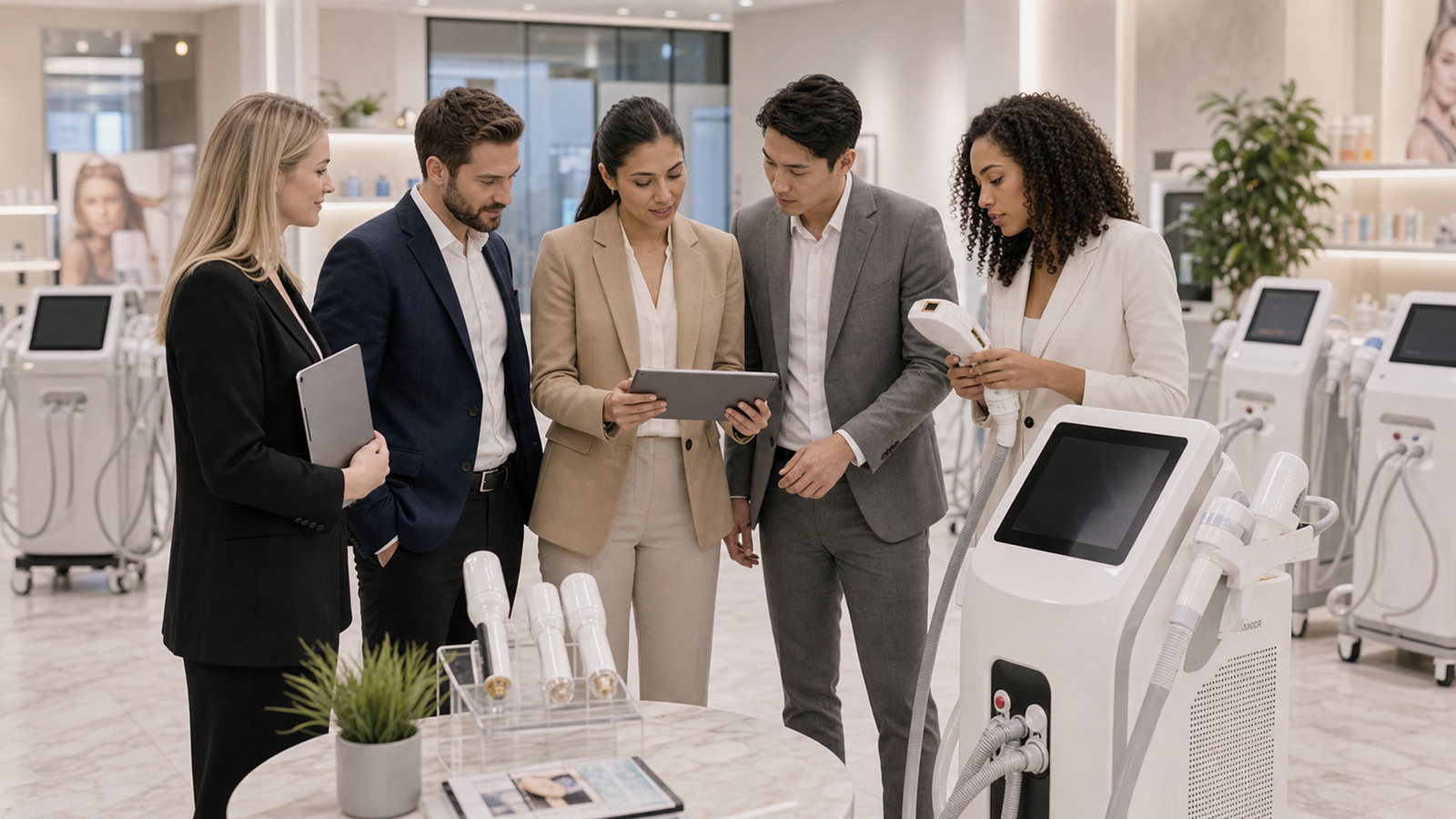
Opportunity 3: Demand From Diverse Skin Types and Customer Groups
International markets serve customers with different skin tones, hair characteristics and treatment expectations.
This increases interest in wavelength options, cooling systems and protocols that help trained operators select appropriate settings.
Common diode configurations may include 755 nm, 808 or 810 nm, 940 nm and 1064 nm wavelengths, either individually or in combinations. A longer feature list does not automatically mean better performance for every client.
Distributors should evaluate:
- actual wavelength configuration
- energy delivery
- pulse control
- cooling performance
- spot size
- operator guidance
- treatment speed
- skin assessment workflow
- supplier training
No wavelength configuration removes the need for client assessment, contraindication screening and trained operation.
The strongest sales message is not “one setting works for everyone.” It is that the platform provides practical options for trained professionals serving a diverse customer base.

Opportunity 4: Male Grooming and Broader Treatment Areas
Hair-removal demand is not limited to traditional female salon services.
Male grooming can expand the addressable market through services for the back, chest, shoulders, neck, beard line and other areas where locally appropriate.
Other growth opportunities may include:
- facial hair management
- underarm packages
- legs and arms
- bikini-area services
- full-body packages
- maintenance programs
- packages for athletes or fitness customers
Distributors should research local culture and customer preferences before building campaigns. The same service names and images will not work equally well in every country.
Opportunity 5: Replacement and Upgrade Demand
Market growth does not only come from first-time buyers.
Existing salons may replace older systems because of:
- weak cooling
- slow treatment speed
- worn handpieces
- unavailable spare parts
- outdated interfaces
- high maintenance cost
- demand for additional wavelengths
- poor technical support
Replacement demand can be attractive because the buyer already understands the service and may have an established client base.
The distributor’s role is to show a clear operational improvement rather than simply presenting a newer shell.
Useful comparison points include:
- treatment time
- cooling comfort
- handpiece weight
- expected maintenance
- warranty
- spare-parts support
- staff retraining requirements
- compatibility with the existing service menu
Opportunity 6: Package-based and Membership Revenue
Diode laser hair removal supports multi-session business models.
A studio can create:
- single-area packages
- multiple-area combinations
- full-body plans
- seasonal promotions
- prepaid treatment courses
- maintenance memberships
For distributors, this makes ROI easier to explain than for services based only on one-time appointments.
The calculation should remain conservative. Treatment revenue depends on local pricing, client acquisition, appointment capacity, consumables, operator cost and package completion rates.
The distributor should help the salon build a service model rather than promise guaranteed payback.
Regional Opportunity Is Not the Same Everywhere
North America
The market has strong consumer awareness and mature professional channels, but competition and customer-acquisition costs can be high. Opportunities may come from specialist studios, replacement systems, better treatment comfort and strong local service support.
Europe
Europe contains very different national markets. Distributors must consider local device classification, documentation, operator requirements, advertising rules and consumer pricing. Localization and compliance support are important.
Middle East
High grooming demand, premium beauty spending and diverse customer profiles can support professional hair-removal services. Cooling, wavelength strategy, training and client assessment are important selling points.
Latin America
Growing beauty-service access may create opportunities, but import cost, financing, exchange rates, local technical service and treatment affordability can strongly affect demand.
Asia-Pacific
The region includes mature markets and rapidly developing beauty sectors. Opportunities vary between high-volume chains, compact salon systems and premium clinic platforms. Local consumer preferences and strong price competition require careful positioning.
Africa
Opportunity may develop through urban salons, med spas and growing professional beauty sectors. Distributors need appropriate training, reliable cooling, support for diverse skin types, practical financing and dependable spare-parts logistics.
These are broad channel observations, not guaranteed regional forecasts. Each country requires separate validation.
What Can Limit Market Growth?
The opportunity is real, but distributors should also understand the constraints.
Strong Price Competition
Similar-looking machines can create price pressure. Competing only on purchase cost weakens margin and after-sales capacity.
Home-use Devices
Consumer IPL devices may attract price-sensitive users. Professional providers must differentiate through assessment, trained operation, treatment power, service experience and support.
Safety and Operator Skill
Poor client screening or incorrect settings can create burns, pigmentation changes or dissatisfaction. Training and responsible protocols are essential.
Exaggerated Claims
Promising permanent removal for every client creates regulatory and reputation risk. Safer wording includes long-term hair reduction and professional hair-removal management.
High Customer-acquisition Cost
A salon may own a good machine but struggle to fill appointments. The distributor should discuss service launch, packages and retention rather than only hardware.
Weak After-sales Support
A failed handpiece can stop the entire service. Parts, diagnostics and repair planning are essential for commercial continuity.
What Product Features Will Matter Most?
In a mature category, practical operating value matters more than decorative features.
Distributors should evaluate:
- stable energy delivery
- effective contact cooling
- suitable wavelength configuration
- practical spot size
- treatment repetition rate
- handpiece ergonomics
- device duty cycle
- interface clarity
- safety controls
- training documentation
- handpiece and parts availability
- warranty and repair process
The device should be matched to the buyer’s workload.
A high-volume studio may need continuous operation and fast treatment. A small salon may prioritize compact size, manageable investment and simple operation.
Training Is a Market-growth Tool
Training protects safety, results and distributor reputation.
It should cover:
- hair and skin assessment
- contraindications
- patch testing where appropriate
- parameter selection
- cooling and contact technique
- protective eyewear
- treatment-area preparation
- client communication
- maintenance
- incident response
A distributor that provides training can compete on value rather than price alone.

How Distributors Should Validate Local Demand
Before importing a larger quantity, distributors should:
1. Interview local salons, laser studios and med spas.
2. Compare treatment prices and package structures.
3. Review competitor appointment availability and customer reviews.
4. Check local search interest for treatment terms.
5. Confirm import, device and operator requirements.
6. Calculate conservative salon ROI.
7. Run demonstrations with trained operators.
8. Test handpiece comfort and continuous operation.
9. Confirm spare-parts and replacement-handpiece supply.
10. Start with a controlled inventory level.
Strong demand is shown by practical buyer questions about training, financing, warranty and delivery, not only by social-media views.
How SHEFMON Distributors Can Position Diode Laser Equipment
SHEFMON distributors can position diode laser equipment around practical business value:
- factory-direct investment level
- wavelength and model options
- cooling and treatment comfort
- operator training
- OEM/ODM localization
- warranty and technical support
- replacement handpieces and parts
- service-package planning
The distributor should confirm the exact specifications and documentation of each model before making performance or compliance claims.
Useful SHEFMON pages include:
Conclusion
Diode laser hair removal equipment still has global growth opportunities.
The opportunity is supported by established consumer awareness, repeat treatment courses, broader professional access, replacement demand, male grooming and demand for more comfortable and efficient platforms.
But the category is mature and competitive.
Success will not come from importing another identical low-priced machine. It will come from selecting the right platform for the local channel and supporting it with training, realistic claims, spare parts, service packages and dependable after-sales care.
The market may continue growing, but distributors must earn their share of that growth.
FAQ
1. Is the global diode laser hair removal market saturated?
Some large cities and premium channels are highly competitive, but opportunities remain in smaller cities, specialist studios, replacement demand and developing professional beauty markets.
2. Are market growth forecasts reliable?
Commercial forecasts provide useful direction, but estimates vary because reports define the market differently. Distributors should combine them with local buyer interviews, treatment prices and competitor research.
3. Why can procedure numbers fall while the market still grows long term?
Annual procedure surveys may cover only certain professional groups and can fluctuate with economic conditions or channel shifts. Equipment and service markets can still expand over a longer period or through other provider types.
4. Which buyer channel has the strongest opportunity?
It depends on the country. Specialist laser studios may value speed and durability, while beauty salons may prioritize investment level, compact size and simple operation.
5. Do multiple wavelengths guarantee better results?
No. Wavelength options can increase flexibility, but performance also depends on energy delivery, pulse control, cooling, operator skill and appropriate client selection.
6. Can professional diode laser compete with home-use IPL devices?
Yes, by offering trained assessment, professional equipment, higher service standards, client support and structured treatment courses. Providers should not compete only on price.
7. What is the biggest purchasing risk for distributors?
Common risks include weak cooling, unreliable handpieces, unclear specifications, poor training, unavailable spare parts and importing too much inventory before validating local demand.
8. What claims should salons avoid?
Avoid guaranteed permanent hair removal for every client, risk-free treatment and identical results for all skin and hair types. Long-term hair reduction is generally more responsible wording.
9. How can a distributor help salons improve ROI?
Help salons create multi-session packages, train staff, choose realistic prices, plan marketing and reduce downtime through local parts and technical support.
10. Will diode laser technology become outdated soon?
The core category is mature and unlikely to disappear soon. Future models will improve comfort, speed, interfaces and support, but stable existing systems can remain commercially useful.