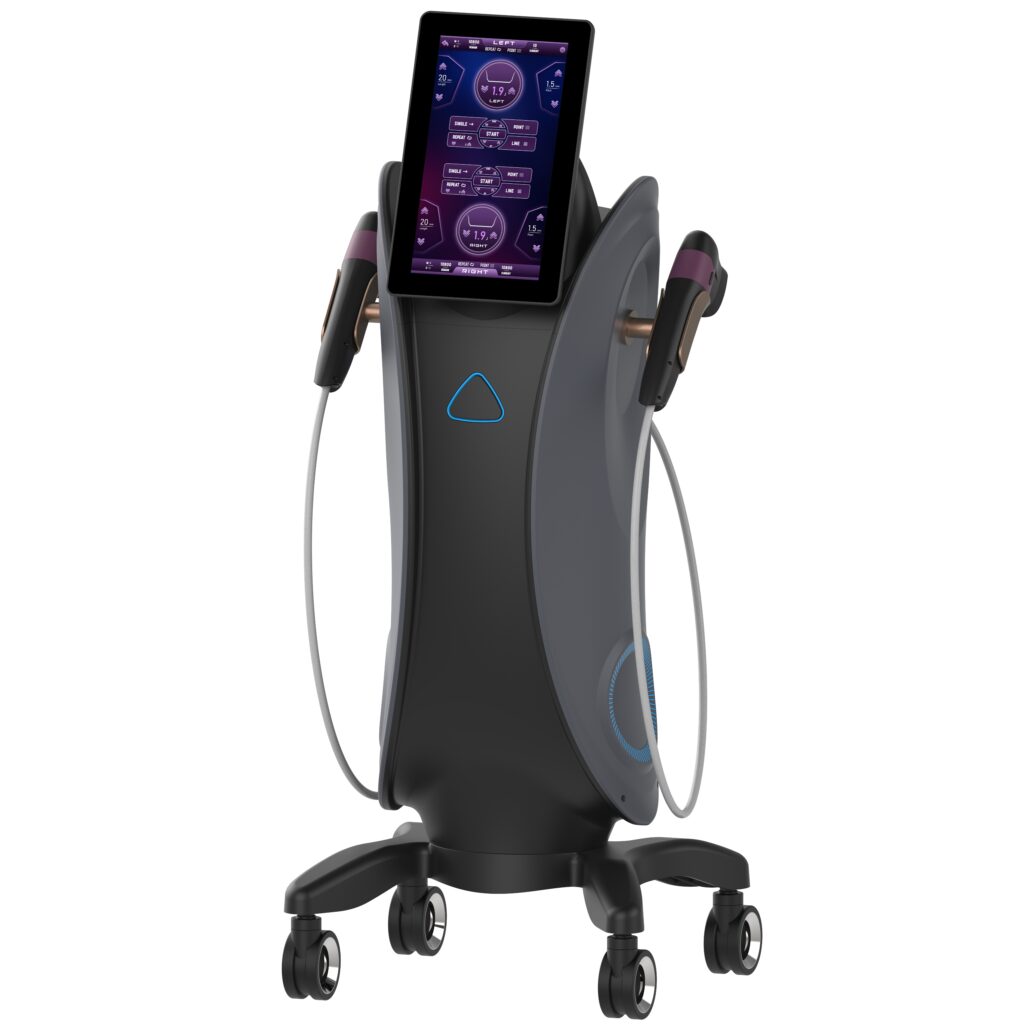










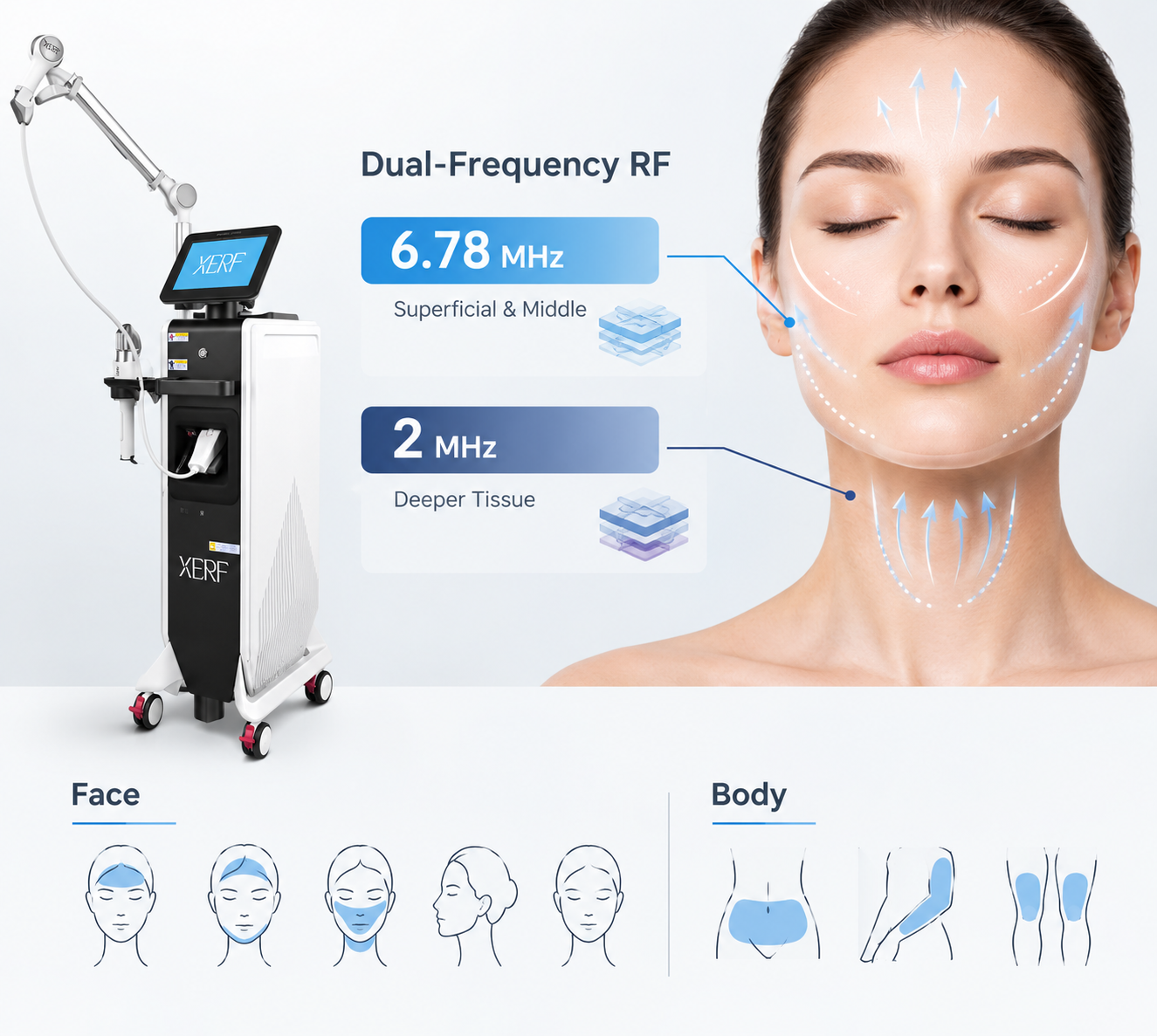
Radiofrequency (RF) skin tightening is not a one-setting treatment. Different areas of the face and body have different tissue thicknesses, contours, and treatment objectives, so RF energy delivery needs to be adjusted accordingly. XERF technology addresses this consideration by combining 6.78 MHz and 2 MHz monopolar RF with three depth settings, adjustable intensity, cooling, and real-time temperature monitoring.
For professional users and equipment buyers, understanding how treatment areas influence RF settings is important. The goal is not simply to increase energy, but to select an appropriate combination of frequency, depth, intensity, applicator, and delivery technique for the area being treated.
1. Why Does the Treatment Area Matter in RF Therapy?
The face and body are made up of different tissue structures. Even within the face, the forehead, periorbital area, cheeks, jawline, and submental region have different anatomical characteristics.
A broad cheek area, for example, provides a relatively large treatment surface, while the area around the eyes requires much more precise energy delivery. Similarly, the jawline and submental area may require a different approach from the forehead because tissue thickness and contour vary.
Clinical research on dual-frequency monopolar RF has therefore used shallow, middle, and deep settings according to the target condition and facial anatomical zone rather than applying one setting uniformly across the entire face.
2. How Does XERF Adjust RF Energy for Different Areas?
2.1 Dual-Frequency RF for Different Tissue Depths
XERF operates at 6,78 MHz e 2 MHz. In its dual-frequency approach, the two frequencies are used sequentially within a single pulse, while treatment depth can be selected according to the intended target.
The 6.78 MHz component is associated with more superficial and intermediate tissue heating, while 2 MHz provides a different, deeper thermal distribution. The combination allows the system to address different tissue planes rather than relying on a single RF frequency.
2.2 Three Depth Settings
XERF provides shallow, middle, and deep treatment settings, allowing practitioners to adapt RF delivery to the target area and treatment objective.
This is particularly useful when moving between areas with different anatomical characteristics. A superficial skin-quality concern does not necessarily require the same treatment approach as deeper laxity around the lower face or jawline.
3. XERF for the Lower and Middle Face
3.1 Cheeks and Midface
The cheeks and midface generally provide broader treatment surfaces than the periorbital region. For these areas, larger treatment applicators and controlled movement can help distribute RF energy across a wider area.
In a 2026 retrospective study, the Effector 60, measuring 20 × 30 mm, was used for the lower and middle face. The protocol combined approximately 50% gliding and 50% stamping techniques. Gliding was used to provide broader thermal distribution, followed by stamping for more localized energy delivery.
This illustrates an important principle: treatment technique can be adjusted along with RF settings. Larger, less contoured areas may benefit from a gliding approach, while more contoured regions can require stable contact and localized delivery.
3.2 Linha do maxilar e parte inferior do rosto
The jawline is a more contoured treatment area where skin laxity and facial definition are common concerns. RF settings can therefore be selected according to the desired depth and tissue characteristics rather than simply treating the entire face identically.
Clinical research has specifically evaluated dual-frequency RF for facial laxity and lower-face lifting, using depth-dependent settings selected according to the target condition and facial anatomical zone.
4. XERF for the Submental Area and Neck
4.1 Why Deeper Settings May Be Relevant
The submental area and neck can contain thicker and more varied tissue structures than some areas of the upper face. When the treatment objective involves deeper tightening, a deeper RF setting may be considered.
Current XERF clinical research also includes submental and neck skin laxity among the areas being evaluated, supporting the broader application of depth-dependent dual-frequency RF beyond the face alone.
However, the appropriate setting should always be determined by the trained operator based on anatomy, tissue characteristics, treatment goals, and patient tolerance.
5. XERF for the Forehead and Upper Face
5.1 Why Smaller Applicators Matter
The upper face has smaller and more complex anatomical areas, so treatment precision becomes particularly important.
In the 2026 clinical protocol, the Effector 10 (10 × 10 mm) e Effector 5 (10 × 5 mm) were used for the forehead, temple, and periorbital areas outside the orbital rim. Treatment was performed using stamping rather than gliding. The E10 was used first, followed by the smaller E5 for more localized treatment of static wrinkles.
This demonstrates how the treatment head itself can be adapted to the anatomy. A smaller applicator can provide more controlled placement when treating compact or curved areas.
5.2 Periorbital and Brow Areas
The area around the eyes requires particular attention to treatment boundaries and energy delivery. In the published protocol, treatment remained outside the orbital rim, with the applicator directed laterally and superiorly away from the globe.
This is a good example of why RF settings should not be considered independently from treatment technique and anatomical safety considerations.
6. How Does XERF Treatment Differ for Body Areas?
6.1 Larger Treatment Surfaces
Body areas such as the abdomen, arms, and thighs generally have larger treatment surfaces than facial regions. For these areas, the priorities can include efficient coverage, consistent energy distribution, and selecting an appropriate treatment depth based on tissue characteristics.
A larger applicator and controlled movement may be useful when treating broad areas, while localized delivery can be considered for more contoured regions.
6.2 Treatment Goals Are Also Different
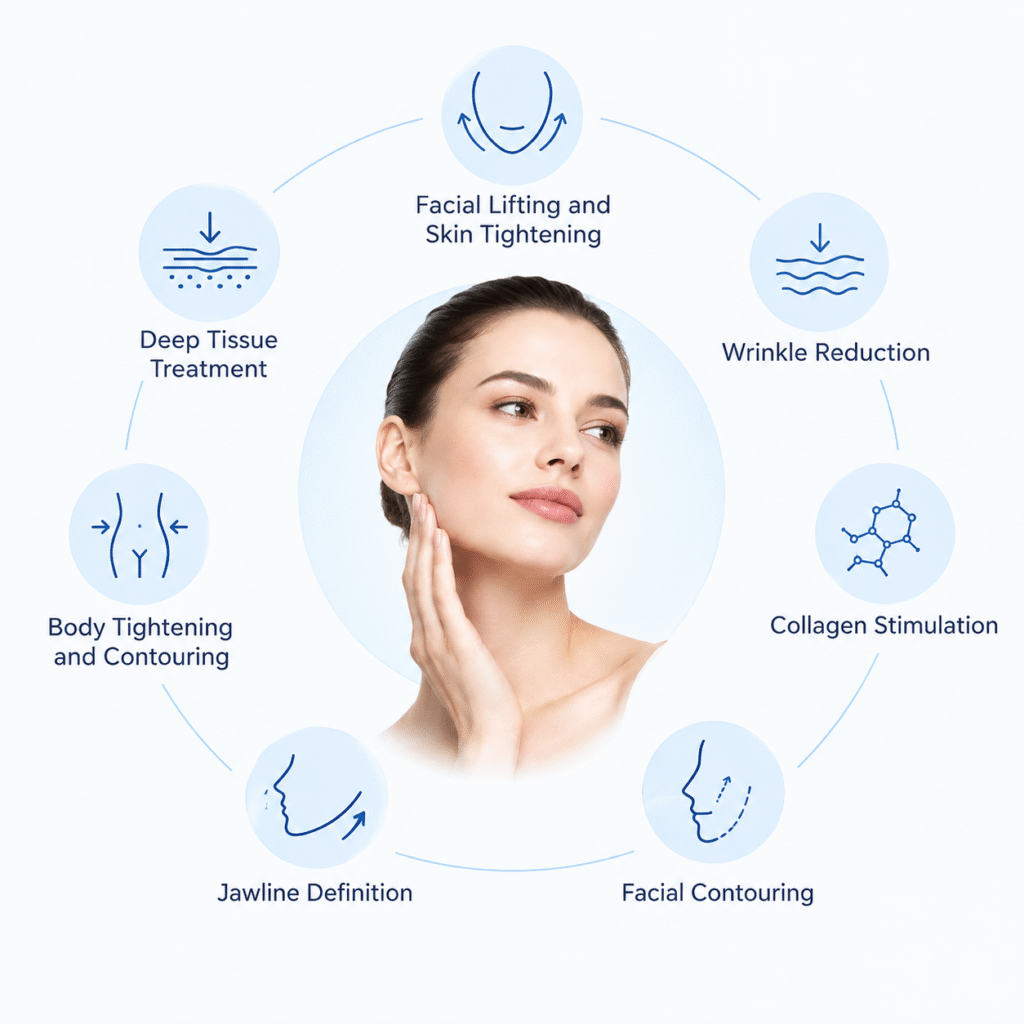
Facial RF treatments commonly focus on skin laxity, firmness, facial contour, and skin quality. Body applications may place greater emphasis on skin tightening and contouring over larger areas.
Therefore, a professional RF system intended for both face and body should offer sufficient flexibility in depth, intensity, applicator selection, and energy delivery mode rather than relying on a single preset.
7. How Do Gliding and Stamping Affect Treatment?
Gliding and stamping are two different ways of delivering RF energy.
Gliding involves moving the applicator continuously across the treatment area. It can help provide more uniform coverage over broader regions.
Stamping involves placing the applicator at specific positions and delivering individual pulses. It provides more controlled energy placement and can be useful for contoured or localized areas.
A prospective multicenter study of dual-frequency monopolar RF used sliding, stamping, or a combination depending on the target site. The researchers described sliding as useful for broad, less-contoured areas and stamping for contoured or bony areas.
8. Why Do Cooling and Temperature Monitoring Matter?
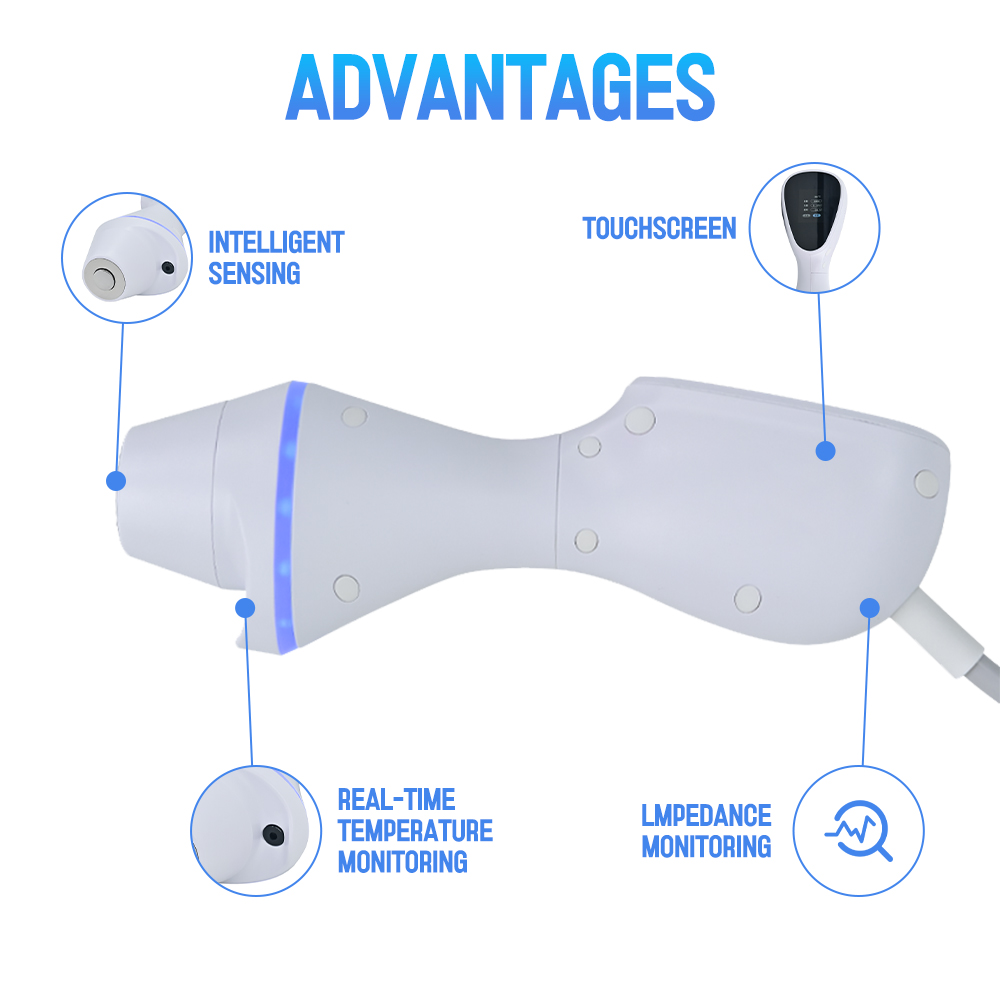
Changing the RF setting according to the treatment area is only part of energy management. XERF also incorporates adjustable cooling and real-time temperature monitoring.
The system uses cooling levels from 1 to 3, while RF output is automatically terminated if the monitored surface temperature exceeds 43°C in the published clinical protocol.
This type of monitoring is particularly relevant when treating areas with different contours and tissue characteristics because surface temperature can change according to contact, movement, energy level, and treatment location.
9. What Should Professional Users Consider When Selecting RF Settings?
Treatment area should be considered together with several other factors:
- Target tissue depth
- Treatment objective
- Tissue thickness and anatomy
- Tamanho do aplicador
- RF frequency and treatment mode
- Energy or intensity level
- Gliding or stamping technique
- Surface cooling
- Monitoramento de temperatura em tempo real
- Patient comfort and tolerance
There is no single RF setting that is automatically appropriate for every area. The value of a multi-depth, dual-frequency system lies in its ability to provide different treatment configurations within one platform.
Conclusão
XERF demonstrates how RF treatment can be adapted according to where the energy is being delivered and what tissue is being targeted. The combination of 6.78 MHz and 2 MHz RF, shallow/middle/deep settings, different applicators, and gliding or stamping techniques allows treatment parameters to be adjusted for areas ranging from the forehead and periorbital region to the cheeks, jawline, submental area, and neck.
For professional Equipamento de radiofrequência, the key consideration is therefore not simply the maximum energy output. Treatment flexibility, depth selection, applicator design, energy control, cooling, and temperature monitoring all contribute to how effectively a system can be adapted to different facial and body treatment areas.