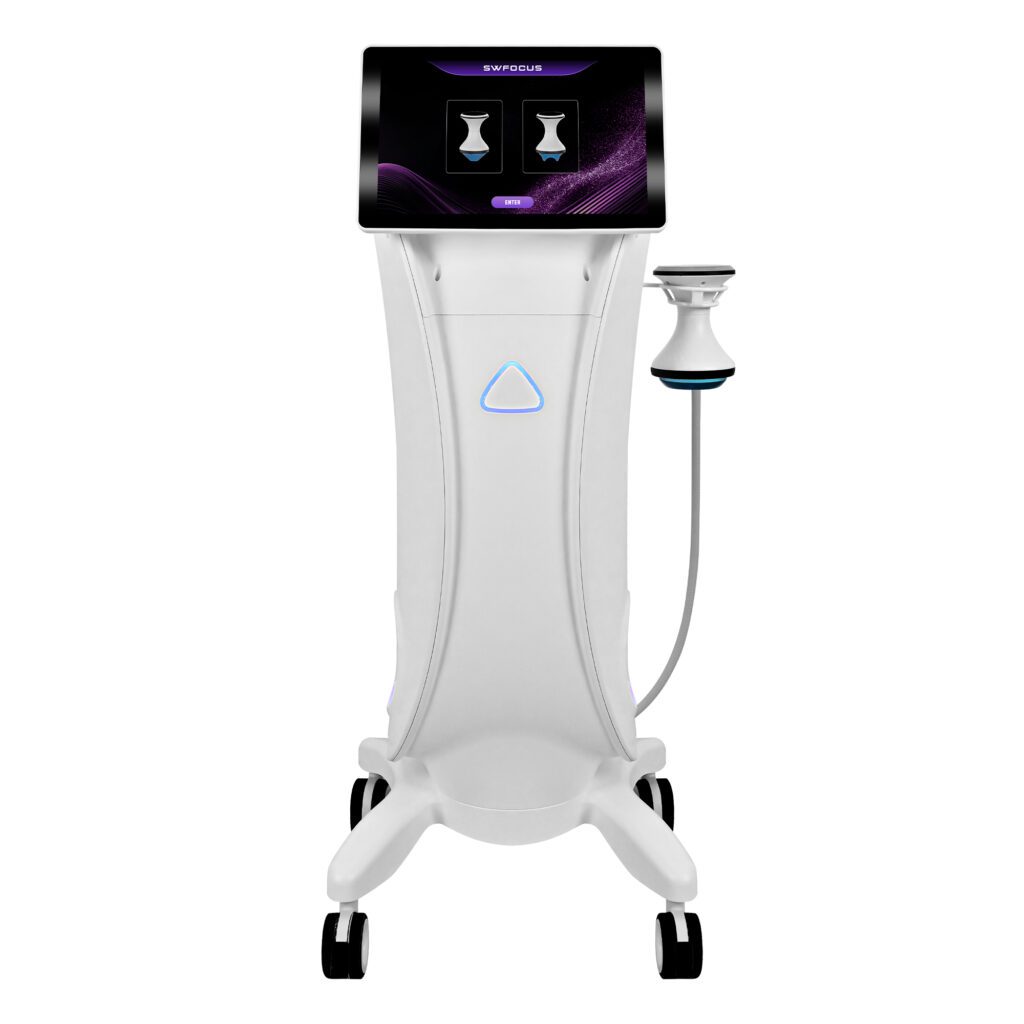
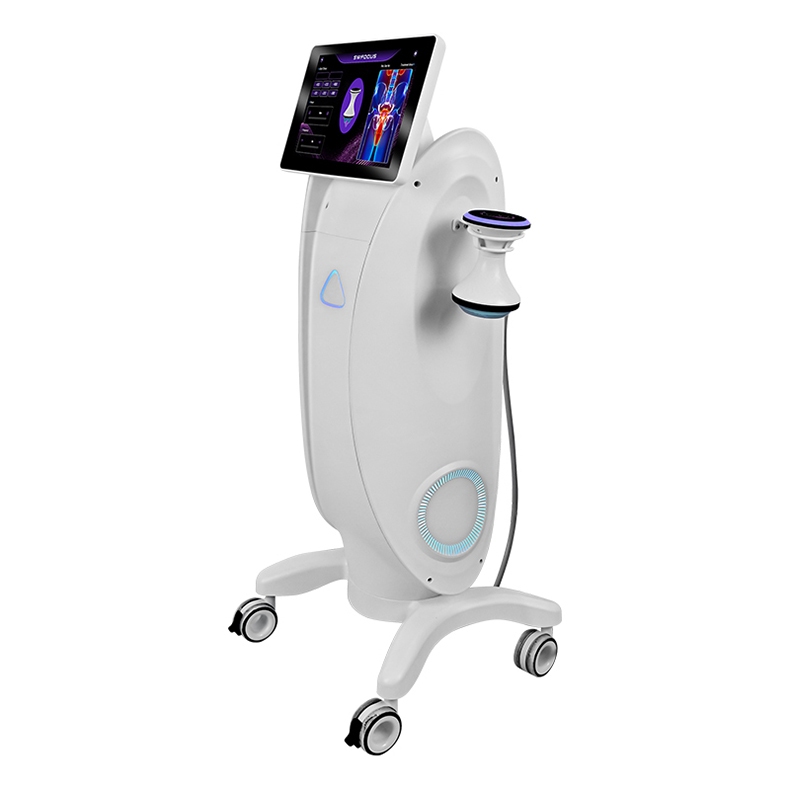
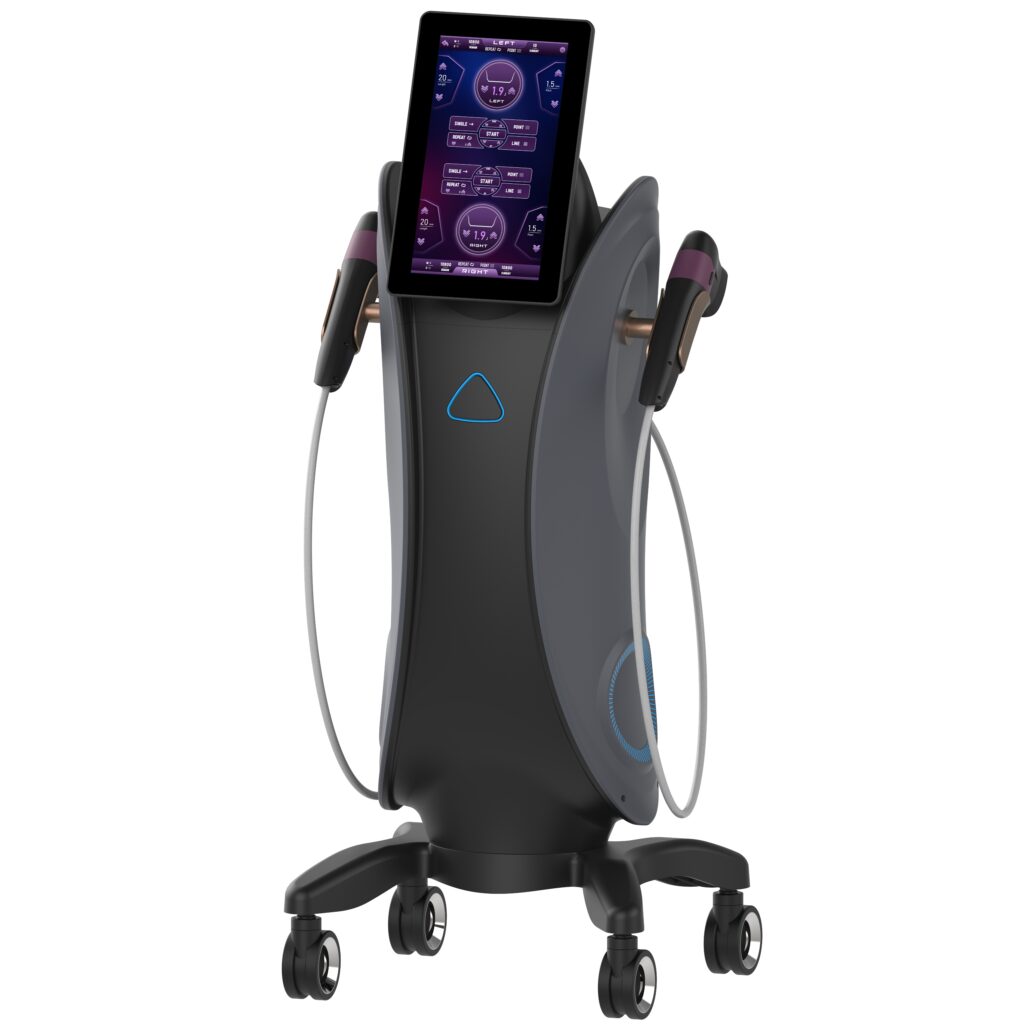
XERF Structural Skin Tightening uses a dual-frequency monopolar RF approach to deliver controlled energy across different tissue depths. Rather than relying on a single RF frequency, XERF combines 6.78 MHz and 2 MHz RF with three depth settings, ten intensity levels, WaveFit™ pulse technology, integrated cooling, and real-time temperature monitoring. This allows treatment parameters to be adjusted according to the treatment area and individual skin profile.
1. Why Does RF Treatment Depth Matter?
RF skin tightening works by converting radiofrequency energy into heat within tissue. Where that thermal energy is concentrated depends on factors such as frequency, electrode design, tissue properties, energy level, and pulse delivery.
The depth of the thermal effect matters because different facial areas have different tissue structures. Superficial skin concerns may require a different energy distribution from areas where deeper connective or supporting structures are being targeted.
This is why multi-depth RF technology can provide greater treatment flexibility than using one fixed energy pattern for every area.
2. What Are Shallow, Middle and Deep RF Treatments?
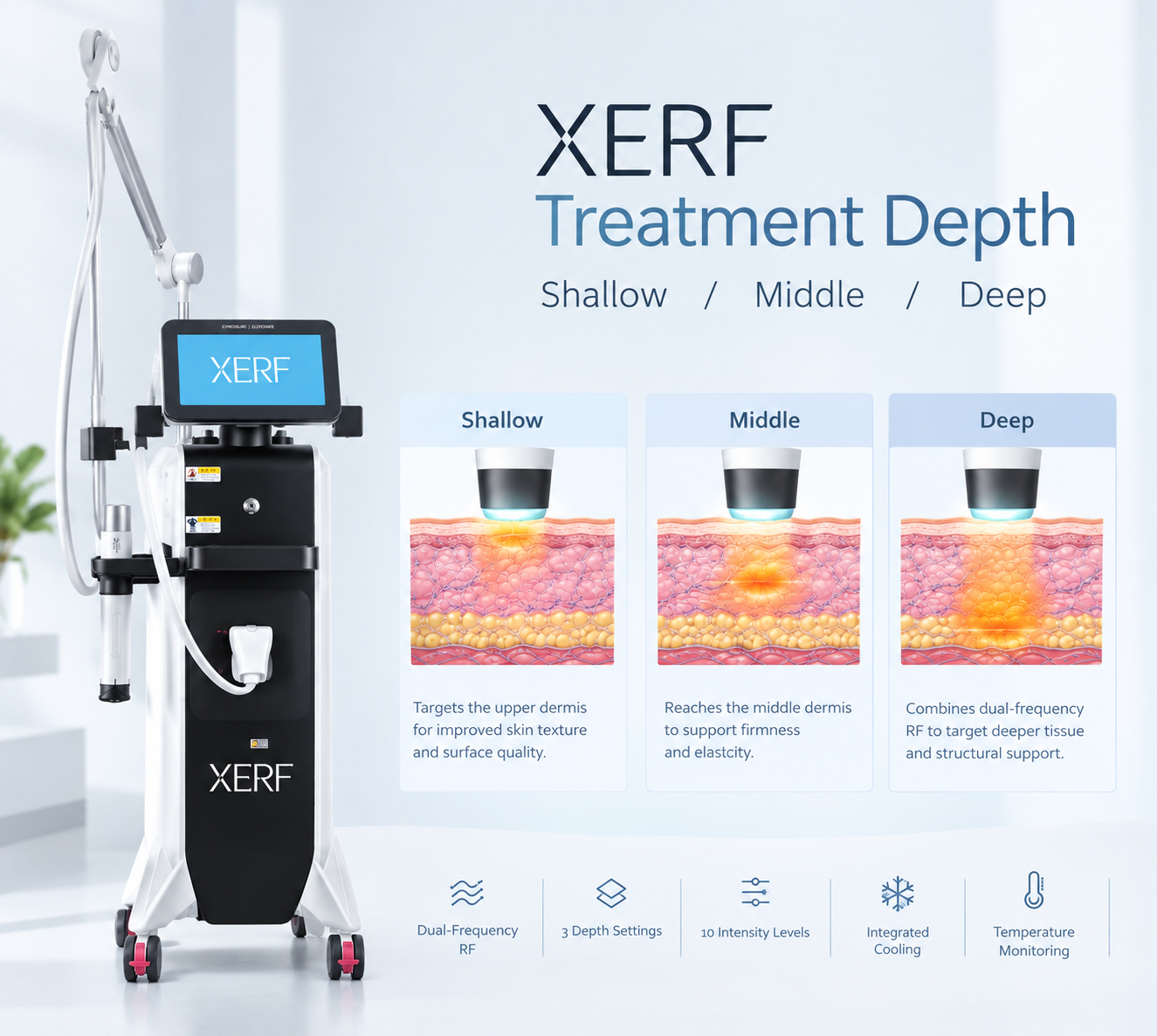
XERF provides three treatment depth settings: shallow, middle, and deep, together with ten intensity levels. These settings allow the operator to select an appropriate treatment approach according to the patient’s skin profile and treatment area.
2.1 Shallow RF Energy
The shallow setting is primarily associated with more superficial tissue heating. In XERF-related research, 6.78 MHz RF has been shown to produce more localized thermal effects in the dermis and along fibrous structures under experimental conditions.
This type of energy distribution can be relevant when the treatment objective is focused on superficial skin quality, fine lines, or areas with relatively thin tissue.
It is important to understand that “shallow” does not mean the RF only affects the skin surface. RF energy still produces a controlled thermal effect within tissue beneath the electrode.
2.2 Middle RF Energy
The middle setting provides an intermediate treatment approach between superficial and deeper energy delivery.
The exact thermal distribution is influenced by the selected energy level, applicator, tissue thickness, and treatment technique. Therefore, middle-depth treatment should not be understood as one fixed anatomical depth for every patient.
Instead, it provides another parameter range that can be selected according to the treatment area and desired treatment approach.
2.3 Deep RF Energy
The deep setting is where XERF’s dual-frequency concept becomes particularly important.
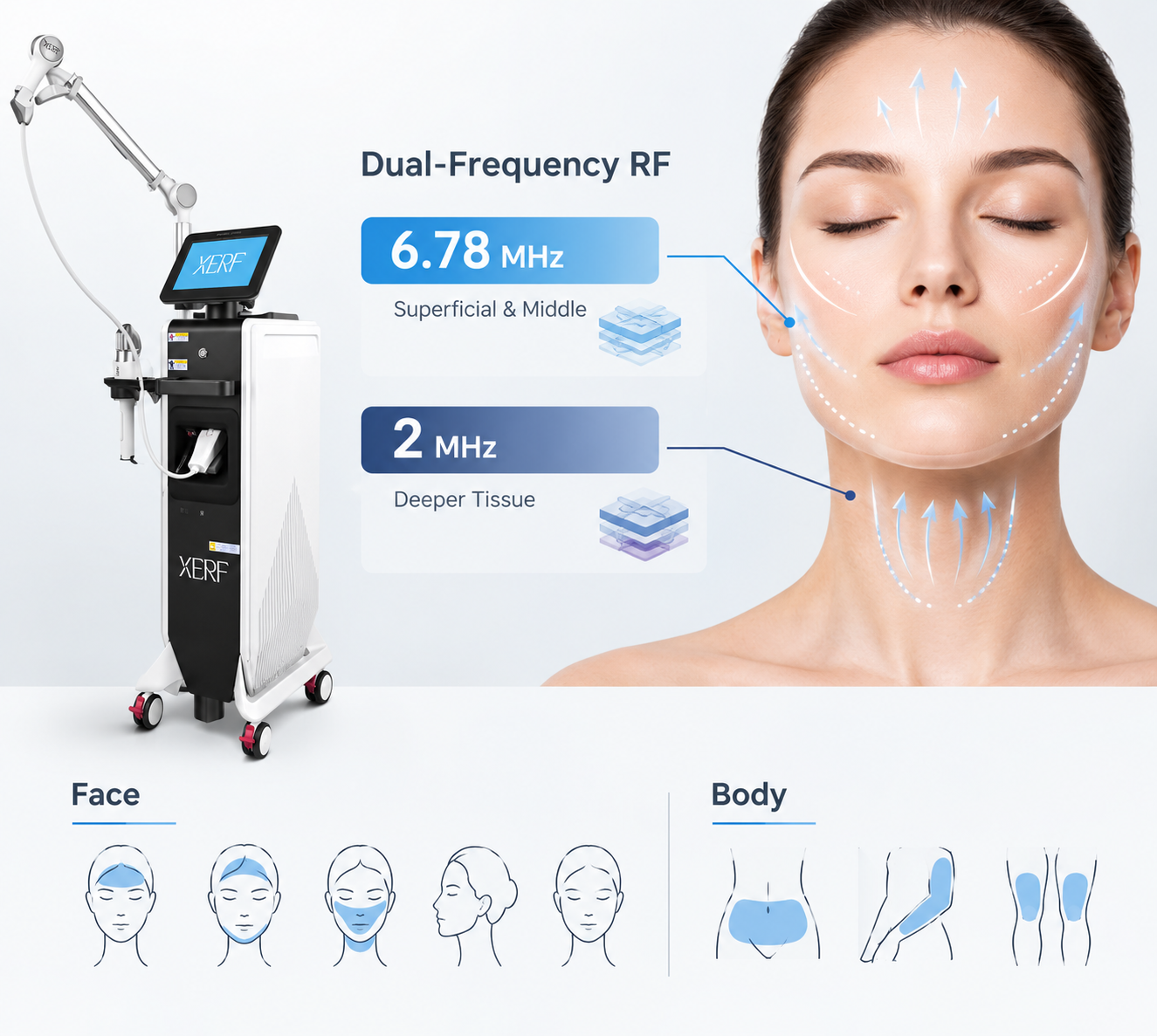
In deep mode, 6.78 MHz and 2 MHz RF can be delivered sequentially within a single treatment pulse. Experimental modeling has shown that 2 MHz can produce a broader and deeper thermal distribution than 6.78 MHz under equivalent test conditions. Meanwhile, 6.78 MHz demonstrated more localized thermal effects around fibrous septa.
Recent clinical research describes XERF as using the shallow setting primarily with 6.78 MHz, while the deep approach combines 6.78 MHz with 2 MHz to extend the treatment effect toward deeper tissue planes. However, the precise depth of effect in humans should not be reduced to a specific millimeter value because it varies with anatomy and treatment parameters.
3. How Do 6.78 MHz and 2 MHz Work Together?
3.1 6.78 MHz RF
The 6.78 MHz frequency is associated with more localized heating, particularly within the dermis and fibrous tissue structures. Experimental studies have observed thermal reactions along subcutaneous fibrous septa with this frequency.
This provides the basis for the more superficial part of XERF’s multi-depth energy delivery.
3.2 2 MHz RF
The 2 MHz frequency can produce a broader and deeper thermal distribution under the conditions studied. Computational modeling showed greater thermal diffusion into subcutaneous tissue compared with 6.78 MHz when equivalent total energy was used.
However, RF frequency alone does not determine treatment depth. Electrode geometry, tissue characteristics, energy, pulse duration, and treatment technique also influence how RF energy is distributed.
3.3 Sequential Dual-Frequency Delivery
One important feature of XERF is that the two frequencies can be delivered sequentially within a single pulse in deep mode. This means the treatment is not simply a separate 6.78 MHz session followed by a separate 2 MHz session.
The combination is designed to create a broader thermal treatment pattern across different tissue levels. Preclinical research has shown that dual-frequency delivery can produce thermal and histological changes extending from the dermis toward the dermo-subcutaneous interface and fibrous structures.
4. How Does Treatment Depth Change by Facial Area?
Not every facial area requires the same RF approach.
4.1 Lower and Middle Face
The cheeks, lower face, and jawline contain different amounts and arrangements of dermal, connective, and subcutaneous tissue. Published XERF protocols have used a larger Effector 60 applicator for lower and middle facial treatment, with a combination of gliding and stamping techniques.
4.2 Upper Face and Periorbital Area
The forehead, temples, and areas around the eyes require greater attention to anatomy and applicator size.
Published protocols have used smaller XERF effectors for these areas and applied energy outside the orbital rim. This illustrates why treatment depth, applicator design, and treatment technique need to be considered together rather than selecting a depth independently.
5. How Does XERF Control Energy at Different Depths?
Treatment depth is not controlled by frequency alone.
XERF combines depth settings, intensity levels, WaveFit™ pulse technology, impedance feedback, cooling, and temperature monitoring. WaveFit™ uses controlled RF pulse sequences with variable sub-pulses, while energy and timing can be adjusted according to the selected depth and intensity.
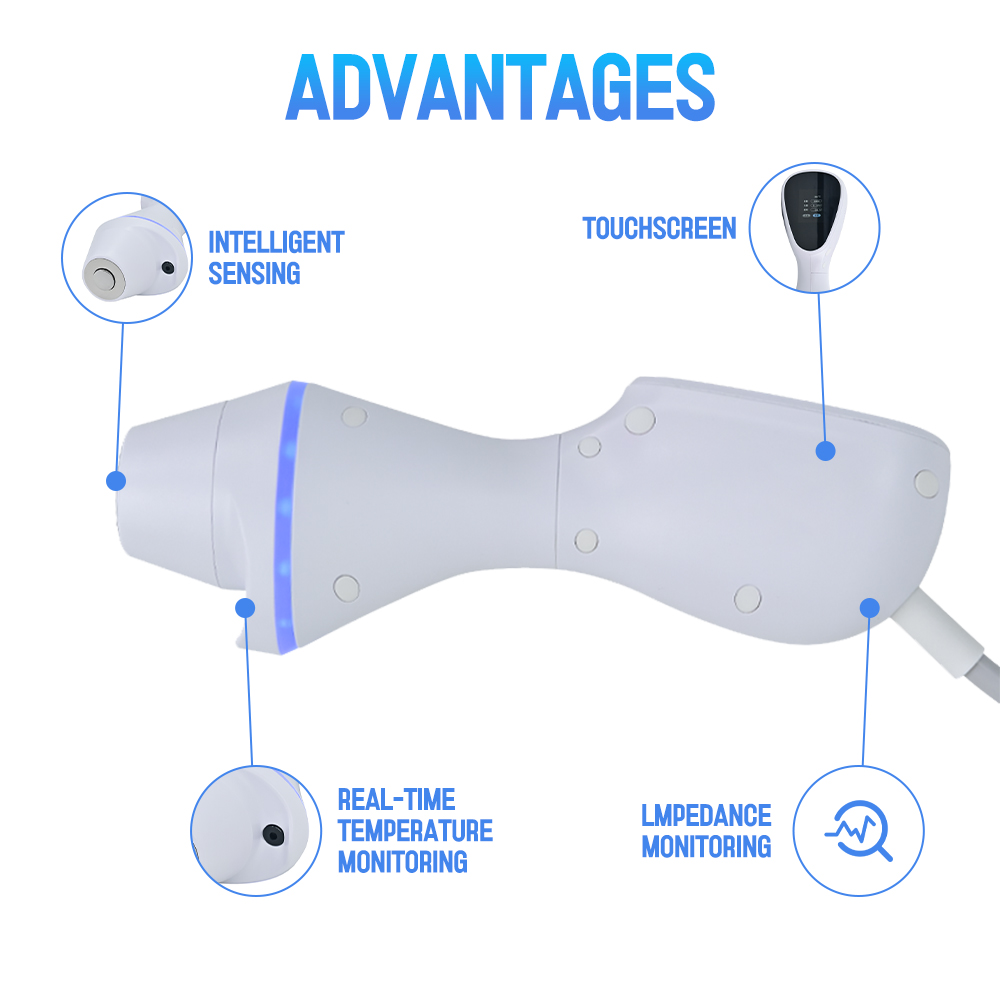
Integrated Cryogen Delivery also helps manage surface temperature during RF delivery. The treatment tip monitors surface temperature in real time, and published protocols describe automatic RF interruption when the monitored surface temperature exceeds 43°C.
This combination allows the operator to consider both the intended internal thermal effect and surface temperature management.
6. Why Does Multi-Depth RF Matter for Skin Tightening?
Skin is not a single uniform layer. The dermis, connective structures, subcutaneous tissue, and deeper supporting layers have different physical and anatomical characteristics.
A multi-depth RF approach therefore provides more flexibility than treating every area with the same energy distribution.
The objective is not simply to deliver the highest possible RF energy. Instead, the treatment approach focuses on selecting the appropriate depth, intensity, frequency, pulse pattern, applicator, and treatment technique for the area being treated.
This is particularly relevant for professional RF machines, where treatment customization can be an important consideration for operators and equipment buyers.
結論
XERF treatment depth is based on a combination of shallow, middle, and deep RF settings, rather than one fixed penetration depth. The 6.78 MHz and 2 MHz frequencies have different thermal distribution characteristics, with 2 MHz showing broader and deeper thermal effects in experimental models. In deep mode, the two frequencies can be delivered sequentially within a single pulse.
By combining frequency selection with WaveFit™ pulse control, adjustable intensity, impedance feedback, cooling, and temperature monitoring, XERF provides a multi-depth approach to RF skin tightening. For buyers evaluating an RFスキンタイトニングマシン, understanding how these elements work together is more useful than comparing frequency or power specifications alone.
よくある質問
1. How long does a treatment take?
A session usually takes about 45 minutes, although the time can vary depending on the treatment areas.
The number of sessions needed depends on your individual skin condition and goals. Your provider can help you develop a plan that is right for you.
2. When can I resume my daily activities?
You can resume most daily activities immediately after the treatment.
3. 痛いですか?
The XERF™ treatment has been carefully designed with comfort in mind. The treatment feels warm and comfortable, thanks to Integrated Cryogen Delivery (ICD), which monitors the temperature of your skin, and WaveFit™ pulse technology, which balances energy delivery with cooling.
Unlike treatments that use needles, XERF is a non-invasive RF treatment and official materials describe it as requiring no numbing. Individual treatment sensations can vary.
4. 結果はいつわかりますか?
You may notice an immediate tighter feeling after treatment. In the following weeks, the skin’s remodeling response continues, with collagen-related changes developing over time. Official XERF materials describe visible improvement immediately after treatment with continued collagen building afterward.