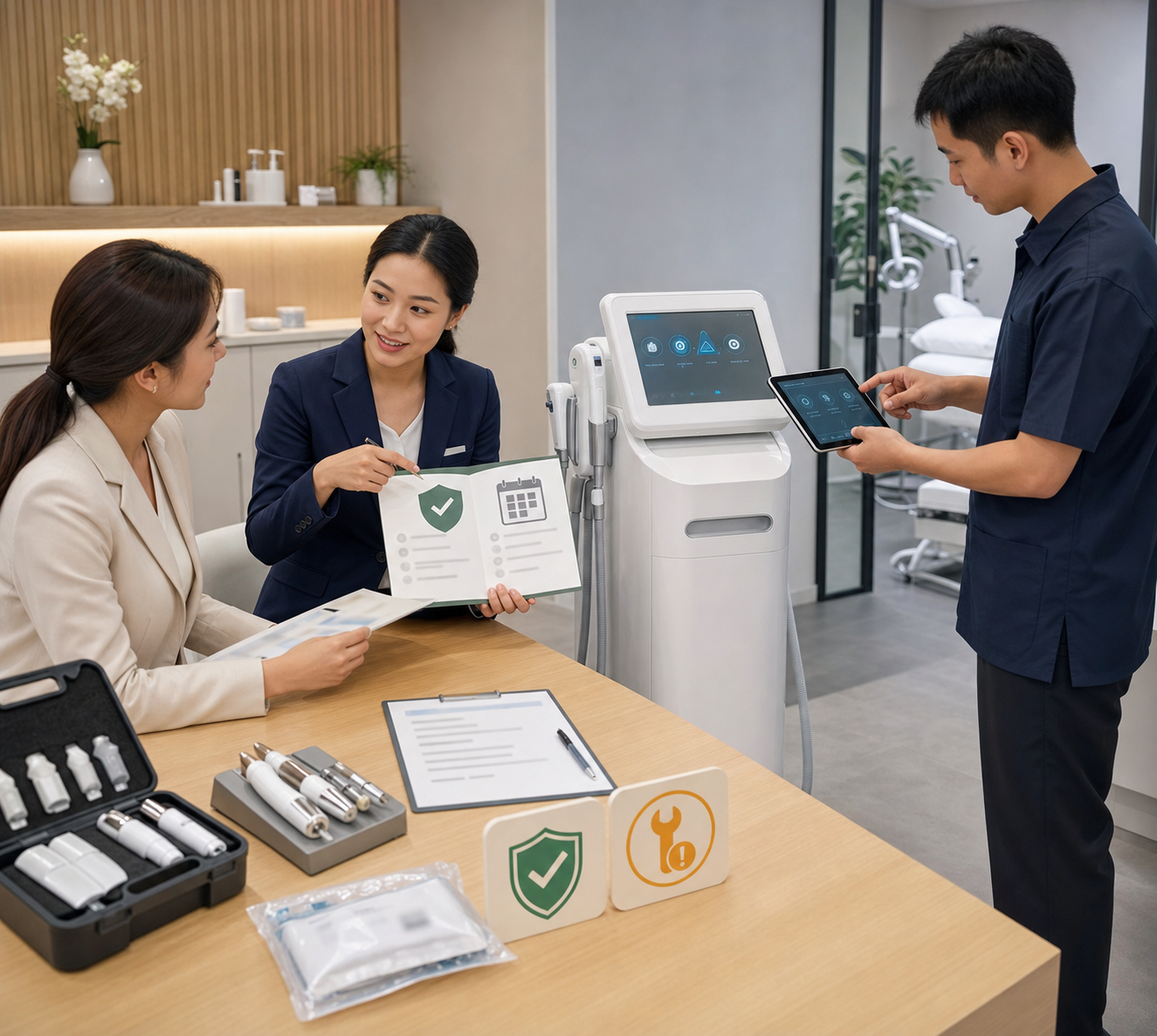
Repair during the beauty equipment warranty period is not always completely free. In most cases, warranty repair is free only when the problem is within the warranty scope, appears within the warranty period, and is caused by a covered product defect rather than wrong operation, accidental damage, unauthorized repair, consumable wear, transport damage after delivery, or poor maintenance.
For beauty salons and distributors, the most important point is to check the warranty terms before purchase. A supplier may say one-year warranty, but that phrase alone does not explain whether handpieces are covered, whether labor is free, whether shipping is free, whether on-site service is included, whether consumables are excluded, or what happens after repeated failures.
The right question is not only: Is repair free during warranty? The better question is: which parts are covered, what failure types are covered, who pays shipping, how fast the supplier responds, and what evidence is needed for a warranty claim?
Short Answer: Covered Defects Are Usually Free, But Not Everything Is Covered
During the warranty period, the supplier will usually repair or replace covered defective parts at no charge if the machine fails because of a manufacturing defect or component quality issue. This may include the main unit, circuit board, screen, power supply, pump, compressor, sensor, cooling system, or other covered components, depending on the warranty policy.
However, many costs may still be excluded or handled separately:
- Shipping cost for sending the machine or part back.
- On-site service fee outside the supplier’s service area.
- Labor fee after a limited free service period.
- Consumables such as filters, tips, gels, tubes, lamps, cartridges, membranes, and pads.
- Wear parts that have reached normal service life.
- Damage caused by dropping, collision, water ingress, overheating, wrong voltage, poor cleaning, unauthorized repair, or misuse.
- Damage caused by using non-approved accessories or consumables.
- Cosmetic scratches that do not affect function.
- Problems caused by software account expiry or subscription non-renewal.
This is why buyers should read the warranty policy carefully instead of assuming warranty equals free repair for everything.
Why Warranty Period Does Not Automatically Mean Free Repair
Warranty is a promise with conditions. It is not a blank check. A warranty normally defines who gives the warranty, what product is covered, which parts are covered, how long the coverage lasts, what the supplier will do, what the buyer must do, and which situations are excluded.
In beauty equipment transactions, the warranty can be affected by:
- Product category.
- Supplier policy.
- Purchase contract.
- Country or region.
- Whether the buyer is a consumer, salon, distributor, or commercial buyer.
- Whether the warranty is full, limited, commercial, or extended.
- Whether the product is standard, customized, sample, refurbished, or used.
For B2B beauty equipment purchases, contract terms are especially important. Commercial buyers often negotiate warranty details directly with the supplier. If the contract does not define repair cost, shipping, labor, and exclusions, disputes become more likely.
What Is Usually Free During Warranty?
Although terms vary, many suppliers provide free service for covered quality problems during the warranty period.
Free warranty support may include:
- Remote diagnosis for covered faults.
- Technical guidance by video call or message.
- Replacement of covered defective parts.
- Repair of covered components.
- Main unit repair for manufacturing defects.
- Software troubleshooting if included in the warranty.
- First-time operation support if the issue is caused by unclear setup.
- Missing accessory replacement if reported during the acceptance period.
For example, if a covered circuit board fails under normal use within the warranty period, the supplier may send a replacement board or arrange repair without charging for the part. If a sensor fails because of a product defect, the supplier may replace the sensor. If a screen does not work when the machine arrives, the supplier may treat it as a warranty or arrival defect issue.
The buyer should still confirm whether labor and shipping are also free. Some suppliers provide free parts but require the buyer to pay freight or local technician fees.
What May Not Be Free During Warranty?
Many warranty disputes come from items that buyers assume are free but suppliers treat as excluded.
Common non-free items include:
Consumables
Consumables are usually not covered like the main machine. Examples include disposable tips, filters, tubes, gels, serums, HIFU cartridges, IPL lamps, membranes, pads, protective covers, solution bottles, and other parts designed for repeated replacement.
Some lamps or cartridges may have a rated shot count or line count. If the count is used up, replacement is normally a consumable cost, not a warranty repair.
Wear Parts
Some parts are reusable but still wear out over time. Seals, tubes, buttons, connectors, handles, probes, wheels, hinges, and silicone parts may have different coverage from the main unit. Buyers should ask whether these are covered and for how long.
Misuse Or Wrong Operation
Damage caused by wrong voltage, wrong parameter use, blocked filters, skipped cleaning, unsuitable disinfectant, water entering the machine, dropping the handle, rough transport, or unauthorized disassembly is usually excluded from free warranty service.
Unauthorized Repair
If the buyer opens the machine, replaces internal parts, changes wiring, modifies software, or uses an unapproved technician without supplier permission, the warranty may be reduced or voided.
Shipping And On-Site Service
Some suppliers offer free parts but charge shipping. Others provide remote support for free but charge for on-site visits. For large machines, this cost can be significant.
Software Subscription And Cloud Service
Skin analyzers, AI systems, or smart devices may include software accounts, app access, cloud storage, or report functions. If the software service is subscription-based, expired subscription issues may not be treated as warranty repair.
Main Unit Warranty Vs Handpiece Warranty
Beauty equipment buyers should pay special attention to handpieces and probes. Many machines depend on handpieces for actual treatment, but handpiece warranty may be shorter than main unit warranty.
A quotation may say:
Main unit: 12 months.
Handpieces: 3 months, 6 months, or different terms.
Consumables: not covered.
This difference matters because RF handles, ultrasound probes, EMS accessories, vacuum heads, IPL handpieces, HIFU cartridges, laser handles, and body contouring applicators can be expensive. If a handpiece fails, the project may stop even when the main unit still works.
Before purchase, buyers should ask:
- Are all handpieces included in the warranty?
- Is the handpiece warranty the same length as the main unit?
- Are cables and connectors included?
- Are lamps, cartridges, sensors, cooling tips, and probes covered?
- What happens if the handpiece fails repeatedly?
- Can the supplier provide a spare handpiece while repairing?
Handpiece coverage should be written clearly because it is one of the most common after-sales cost points.
Parts, Labor, Shipping, And On-Site Fees Should Be Separated
When asking whether warranty repair is free, buyers should separate four cost types.
Parts Cost
This is the cost of replacement components, such as circuit boards, power supplies, screens, pumps, sensors, handles, or probes. Covered parts may be free during warranty.
Labor Cost
This is the cost of technician work. Some suppliers include labor during warranty. Others provide free parts but charge local labor, especially when the repair is done by a third-party technician.
Shipping Cost
Shipping may include sending the machine to the supplier, shipping parts to the buyer, or returning the repaired unit. The contract should state who pays shipping both ways.
On-Site Service Fee
If a technician visits the salon, the supplier may charge travel cost, hotel cost, labor fee, or service fee. On-site service is not always included unless written.
A good warranty policy should explain all four costs. If the policy only says free repair but does not mention labor, shipping, or on-site service, the buyer should ask for clarification.
What Counts As A Warranty-Covered Fault?
A covered fault usually means the machine or part fails under normal use within the warranty period due to product quality, manufacturing, or component defect.
Examples may include:
- Machine cannot start because of covered internal component failure.
- Screen failure under normal use.
- Pump or compressor failure not caused by poor maintenance.
- Sensor failure under normal operation.
- Circuit board defect.
- Cooling system failure not caused by blockage or misuse.
- Software bug included in the service policy.
- Handle recognition failure caused by covered connector or board issue.
The buyer should provide evidence such as photos, videos, serial number, error codes, usage conditions, and maintenance records. The supplier may need to diagnose whether the issue is covered.
What Is Usually Excluded From Free Warranty?
Common exclusions include:
- Accidental dropping or impact.
- Liquid entering the machine.
- Wrong voltage or unstable power damage.
- Use of non-approved power adapters or accessories.
- Unauthorized repair or modification.
- Damage caused by wrong cleaning chemicals.
- Failure to replace filters, tubes, water, or consumables as instructed.
- Blockage caused by poor maintenance.
- Overuse beyond rated limits.
- Normal wear and tear.
- Consumables reaching rated life.
- Cosmetic damage after acceptance.
- Transport damage after risk has transferred to the buyer.
- Damage caused by fire, flood, lightning, or other external events.
These exclusions should be written in the warranty policy. If they are not written, buyers and suppliers may argue later.
What Should Buyers Do Before Sending A Machine For Warranty Repair?
Before shipping a machine or part back, the buyer should follow a clear process.
Recommended steps:
- Stop using the machine if there is abnormal heat, smell, sound, error code, output instability, or customer discomfort.
- Record the machine model and serial number.
- Take photos and videos showing the issue.
- Record when the issue happened and which staff operated the machine.
- Check whether the issue is listed in the manual or error code guide.
- Contact the supplier before opening or repairing the machine.
- Keep packaging if the machine must be shipped.
- Confirm who pays shipping before sending anything.
- Ask whether the supplier will repair, replace, or send parts.
- Keep written communication and service records.
This protects the buyer’s warranty rights and helps the supplier diagnose faster.
Why Maintenance Records Help Warranty Claims
Suppliers may reject free warranty repair if they believe the fault was caused by poor maintenance. Maintenance records can help the buyer prove normal use.
Useful records include:
- Cleaning log.
- Filter replacement log.
- Consumable replacement record.
- Operator training record.
- Error code record.
- Customer treatment record.
- Photos or videos of abnormal issues.
- Repair communication history.
- Supplier maintenance guidance.
For high-use salons, these records are not extra paperwork. They protect the store when a machine fails.
How To Write Free Repair Terms Into The Contract
The purchase contract should define warranty repair in detail.
Important terms include:
- Warranty period for the main unit.
- Warranty period for each handpiece and probe.
- Warranty period for major components.
- Whether consumables are excluded.
- Whether labor is free.
- Whether parts are free.
- Who pays shipping for warranty repair.
- Whether on-site service is included.
- Response time for technical support.
- Repair time target.
- Replacement policy if the same fault repeats.
- Whether a loaner or backup part is available.
- What evidence buyer must provide.
- What actions void warranty.
- After-warranty repair price rules.
The contract should avoid vague language. Instead of saying free warranty, write what is free and what is not.
How Salons Should Ask Suppliers About Free Warranty Repair
Before buying, salons can ask:
- During warranty, are parts free?
- During warranty, is labor free?
- During warranty, who pays shipping?
- Is on-site service free or charged?
- Is remote diagnosis free?
- Are handpieces covered?
- Are probes covered?
- Are lamps, cartridges, filters, tubes, batteries, and consumables covered?
- What failures are excluded?
- What maintenance must the salon perform to keep warranty valid?
- If the same issue happens again, will the part be replaced?
- How long does repair usually take?
- What happens if repair takes too long and the salon loses appointments?
- Can the supplier provide a spare handle for high-value projects?
- Does the warranty start from payment date, shipment date, delivery date, or installation date?
These questions make the real cost visible.
How Distributors Should Design Warranty Policies
Distributors need warranty policies that are clear and operational. If the policy is vague, sales may be easy at first, but after-sales disputes will increase.
A good distributor warranty policy should include:
- Standard warranty period by product category.
- Different terms for main unit and handpieces.
- Consumable exclusion list.
- Spare parts price list.
- Warranty claim form.
- Photo and video evidence requirements.
- Remote diagnosis process.
- Repair center address.
- Shipping responsibility.
- Expected response time.
- Replacement part process.
- After-warranty paid repair rules.
- Customer misuse examples.
- Maintenance requirements.
Distributors should also train sales staff not to overpromise. If the salesperson says everything is free, but the service team later charges for shipping or consumables, customer trust will be damaged.
How Manufacturers Can Reduce Warranty Disputes
Manufacturers can reduce warranty disputes by providing better documentation before shipment.
Useful materials include:
- Clear warranty card.
- Covered parts list.
- Excluded parts list.
- Consumable list.
- Spare parts list.
- User manual.
- Cleaning and maintenance guide.
- Error code guide.
- Troubleshooting video.
- Pre-shipment test record.
- Packing list.
- Service request form.
The clearer the materials, the fewer arguments after delivery.
Red Flags In Warranty Promises
Be careful if a supplier says:
- Everything is free during warranty, but refuses to write details.
- Lifetime warranty, but cannot explain what lifetime means.
- Free repair, but no response time.
- One-year warranty, but no parts list.
- Handpieces included, but no written confirmation.
- No need for maintenance, just use it.
- Do not worry about shipping, we will solve it later.
- We have spare parts, but no price list or delivery time.
- Warranty depends on verbal approval after the problem happens.
These promises may sound reassuring, but they are weak if they are not written.
Is Extended Warranty Worth Buying?
Some suppliers offer extended warranty. It can be useful for high-value equipment, high-frequency salon use, or machines with expensive handpieces. However, the buyer should compare the extended warranty cost with likely repair cost and coverage.
Before buying extended warranty, ask:
- What extra period is covered?
- Which parts are included?
- Are handpieces included?
- Is labor included?
- Is shipping included?
- Are consumables excluded?
- Is annual maintenance required?
- Can the extended warranty be transferred if the machine is sold?
- What is the claim process?
Extended warranty is valuable only if the coverage is clear and the supplier can actually perform service.
Common Scenarios
Scenario 1: Main Unit Board Failure During Warranty
If the failure is confirmed as a covered component defect under normal use, the supplier may provide free repair or replacement of the board. Shipping and labor depend on the warranty terms.
Scenario 2: RF Handle Dropped By Staff
If the handle breaks after being dropped, this is usually accidental damage and may not be covered for free, even during warranty.
Scenario 3: HIFU Cartridge Reaches Rated Shot Count
If the cartridge reaches its rated count, replacement is usually a consumable cost, not a free warranty repair.
Scenario 4: Machine Arrives Damaged
This may be a transport damage or arrival defect issue. Responsibility depends on shipping terms, insurance, packaging, acceptance process, and damage reporting deadline.
Scenario 5: Machine Fails After Unauthorized Repair
If the buyer used an unapproved technician or opened the machine without supplier permission, the supplier may refuse free warranty service.
FAQ
Is beauty equipment repair free during the warranty period?
It is usually free only for covered defects within the warranty scope. The buyer may still pay for shipping, on-site service, consumables, wear parts, or damage caused by misuse if the warranty policy says so.
Are beauty equipment handpieces covered by warranty?
Sometimes, but not always for the same period as the main unit. Buyers should confirm the warranty period for each handpiece, probe, cable, connector, lamp, cartridge, and applicator.
Are consumables repaired or replaced for free during warranty?
Usually not. Consumables such as filters, tips, tubes, gels, lamps, cartridges, membranes, and pads are often excluded or covered only for arrival defects.
Who pays shipping for warranty repair?
It depends on the contract. Some suppliers pay both ways, some pay one way, and some require the buyer to pay shipping. This should be written before purchase.
What can void a beauty equipment warranty?
Wrong voltage, water damage, dropping, unauthorized repair, using non-approved parts, poor maintenance, unsuitable cleaning chemicals, or operating outside the manual may void or limit warranty coverage.
Conclusion
Repair during the beauty equipment warranty period may be free, but only for covered problems under the agreed warranty terms. Buyers should not assume that warranty means all repairs, parts, labor, shipping, on-site service, and consumables are free.
For salons, the safest approach is to confirm the warranty scope before purchase and keep maintenance records after delivery. For distributors and manufacturers, a clear warranty policy reduces disputes and builds long-term trust. The best warranty language is specific: which parts are covered, how long they are covered, what is excluded, who pays shipping, how fast support responds, and what happens if repair fails.