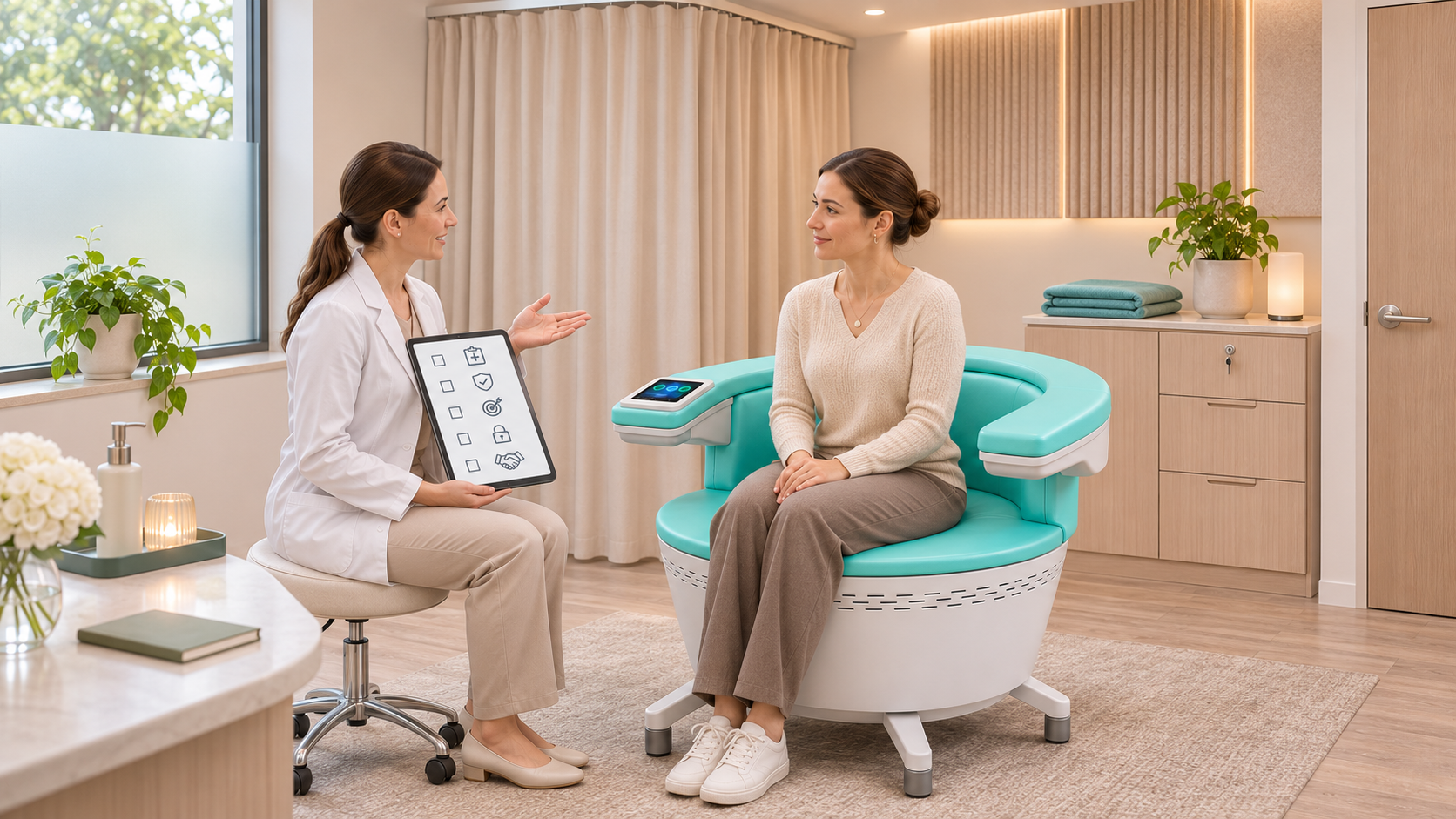
Pelvic floor services involve more than placing an EMS chair in a quiet corner. The client may disclose urinary, bowel, sexual, postpartum, surgical, or pain-related information that she has never discussed with a salon employee before. Privacy therefore begins with the booking name and continues through reception, consultation, room access, device operation, records, follow-up messages, and marketing consent.
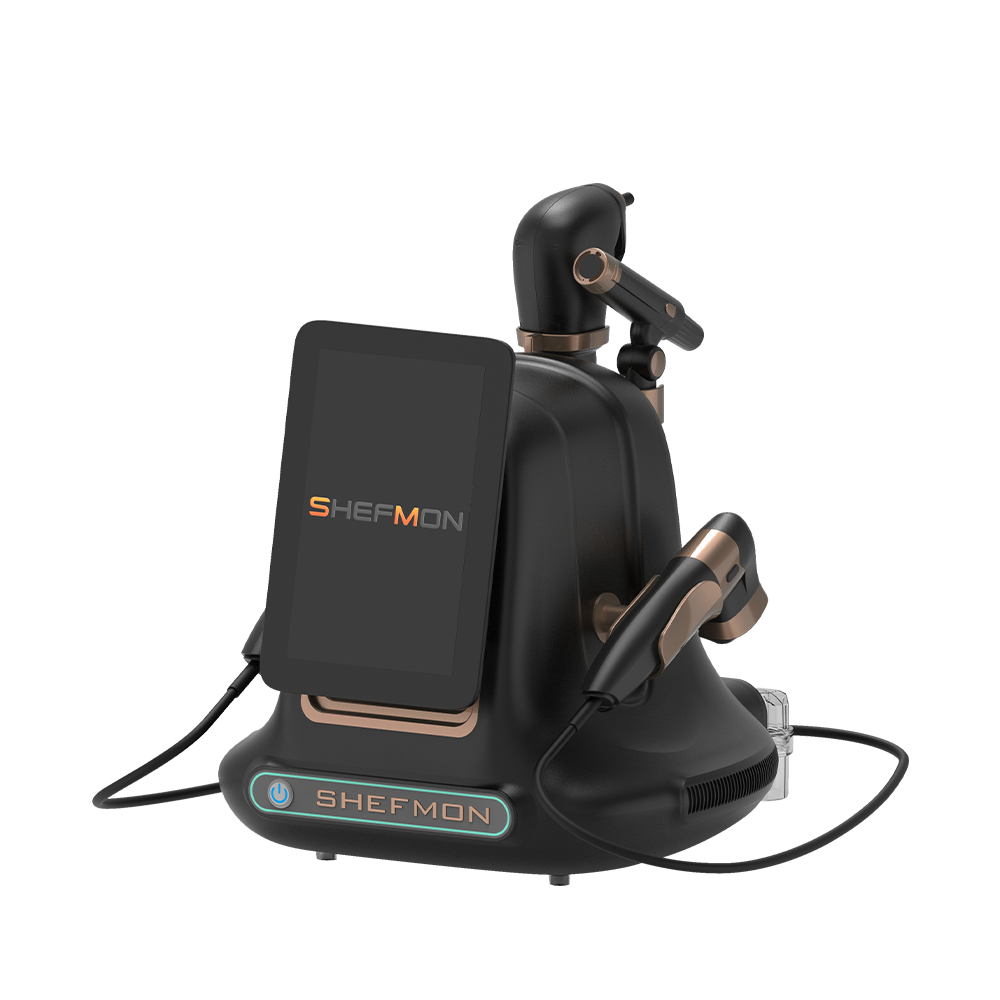
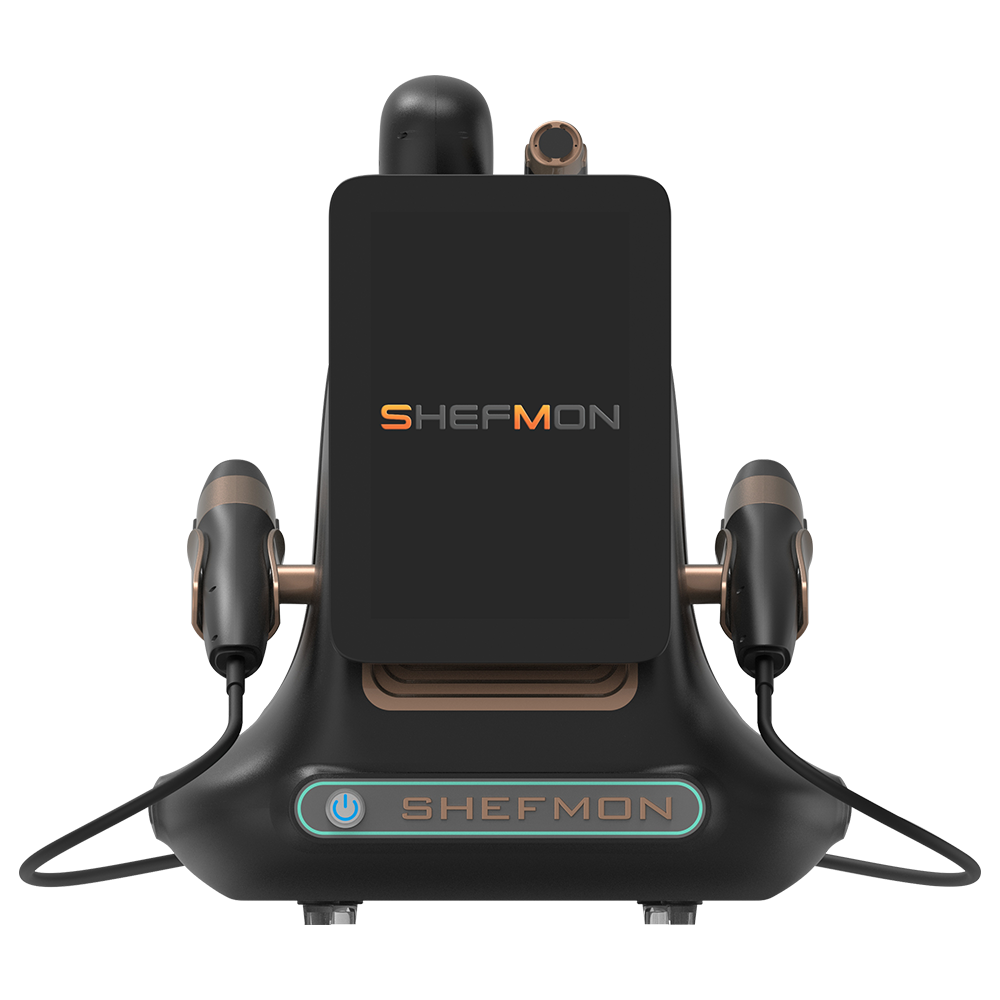
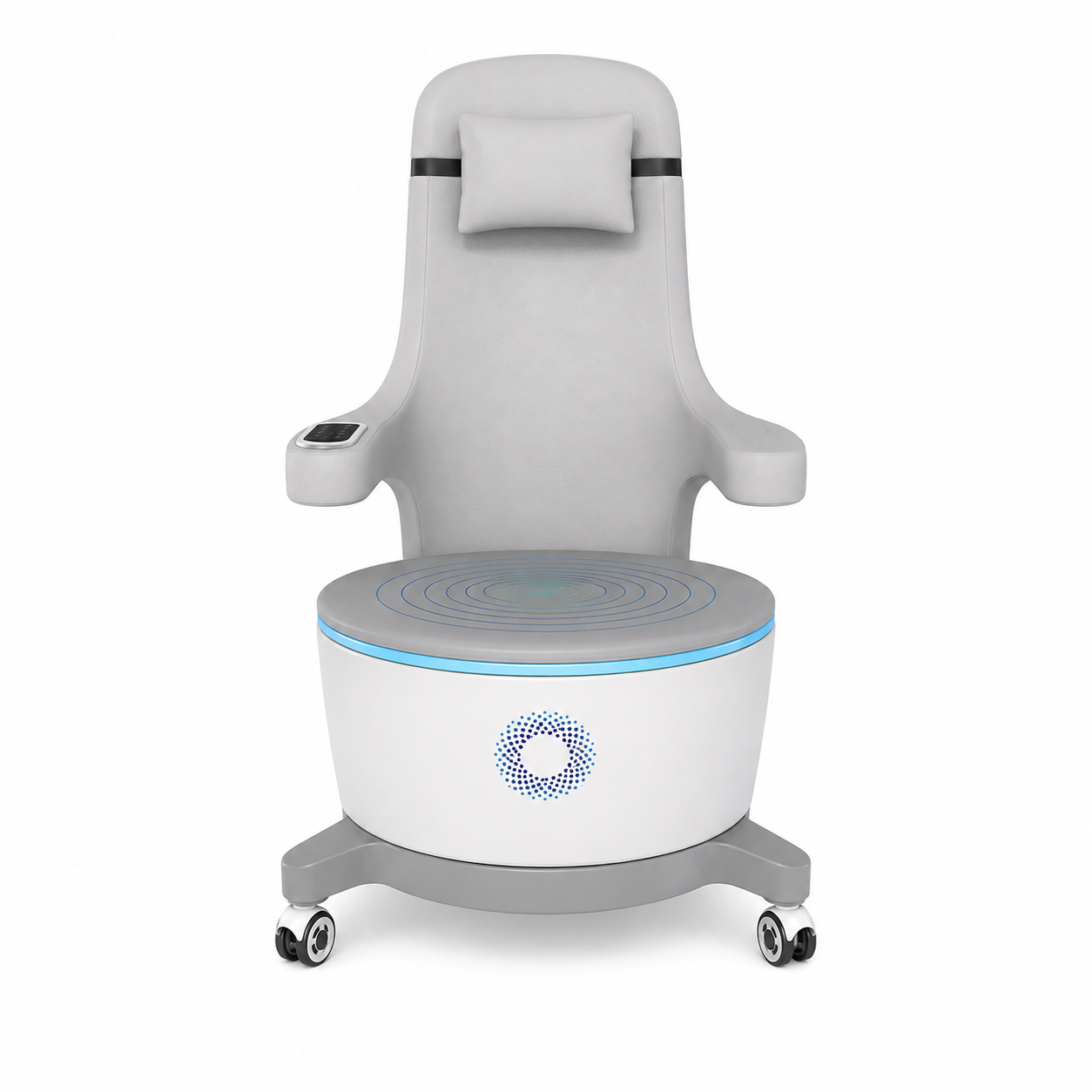
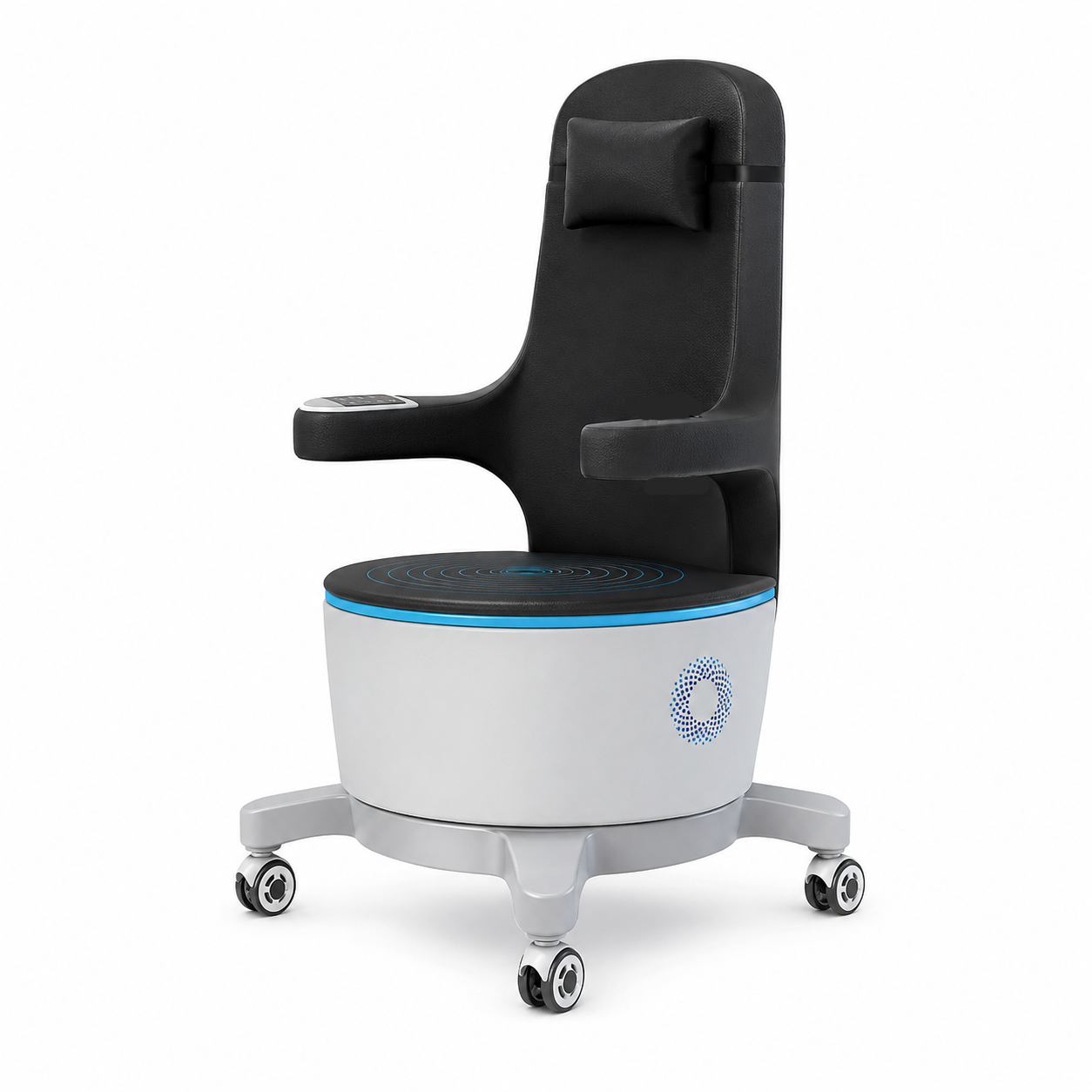
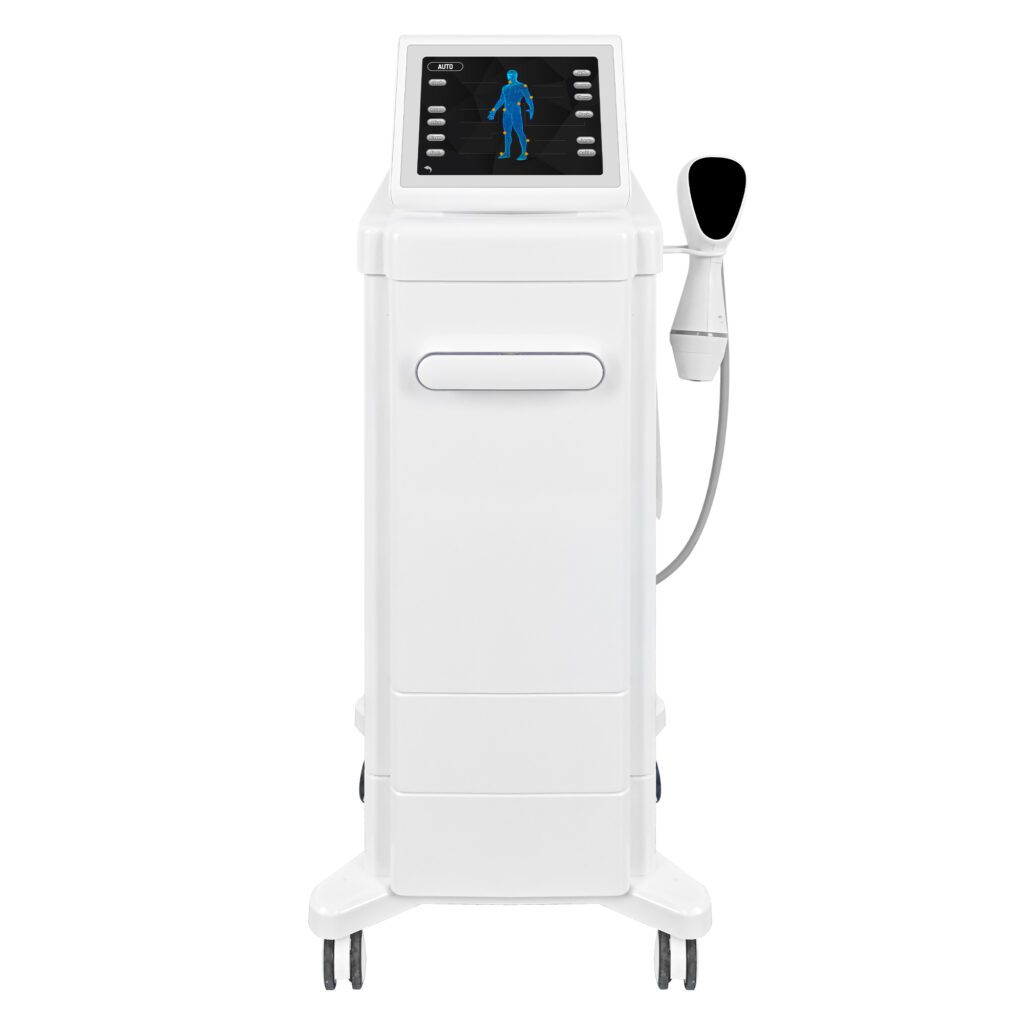
その SHEFMON E0435 EMS pelvic floor chair uses focused electromagnetic pulse technology in a seated chair format. A responsible E0435 service can be organized around muscle-stimulation and wellness support for suitable clients, but it should not replace medical assessment, pelvic health physiotherapy, postpartum care, or diagnosis of urinary, bowel, prolapse, pain, or sexual-health concerns.
This guide provides a practical privacy and consultation checklist for postpartum centers, women’s wellness businesses, appropriately governed clinics, and distributors training professional buyers. It is not a universal consent form or legal policy. Local privacy law, device labeling, professional scope, safeguarding rules, and the current E0435 manual take priority.
エグゼクティブサマリー
- Use a discreet public booking name and explain the service privately before asking sensitive questions.
- Design the room so conversations cannot be casually overheard and staff cannot enter without warning.
- Collect only information needed for suitability, safety, referral, consent, and follow-up.
- Separate clinical-service consent from photography, testimonials, marketing, and contact preferences.
- Give the client control over support-person or chaperone requests within the center’s safeguarding policy.
- Do not diagnose incontinence, prolapse, sexual dysfunction, postpartum injury, or pelvic pain in a beauty consultation.
- Refer significant, new, worsening, or unexplained symptoms to an appropriate healthcare professional.
- Reconfirm privacy, consent, health changes, and the client’s right to stop at every visit.
- Use neutral language and a clear escalation path when the service is not suitable.
1. Define E0435’s Role Before Designing the Consultation
The current E0435 product page describes a chair-format system that uses focused electromagnetic energy pulses to stimulate contractions in the pelvic floor region. Its public content discusses postpartum, pelvic floor, urinary, intimate-wellness, and male and female service directions.
Those marketing directions do not define what every center is legally or professionally allowed to provide. Before accepting bookings, the business should document:
- whether the service is wellness, aesthetic, physiotherapy-led, medical, or another locally recognized category;
- who may conduct the consultation and operate the chair;
- which client groups and symptoms the service accepts;
- which conditions require written clearance or direct referral;
- whether postpartum clients need review by their maternity or pelvic health provider;
- whether male clients are included and what privacy arrangements apply;
- what the team may record, explain, and advertise;
- which complaints, adverse events, and privacy incidents require escalation.
E0435 should not be promoted as a device that makes evaluation unnecessary. A chair session cannot determine why leakage, urgency, pelvic pressure, pain, or emptying difficulty is occurring.
Businesses comparing related equipment can review SHEFMON’s EMSlimカテゴリー. The E0435 workflow should remain separate from body EMSlim services for abdomen, glutes, arms, or thighs.
2. Treat Privacy as a Room-Design Requirement
Privacy is not only confidentiality in a database. It is also what another client can hear in the hallway, what appears on a public screen, who opens the door, where the client changes, and whether marketing consent feels optional.
Use a privacy-by-design review before launch:
| Privacy point | Practical control | Common failure to avoid |
|---|---|---|
| Booking name | Use a discreet name such as “E0435 Private Wellness Consultation” | Displaying “urine leakage treatment” on public calendars or reminder screens |
| 受付 | Verify identity quietly and avoid asking symptoms at the desk | Discussing childbirth, bladder, bowel, or sexual concerns within earshot of others |
| Consultation room | Close the door, control interruptions, and manage sound transmission | Conducting the intake behind only a curtain or open partition |
| 顧客の持ち物 | Provide a private, secure place away from the chair and console | Asking the client to leave items in a public hallway |
| Staff access | Use an occupied indicator and knock-and-wait policy | Entering with a key or master code without warning during consultation |
| 記録 | Role-based access and discreet screen positioning | Leaving sensitive forms or a client name visible on a shared desk |
| Messaging | Agree on safe channels, names, and message detail | Sending explicit pelvic-floor information in a lock-screen notification |
| マーケティング | Separate voluntary authorization from service consent | Making photographs or testimonials feel required for a package discount |
The room does not have to be soundproof, but the center should assess whether ordinary conversation can be understood outside it. Use appropriate building solutions, door seals, background sound outside the room, schedule spacing, or another privacy control consistent with local standards. White noise should not prevent the operator from hearing the client or alarms.
3. Use Discreet Booking and Reminder Language
The privacy checklist starts before the client arrives.
オンライン予約
The public page should explain the service sufficiently for informed interest without requiring the client to type detailed symptoms into an unsecured free-text field. Ask only for contact details, general appointment type, accessibility needs, preferred contact method, and whether a private callback is safe.
Telephone booking
Reception can say:
“This service begins with a private suitability consultation. You do not need to discuss sensitive symptoms at reception. A trained consultant will speak with you in a private room.”
Reception staff should not diagnose, promise acceptance, recommend intensity, or ask the client to describe intimate symptoms where colleagues or visitors can hear.
Reminders
Ask whether the client prefers SMS, email, telephone, or no detailed reminder. Use a neutral appointment name unless the client explicitly requests more detail. Do not include sensitive symptoms in the subject line, push notification, or voicemail.
Shared calendars
Use an internal code that staff understand without revealing the client’s concern to everyone with calendar access. Limit detailed notes to the protected client record rather than the appointment title.
4. Create a Private Check-In Process
On arrival:
- confirm the client’s identity quietly;
- avoid saying the full service name across the room;
- take forms directly to the consultation room or provide a protected digital method;
- do not ask the client to hand an open symptom form across a public counter;
- offer a private way to state accessibility, language, interpreter, support-person, or safeguarding needs;
- show the client where personal belongings can be stored;
- explain who will conduct the consultation and whether any trainee is present;
- obtain permission before including a trainee, observer, translator, or second staff member.
If a companion attends, address the client first. Ask privately whether she wants the companion present for the entire consultation, part of it, or not at all. A companion’s presence should not be assumed to equal consent to disclose sensitive information.
5. Prepare the Room for Dignity and Safety
The room should feel private without becoming unsafe or difficult to supervise.
含む:
- a full-height door rather than only a curtain where possible;
- an occupied indicator and a knock-and-wait procedure;
- emergency access that follows building and safeguarding rules;
- seating that lets the client and consultant talk at the same level;
- a screen positioned away from the doorway or visitor sightlines;
- closed storage for paper records, cleaning products, and personal items;
- a discreet place to change or adjust clothing if the manual requires it;
- a clean approved chair barrier or surface-preparation system;
- a clear route to stand and leave safely after stimulation;
- an accessible call or stop method during the session;
- a method for a support person or chaperone to sit without blocking the operator;
- signage that does not disclose the nature of the service.
Avoid mirrors, cameras, open video-conferencing devices, smart speakers, or unrelated recording equipment in the room unless there is a documented, lawful reason and explicit consent. Disable automatic transcription or ambient recording features during sensitive consultations unless they are authorized and necessary.
6. Limit Staff Access to What Their Role Requires
Not every employee needs the same information.
| 役割 | Information normally needed | Information that should remain restricted unless necessary |
|---|---|---|
| 受付 | Contact details, neutral booking code, arrival status, safe contact preference | Detailed urinary, bowel, sexual, delivery, pain, or surgical history |
| Consultant/operator | Safety screen, symptoms relevant to scope, consent, referral status, session record | Unrelated history with no relevance to safety or service delivery |
| 臨床責任者 | Escalated symptoms, clearance, incident and referral information | Marketing preferences unless separately relevant |
| Billing staff | Service code, payment status, invoice details | Narrative consultation notes |
| Marketing staff | Separate authorized media or testimonial materials | Treatment and symptom record |
| テクニカルサポート | Device ID, fault, settings, anonymized event details where possible | Client identity unless necessary and lawfully authorized |
The U.S. HHS minimum necessary privacy guidance applies to HIPAA-covered contexts, not every business worldwide. Its core idea—limit access, use, and disclosure to what is needed for the purpose—is nevertheless a useful design principle. Every center must follow the laws that actually apply in its market.
7. Send a Pre-Consultation Privacy Notice
Before collecting sensitive information, explain:
- why the center needs the information;
- who can access it;
- how it will be stored;
- how long it will be retained;
- whether it may be shared with a healthcare professional and under what consent or legal basis;
- how the client can request access, correction, or another privacy right available locally;
- how the center uses SMS, email, cloud forms, video calls, or third-party booking software;
- where the client can raise a privacy concern;
- that marketing consent is optional and separate.
Avoid a single checkbox that combines treatment, health-data processing, photographs, social media, testimonials, email marketing, and supplier contact. Different purposes require clear choices and locally appropriate legal handling.
8. Use a Structured Client Consultation Checklist
The following checklist is designed for operational consistency. It is not a substitute for the current E0435 manual or a clinician’s assessment.
A. Identity, communication, and privacy preferences
- Confirm name, date of birth or locally required identifier, and contact details.
- Ask which contact channel is safe and what wording may be used.
- Confirm preferred language, interpreter needs, accessibility needs, and communication support.
- Ask whether the client wants a support person or chaperone.
- Explain who will see the record and how privacy is protected.
- Confirm whether the client is comfortable continuing in the current room.
B. Service goal and expectations
- Ask the client to describe the goal in her own words.
- Clarify whether the concern is wellness support or an unresolved medical symptom.
- Explain that E0435 stimulates muscle contractions but does not diagnose pelvic floor conditions.
- Explain alternatives: no service, voluntary pelvic floor education, pelvic health physiotherapy, medical review, or another appropriate pathway.
- Correct expectations of guaranteed continence, prolapse correction, sexual-function change, “tightening,” or instant postpartum recovery.
C. Postpartum and relevant history
Collect only details needed for safety and scope, which may include:
- postpartum status and date of delivery;
- delivery type and relevant healing concerns;
- caesarean, perineal, abdominal, pelvic, urologic, or gynecologic surgery;
- current bleeding, wound, infection, or medical restrictions;
- catheter, mesh, implanted device, or metal history;
- current pregnancy or possibility of pregnancy;
- relevant medications and professional advice;
- previous pelvic health assessment or therapy.
Do not ask for a full sexual or obstetric history merely because the service is intimate. Every question should have a documented purpose.
D. Current symptoms and referral screen
Use neutral questions and record the client’s words without diagnosing. Ask about:
- urinary leakage, urgency, frequency, burning, pain, or difficulty emptying;
- bowel leakage, loss of control, constipation, or emptying difficulty;
- pelvic pressure, heaviness, or a bulging sensation;
- pelvic, abdominal, perineal, back, or sexual pain;
- numbness, weakness, altered sensation, or new neurological symptoms;
- fever, infection concerns, wound changes, unusual discharge, or bleeding;
- recent symptom worsening or a sudden change;
- the effect on daily activity and whether a healthcare professional is already involved.
E. Device-specific safety screen
Use the current E0435 manual. Common electromagnetic or muscle-stimulation concerns that may need exclusion, postponement, or clearance include:
- pacemaker, defibrillator, insulin pump, neurostimulator, or another active implant;
- metal, mesh, surgical hardware, or another implant in or near the treatment area;
- pregnancy or possible pregnancy;
- significant heart or neurological conditions;
- 発作歴;
- recent surgery, unhealed tissue, or a condition strong contractions could worsen;
- 感覚の低下、または不快感を確実に伝えることができない状態。;
- active infection, fever, inflamed tissue, unexplained bleeding, or acute illness;
- another contraindication named in the manual or local professional guidance.
F. Consent and plan
- State whether the client is suitable, needs clarification, requires clearance, or should be referred.
- Explain the chair principle, expected sensation, monitoring, possible discomfort, and right to stop.
- Explain the limits of the service and absence of guaranteed outcomes.
- Confirm privacy, record use, contact preference, and support-person decision.
- Obtain service consent without bundling optional marketing permission.
- Record the agreed next step and who is responsible for follow-up.
9. Ask Sensitive Questions Without Diagnosing
Good consultation language is specific, neutral, and non-judgmental.
Instead of “How bad is your incontinence?” ask:
“Have you noticed urine leakage, urgency, or difficulty emptying your bladder? If yes, when does it occur, and has a healthcare professional assessed it?”
Instead of “Do you have prolapse?” ask:
“Have you noticed pelvic heaviness, pressure, or a sensation of tissue bulging? These symptoms need appropriate clinical assessment before we decide whether a wellness service is suitable.”
Instead of “Is sex painful?” ask:
“Do you have pelvic or intimate pain that you would like the consultant to know about? You may decline to answer, but unexplained pain may mean we postpone and refer.”
Instead of “Have you healed from childbirth?” ask:
“Has your maternity or healthcare team confirmed that your recovery is progressing normally, and are there any wounds, bleeding, pain, restrictions, or symptoms still under review?”
Staff should not use euphemisms so vague that safety information is missed, but they should explain why a question is being asked and allow the client time to answer.
10. Set a Clear Referral Boundary
An E0435 consultation should result in one of four decisions:
- Proceed under the approved wellness or clinical protocol.
- Postpone until a temporary issue resolves or information is confirmed.
- Request appropriate professional clearance.
- Refer because the client needs assessment outside the center’s scope.
Possible referral triggers include significant or worsening pelvic pain, pelvic pressure or bulging, difficulty emptying the bladder or bowel, new bowel incontinence, unexplained bleeding, fever or infection concerns, wound separation or discharge, new weakness or numbness, severe urinary symptoms, acute postpartum concerns, or another symptom the team is not qualified to assess.
ACOG notes that leaking urine, inability to empty the bladder, pressure, or pain can be associated with pelvic floor problems and deserve appropriate care. Its pelvic organ prolapse information そして postpartum pain guidance reinforce that serious, persistent, or concerning postpartum symptoms should not be dismissed as a routine beauty issue.
Referral is not a diagnosis. Staff can say:
“Your answer falls outside what our E0435 wellness consultation can safely assess. We recommend that you speak with an appropriate healthcare professional before we consider this service.”
11. Separate Service Consent From Privacy Choices
The service consent should cover:
- what E0435 does and does not do;
- the expected seated position and sensation;
- known risks, discomforts, and uncertainty described in the manual;
- alternatives, including no service and professional referral;
- monitoring and stop procedures;
- the client’s right to withdraw consent;
- record keeping and required disclosures;
- the agreed program and review process.
Use separate optional choices for:
- appointment reminders and the level of detail allowed;
- communicating with a named healthcare professional;
- including a support person;
- photography for the confidential record;
- photography or video for marketing;
- testimonials;
- email or SMS marketing;
- supplier case review or training use.
Declining marketing permission must not reduce service quality or create pressure. If a discount depends on publicity, review whether consent is genuinely voluntary under local law and ethical policy.
12. Establish a Chaperone and Support-Person Policy
A chaperone policy should protect the client without removing her choice.
The center should define:
- when a trained chaperone is offered or required by policy;
- how the client requests a person of a preferred gender where possible;
- whether the client may bring a trusted support person;
- how staff obtain the client’s permission before discussing sensitive history in front of that person;
- how the operator documents who was present and for which part of the visit;
- how safeguarding concerns override ordinary preferences when legally required;
- what happens if the requested chaperone is unavailable.
A support person is not automatically a trained chaperone, interpreter, or decision-maker. The client remains the person giving consent unless lawful representation applies.
13. Protect Privacy During Positioning and the Session
Before positioning:
- explain the chair and clothing requirements from the current manual;
- give the client privacy to adjust clothing if required;
- ask permission before touching or adjusting any clothing, cushion, or position;
- explain which personal and metal items must be removed or relocated;
- confirm the client is seated comfortably and can stand safely;
- show how to request an immediate stop;
- close the door and activate the occupied indicator.
The chair format should not be used as a reason to perform an internal examination or request unnecessary exposure. A salon or wellness operator must not exceed professional scope. If an examination is clinically required, it belongs with an appropriately qualified professional in an authorized setting.
セッション中:
- keep conversation private and relevant;
- monitor comfort, position, communication, and device status;
- do not discuss another client or use the session for sales pressure;
- do not bring staff into the room without permission except in an emergency;
- stop when the client requests it or the approved criteria are met;
- record the actual program and response, not intimate commentary unrelated to care.
14. Use a Knock, Entry, and Interruption Protocol
Every employee should follow the same door rule:
- Check the occupied indicator and schedule.
- Knock once and state name and role.
- Wait for a clear response.
- Enter only after permission unless an emergency or safeguarding duty requires access.
- Close the door promptly and explain any necessary interruption.
Cleaning staff, managers, trainees, engineers, and delivery personnel are not exceptions. Schedule maintenance outside client sessions whenever possible.
If the door is locked for privacy, the arrangement must still comply with emergency, accessibility, fire, and safeguarding requirements. An occupied indicator and controlled entry may be safer than a lock in some premises.
15. Minimize and Secure Consultation Records
The record should be detailed enough for safety and continuity but not become an unrestricted narrative of the client’s intimate life.
記録:
- identity and safe contact preference;
- relevant service goal;
- safety-screen answers;
- symptoms that affected the proceed, postpone, clear, or refer decision;
- referral or clearance status;
- consent version and date;
- support person or chaperone present;
- program, settings, position, comfort, adjustments, and stop reason;
- aftercare and next step;
- privacy preferences and any disclosure authorization;
- incident or complaint information when required.
避ける:
- copying an entire medical record when a focused clearance is enough;
- recording gossip, assumptions, or judgmental descriptions;
- storing photographs in personal phones or general chat groups;
- putting symptoms in file names visible to unauthorized staff;
- keeping printed forms in unlocked open trays;
- sharing records with SHEFMON, a distributor, or a technician without a lawful need and appropriate privacy control.
Use role-based accounts, strong authentication, audit logs where available, encrypted approved systems, secure disposal, and a locally compliant retention schedule.
16. Use Discreet Payment, Invoicing, and Messaging
Where systems allow, use a neutral but accurate service code on receipts and client-facing bank or booking descriptions. Do not falsify records, but avoid unnecessary intimate detail.
Before leaving a voicemail or sending a message, confirm:
- the client owns or controls the contact method;
- the chosen wording is acceptable;
- whether another household member can see notifications;
- whether attachments or links contain sensitive titles;
- whether the channel is approved for health information under local policy;
- what to do if the message goes to the wrong person.
Do not send detailed symptoms, referral notes, or intimate photographs through ordinary consumer messaging merely because it is convenient.
17. Keep Marketing Consent Separate and Specific
Pelvic floor before-and-after content is rarely necessary for routine service records and may create significant privacy risk. If the center uses testimonials or educational case material:
- obtain separate written authorization;
- explain the exact image, quote, platform, audience, duration, and withdrawal process;
- avoid promising anonymity when details could identify the client;
- give the client time to decide outside the treatment chair;
- do not let the consultant who is pressuring for a package also pressure for publicity;
- avoid publishing intimate symptoms, childbirth details, or sexual-health information beyond the specific authorization;
- keep the original record separate from marketing copies;
- document edits and approved final wording.
Generic consent to “use images for education and marketing” is not meaningful when the client cannot see how sensitive information will appear.
18. Create a Daily Privacy and Room Checklist
Before opening
- Door, occupied indicator, blinds, curtains, and sound controls work.
- Screens are angled away from the doorway and use automatic locking.
- Paper forms and printers are not visible to visitors.
- Client-belongings storage is empty and secure.
- No camera, microphone, smart speaker, or recording feature is active without authorization.
- Chair surface, barrier, console, and room are ready under the manual and cleaning SOP.
- Referral contacts, emergency process, and privacy-incident procedure are available.
- The schedule uses neutral booking names.
Before each consultation
- Confirm who is present and obtain permission for observers, trainees, interpreters, or companions.
- Close the door and activate the occupied indicator.
- Verify the client’s preferred contact and privacy choices.
- Open only the record needed for this client.
- Explain confidentiality limits, consent, and referral boundaries.
After each client
- Finish and secure the record before opening another client’s file.
- Clear the screen and remove papers from view.
- Process the chair and room according to the approved SOP.
- Remove names, labels, or notes from public surfaces.
- Confirm follow-up wording and channel before sending a message.
- Log any privacy, safeguarding, or device incident.
At closing
- Reconcile paper forms and lock or securely dispose of them.
- Sign out of systems and secure portable devices.
- Check that no photographs remain on unapproved devices.
- Empty temporary print, scan, download, or message queues.
- Lock record storage and verify room access.
- Review unresolved referrals, consent withdrawals, wrong-recipient messages, or privacy complaints.
19. Protect Privacy in Follow-Up
Follow-up should be agreed before the client leaves.
聞く:
- which channel is safe;
- what time is safe;
- whether voicemail is allowed;
- whether the service name may appear;
- whether the client wants only a booking link or a clinical check-in;
- what to do if the center cannot reach her;
- whether information may be sent to a named healthcare professional.
The message can remain neutral:
“This is [Center] checking in after your private wellness appointment. Please use the secure contact method we agreed if you have concerns or wish to change your next booking.”
If the client reports a serious or worsening symptom, move the conversation to the approved clinical or referral process. Do not continue a detailed assessment through an insecure channel.
20. Respond to Privacy Incidents
例:
- sending a reminder or report to the wrong person;
- discussing symptoms within earshot of another client;
- a staff member entering without permission;
- losing a paper form or device;
- storing photographs in an unauthorized account;
- allowing unnecessary staff access to a record;
- using a testimonial beyond the agreed scope;
- a companion coercing the client or controlling answers;
- a technical-support request containing unnecessary identity information.
The response plan should state how to contain the incident, preserve evidence, notify the privacy lead, assess risk, meet legal notification duties, communicate with the client, correct access, and prevent recurrence. Staff should report incidents promptly without fear that hiding them is safer.
21. Train Staff With Privacy Scenarios
Training should include role-play, not only policy reading.
Practice:
- moving a sensitive reception question into the private room;
- asking a companion to leave for part of the consultation;
- explaining why a symptom requires referral;
- handling a client who declines to answer;
- responding when a trainee enters without permission;
- correcting a reminder sent with excessive detail;
- responding to possible coercion or safeguarding concerns;
- declining a marketing photograph without affecting service;
- handling a new implant or pregnancy possibility at a repeat visit;
- stopping a session when the client becomes uncomfortable.
Audit booking names, door-entry behavior, record access, messaging, and consent separation periodically. Privacy standards weaken when they are not observed in daily workflow.
22. Buyer Checklist Before Launching E0435
SHEFMONに確認を依頼してください。
- exact E0435 configuration and delivered accessories;
- chair dimensions, weight, power, plug, ventilation, and room requirements;
- client clothing, positioning, and personal-item instructions;
- contraindications, warnings, and intended service population;
- 取扱説明書およびトレーニング資料;
- approved programs, settings, and stop procedure;
- chair-surface cleaning, barrier, and disinfection instructions;
- daily checks and preventive-maintenance schedule;
- warranty, spare parts, technical support, and fault process;
- 仕向市場向け書類およびラベル表示。;
- whether current materials distinguish wellness claims from medical indications.
The product page is a starting point. The center’s privacy checklist must also be reviewed against local health-data law, professional regulation, safeguarding duties, advertising rules, and facility requirements.
よくある質問
1. Why does an E0435 room need stronger privacy controls?
Clients may discuss urinary, bowel, sexual, postpartum, surgical, pain, and implant information. Privacy therefore affects booking names, sound, door access, records, messages, companions, marketing, and room behavior—not only the treatment itself.
2. Should reception ask why the client wants the chair service?
Reception should collect only enough information to book a private consultation and identify urgent operational needs. Detailed symptoms should be discussed with the trained consultant in a private setting.
3. Can a partner or family member stay during the consultation?
Only with the client’s permission and within safeguarding policy. Ask the client privately whether she wants the person present for all, part, or none of the visit.
4. Does the E0435 consultation diagnose incontinence or prolapse?
No. Staff may record symptoms and decide whether the service is within scope, but diagnosis and clinical assessment belong with appropriately qualified healthcare professionals.
5. What symptoms should trigger referral?
Examples include significant or worsening pain, pelvic pressure or bulging, emptying difficulty, new bowel incontinence, unexplained bleeding, fever or infection concerns, wound problems, new weakness or numbness, severe urinary symptoms, or another concern outside staff competence.
6. Should marketing consent be included in the service form?
Marketing authorization should be separate, specific, optional, and revocable as local law permits. Declining it should not reduce service quality or affect ordinary consent.
7. Can the room door be locked during treatment?
Privacy must be balanced with emergency access, fire, accessibility, and safeguarding rules. An occupied indicator and knock-and-wait procedure may be more appropriate in some premises.
8. How should reminder messages describe the appointment?
Use the neutral wording agreed with the client, such as “private wellness consultation.” Avoid symptoms or explicit pelvic-floor information in subject lines, lock-screen notifications, or voicemails.
9. Can staff use personal phones for consultation photographs?
Not unless the center has a lawful, secure, explicitly authorized system and policy allowing it. Sensitive images should not remain in personal galleries, cloud backups, or consumer chat applications.
10. What should buyers confirm before opening an E0435 service?
Confirm the delivered chair, room and electrical requirements, contraindications, clothing and positioning instructions, cleaning, training, maintenance, warranty, intended use, local privacy rules, professional scope, referral network, and safeguarding policy.
結論
An E0435 service earns trust when the client controls who hears, sees, records, and receives her information. A private room alone is not enough. The center needs discreet booking, private check-in, minimum necessary information, neutral consultation language, separate consent choices, controlled door access, secure records, safe messaging, and a clear referral pathway.
The best consultation checklist does not force every client toward a chair session. It supports four responsible outcomes: proceed, postpone, obtain clearance, or refer. That makes E0435 a professionally governed pelvic floor muscle-stimulation service rather than an unsupported promise about intimate health.
現状を確認する SHEFMON E0435 product page または シェフモンに連絡してください to confirm the delivered configuration, client preparation, training, cleaning, maintenance, and technical support.