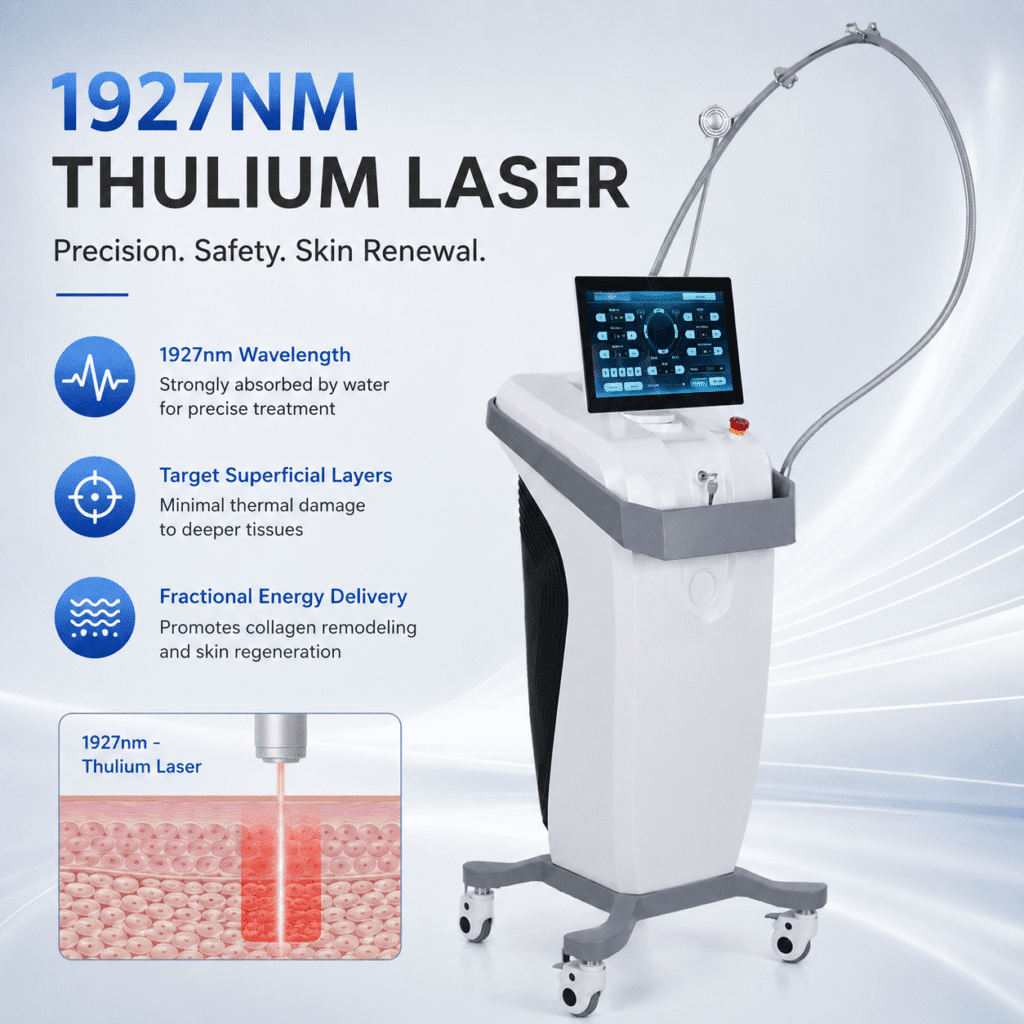








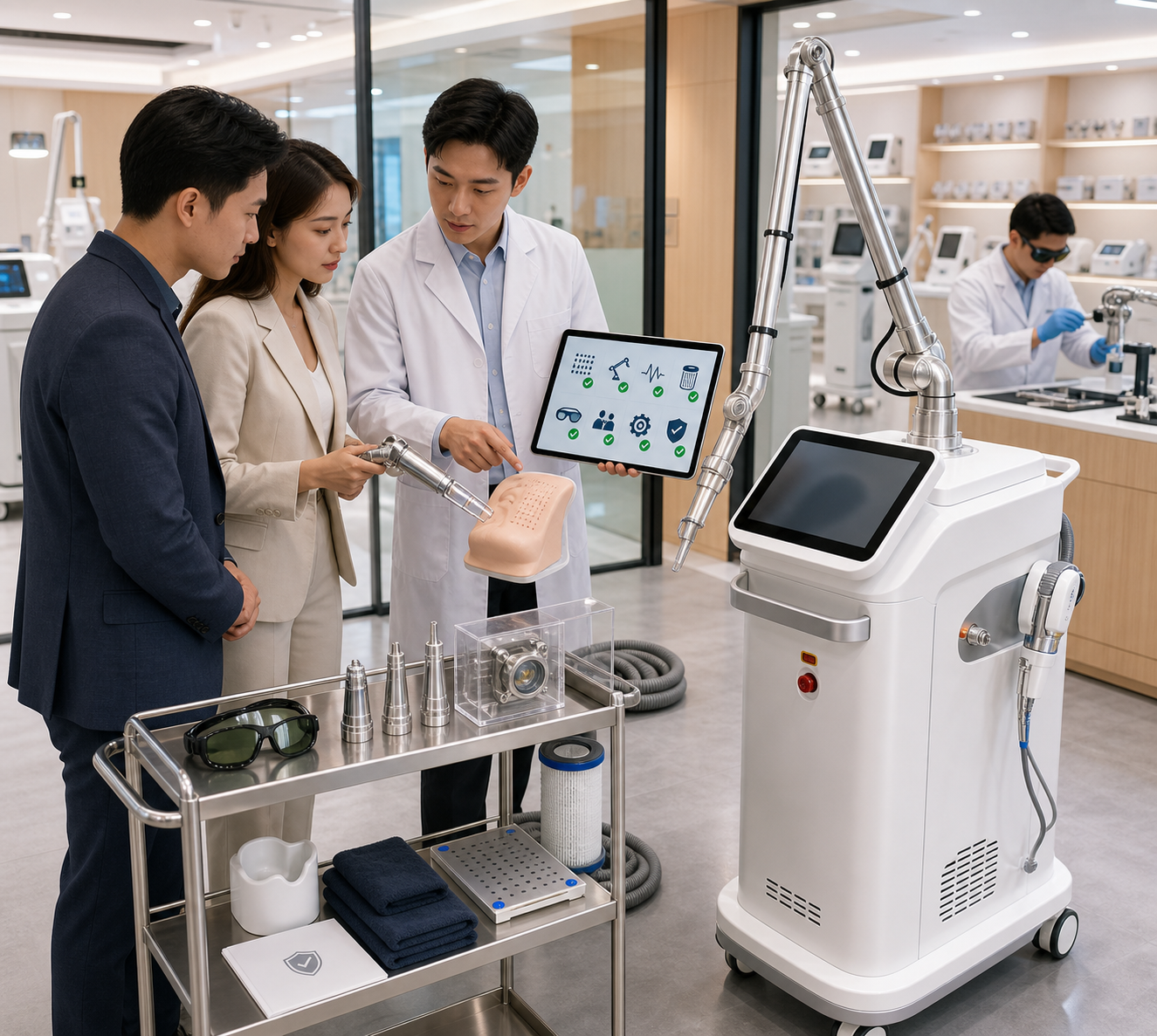
Choosing a CO2 fractional laser machine supplier is a major decision for acne scar clinics, dermatology practices, aesthetic clinics, medspas, distributors, and private label buyers. Fractional CO2 laser resurfacing can be a premium acne scar procedure when it is performed by qualified professionals with appropriate patient selection, device settings, safety controls, aftercare, and follow-up. But it is also an ablative laser procedure that carries real clinical, regulatory, operational, and reputational risk.
The wrong supplier can create problems far beyond weak treatment results. Poor documentation, unstable laser output, inaccurate scanner patterns, weak articulated arm transmission, unreliable optics, low-quality handpieces, missing smoke evacuation guidance, unclear training, vague warranty terms, and poor spare parts supply can lead to downtime, patient complaints, safety problems, and lost trust.
The best supplier is not simply the one with the lowest price, the highest watt number, or the most dramatic acne scar before and after photos. A professional CO2 fractional laser supplier should support the full procedure lifecycle: device documentation, 10,600 nm laser performance, scanner accuracy, laser safety, plume management, staff training, patient screening, treatment protocols, consumables, maintenance, after-sales service, and realistic marketing.
This guide explains how acne scar clinics and distributors should evaluate a CO2 fractional laser machine supplier before buying.
What Is A CO2 Fractional Laser Machine?
A CO2 laser emits infrared laser energy at about 10,600 nm. In dermatology and plastic surgery, CO2 laser energy is absorbed strongly by water in tissue, allowing controlled cutting, vaporization, ablation, coagulation, and resurfacing depending on device design and settings.
A fractional CO2 laser divides the laser beam into many small microbeams or treatment spots. Instead of treating the entire skin surface uniformly, fractional delivery creates microscopic treatment zones while leaving surrounding tissue untreated. This can support skin resurfacing and scar remodeling while allowing a different healing profile from fully ablative resurfacing.
For acne scar clinics, fractional CO2 laser machines are commonly considered for:
- Atrophic acne scar resurfacing
- Boxcar scar appearance improvement
- Rolling scar appearance improvement
- Texture irregularity management
- Enlarged pore appearance
- ニキビ跡の肌荒れ
- Wrinkle and photoaging projects where permitted
- Surgical scar revision where permitted
- Combination acne scar programs
The exact claims and treatment areas depend on the device’s cleared or authorized indications, local regulations, provider qualification, and clinical judgment.
Why Acne Scar Clinics Use Fractional CO2 Lasers
Acne scar patients often need more than topical skin care. Atrophic acne scars involve changes in skin texture, dermal structure, and surface contour. Fractional CO2 resurfacing can be part of a professional acne scar treatment plan because it can resurface uneven texture and stimulate wound healing responses in a controlled clinical setting.
The American Academy of Dermatology explains that dermatologists use lasers to resurface skin with acne scars and that collagen and elastin production during healing can help diminish scar appearance. Mayo Clinic also describes laser resurfacing as a procedure using an energy-based device to improve the look and feel of skin, while warning that it is not suitable for everyone and can carry risks such as color changes and scarring.
For clinics, this means CO2 laser equipment can support strong demand, but the service must be positioned carefully. The clinic should not promise that all scars will disappear. It should explain acne scar type, skin type, treatment plan, downtime, risks, combination procedures, and realistic improvement.
CO2 Laser Is Not A Basic Salon Device
A fractional CO2 laser is not comparable to a basic facial machine or low-energy beauty device. It is an ablative energy-based system that can remove or vaporize tissue and may be regulated as a medical device in many markets. In the United States, FDA’s 510(k) summary examples for fractional CO2 laser machines show Class II regulation under 21 CFR 878.4810, with product codes such as GEX and ONG for laser surgical instruments and microbeam or fractional output. The example indications include fractional mode for ablative skin resurfacing and non-fractional mode for soft tissue incision, excision, ablation, vaporization, and coagulation in relevant medical specialties.
This does not mean every supplier’s device has the same clearance or same indications. It means buyers should treat the category seriously and verify the exact model, exact manufacturer, exact indications, and exact market documentation before purchase.
Start With The Clinic’s Scope And Market
Before comparing suppliers, define the clinic’s intended use and target market.
Clarify:
- Country or sales market
- 診療科の種類
- Whether the procedure is medical, aesthetic, or delegated under supervision
- Who will operate the laser
- Whether the clinic treats acne scars only or also wrinkles, lesions, surgical scars, and resurfacing
- Whether the clinic needs fractional mode, surgical cutting mode, or both
- Whether the laser will be used on face, neck, body, or intraoral tissue
- What Fitzpatrick skin types are commonly treated
- Whether the clinic has plume evacuation and laser safety infrastructure
- Whether the device will be sold under supplier brand or private label
- Whether local law allows the intended claims and operator model
The right supplier should be able to discuss these details. A supplier that only says “this machine removes acne scars fast” is not professional enough for an acne scar clinic.
Match The Supplier To Your Business Model
Different buyers need different supplier support.
Dermatology And Acne Scar Clinics
Clinics need strong regulatory documentation, acne scar protocol support, patient screening forms, informed consent templates, laser safety training, post-treatment care instructions, complication response guidance, photography standards, and technical support for device settings.
メディカルスパ
Medspas need clear provider supervision workflow, scope-of-practice awareness, staff training, safe delegation rules where permitted, patient education, conservative protocols, and post-procedure follow-up systems.
販売代理店
Distributors need stable batch quality, wholesale price structure, spare parts, articulated arm supply, scanner support, replacement tips, training materials, documentation packages, territory policy, and fast technical escalation.
OEM And Private Label Buyers
OEM buyers need logo customization, interface localization, IFU and label review, packaging support, serial number traceability, certificate scope confirmation, and legal responsibility clarity if the product is marketed under a private label.
Choose a supplier that fits your operational model, not just your purchase budget.
Verify Supplier Identity
Before paying a deposit, verify who the supplier is.
尋ねる:
- Legal company name
- 事業許可証
- 工場住所
- Office address
- Manufacturer role
- Export history
- Main product lines
- 創業年数
- Quality management certificate
- Production line photos or videos
- Engineering team information
- Regulatory team information
- After-sales team structure
- Laser tube and optics supplier information where appropriate
- Customer references where available
Clarify whether the seller is:
- The legal manufacturer
- A brand owner
- A trading company
- A contract manufacturer
- A distributor of another manufacturer’s machine
- An OEM or ODM service provider
Trading companies can be useful, but buyers should know who is responsible for quality, documents, laser modules, scanner parts, warranty, and adverse event support.
Verify Regulatory Documentation
Regulatory documentation is one of the most important supplier-selection factors.
リクエスト:
- Full certificate copies
- FDA 510(k) number and summary where applicable
- Product code and regulation number where applicable
- Device listing and establishment registration information where applicable
- Declaration of conformity where applicable
- CE certificate and notified body details where applicable
- EU MDR technical documentation support where applicable
- User manual or instructions for use
- Label and rating plate
- Laser safety labels
- Product report or accession number documentation where applicable for radiation-emitting products
- 電気安全報告書
- EMCレポート
- ソフトウェアバージョン
- Handpiece and scanner accessory list
- Indications for use
- Contraindication and warning information
- Quality system certificate
- Inspection report sample
- 保証条件
Documents must match the exact model you buy. A certificate for one CO2 laser model does not automatically cover another model, another handpiece, another scanner, another software version, or a private label configuration.
Understand FDA Registration, Clearance, And Approval
Many suppliers use FDA wording loosely. Clinics should be careful.
Important distinctions:
- FDA establishment registration means a facility is registered where required.
- FDA device listing means a device is listed in a database where required.
- FDA 510(k) clearance means FDA determined the device is substantially equivalent to a legally marketed device for specific intended uses.
- FDA approval is a different concept and should not be used casually for every medical device.
FDA explains that registration or listing does not denote approval, clearance, or authorization. FDA also warns that “FDA registered” or “FDA certified” words can mislead buyers. Therefore, if a supplier says “FDA approved CO2 laser”, ask:
- What exact FDA status do you mean?
- What is the 510(k) number where applicable?
- What is the device name?
- What is the manufacturer name?
- What is the product code?
- What is the regulation number?
- What are the indications for use?
- Does it cover acne scar resurfacing or only general skin resurfacing?
- Does it cover this model and software version?
- Does it cover private label versions?
Do not buy based on FDA wording until it is verified in official records.
Check Laser Product Compliance
CO2 lasers are also radiation-emitting electronic products. For the United States, FDA explains that manufacturers of laser products are responsible for compliance with applicable requirements in 21 CFR Parts 1000 through 1040. eCFR 21 CFR Part 1040 includes performance standards for light-emitting products, including laser products and specific purpose laser products.
供給業者に問い合わせてください:
- Has a laser product report been submitted where required?
- Is there an accession number where applicable?
- Are required laser safety labels included?
- Is the laser class clearly labeled?
- Are user information and service instructions provided?
- Is there a key switch?
- Is there an emission indicator?
- Is there a shutter or output control?
- Is there an emergency stop?
- Is the aiming beam specified?
- Is the interlock system described?
- Are service procedures restricted to qualified personnel?
Medical device clearance and laser product radiation compliance are related but not the same. A professional supplier should understand both.
Evaluate EU MDR And CE Requirements
For the European Union, CO2 fractional lasers used for clinical skin resurfacing are likely to require medical device review based on intended use and claims. Buyers should request:
- CE certificate
- MDR classification
- 適合宣言
- Notified body details where required
- EU authorized representative information
- UDI support where applicable
- Technical documentation summary
- Risk management documentation
- Clinical evaluation or performance evidence where applicable
- Labeling and IFU in required languages
- Post-market surveillance process
- Vigilance reporting process
If the supplier only sends a generic CE test certificate for electrical safety but cannot explain medical device CE or MDR scope, the documentation may not be enough for professional clinic use.
Check Local Medical And Operator Rules
Even if a device is properly documented, the clinic must verify whether local law allows the intended user to operate it.
チェック:
- Physician supervision requirements
- Laser operator licensing
- Aesthetic procedure delegation rules
- Medspa laws
- Facility registration requirements
- Laser safety officer requirements
- Patient consent rules
- Advertising restrictions
- Medical waste and sharps or plume policies
- Infection control requirements
- Adverse event reporting obligations
A supplier can provide documents and training, but the clinic is responsible for local compliance.
Evaluate Core Technical Specifications
CO2 fractional laser performance depends on a group of specifications, not one number.
主な仕様は次のとおりです。
- 波長
- Maximum output power
- パルス持続時間
- Pulse energy
- Repeat rate
- Fractional spot size
- Scan area
- Spot density
- Inter-beam spacing
- スキャンパターン
- Fractional and non-fractional modes
- Aiming beam power
- Beam delivery system
- Articulated arm quality
- Scanner accuracy
- Foot switch response
- 冷却システム
- Software control
- 治療プリセット
- Service calibration method
A high watt number does not automatically mean better acne scar treatment. Controlled energy delivery, scan uniformity, pulse stability, and provider training are more important.
Understand 10,600 nm CO2 Laser Output
Most CO2 resurfacing lasers emit at 10,600 nm, sometimes written as 10.6 um. The wavelength is absorbed by water, which is abundant in skin tissue. This allows the laser to ablate tissue and create controlled thermal zones.
供給業者に問い合わせてください:
- What is the exact wavelength?
- What is the laser tube type?
- Is it a sealed glass tube, RF-excited metal tube, or another structure?
- What is the rated power?
- What is the measured output power at the handpiece?
- How is output measured?
- How often should calibration be checked?
- Does output remain stable during long use?
- What is the expected laser source lifetime?
- What is the replacement cost?
For acne scar clinics, output stability is more important than brochure power. A device with unstable output can cause uneven treatment and inconsistent results.
Compare Laser Source Types
CO2 fractional machines may use different laser source designs.
Glass Tube CO2 Laser
Glass tube systems are often lower cost and common in many beauty equipment markets. They may be suitable for budget-conscious buyers if the supplier provides strong quality control, stable output, safe design, and replacement tube support.
質問:
- What is the tube lifetime?
- Is the tube water-cooled or air-cooled?
- How is power stability tested?
- Is replacement easy?
- Is the tube fragile during transport?
- What warranty applies to the tube?
RF-Excited Metal Tube CO2 Laser
RF-excited metal tube systems are often positioned as more stable, durable, and professional, but they may cost more. They can be attractive for clinics with high treatment volume.
質問:
- What brand or source is used?
- What is the expected lifetime?
- What is the warm-up time?
- How is output calibrated?
- What is the replacement cost?
- What warranty applies?
- Can the supplier service it locally?
Do not choose source type by name alone. Choose based on treatment volume, budget, service access, and documentation.
Evaluate Scanner Accuracy
The fractional scanner determines how laser spots are placed on the skin. Poor scanner accuracy can create uneven treatment, missed areas, overlap, or higher injury risk.
聞く:
- What scan patterns are available?
- What scan area can be adjusted?
- What spot spacing options are available?
- What density range is available?
- Is random scanning available?
- Does random scanning reduce heat stacking?
- How is scanner accuracy tested?
- Is scan speed stable?
- Does pattern distortion occur at the edge of the scan area?
- Is there a preview or aiming pattern?
- What happens if scanner movement fails?
For acne scar procedures, controlled and uniform fractional delivery matters. A scanner that looks impressive on the screen but performs unevenly on skin or test paper is not acceptable.
Review Pulse Control
Pulse control affects ablation depth, thermal damage, patient downtime, and safety.
聞く:
- What pulse duration range is available?
- What pulse energy range is available?
- What modes are available?
- Is there super pulse or ultra pulse mode?
- Is continuous wave available?
- Are fractional and surgical modes separate?
- Are parameters locked by treatment preset?
- Can the provider adjust dwell time and density?
- How does the system prevent accidental excessive output?
Clinics should not buy a machine because it has many modes unless the supplier can train providers on when and how to use them.
Evaluate Beam Delivery And Articulated Arm
The articulated arm or beam delivery system is critical for CO2 laser quality. It must transmit energy accurately and allow smooth movement.
チェック:
- Arm smoothness
- Joint stability
- Mirror quality
- Alignment stability
- Energy loss through the arm
- 掃除のしやすさ
- Protection against dust
- Handpiece attachment stability
- Scanner attachment stability
- メンテナンス要件
- Replacement parts availability
If the articulated arm is stiff or misaligned, the provider’s hand movement and treatment accuracy suffer.
Review Handpieces And Accessories
CO2 laser systems may include fractional scanning handpieces, cutting handpieces, gynecological accessories, oral surgery accessories, or other attachments. An acne scar clinic may not need every accessory.
チェック:
- Fractional scanner handpiece
- Focus lens options
- Distance gauge or spacer
- Surgical handpiece
- Spot size options
- Aiming beam alignment
- Handpiece sterilization or cleaning instructions
- Protective caps
- Replacement lens cost
- Scanner window replacement
- 保証範囲
- Compatibility with the exact model
Do not pay for accessories that do not fit your clinical service menu unless they are needed for future expansion and properly documented.
Laser Safety Is Non-Negotiable
CO2 lasers are typically high-power medical lasers and may be Class IV products. Laser safety must be part of the purchasing decision.
Ask the supplier to provide:
- Laser class information
- Safety labels
- Protective eyewear specifications for 10,600 nm
- Optical density recommendation
- Key switch
- Emergency stop
- Standby and ready mode
- Emission indicator
- Foot switch control
- Door interlock compatibility where applicable
- Warning sign template
- Nominal hazard zone guidance where available
- Fire safety warnings
- Plume evacuation guidance
- User manual safety section
- Service safety instructions
OSHA laser hazard materials describe hazards associated with accessible laser radiation and emphasize laser classification and control measures. A clinic should build a laser safety program before launching CO2 resurfacing services.
Protective Eyewear Must Match The Laser
Laser eyewear is not generic. CO2 laser protection must be suitable for 10,600 nm infrared radiation and the device’s output conditions.
聞く:
- What eyewear is included?
- What wavelength range does it protect?
- What optical density is specified?
- Is the eyewear marked properly?
- Is eyewear suitable for staff and patient?
- Are external metal eye shields required for periocular work?
- What eye area restrictions are included in protocols?
- Is the aiming beam also considered?
Do not use IPL glasses, diode laser glasses, or generic tinted glasses for CO2 laser procedures unless they are specifically rated for the wavelength and use.
Plan For Smoke Plume Evacuation
CO2 laser resurfacing creates plume because tissue is thermally destroyed or vaporized. NIOSH describes smoke from laser or electrical surgical procedures as a byproduct of thermal tissue destruction. OSHA has a dedicated laser and electrosurgery plume topic page and notes related hazards and possible controls.
A professional supplier should not ignore plume.
聞く:
- Does the system include a smoke evacuator?
- If not, what smoke evacuation system is recommended?
- What suction flow is needed?
- What filter type is recommended?
- How often should filters be changed?
- Is tubing single-use or reusable?
- How close should suction be to the treatment site?
- How should staff wear PPE?
- What room ventilation is recommended?
- Are plume evacuation accessories available?
Plume management protects staff, patient comfort, visibility, odor control, and professional credibility.
Evaluate Infection Control And Cleaning
Fractional CO2 laser procedures create ablated skin and post-treatment wounds. Infection control is central.
供給業者に問い合わせてください:
- Which handpiece parts contact patient skin?
- Which parts are reusable?
- Which parts are single-use?
- How should spacers and tips be cleaned or sterilized?
- Which disinfectants are compatible?
- How should lens windows be protected?
- How should smoke tubing be handled?
- What PPE is recommended?
- What after-treatment wound care instructions are provided?
- How should treatment room surfaces be cleaned?
CDC disinfection and sterilization guidance should be considered along with manufacturer IFU and local clinical rules. Clinics should never treat cleaning as a generic wipe-down if reusable parts contact broken skin or contaminated surfaces.
Screen Patients Carefully
Not every acne scar patient is a good CO2 laser candidate. Patient selection affects both results and risk.
Screen for:
- Active acne inflammation
- 活動性の皮膚感染症
- 開いた傷
- ケロイドまたは肥厚性瘢痕の既往歴
- Recent isotretinoin use where clinically relevant
- Recent laser, peel, surgery, filler, or energy treatment
- 妊娠中または授乳中
- Immunosuppression
- Poor wound healing
- History of herpes simplex
- Tanned skin or recent sun exposure
- Fitzpatrick skin type and pigment risk
- 非現実的な期待
- Inability to follow downtime and aftercare
Mayo Clinic lists several situations where laser resurfacing may not be appropriate or requires caution, including isotretinoin use, immune conditions, keloid history, radiation therapy to the face, cold sores, brown skin or very tan skin, pregnancy, and breastfeeding. The clinic should adapt screening based on qualified provider judgment.
Explain Risks And Downtime
Patients should understand that fractional CO2 resurfacing can involve downtime and risks.
Possible effects and risks include:
- 赤み
- 腫れ
- 灼熱感
- かゆみ
- 痛み
- Crusting
- ピーリング
- Oozing
- Acne or milia flare
- 感染
- Herpes reactivation
- 炎症後色素沈着
- 色素沈着低下
- 傷跡
- 長引く赤み
- Unsatisfactory result
The supplier should help clinics build patient education and aftercare materials. But final medical consent should be reviewed by qualified clinical leadership.
Build Acne Scar Protocols
A supplier should provide treatment protocol support, but acne scar clinics must adapt protocols clinically.
尋ねる:
- Acne scar assessment form
- Scar type classification guidance
- Fitzpatrick skin type guidance
- Treatment depth and density guidance
- Fractional pattern recommendations
- Energy starting ranges
- Pass count guidance
- Endpoint guidance
- Pain control and anesthesia guidance
- Antiviral consideration reminders where appropriate
- Pre-treatment skin preparation
- Post-treatment wound care
- Sun avoidance guidance
- フォローアップスケジュール
- Complication response process
- Photography standard
- Treatment record template
Protocol quality separates a professional supplier from a hardware seller.
Treat Scar Types Differently
Not all acne scars respond the same way.
Common scar types:
- Icepick scars
- 有蓋車の傷跡
- 転がる傷跡
- 肥厚性瘢痕
- 混合型の傷跡
- Post-inflammatory erythema
- 炎症後色素沈着
Fractional CO2 laser may be useful for texture and resurfacing, but deep tethered rolling scars may require subcision. Icepick scars may need TCA CROSS or punch techniques. Redness may require vascular lasers. Pigment may require different strategies. A supplier should not claim one CO2 laser treats every acne scar equally.
A clinic should use the machine as part of a scar program, not as a universal answer.
Evaluate Training Quality
Training must be provider-level.
研修内容には以下が含まれるべきである。
- CO2 laser physics
- 10,600 nm tissue interaction
- Fractional vs non-fractional modes
- Acne scar assessment
- Skin type risk
- Patient screening
- 禁忌
- パラメータ選択
- Density and spot spacing
- Pulse duration and energy
- Treatment mapping
- 目の保護
- Laser room setup
- Plume evacuation
- Fire safety
- 疼痛管理
- Endpoint recognition
- 治療後のケア
- Complication management
- Device cleaning
- メンテナンス
- ドキュメント
- Before and after photo standards
- Marketing claim limits
If training is only a short video about buttons, it is not enough for an acne scar clinic.
Review User Interface And Software
The software should reduce mistakes.
チェック:
- 言語オプション
- Fractional mode controls
- Surgical mode controls
- 治療プリセット
- Parameter lock
- Spot density display
- Scan area display
- Pattern preview
- Aiming beam control
- Ready and standby state
- Foot switch status
- エラーメッセージ
- Service reminders
- Shot or pulse counter
- User permission settings
- Maintenance menu
- ソフトウェアアップデートポリシー
For OEM buyers, any software or mode changes may affect documentation and regulatory responsibilities.
Ask About Calibration And Maintenance
CO2 laser machines need maintenance. Supplier support should be clear.
聞く:
- How often should output be calibrated?
- What tools are needed for calibration?
- Can the clinic verify output?
- Who can align the articulated arm?
- How often should mirrors be inspected?
- How are lenses cleaned?
- How is the scanner tested?
- How is the aiming beam aligned?
- What maintenance can users perform?
- What service is restricted to technicians?
- メンテナンスに関する動画はありますか?
- Are spare optical parts in stock?
Do not buy a machine that no one can service in your country or region.
Compare Consumable And Accessory Costs
CO2 fractional laser profitability is affected by consumables and maintenance.
Cost items include:
- Scanner tips
- Distance spacers
- Lenses
- Protective windows
- Articulated arm mirrors
- Smoke evacuation filters
- Smoke tubing
- Patient eye protection
- Staff eyewear
- Anesthesia supplies
- Post-treatment dressings
- Wound care products
- Disinfectants
- 交換用ハンドピース
- Laser tube replacement
- Calibration service
Ask for a price list before buying. A cheap machine can become expensive if optics, tubes, filters, and scanner parts are difficult to obtain.
Check Warranty Terms Carefully
Warranty must be component-specific.
確認する:
- Full machine warranty
- Laser source warranty
- Articulated arm warranty
- Scanner warranty
- Handpiece warranty
- Power supply warranty
- Main board warranty
- Screen warranty
- Aiming beam warranty
- Foot switch warranty
- Optical components coverage
- Consumable exclusions
- Shipping cost responsibility
- Remote diagnosis process
- Repair turnaround time
- Replacement part policy
- 応答時間
- What voids warranty
“One year warranty” is not enough. CO2 laser systems include expensive components that should be addressed separately.
Confirm Spare Parts Supply
Long-term service depends on parts availability.
尋ねる:
- Laser source or tube
- 電源
- Main board
- Scanner
- Fractional handpiece
- Surgical handpiece
- Lenses
- ミラー
- Protective windows
- Aiming beam diode
- Foot switch
- Articulated arm joints
- Cooling fans
- 画面
- Emergency stop switch
- Smoke evacuator parts
- Filters and tubing
聞く:
- どの部品が在庫にありますか?
- What is the lead time?
- 価格表は何ですか?
- Can distributors stock parts locally?
- 部品はモデル間で互換性がありますか?
- Will the supplier support discontinued models?
If the supplier cannot provide parts, the clinic may face long downtime.
Evaluate Delivery And Installation Support
CO2 fractional lasers can be sensitive during transport, especially optical alignment and glass tube systems.
確認する:
- Packing method
- Shock protection
- Wooden case or reinforced carton
- 保険
- Shipping terms
- Customs documents
- 電圧とプラグの確認
- Accessory packing list
- Serial number record
- Installation video
- Remote installation support
- Arrival inspection checklist
- Damage claim process
- Alignment check after arrival
The clinic should inspect the machine before first patient use.
Build A Clinic Launch Plan
After receiving the machine, do not immediately sell acne scar packages.
Suggested launch process:
- Inspect packaging and accessories
- Record serial number
- Confirm documents
- Check voltage and plug
- Inspect articulated arm and scanner
- Test startup
- Test aiming beam
- Test fractional pattern on test material
- Test foot switch and emergency stop
- Confirm plume evacuation setup
- Complete provider training
- Prepare laser safety room
- Prepare patient screening forms
- Update informed consent
- Prepare aftercare instructions
- Set photography standards
- Build acne scar consultation workflow
- Create pricing and package structure
- Run supervised internal training where appropriate
- Open limited treatment slots
- Track early outcomes and adverse events
- Review project performance after 30 days
This launch process protects patients, staff, and the clinic’s reputation.
Design A Profitable Acne Scar Project
CO2 fractional laser should be packaged as a clinical acne scar program, not a discount facial.
Define:
- Acne scar consultation fee
- Photography and analysis process
- Scar type classification
- Single-session price
- Treatment series pricing
- Combination treatment policy
- Anesthesia and consumable charges
- フォローアップ訪問
- Post-treatment care kit
- Revision or touch-up policy
- Patient education materials
- Case photo consent
- Long-term maintenance plan
Acne scar patients often need multiple modalities. The clinic may combine CO2 laser with subcision, RF microneedling, chemical peels, PRP, topical medical skin care, or other procedures where clinically appropriate and legally allowed. Supplier materials should not force a one-machine answer for every scar.
Set Realistic Marketing Claims
Marketing should be conservative and evidence-aware.
避ける:
- Removes all acne scars
- Permanent scar cure
- ダウンタイムなし
- 痛みはない
- リスクなし
- Suitable for everyone
- One session fixes scars
- Safe for all skin types without assessment
- Guaranteed collagen regeneration
- Medical miracle
より良い表現:
- Fractional CO2 laser resurfacing for selected acne scar patients
- Designed to improve the appearance of certain acne scars where clinically appropriate
- Consultation is required
- Treatment plan depends on scar type and skin type
- Downtime and risks will be discussed before treatment
- Multiple sessions or combination treatment may be recommended
- Individual results vary
FTC guidance emphasizes that health-related claims should be truthful, not misleading, and supported by appropriate evidence. Before and after photos and testimonials should be used carefully and with permission.
Use Before And After Cases Responsibly
Acne scar clinics rely heavily on case photos. A supplier should help clinics create case standards instead of only sending dramatic stock images.
Case standards:
- Patient permission
- 同じ照明
- Same camera
- Same lens
- 同じ角度
- Same distance
- 同じ表情
- No smoothing filter
- No color editing that changes scar visibility
- 同じメイクアップ状態
- Treatment timeline
- セッション数
- 傷跡の種類
- Treatment combination disclosed where relevant
- Downtime explained
- Individual results vary statement
Do not use supplier photos as if they are your clinic’s own cases. Do not imply that one strong case is typical unless you have support.
Evaluate Combination Treatment Guidance
Acne scars often need combination treatment. The supplier should be honest about what CO2 laser can and cannot do.
聞く:
- Can protocols be combined with subcision?
- What waiting period is recommended after fillers?
- What waiting period is recommended after RF microneedling?
- What skin preparation is recommended?
- Are peels recommended before or after treatment?
- What topical products are safe after ablative resurfacing?
- Are exosomes, PRP, or biologics discussed responsibly?
- Who should approve combination protocols?
Supplier marketing should not encourage unreviewed drug, biologic, or topical infusion claims without proper clinical and regulatory support.
Use A Supplier Scorecard
A scorecard helps buyers compare suppliers objectively.
Suggested scoring:
- Supplier credibility: 10 points
- Regulatory documentation: 15 points
- Laser product compliance: 10 points
- Output stability and calibration: 15 points
- Scanner and handpiece quality: 15 points
- Laser safety and plume guidance: 10 points
- Training and protocols: 10 points
- Warranty and spare parts: 5 points
- Consumables and maintenance cost: 5 points
- Marketing and clinic support: 5 points
Do not let price dominate the decision. A CO2 laser mistake can be far more expensive than the purchase discount.
Key Questions To Ask A Supplier
注文する前に、以下の点を確認してください。
- Are you the legal manufacturer?
- What exact model will be shipped?
- What is the device’s regulatory status in my target market?
- What FDA 510(k), CE, MDR, or other market documents apply where applicable?
- What product code and regulation number apply where applicable?
- Does the documentation cover fractional mode?
- What indications for use are listed?
- Does the model support acne scar resurfacing claims directly or only general resurfacing?
- What is the laser source type?
- What is the measured output power at the handpiece?
- How is output calibrated?
- What scan patterns and density settings are available?
- What safety features are included?
- What laser eyewear is required?
- What smoke evacuation setup is recommended?
- どのような研修が含まれていますか?
- What contraindication checklist is provided?
- What warranty covers the laser source, scanner, and articulated arm?
- What spare parts are stocked?
- What consumables are needed per treatment?
- Do you support OEM or private label?
- What changes may affect compliance?
- What marketing claims should we avoid?
- What happens if the machine is damaged during shipping?
The supplier should answer clearly and in writing.
Red Flags
Be cautious if a supplier:
- Says CO2 laser is a simple beauty salon machine
- Uses “FDA approved” without exact proof
- Sends only certificate screenshots
- Cannot match documents to the exact model
- Cannot explain 21 CFR 878.4810 or relevant product code where applicable
- Cannot explain laser product compliance
- Cannot provide safety labels or eyewear specifications
- Ignores smoke plume evacuation
- Cannot explain scanner accuracy
- Cannot show output testing
- Has no acne scar protocol support
- Says all skin types can be treated the same way
- Promises acne scars will disappear
- Says no downtime or no risk
- Has no spare laser tube or optics supply
- Has vague warranty terms
- Offers no provider-level training
- Avoids written commitments
複数の危険信号が重なった場合は、購入を中止すべきだ。.
How Acne Scar Clinics Should Choose
Clinics should prioritize:
- Verified regulatory documentation
- Clear indications for use
- Stable 10,600 nm output
- Accurate fractional scanner
- Strong laser safety features
- Plume evacuation support
- Provider-level training
- Acne scar protocols
- Patient screening and consent support
- アフターケアに関するガイダンス
- Calibration and maintenance support
- スペアパーツの入手可能性
- Realistic marketing materials
The best supplier helps the clinic perform safely and consistently, not only sell a high-ticket procedure.
How Distributors Should Choose
Distributors should think beyond one order.
Prioritize:
- Stable production quality
- Full documentation package
- Laser tube and optics supply
- Scanner spare parts
- Distributor training
- Technical repair training
- Local spare parts strategy
- 保証内容の明確化
- Territory policy
- OEM support
- Multilingual materials
- Fast technical escalation
CO2 fractional lasers can produce strong margins, but weak after-sales support can quickly destroy those margins.
How OEM Buyers Should Choose
Private label buyers should confirm:
- 最小注文数量
- ロゴの配置
- インターフェース言語
- User manual responsibility
- Label and rating plate rules
- パッケージのカスタマイズ
- UDI or traceability requirements where applicable
- Regulatory holder responsibility
- Product report or accession responsibilities where applicable
- Certificate scope
- 510(k) holder status where applicable
- EU authorized representative where applicable
- Software customization limits
- Claim wording limits
- Warranty responsibility
- Spare parts branding
- Post-market complaint handling
Do not assume private label is only a cosmetic change. In regulated markets, it may create manufacturer, importer, distributor, labeling, and post-market responsibilities.
よくある質問
Is a CO2 fractional laser suitable for acne scars?
Fractional CO2 laser resurfacing can be used by qualified professionals for selected acne scar patients, especially certain atrophic scars and texture irregularities. Suitability depends on scar type, skin type, medical history, downtime tolerance, and provider judgment.
Is FDA registration the same as FDA clearance?
No. FDA registration or device listing is not the same as 510(k) clearance or approval. Ask for the exact 510(k) number, product code, regulation number, device name, manufacturer, and indications where applicable.
What is the key wavelength for CO2 fractional lasers?
CO2 lasers commonly emit at about 10,600 nm, also written as 10.6 um. Buyers should verify output power, pulse control, scanner accuracy, and energy delivery at the treatment handpiece.
What is more important: wattage or scanner quality?
Both matter, but wattage alone is not enough. Acne scar treatment depends on controlled energy delivery, pulse settings, fractional density, scanner uniformity, provider skill, patient selection, and aftercare.
Does a clinic need smoke evacuation?
Yes, plume management should be part of the procedure setup. CO2 laser ablation creates smoke plume from thermal tissue destruction. Clinics should use appropriate smoke evacuation, filtration, room workflow, and PPE according to applicable guidance and manufacturer instructions.
What safety accessories are needed?
Clinics need wavelength-appropriate protective eyewear, laser warning signs, smoke evacuation, foot switch control, emergency stop access, room safety controls, PPE, and clear operating procedures. Eye protection must be rated for the CO2 wavelength.
Can a medspa operate a CO2 fractional laser?
It depends on local law, supervision rules, provider qualification, device classification, and intended use. CO2 laser resurfacing is often treated as a medical aesthetic procedure, so medspas should verify legal scope before purchasing.
What after-sales support matters most?
Laser source replacement, articulated arm alignment, scanner service, optics supply, calibration support, remote troubleshooting, software help, spare parts, plume accessories, training updates, and response time are especially important.
結論
Choosing a CO2 fractional laser machine supplier requires clinical, regulatory, technical, and business judgment. Acne scar clinics should verify exact regulatory status, laser product compliance, 10,600 nm output stability, scanner accuracy, pulse control, handpiece quality, safety features, plume evacuation support, provider training, patient screening, informed consent, aftercare, warranty, spare parts, consumable cost, and marketing claim boundaries.
Fractional CO2 laser resurfacing can be a strong premium procedure for acne scar clinics, but it is not a simple beauty device. A professional supplier helps the clinic protect patients, train providers, manage downtime, maintain equipment, and build repeatable revenue. A weak supplier may create safety risks, unclear claims, downtime, and loss of trust. The smarter choice is to buy from a supplier that supports the full lifecycle of the procedure, from documentation and installation to training, maintenance, after-sales service, and responsible patient communication.