









Before a beauty salon buys a new beauty device, one of the most important questions is simple: will local customers accept this equipment-based treatment?
Many salon owners think acceptance means customers say the treatment sounds interesting. In reality, real acceptance is stronger than curiosity. Customers must understand the project, trust the treatment, accept the price, book the service, complete the course, and ideally return for maintenance.
This article explains how beauty salons can judge whether local customers are likely to accept equipment-based treatments before investing in machines, training, marketing, and inventory.
Customer Acceptance Means More Than Interest
When a customer says, “This sounds good,” it does not always mean the customer will pay for it. Beauty salons need to separate surface interest from real buying intention.
Real customer acceptance usually includes several signals:
- Customers understand the treatment benefit.
- Customers believe the treatment is relevant to their problem.
- Customers accept the price range.
- Customers are willing to try a first session.
- Customers are willing to buy a course package.
- Customers can explain the value in their own words.
- Customers return for follow-up treatments.
- Customers recommend the project to friends.
If customers only ask questions but do not book, pay, or return, the project may not have enough market acceptance yet.
1. Start With Existing Client Data
The easiest place to judge acceptance is the salon’s own customer data. Existing clients already trust the salon, so their behavior is more useful than general market trends.
Il salone dovrebbe esaminare:
- Which treatments have the highest booking volume.
- Which treatments have the strongest repeat purchase rate.
- Which treatments have the highest average ticket.
- Which add-on services customers already accept.
- Which customer groups buy course packages.
- Which concerns appear most often during consultation.
- Which treatments clients ask about but do not buy.
- Which promotions create bookings instead of only views.
For example, if many clients already buy anti-aging facials, lifting masks, firming ampoules, and premium skincare, they may be more open to RF, microcurrent, LED, ultrasound-related, or skin analysis projects. If most clients only buy low-price basic cleansing, the salon may need to start with more affordable and easy-to-explain equipment.
2. Listen To Consultation Questions
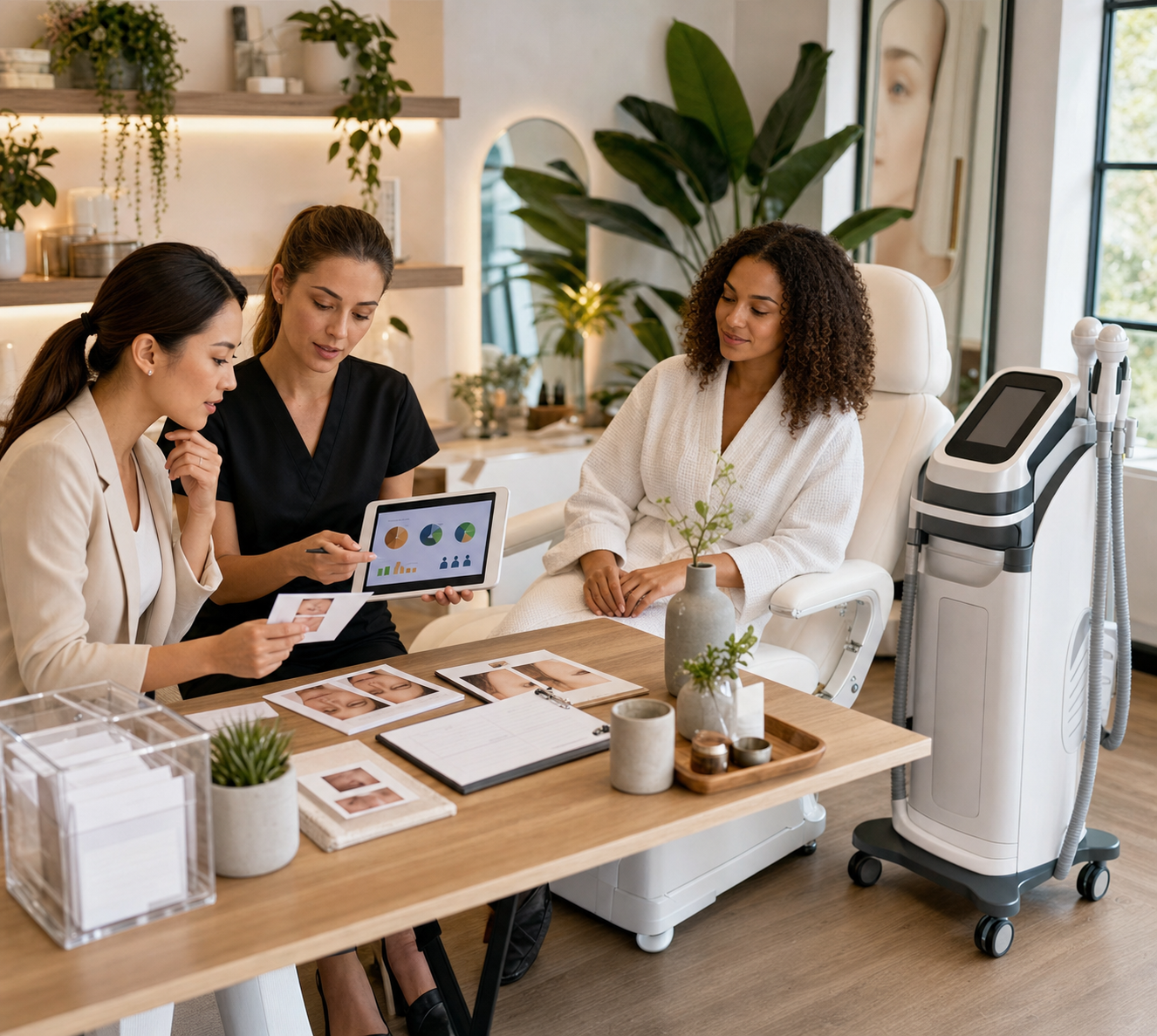
Consultation records are a powerful market research tool. They reveal what clients worry about before a salon tries to sell a new project.
The salon should collect questions such as:
- Can this improve fine lines?
- Can this help sagging skin?
- Is this painful?
- Ci sono tempi di inattività?
- Di quante sedute ho bisogno?
- Is this suitable for sensitive skin?
- How soon can I see changes?
- È sicuro?
- How much does it cost?
- Is it different from normal facial care?
If many clients already ask about the same concern, the salon has a clearer market opportunity. If clients rarely mention the problem, the salon may need more education before launching the project.
3. Match Equipment With Local Customer Pain Points
Local customer acceptance depends on whether the treatment solves a problem people already care about.
Common pain points include:
- Acne-prone skin and clogged pores.
- Dehydration and dullness.
- Fine lines and early aging.
- Facial sagging and loss of firmness.
- Pigmentation and uneven skin tone.
- Enlarged pores and rough texture.
- Peli superflui.
- Body shape and localized fat concerns.
- Postpartum body recovery.
- Sensitive or stressed skin.
Different areas have different demand. Office districts may have more demand for quick skin refreshment, hydration, and anti-fatigue care. Residential areas may prefer repeat maintenance packages. High-income areas may accept premium anti-aging and body management projects. Student areas may prefer entry-level cleansing, acne-prone skin care, and affordable skin management.
4. Segment Customers Before Judging Acceptance
A salon should not ask whether “local customers” accept equipment projects in general. It should ask which customer segment accepts which project at what price.
Useful segments include:
- Fascia d'età.
- Gender.
- Livello di reddito.
- Frequenza di spesa.
- Principale problema cutaneo o del corpo.
- Existing membership status.
- Past treatment history.
- Sensibilità al prezzo.
- Interesse per i risultati visibili.
- Fiducia nei trattamenti basati sulla tecnologia.
For example, customers aged 25 to 35 may accept skin analysis, LED, hydration, and early anti-aging projects. Customers aged 35 to 55 may accept RF, microcurrent, lifting, firming, and body contouring projects if the salon explains the course value. Younger customers may accept small bubble, hydro facial, oxygen infusion, and basic skin management more easily.
5. Research Local Competitors
Competitor research helps salons see whether the local market has already accepted similar projects.
Il salone dovrebbe controllare:
- Which nearby salons, spas, clinics, and med spas offer equipment-based treatments.
- Which device categories they promote.
- Che prezzi praticano.
- Whether they sell single sessions or packages.
- Quali nomi di trattamenti utilizzano.
- Cosa dicono le recensioni dei clienti.
- Whether customers mention results, comfort, service, or price.
- Whether competitors are discounting heavily.
- Whether the market looks crowded or underdeveloped.
If competitors sell similar projects at stable prices and have positive customer reviews, acceptance may already exist. If competitors constantly discount, close projects quickly, or receive complaints, the salon should investigate carefully.
Competitor research should not lead to blind copying. The goal is to understand what customers already accept and where the salon can differentiate.
6. Test Customer Understanding
A project is easier to sell when customers can understand it quickly. If the salon needs a long explanation every time, acceptance may be slower.
The salon can test different ways to explain the treatment:
- “Deep cleansing and pore management.”
- “Hydration and glow care.”
- “Early anti-aging maintenance.”
- “Firming and facial contour support.”
- “Skin analysis plus customized repair.”
- “Body contour management.”
- “Postpartum body recovery support.”
Staff can observe which descriptions customers understand fastest. If customers immediately connect the project with their own concern, acceptance is stronger.
7. Run A Simple Client Survey
A short survey can help the salon measure interest before buying equipment. The survey should be direct and practical.
Tra le domande utili figurano:
- Which skin or body concern do you most want to improve?
- Have you tried beauty equipment treatments before?
- Which result interests you most?
- Quale fascia di prezzo ritieni accettabile per una singola seduta?
- Would you prefer a trial, single session, or course package?
- What would make you trust this project?
- Quali preoccupazioni ti impedirebbero di provarlo?
- Would you book a trial if the salon launched this service?
The salon should not only count positive answers. It should look at the strength of the response. A customer who says “maybe” is not the same as a customer who asks for a launch date or deposits for a trial.
8. Test Price Acceptance Before Buying
Many equipment projects fail because customers like the idea but do not accept the price. Price testing should happen before purchase.
The salon can test:
- Prezzo per singola seduta.
- Prezzo del pacchetto del corso.
- Prezzo riservato ai soci.
- Prezzo di prova.
- Upgrade price from an existing facial.
- Prezzo speciale per l'acquisto in bundle con prodotti per la cura della pelle.
- Add-on price inside a facial or body treatment.
A useful method is to present two or three package options and see which one clients choose. For example:
- Basic trial: one session at an entry price.
- Standard course: six sessions with progress tracking.
- Premium plan: skin analysis, equipment treatment, products, and follow-up.
If customers only choose the cheapest option and reject packages, the salon may need to adjust project positioning, treatment proof, or target audience.
9. Use Trial Campaigns To Measure Real Behavior
A trial campaign is one of the best ways to test acceptance. It moves customers from opinion to action.
The salon can run a small campaign with:
- VIP clients.
- Existing members.
- Customers who already buy related services.
- Staff models.
- A limited number of trial slots.
- A clear follow-up offer.
- Consultation before and after the treatment.
Important indicators include:
- How many customers book the trial.
- How many show up.
- How many ask questions after treatment.
- How many buy a package.
- How many rebook.
- What objections appear most often.
- Whether staff can explain the project smoothly.
A trial campaign does not need to be large. Even 20 to 50 targeted customers can provide useful evidence.
10. Measure Pre-Sale Willingness
Pre-sales are stronger than surveys because they show whether customers will pay before the project fully launches.
The salon can test:
- Small deposits for launch slots.
- VIP early-bird packages.
- Limited course pre-orders.
- Membership upgrades.
- Trial vouchers.
- Add-on upgrades to existing appointments.
If customers are willing to pay a deposit or reserve sessions, acceptance is much stronger. If they only say they are interested but do not commit, the salon should be cautious.
11. Observe Upgrade Behavior
A salon can judge acceptance by checking whether customers upgrade from manual treatments to equipment-assisted treatments.
Useful signs include:
- Customers accept a machine add-on during a facial.
- Customers ask to repeat the instrument step next time.
- Customers compare visible or measurable improvement.
- Customers are willing to pay more for a more complete treatment.
- Customers buy a course after trying an upgrade once.
This is especially useful for salons that already offer basic facials. Instead of launching a completely new project, the salon can test equipment as an upgrade inside an existing service.
12. Use Skin Analysis To Improve Acceptance
Skin analysis equipment can help customers accept other equipment projects because it makes invisible problems visible.
For example, a skin analyzer may help show:
- Hydration level.
- Oil distribution.
- Pore condition.
- Pigmentation risk.
- Texture.
- Redness.
- Linee sottili.
- Skin age indicators.
When customers see data, photos, or progress records, they may better understand why an equipment-based project is recommended. This can improve consultation trust and package conversion.
However, salons should avoid overclaiming what skin analysis can prove. The tool should support consultation, not replace professional judgment or create exaggerated promises.
13. Check Local Search And Social Media Interest
Online behavior can provide early signals of customer acceptance.
The salon can observe:
- Local searches for facial lifting, RF facial, hydro facial, hair removal, body contouring, skin analysis, or LED therapy.
- Social media comments on similar treatments.
- Questions in local community groups.
- Engagement on competitor posts.
- Reviews mentioning equipment-based treatments.
- Popular treatment names in the area.
- Influencer or lifestyle content related to the category.
High online interest does not guarantee purchase, but it shows that customers may already understand the category. Low online interest means the salon may need more education and stronger consultation.
14. Ask Staff For Sales Feedback
Front-line staff often know customer acceptance earlier than the owner because they hear objections directly.
The salon should ask staff:
- Which customer concerns appear most often?
- Which treatment explanations customers understand fastest?
- Which price points create hesitation?
- Which customer groups are most interested?
- What objections stop customers from booking?
- Are staff confident recommending the project?
- Do staff believe the device fits the salon’s customer base?
If staff cannot explain the treatment clearly, acceptance will be lower. Before judging the market, the salon should also judge its own consultation ability.
15. Evaluate Repeat Purchase Potential
The strongest sign of acceptance is not the first booking. It is repeat purchase.
The salon should track:
- Rebooking rate after the first session.
- Package conversion rate.
- Tasso di completamento del corso.
- Customer feedback after each session.
- Maintenance booking rate.
- Tasso di segnalazione.
- Complaint rate.
- Refund or cancellation rate.
Some projects create strong first-time curiosity but weak repeat sales. Other projects may grow more slowly but generate stable course purchases. Salons should prefer projects with repeat logic because equipment utilization and profitability depend on consistent use.
16. Compare Acceptance Across Equipment Categories
Different device categories have different acceptance barriers.
Hydro facial and small bubble devices often have lower acceptance barriers because customers understand cleansing and hydration easily.
Skin analysis equipment may be accepted because it supports consultation, but it may not directly generate high service revenue unless connected to packages.
LED light therapy may be accepted when positioned as part of skin management, calming, or recovery support, but claims should stay within the device’s intended use and local rules.
RF and microcurrent equipment may support higher-value anti-aging projects, but customers need more education about course frequency and realistic results.
Hair removal devices may have broad demand in many markets, but competition and pricing pressure can be strong.
Body contouring equipment may attract attention, but customers may ask for visible results, proof, and strong package value.
Private care or postpartum recovery equipment may have specific demand, but acceptance depends heavily on privacy, trust, local culture, and staff training.
17. Watch For Red Flags
Local customers may not be ready for a project if the salon sees several warning signs.
Red flags include:
- Customers say the idea is interesting but refuse trials.
- Le prenotazioni di prova sono numerose, ma il tasso di conversione dei pacchetti è basso.
- Customers only accept very low prices.
- Staff cannot explain the project simply.
- Competitors are heavily discounting similar services.
- Customers worry about safety and do not trust the explanation.
- The project requires claims the salon cannot support.
- The treatment does not match the salon’s main customer age group.
- The expected ROI depends on unrealistic daily treatment volume.
- Customers do not rebook after the first session.
If these signs appear, the salon should adjust the project, pricing, supplier choice, or training before buying more equipment.
18. Build A Customer Acceptance Scorecard
Salons can use a simple scorecard to judge whether a project is ready to launch.
Aree di punteggio suggerite:
- Existing customer demand.
- Local competitor acceptance.
- Comprensione del cliente.
- Accettazione del prezzo.
- Tariffa per la prenotazione di prova.
- Package conversion rate.
- Potenziale di acquisti ripetuti.
- Fiducia del personale.
- Supplier training support.
- Conformità e chiarezza delle dichiarazioni.
- Fit with salon positioning.
- Fattibilità del ritorno sull'investimento (ROI).
Each area can be scored from 1 to 5. A project with high interest but low price acceptance should be treated carefully. A project with moderate interest but strong repeat purchase and good margins may be more valuable.
19. Decision Criteria Before Buying The Device
Before purchasing equipment, the salon should be able to answer these questions:
- Which customer segment will buy this project?
- What problem does the project solve?
- What price will customers accept?
- How many treatments per week are realistic?
- How many customers joined the trial or pre-sale?
- What percentage converted to packages?
- What objections appeared most often?
- Can staff explain and operate the project well?
- Can the salon make accurate and compliant claims?
- Does the supplier provide training and after-sales support?
- Can the project recover investment within a realistic period?
If the salon cannot answer these questions, it should continue testing before making a large purchase.
20. How Distributors Can Help Salons Judge Acceptance
Beauty equipment distributors can improve sales by helping salons test acceptance instead of only selling machines.
Il supporto utile include:
- Local market research templates.
- Customer survey forms.
- Piani per la campagna di prova.
- Esempi di pacchetti di trattamento.
- Price positioning guidance.
- Calcolatori del ROI.
- Script per le consultazioni con il personale.
- Training videos and manuals.
- Modelli di monitoraggio prima e dopo, ove opportuno.
- Compliance and claim guidance.
- After-sales support plans.
Distributors who help salons validate demand are more likely to build long-term customers because the salon sees the distributor as a business partner, not just a seller.
Conclusione
Beauty salons can judge whether local customers accept equipment-based treatments by combining customer data, consultation records, competitor research, price testing, surveys, trial campaigns, pre-sales, upgrade behavior, staff feedback, and repeat purchase tracking.
The key is to look for real behavior, not only verbal interest. Customers who book, pay, return, upgrade, and refer others show stronger acceptance than customers who only say the treatment sounds good.
For salons, the safest approach is to test acceptance before buying expensive equipment. When local demand, pricing, staff capability, supplier support, and compliance are clear, the equipment project has a much better chance of becoming a stable revenue source.
Domande frequenti
How can a beauty salon know if local customers accept equipment treatments?
A salon can judge acceptance by tracking consultation demand, customer surveys, trial bookings, package conversion, price acceptance, competitor activity, repeat purchase rate, and customer feedback after treatment.
Is customer interest enough to justify buying a beauty device?
No. Interest is only an early signal. Stronger evidence includes deposits, trial bookings, package purchases, rebookings, and repeat treatment behavior.
What is the best way to test a new equipment project?
The best method is a small pilot campaign with existing clients or VIP members. The salon should track trial booking rate, package conversion, objections, satisfaction, and rebooking.
Why is price testing important before buying beauty equipment?
Price testing shows whether customers accept the project’s real commercial value. A treatment may be attractive, but it may not be profitable if customers only buy it at a deep discount.
What signs show that a local market is not ready for an equipment project?
Warning signs include low trial participation, weak package conversion, strong price resistance, customer safety concerns, heavy competitor discounting, poor staff confidence, and low repeat booking after the first session.