









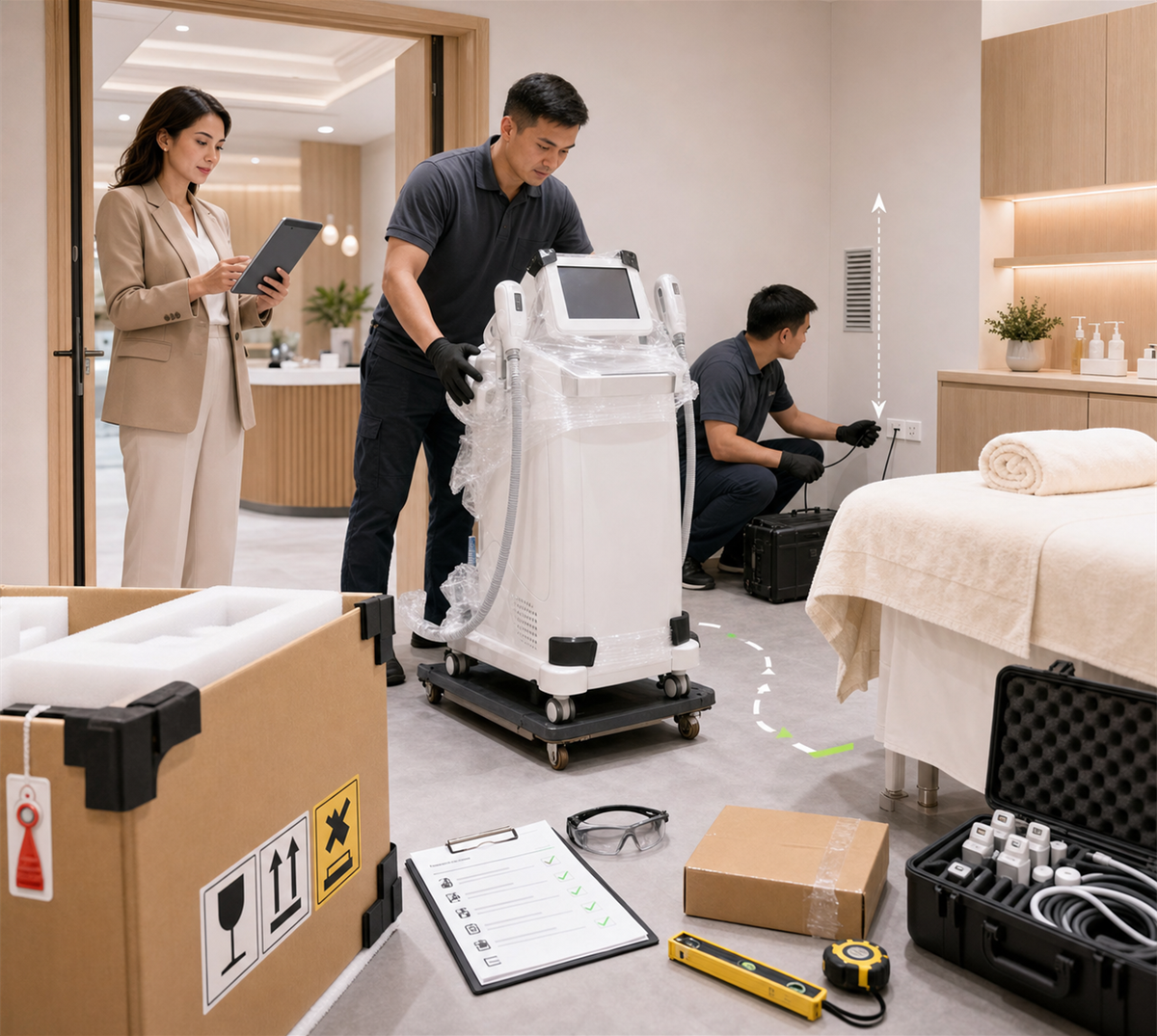
Beauty equipment transportation and installation should be managed carefully because many after-sales problems start before the machine is ever used. A machine may be damaged during shipping, arrive with missing accessories, use the wrong voltage, be installed in a room with poor ventilation, or be put into service before staff understand the startup, cleaning, and maintenance process.
For beauty salons, transportation and installation affect safety, treatment quality, warranty rights, customer appointments, and return on investment. For distributors and manufacturers, a clear delivery and installation process reduces disputes, repair claims, and customer complaints.
The key rule is simple: do not treat delivery as the end of purchase. Delivery is only the beginning of acceptance, installation, training, and trial operation.
Short Answer: Check Before Shipping, Inspect On Arrival, Install By The Manual
Beauty salons should pay attention to three stages.
Before shipping: Confirm model, configuration, voltage, plug, language, accessories, consumables, packing method, insurance, delivery address, shipping term, and inspection documents.
During delivery and arrival: Check the outer package, take photos and videos, inspect damage, verify accessories, record missing parts, and report transport damage within the required time.
During installation: Prepare proper space, power, grounding, ventilation, water or drainage if needed, stable internet if software is used, cleaning supplies, storage area, staff training, and final test run.
If these steps are skipped, the salon may face delivery disputes, warranty problems, downtime, wrong operation, or customer complaints.
1. Confirm The Machine Before Shipping
Before the supplier ships the machine, the buyer should confirm the exact order details. This prevents wrong model, missing handles, wrong plug, or wrong software version.
The pre-shipment confirmation should include:
- Machine model and version.
- Color and appearance if customized.
- Tension et type de prise.
- Interface linguistique.
- Software version and account information if applicable.
- Main unit quantity.
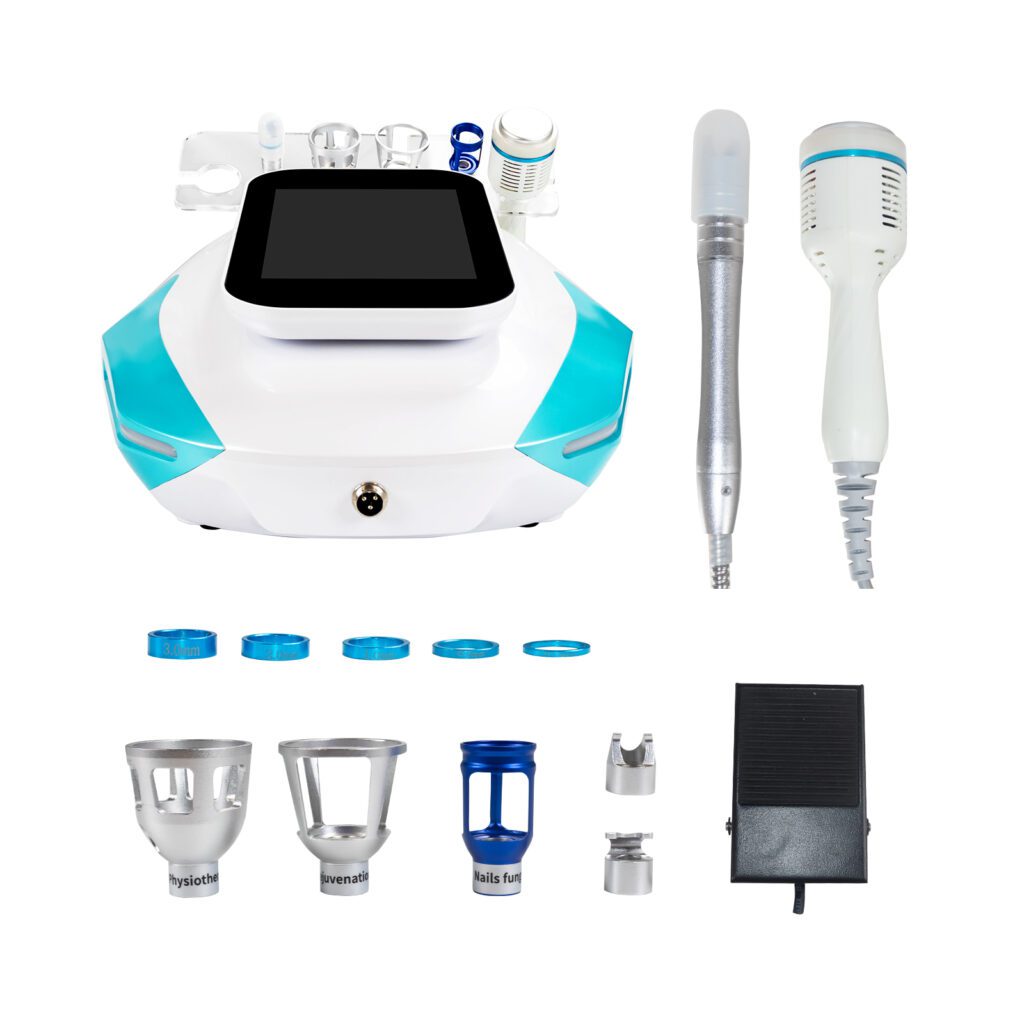
- Handpieces, probes, cartridges, lamps, and accessories.
- Starter consumables.
- Power cord, foot switch, goggles, covers, tips, tubes, filters, bottles, and tool kits.
- User manual, quick start guide, and training materials.
- Carte de garantie.
- Liste de colisage.
- Photo du numéro de série.
For OEM or ODM orders, confirm logo, packaging, labels, manual language, screen logo, and software language before shipment. If the buyer approves only the appearance but forgets voltage, plug, accessories, or manual version, problems may appear after arrival.
2. Request Pre-Shipment Testing
For high-value machines or cross-border orders, pre-shipment testing is useful. The supplier can send photos or videos showing the machine powers on, each handle connects, the screen works, the language is correct, and accessories are packed.
Useful pre-shipment evidence includes:
- Startup video.
- Function test video.
- Handle recognition video.
- Screen language photo.
- Photo du numéro de série.
- Accessory and packing list photo.
- Outer package photo.
- Wooden crate or carton photo.
- Quality inspection record.
Pre-shipment testing does not replace arrival inspection, but it reduces the chance of receiving the wrong configuration.
3. Pay Attention To Packaging
Beauty equipment can include screens, glass, optical windows, handpieces, cooling parts, pumps, tubes, circuit boards, cameras, and fragile plastic shells. Packaging should match the machine value and shipping distance.
Un bon emballage peut comprendre :
- Strong carton or wooden crate for heavy machines.
- Foam protection around the main unit.
- Separate protection for handpieces and probes.
- Cable protection.
- Moisture protection.
- Shock protection.
- Fragile labels.
- Upright direction marks.
- Accessory compartment.
- Packing list inside the box.
For large or high-value machines, buyers should ask whether reinforced packaging or wooden crate packaging is included. If the supplier ships a heavy machine in weak packaging, transport damage risk increases.
4. Clarify Shipping Terms, Insurance, And Risk
Transportation disputes often happen because the buyer and supplier do not define who is responsible at each step. For international transactions, trade terms such as EXW, FOB, CIF, DAP, or DDP affect cost and risk responsibilities. Buyers should understand the agreed term and location.
The contract or order should define:
- Who arranges shipping.
- Who pays freight.
- Who pays insurance.
- Who handles customs clearance.
- Who pays duties and taxes.
- When risk transfers from supplier to buyer.
- Who handles damage claims.
- What documents are required.
- What the buyer must do if damage is found.
Insurance is especially important for high-value equipment. If the package is damaged or the machine is lost, insurance and shipping evidence may determine whether the loss can be recovered.
5. Prepare The Salon Before The Machine Arrives
Installation should not start after the delivery driver is waiting at the door. The salon should prepare the site before arrival.
Check the treatment room:
- Enough floor space.
- Enough doorway and corridor width for the package.
- Treatment bed or chair position.
- Staff movement space.
- Confidentialité des clients.
- Power outlet location.
- Stable power supply.
- Ventilation.
- Temperature and humidity control.
- Clean storage area for accessories.
- Water supply or drainage if required.
- Internet connection if software is used.
- Safe place for packaging until acceptance is complete.
If the machine is heavy, arrange enough people or proper handling tools. Do not ask one staff member to move a large machine alone.
6. Inspect The Package Before Signing
When the machine arrives, staff should inspect the outer package before signing or accepting delivery if possible. This is important for shipping damage claims.
Vérifier:
- Is the carton or crate broken?
- Is there water damage?
- Are corners crushed?
- Is the package tilted or upside down?
- Are seals broken?
- Are there holes, dents, or impact marks?
- Is the number of packages correct?
- Does the shipping label match the order?
Take photos and videos before opening. If the package is visibly damaged, record it on the delivery receipt if possible and notify the supplier immediately. Do not throw away the packaging before the machine is fully checked.
7. Unpack Carefully And Keep Evidence
Unpacking should be slow and documented. Staff should avoid cutting too deep with knives because cables, tubes, accessories, and soft packing may be close to the carton surface.
During unpacking:
- Record a short unboxing video.
- Photograph the packing condition.
- Check the packing list.
- Place accessories on a clean table.
- Confirm each handpiece and probe.
- Check for cracks, dents, scratches, loose parts, broken screen, or leaking fluid.
- Keep foam, carton, crate, and labels until acceptance is complete.
If something is missing or damaged, report it quickly with photos, videos, and packing list references.
8. Check Accessories Before Powering On
Do not plug in the machine immediately just because it looks fine. First verify that the machine and accessories match the order.
Vérifier:
- Main unit model.
- Numéro de série.
- Tension et prise.
- Power cord.
- Pièces à main et sondes.
- Filters, tubes, bottles, seals, tips, cartridges, lamps, pads, covers, or membranes.
- Protective goggles if required.
- Manuel d'utilisation.
- Carte de garantie.
- Matériel de formation.
- Software license or account information.
If the voltage or plug does not match the salon environment, do not use random adapters without supplier approval. Wrong voltage can damage the machine and may affect warranty.
9. Power And Electrical Safety Are Critical
Beauty equipment may include motors, pumps, compressors, heating parts, cooling systems, RF generators, IPL power supplies, laser modules, screens, and software systems. Power setup must be stable and suitable.
Before installation, confirm:
- Required voltage.
- Frequency.
- Type de prise.
- Rated power.
- Whether a dedicated circuit is recommended.
- Grounding requirements.
- Surge protection needs.
- Whether an extension cord is allowed.
- Whether the room has wet conditions.
- Whether the outlet is overloaded.
Avoid using damaged cords, loose outlets, unstable adapters, or overloaded power strips. If the machine is high-power or the salon is unsure about the electrical system, a qualified electrician should check the site.
10. Water, Cooling, Drainage, And Ventilation
Some beauty machines need water, cooling, drainage, airflow, or temperature control. Poor setup can cause overheating, weak output, leakage, odor, or machine alarms.
Check the manual for:
- Water type if required.
- Water level.
- Cooling liquid requirements.
- Filter condition.
- Drainage method.
- Waste bottle capacity.
- Tube connection.
- Fan clearance.
- Ventilation distance.
- Room temperature limits.
- Humidity limits.
- Dust control.
IPL, laser, cryolipolysis, RF, hydro facial, small bubble, oxygen, and body contouring machines may have different requirements. Do not block air outlets or place the machine against a wall if ventilation space is required.
11. Cleaning And Disinfection Setup
Before the first customer treatment, the salon should set up cleaning and disinfection procedures. New equipment can collect dust during shipping, and reusable accessories need proper handling before and after use.
Préparer:
- Cleaning cloths.
- Approved cleaning agents.
- Disinfectant compatible with the device.
- Disposable covers.
- Waste container.
- Clean storage trays.
- Gloves if needed.
- Labels for opened liquids.
- Journal de nettoyage.
The salon should follow the manufacturer manual for cleaning and disinfection. Do not soak probes, spray directly into screens or connectors, or use harsh chemicals unless the supplier confirms compatibility.
12. Software, Network, And Data Setup
Many modern beauty devices use software, apps, cloud accounts, skin analysis reports, customer files, or online updates. These should be installed and tested before the salon promotes the project.
Vérifier:
- Account registration.
- Password and login.
- Language setting.
- Version du logiciel.
- Report export.
- Printer or tablet connection if needed.
- Camera or lighting setup for skin analyzer.
- Network stability.
- Data backup.
- Subscription status.
- Remote support access policy.
For skin analyzers, test the full process: customer file creation, image capture, report generation, report export, and before-and-after comparison.
13. Category-Specific Installation Notes
Different beauty equipment categories require different installation attention.
Petites machines à bulles et hydrofaciales
Check tubes, bottles, filters, solution containers, waste bottle sealing, suction strength, drainage, and cleaning process. Weak suction is often caused by loose tubes, blocked filters, or poor bottle sealing.
Équipements RF, EMS et à ultrasons
Check handle recognition, probe surface, cables, grounding if required, conductive gel, normal output feeling, and parameter range. Train staff to identify abnormal heat, poor contact, loose cable, or damaged coating.
IPL And Laser Machines
Check cooling system, water level if applicable, optical window, handpiece cable, shot count, goggles, warning labels, ventilation, and room control. Do not use if cooling alarms, abnormal heat, cracked housing, or unstable output appears.
Machines HIFU
Check cartridge recognition, line count, handle connection, cartridge surface, software settings, and treatment depth selection. Do not continue using cartridges beyond their rated count.
Machines de cryolipolyse et de remodelage corporel
Check applicators, membranes, vacuum sealing, cooling temperature, sensor alarms, tube connections, filters, and emergency stop if included. Applicators should be stored safely because dropping them can be expensive.
Appareils de luminothérapie LED
Check panel stability, light uniformity, power adapter, stands, hinges, eye shields, and protective covers. Make sure the customer position is comfortable and the device does not tip or wobble.
Analyseurs de peau
Check lighting, camera focus, chin rest, forehead support, software language, customer report, photo angle, and data export. The room should avoid unstable lighting if the analyzer depends on consistent images.
14. First Test Run Should Be Done Before Customer Use
After installation, perform a test run before scheduling customer treatments.
The test run should confirm:
- Machine starts normally.
- Screen and buttons work.
- All handles connect.
- Each main function can be activated.
- No error code appears.
- Cooling, suction, heat, light, current, or vibration feels normal.
- Tubes and bottles do not leak.
- Noise level is acceptable.
- Software works.
- Staff understand basic operation.
- Cleaning steps are clear.
For higher-energy devices, the first test should be guided by the supplier, distributor, or trained technician. Do not use real customers until staff understand suitability screening, normal sensations, stop-use conditions, and aftercare.
15. Acceptance Should Be Written
Installation should end with a written acceptance record. This protects both buyer and supplier.
The acceptance record can include:
- La date de livraison.
- Date d'installation.
- Machine model and serial number.
- Accessories received.
- Damages or missing items.
- Software account status.
- Training completed.
- Test run result.
- Problems found.
- Supplier follow-up actions.
- Buyer signature or confirmation.
If the machine has a problem, do not sign full acceptance without noting it. Write the issue clearly and agree on the next action.
16. Training Must Be Part Of Installation
Installation is incomplete if staff do not know how to use the machine. Training should be included during or soon after setup.
La formation devrait couvrir :
- Startup and shutdown.
- Étapes du traitement.
- Parameter setting.
- Customer suitability.
- Contraindications and precautions.
- Normal and abnormal sensations.
- Nettoyage et désinfection.
- Pièce de rechange consommable.
- Programme de maintenance.
- Dépannage.
- Warranty contact.
- Service record process.
The salon should record who was trained and keep videos or manuals for future staff. If the supplier only installs the machine but provides no training, the project may still fail.
17. Keep Documents And Packaging
After installation, keep important documents in one folder.
Keep:
- Contract or invoice.
- Carte de garantie.
- Manuel d'utilisation.
- Guide de démarrage rapide.
- Liste de colisage.
- Photo du numéro de série.
- Training files.
- Guide de nettoyage et d'entretien.
- Liste des pièces détachées.
- Liste de prix des consommables.
- Installation record.
- Acceptance record.
- Shipping damage evidence if any.
Keep packaging at least until acceptance and first test run are complete. Some suppliers may require original packaging for return or repair shipment.
18. What To Do If Transport Damage Is Found
If the machine is damaged during transport, act quickly.
Mesures:
- Stop unpacking if serious damage is visible.
- Take photos and videos of the package before and after opening.
- Keep carton, crate, foam, labels, and seals.
- Record package count and visible damage.
- Do not attempt repair without supplier approval.
- Notify the supplier and carrier immediately.
- Submit damage evidence within the required time.
- Ask whether the issue is transport claim, replacement, repair, or missing part shipment.
- Confirm who pays return freight.
Late reporting may make shipping claims harder. This is why arrival inspection should happen as soon as possible.
19. Common Installation Mistakes To Avoid
Avoid these common mistakes:
- Powering on before checking voltage.
- Throwing away packaging before acceptance.
- Signing delivery without noting visible damage.
- Using random plug adapters.
- Placing the machine in a narrow, hot, humid, or dusty area.
- Blocking ventilation outlets.
- Skipping water or cooling checks.
- Using the machine before training.
- Letting untrained staff operate high-energy devices.
- Mixing cleaning chemicals or using unsuitable disinfectants.
- Ignoring error codes during the first test run.
- Promoting treatments before test operation is complete.
Most of these mistakes are preventable with a simple checklist.
20. What Distributors Should Provide
Distributors can improve buyer confidence by providing a standard transportation and installation package.
L'assistance utile comprend :
- Pre-shipment checklist.
- Packing photo and video.
- Delivery inspection guide.
- Installation checklist.
- Vidéo de déballage.
- Power and site preparation guide.
- Training schedule.
- Acceptance form.
- Transport damage claim guide.
- Spare parts and consumable list.
- Liste de contrôle pour la maintenance.
- Remote support contact.
When distributors provide these materials, customers feel the product is easier to manage and after-sales disputes are reduced.
21. What Manufacturers Should Provide
Manufacturers should design machines and documents for easier delivery and installation.
Useful manufacturer support includes:
- Strong packaging.
- Clear outer labels.
- Suivi des numéros de série.
- Liste de colisage.
- Installation manual.
- Guide de démarrage rapide.
- Power requirement label.
- Accessory diagrams.
- Instructions de nettoyage et d'entretien.
- Guide des codes d'erreur.
- Software setup guide.
- Vidéos de formation.
- Politique de garantie.
- Service request process.
The better the installation documentation, the less pressure on the after-sales team.
FAQ
Should beauty salons inspect the package before signing delivery?
Yes. Salons should inspect the outer package, take photos or videos, record visible damage if possible, and keep packaging until the machine has passed acceptance and test run.
Can a salon install beauty equipment by itself?
Some simple machines can be installed by salon staff with video guidance. High-value, heavy, water-based, cooling-based, IPL, laser, HIFU, cryolipolysis, or complex systems may need supplier guidance, distributor installation, or a qualified technician.
What should be checked before powering on a beauty machine?
Check model, serial number, voltage, plug, power cord, accessories, handpieces, tubes, filters, bottles, software, and visible damage. Do not power on if voltage is wrong, the package is seriously damaged, or cables are cracked.
Who is responsible if the machine is damaged during transport?
Responsibility depends on shipping terms, insurance, risk transfer, carrier rules, and damage reporting evidence. The purchase contract should define this before shipment.
What should installation acceptance include?
It should include model, serial number, accessory list, damage check, software setup, test run result, staff training, problems found, supplier follow-up, and buyer confirmation.
Conclusion
Beauty equipment transportation and installation should be managed as a formal process. Before shipping, confirm model, configuration, packaging, insurance, delivery terms, and pre-shipment testing. On arrival, inspect the package, record evidence, check accessories, and report damage quickly. During installation, prepare power, space, ventilation, water or cooling needs, software, cleaning materials, staff training, and final test run.
For salons, careful transportation and installation protect warranty rights, reduce downtime, and support a smooth project launch. For distributors and manufacturers, clear delivery and installation systems reduce disputes and make the equipment easier to sell and support long term.