Résumé exécutif
Les distributeurs de matériel de beauté peuvent calculer le délai d'amortissement d'une machine en comparant son coût total d'investissement au flux de trésorerie net mensuel généré. La formule la plus simple est :
Délai de récupération en mois = Coût total de l'investissement / Apport mensuel net
Pour les ventes en salon, les distributeurs doivent également calculer le seuil de rentabilité en nombre de séances de traitement :
Nombre de séances rentables = Coût total de l'investissement / Contribution nette par traitement
Alors:
Délai d'amortissement en mois = Nombre de séances à l'équilibre / Nombre de séances de traitement mensuelles prévues
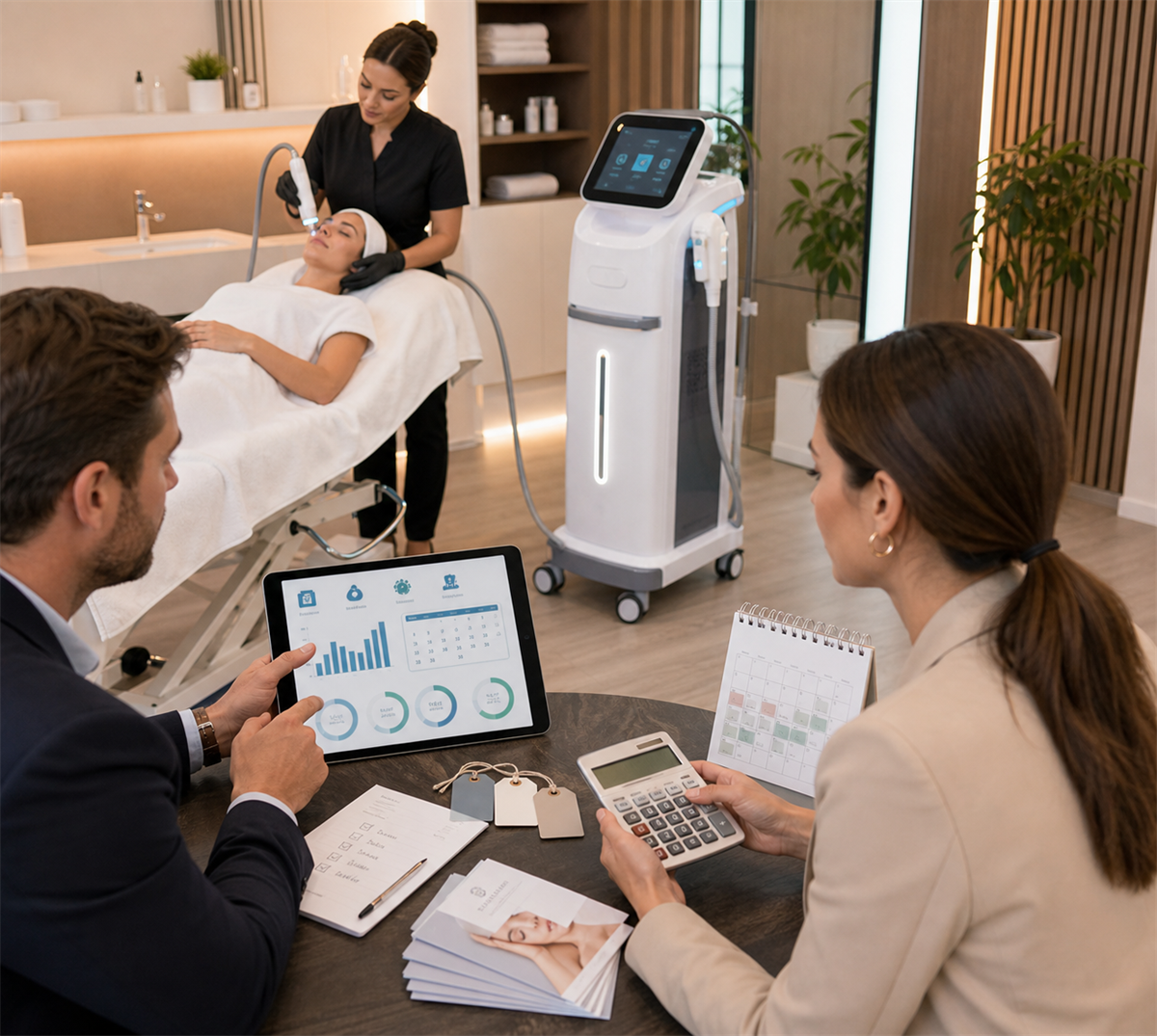
Ce calcul permet aux distributeurs d'expliquer si une machine est adaptée au budget, à la fréquentation, aux tarifs des prestations, à la fréquence des traitements, au coût des consommables, aux charges de personnel et à l'offre du salon. Une machine de haute technologie peut s'avérer difficile à vendre si le salon ne peut pas amortir son investissement dans un délai raisonnable. À l'inverse, une machine moins chère peut ne pas être intéressante si le prix des traitements et la demande sont trop faibles.
Le calcul du retour sur investissement ne doit pas se fonder uniquement sur des prévisions de ventes optimistes. Il doit prendre en compte le coût de la machine, le transport, les taxes, l'installation, la formation, les consommables de démarrage, les frais de lancement marketing, la provision pour garantie, la provision pour maintenance, les frais de paiement, les coûts de personnel, les consommables, le taux d'utilisation prévu et la demande réaliste des clients du salon.
Le principe de base est simple : ne calculez pas le retour sur investissement uniquement à partir du chiffre d’affaires. Calculez-le à partir de la marge sur coûts variables nette.
1. Pourquoi la période de retour sur investissement est importante dans la vente d'équipements de beauté
Avant d'acheter une machine, les propriétaires de salons de beauté se posent généralement une question pratique : “ Combien de temps faudra-t-il pour rentabiliser l'investissement ? ”
Les distributeurs capables de répondre à cette question par des chiffres sont plus convaincants que ceux qui ne parlent que de technologie, d'apparence ou de tendances.
La période de retour sur investissement est utile :
- Évaluer si une machine vaut la peine d'être achetée
- Comparer différents modèles
- Choisissez la bonne tranche de prix
- Expliquer le retour sur investissement d'un salon
- forfaits de traitement de conception
- Fixer le prix du service
- Estimer la demande mensuelle
- Évitez de surstocker les machines coûteuses.
- Réduire les objections des clients
- Améliorer le taux de conversion des ventes
Pour les distributeurs, le calcul du retour sur investissement est à la fois un outil de vente et un outil de contrôle des risques.
2. La période de récupération n'est pas la même chose que la marge bénéficiaire.
Réponses concernant le délai de récupération : combien de temps faut-il pour que la machine permette de récupérer l’investissement ?
Réponses concernant la marge bénéficiaire : quel est le montant du profit réalisé sur chaque service ou vente ?
Une machine peut présenter une marge de traitement élevée, mais un retour sur investissement lent si son coût d'achat est important ou si le volume de clients est faible. À l'inverse, une machine peut avoir un prix d'entretien plus bas, mais un retour sur investissement rapide si elle est utilisée fréquemment.
Par exemple:
- Un appareil d'hydromassage peut avoir un prix d'entretien modéré mais une fréquence de traitement élevée.
- Une machine anti-âge à radiofréquence peut avoir un prix de service plus élevé mais un cycle de décision plus long.
- Une machine de remodelage corporel peut avoir un potentiel de vente élevé, mais elle nécessite plus d'espace, de formation et de confiance de la part des clients.
- Un analyseur de peau ne génère peut-être pas directement de revenus liés aux traitements, mais il peut améliorer les consultations et contribuer à la vente d'autres produits.
Les distributeurs doivent calculer le retour sur investissement en fonction du rôle commercial réel de la machine.
3. La formule de base du retour sur investissement
La formule de base est :
Délai de récupération = Coût total de l'investissement / Apport mensuel net en espèces
Où:
- Le coût total d'investissement correspond à l'ensemble des sommes nécessaires pour rendre la machine opérationnelle.
- La contribution nette mensuelle en trésorerie correspond aux revenus mensuels générés par la machine moins les coûts variables et les coûts d'exploitation directs.
Si une machine coûte 6 000 USD au total et génère un flux de trésorerie net de 2 000 USD par mois, la période de récupération est de :
6 000 USD / 2 000 USD = 3 mois
Il s'agit d'un calcul de retour sur investissement simplifié. Il ne tient pas compte du traitement fiscal, de la comptabilisation des amortissements, de la structure de financement ni du coût d'opportunité, sauf si le distributeur les ajoute.
4. La formule du traitement à seuil de rentabilité
Le calculateur de seuil de rentabilité de la Small Business Administration (SBA) américaine utilise la formule suivante :
Coûts fixes / (Prix – Coûts variables) = Seuil de rentabilité en unités
Pour les appareils de beauté, l“” unité » peut correspondre à une séance de traitement.
Version équipement de beauté :
Nombre de séances rentables = Coût total de l'investissement / Contribution nette par traitement
Contribution nette par traitement = Prix du service par traitement – Coût variable par traitement
Si l'investissement total est de 6 000 USD et que chaque traitement rapporte 50 USD après déduction des consommables et des coûts directs, la machine a besoin de :
6 000 USD / 50 USD = 120 séances pour atteindre le seuil de rentabilité
Si le salon peut réaliser 40 séances par mois, la période de retour sur investissement est de :
120 séances / 40 séances par mois = 3 mois
C'est l'une des manières les plus claires d'expliquer le principe de retour sur investissement aux propriétaires de salons de coiffure.
5. Étape 1 : Calculer le coût total de l'investissement
Ne vous basez pas uniquement sur le prix de la machine. L'investissement réel comprend tout ce qui est nécessaire au lancement et à l'exploitation du projet.
L'investissement total peut comprendre :
- prix d'achat de la machine
- Fret
- Droits d'importation
- Impôt
- Frais de courtier en douane
- Assurance
- coût d'installation
- coût de la formation
- consommables de démarrage
- Accessoires
- kit de démarrage de pièces détachées
- coût de lancement marketing
- Aménagement de la chambre
- Installation électrique
- Temps de formation du personnel
- Réserve de garantie
- Réserve d'entretien
- Frais de financement
- Frais de plateforme de paiement, le cas échéant
Pour un retour sur investissement axé sur les salons de coiffure, le distributeur doit présenter à la fois l'investissement de base et l'investissement total de lancement.
6. Étape 2 : Calculer le prix du service par traitement
Le prix du service doit refléter la réalité du marché local.
Recherche:
- Prix des services concurrents
- Positionnement du salon
- niveau de revenu du client
- Durée du traitement
- Coût des consommables
- niveau de compétence du personnel
- Valeur du projet
- Consentement des clients à payer
- Prix du forfait
- Demande saisonnière
Les recommandations de la SBA en matière d'études de marché soulignent la nécessité de comprendre les clients, la demande, les coûts et le positionnement concurrentiel avant de prendre des décisions concernant les prix.
Le distributeur ne doit pas fixer un prix de traitement élevé uniquement pour donner l'illusion d'un retour sur investissement rapide. Si le prix est irréaliste, le calcul n'a aucun sens.
7. Étape 3 : Calcul du coût variable par traitement
Le coût variable change avec chaque traitement.
Pour les projets d'équipement de beauté, les coûts variables peuvent inclure :
- Sérum
- Gel
- Conseils de traitement
- Filtres
- Couvertures jetables
- Masques
- Cartouches
- solution de nettoyage
- Accessoires de protection
- Commission du personnel
- Répartition directe du travail
- frais de traitement des paiements
- frais de blanchisserie ou d'hygiène
- consommables de remplacement
Le coût variable doit être calculé par traitement et non estimé.
Exemple:
- Prix du service : 80 USD
- Consommables : 10 USD
- Commissions du personnel ou main-d'œuvre directe : 18 USD
- Coût des produits jetables et du nettoyage : 2 USD
- Frais de paiement : 2 USD
Contribution nette par traitement :
80 USD – 10 USD – 18 USD – 2 USD – 2 USD = 48 USD
Ces 48 dollars américains correspondent au montant utilisé pour récupérer l'investissement dans la machine.
8. Étape 4 : Estimer le volume de traitement mensuel
Le volume mensuel de traitements représente souvent la plus grande incertitude.
Estimation basée sur :
- clientèle existante
- Fréquentation du salon
- Groupe d'âge des clients
- Horaire du personnel
- Durée du traitement
- Disponibilité des chambres
- plan marketing
- Demande saisonnière
- capacité de vente de colis
- Nombre d'opérateurs
- Répéter l'intervalle de traitement
- Compétition locale
N’utilisez pas la pleine capacité par défaut. Une machine peut être disponible huit heures par jour, mais cela ne signifie pas qu’elle sera réservée huit heures par jour.
Utilisez des scénarios conservateurs, normaux et optimistes.
9. Étape 5 : Calcul de la cotisation mensuelle nette
La contribution nette mensuelle est de :
Contribution nette par traitement x séances de traitement mensuelles
Exemple:
- Contribution nette par traitement : 48 USD
- Séances de traitement mensuelles : 45
Cotisation mensuelle nette :
48 USD x 45 = 2 160 USD
Si l'investissement total est de 6 500 USD :
Délai de récupération :
6 500 USD / 2 160 USD = environ 3 mois
Cela donne au salon une référence commerciale claire.
10. Utilisez trois scénarios
Les distributeurs ne doivent pas présenter un seul calcul optimiste.
Utilisez trois scénarios :
- Scénario prudent : volume de traitements et prix inférieurs.
- Scénario normal : volume et prix de marché réalistes.
- Scénario optimiste : ventes plus importantes, meilleure conversion des forfaits et taux d’utilisation plus élevé.
Exemple:
- Modèle conservateur : 25 séances par mois x contribution de 48 USD = 1 200 USD par mois. Retour sur investissement pour un investissement de 6 500 USD : 5,4 mois.
- Normalement : 45 séances par mois x 48 USD de contribution = 2 160 USD par mois. Retour sur investissement : 3 mois.
- Scénario optimiste : 70 séances par mois x contribution de 48 USD = 3 360 USD par mois. Retour sur investissement : 1,9 mois.
Cela permet aux salons de comprendre le risque au lieu de se fier à un seul chiffre parfait.
11. Inclure les ventes de forfaits
De nombreux salons de beauté proposent des forfaits ou des cures plutôt que des soins individuels.
Le calcul du forfait peut inclure :
- prix du traitement unique
- Prix du forfait
- Nombre de séances par forfait
- Rabais
- Coût des consommables par séance
- Expected number of packages sold monthly
- Customer renewal rate
Exemple:
- Package price: USD 480
- Sessions per package: 6
- Revenue per session: USD 80
- Variable cost per session: USD 32
- Contribution per session: USD 48
The package creates upfront cash flow, but the salon must still deliver all sessions. Distributors should not count the whole package payment as pure profit.
12. Include Consumables And Repeat Costs
Consumables affect payback heavily.
For example, two machines may both sell a treatment for USD 100, but one uses USD 8 in consumables and the other uses USD 28. The first machine may recover investment faster even if its purchase price is slightly higher.
Piste:
- Cost per tip
- Cost per filter
- Gel usage per session
- Serum usage per session
- Cartridge shots per treatment
- Lamp life
- Disposable items
- Cleaning materials
- pièces à main de rechange
If consumables are proprietary, the distributor should confirm long-term supply and price stability.
13. Include Staff Labor Or Commission
Some salons ignore staff cost in payback calculations. This makes the result too optimistic.
Staff cost can be calculated as:
- Fixed salary allocation
- Hourly wage x treatment time
- Commission per treatment
- Trainer cost
- Opportunity cost if staff could perform another service
If a treatment takes 60 minutes and occupies a room and operator, the salon must consider whether the service price is high enough.
14. Include Room And Time Utilization
A machine may not be profitable if it occupies a room for too long at a low service price.
Considérer:
- Durée du traitement
- Cleaning time
- Temps de consultation
- Customer changing time
- Room turnover
- Staff preparation
- Explication des soins de suivi
For example, a USD 60 treatment that takes 90 minutes may be less attractive than a USD 45 treatment that takes 30 minutes if demand is stable.
Distributors should calculate contribution per hour, not only contribution per treatment.
15. Calculate Contribution Per Hour
Formule:
Contribution per hour = Net contribution per treatment / Total service time in hours
Exemple:
- Contribution nette par traitement : 48 USD
- Total service time: 45 minutes, or 0.75 hours
Contribution per hour:
USD 48 / 0.75 = USD 64 per hour
This helps salons compare different projects.
16. Include Marketing Launch Cost
A new equipment project often needs promotion.
Marketing costs may include:
- Publicités sur les réseaux sociaux
- Short video production
- Launch poster
- Customer trial offer
- Salon event
- Influencer cooperation
- Staff commission incentive
- Introductory discount
- Online booking promotion
SBA marketing and sales guidance supports the idea that businesses should plan how they will reach customers and persuade them to buy. For beauty equipment ROI, launch marketing cost should be included in the first payback calculation.
17. Include Maintenance And Warranty Reserve
Even good machines may need maintenance.
Reserve should cover:
- remplacement de la pièce à main
- Câbles
- Pompes
- Filtres
- Écrans
- Service visit
- Freight for parts
- Assistance logicielle
- Annual maintenance
- Défauts consommables
- Service client
If the distributor is presenting ROI to a salon, it can include a monthly maintenance reserve to make the calculation more realistic.
18. Include Financing Cost If The Salon Pays In Installments
If the salon uses financing, leasing, or installment payment, cash payback should include financing cost.
Considérer:
- Down payment
- Monthly installment
- Interest or finance charge
- Term length
- Early repayment fee
- Ownership at end of term
- Required insurance
For financed equipment, there are two views:
- Investment payback: based on full equipment cost.
- Cash-flow payback: based on upfront cash and monthly payments.
Both can be useful, but they should not be mixed.
19. Do Not Confuse Depreciation With Cash Payback
Depreciation is an accounting concept. It allocates the equipment cost over time. It may affect financial statements and taxes, depending on local rules.
Cash payback asks when cash generated by the machine recovers the money invested.
For simple salon sales conversations, use cash payback. For formal accounting, tax, or financing decisions, the salon should consult a qualified accountant or tax professional.
20. Payback Period Formula For Distributors Selling To Salons
Distributors can use this salon-facing formula:
Total launch investment = Machine price + Freight + Tax + Installation + Starter consumables + Marketing launch + Training + Maintenance reserve
Net contribution per treatment = Treatment price – Consumable cost – Direct labor or commission – Disposable cost – Payment fee
Break-even sessions = Total launch investment / Net contribution per treatment
Monthly net contribution = Net contribution per treatment x Expected monthly sessions
Délai de retour sur investissement = Investissement total initial / Contribution nette mensuelle
This is clear enough for most salon owners.
21. Payback Period Formula For Distributors Evaluating Inventory
Distributors may also calculate payback on a demo machine or inventory unit.
For a distributor, total investment may include:
- prix d'achat en usine
- Fret
- Taxes à l'importation
- Customs fee
- coût d'entrepôt
- Coût du marketing
- Demo cost
- Sales commission
- Réserve de garantie
- Financing cost
- Unsold inventory risk
Distributor payback can come from:
- Machine resale margin
- Demo service income
- Consumable sales
- Spare parts sales
- Training fee
- forfait de services
- Upgrade sale
For a distributor, the single-machine payback may include both initial sale profit and follow-up income.
22. Example 1: Hydro Facial Machine
Assume:
- Machine price: USD 3,800
- Freight and tax: USD 500
- Starter consumables: USD 300
- Marketing de lancement : 300 USD
- Maintenance reserve: USD 200
Total investment:
USD 5,100
Treatment calculation:
- Service price: USD 65
- Consumables: USD 9
- Staff cost: USD 15
- Disposable and cleaning: USD 2
- Frais de paiement : 2 USD
Contribution nette par traitement :
USD 65 – USD 9 – USD 15 – USD 2 – USD 2 = USD 37
Séances à seuil de rentabilité :
USD 5,100 / USD 37 = about 138 sessions
If the salon performs 50 sessions per month:
138 / 50 = about 2.8 months
This type of machine may pay back quickly if customer flow is stable.
23. Example 2: RF Anti-Aging Machine
Assume:
- Machine price: USD 9,000
- Freight and tax: USD 900
- Training and launch: USD 600
- Starter gel and accessories: USD 300
- Maintenance reserve: USD 400
Total investment:
USD 11,200
Treatment calculation:
- Service price: USD 150
- Gel and consumables: USD 12
- Staff cost or commission: USD 30
- Disposable and cleaning: USD 3
- Payment fee: USD 4
Contribution nette par traitement :
USD 150 – USD 12 – USD 30 – USD 3 – USD 4 = USD 101
Séances à seuil de rentabilité :
USD 11,200 / USD 101 = about 111 sessions
If the salon performs 30 sessions per month:
111 / 30 = about 3.7 months
This machine may have a higher price but also higher treatment contribution.
24. Example 3: AI Skin Analyzer
A skin analyzer may not generate treatment revenue directly. It supports consultation and conversion.
Assume:
- Analyzer cost and launch investment: USD 4,500
- It increases monthly course package sales by 8 packages
- Average additional profit per package: USD 90
Monthly contribution:
8 x USD 90 = USD 720
Remboursement:
USD 4,500 / USD 720 = about 6.25 months
For consultation tools, payback should be calculated by increased conversion, higher package sales, membership growth, or improved customer retention.
25. Example 4: Body Contouring Machine
Body contouring machines may have higher ticket potential but also higher risk.
Assume:
- Total investment: USD 16,000
- Service price per session: USD 220
- Consommables et articles jetables : 20 USD
- Staff cost: USD 45
- Marketing cost allocated per session: USD 10
- Payment fee: USD 5
Contribution nette :
USD 220 – USD 20 – USD 45 – USD 10 – USD 5 = USD 140
Séances à seuil de rentabilité :
USD 16,000 / USD 140 = about 115 sessions
If the salon performs 20 sessions per month:
115 / 20 = about 5.8 months
If demand is only 10 sessions per month, payback becomes about 11.5 months. This shows why volume assumptions matter.
26. Sensitivity Analysis: The Three Variables That Matter Most
Payback period is most sensitive to:
- Prix du traitement
- Contribution nette par traitement
- Monthly treatment volume
Small changes can change payback dramatically.
If net contribution is USD 50 and monthly volume is 40, monthly contribution is USD 2,000.
If monthly volume falls to 20, monthly contribution becomes USD 1,000 and payback doubles.
If the salon discounts too heavily, contribution per treatment falls and payback slows.
Distributors should show salons how price, volume, and cost affect results.
27. Use A Conservative Assumption First
A good distributor should not build ROI only on perfect utilization.
Conservative assumptions may include:
- Lower first-month customer volume
- Launch discount
- courbe d'apprentissage du personnel
- Consumable waste during training
- Seasonal slow period
- Extra marketing cost
- Machine idle time
- Customer cancellation
If the machine still looks reasonable under conservative assumptions, the investment is stronger.
28. Calculate Payback By Customer Packages
Some salon owners think in packages rather than sessions.
Formule:
Packages needed to break even = Total investment / Net contribution per package
Exemple:
- Total investment: USD 6,000
- Package price: USD 480
- Package variable cost: USD 190
- Net contribution per package: USD 290
Packages needed:
USD 6,000 / USD 290 = about 21 packages
If the salon sells 6 packages per month:
21 / 6 = 3.5 months
This can be easier for salons that sell course packages.
29. Calculate Payback By Existing Customers
A distributor can ask the salon:
- How many active customers do you have?
- What percentage may accept this project?
- How many will buy a single trial?
- How many will buy a course?
- How often will they repeat?
Exemple:
- Salon has 300 active customers.
- 15 percent are suitable and interested.
- 45 customers may try.
- 40 percent of trial customers buy a package.
- 18 packages are sold.
This is a more realistic sales pathway than saying “everyone will buy.”
30. Calculate Payback By Room Capacity
Room capacity limits revenue.
Formule:
Maximum sessions per month = Available treatment hours per month / Time per session
Then adjust for expected utilization.
Exemple:
- Room available 100 hours per month
- Service time per session is 1 hour
- Maximum capacity is 100 sessions
- Expected utilization is 40 percent
Expected sessions:
100 x 40 percent = 40 sessions per month
This avoids unrealistic volume estimates.
31. Calculate Payback By Staff Capacity
Staff availability can be the limiting factor.
Vérifier:
- Number of trained staff
- Staff working hours
- Existing service workload
- Training time
- Commission plan
- Confiance du personnel
- compétences commerciales du personnel
If only one staff member can operate the machine, the projected volume must reflect that limit.
32. Include Salon Customer Acquisition Cost
If the salon needs ads or promotions to attract customers, include customer acquisition cost.
Exemple:
- Monthly ad spend: USD 300
- New customers from ad: 10
- Ad cost per customer: USD 30
If each new customer buys one treatment with USD 48 contribution, real contribution after acquisition cost is:
USD 48 – USD 30 = USD 18 for the first treatment
Package conversion becomes important. One-time trial customers may not pay back the machine quickly.
33. Include Repeat Purchase And Retention
A machine becomes more valuable when customers repeat.
Piste:
- Trial-to-package conversion
- taux de renouvellement du forfait
- Mise à niveau de l'abonnement
- Consumable follow-up
- Seasonal repurchase
- Cross-sell to other projects
If a machine increases customer retention, the payback period may be better than single-treatment revenue suggests.
34. Compare Machines With The Same Method
When comparing models, use the same calculation method.
Comparer:
- Total launch investment
- Prix du traitement
- Variable cost
- Contribution nette
- Durée du traitement
- Monthly volume
- Break-even sessions
- Payback months
- Difficulté d'entraînement
- After-sales cost
- Fournitures consommables
- Risque de non-conformité
- Salon acceptance
The machine with the lowest purchase price is not always the fastest payback. The machine with the highest treatment price is not always the safest investment.
35. Payback Period By Product Category
Different categories have different payback patterns.
Soin hydrofacial à petites bulles :
- Lower investment
- High frequency
- Moderate contribution
- Often faster payback when customer flow is stable
luminothérapie LED :
- Bonne valeur ajoutée
- Often paired with other services
- Payback depends on packaging and utilization
RF and EMS:
- Higher project price
- Good anti-aging demand
- Requires training and course sales
Analyseur de peau :
- Indirect payback through better consultation and conversion
- Needs tracking of package sales
Épilation:
- Higher ticket potential
- Seasonal and competitive
- Needs strong safety and training
Remodelage corporel :
- High ticket potential
- Higher marketing and expectation risk
- Volume assumptions must be conservative
36. Payback Period And Product Claims
Be careful when using payback calculations in sales.
Do not promise:
- Guaranteed customer results
- Guaranteed revenue
- Guaranteed payback
- Guaranteed profit
- Guaranteed customer volume
- Medical treatment outcome
FTC health product guidance supports the need for truthful, not misleading, and supported claims. FDA also notes that aesthetic devices may be regulated depending on intended use and whether they affect the structure or function of the body.
Therefore, ROI examples should be described as estimates based on assumptions, not guaranteed outcomes.
37. How Distributors Should Present ROI To Salons
A good ROI presentation should include:
- Simple formula
- Total investment list
- Treatment price assumption
- Variable cost assumption
- Monthly volume assumption
- Conservative, normal, and optimistic scenarios
- Break-even sessions
- Payback months
- Launch plan
- Training plan
- Assistance après-vente
- Notes about assumptions and non-guaranteed results
This makes the distributor look professional and protects trust.
38. Create A One-Page Payback Calculator
Distributors should prepare a one-page worksheet.
Fields:
- Modèle de machine
- Prix de la machine
- Frais de transport et taxes
- Installation and training
- consommables de démarrage
- Launch marketing
- Réserve d'entretien
- Total investment
- Prix du service
- Coût des consommables
- Coûts du personnel
- Disposable cost
- Payment fee
- Contribution nette par traitement
- séances mensuelles prévues
- Monthly net contribution
- Break-even sessions
- Payback months
This worksheet can be used during salon sales meetings.
39. Red Flags In Payback Calculations
Soyez prudent lorsque :
- The calculation uses revenue instead of profit contribution.
- Consumables are ignored.
- Staff cost is ignored.
- Marketing cost is ignored.
- Treatment volume assumes full capacity.
- Package revenue is counted before service delivery cost.
- Machine downtime is ignored.
- Warranty and maintenance are ignored.
- Customer acquisition cost is ignored.
- Seasonality is ignored.
- Results are described as guaranteed.
- The treatment price is higher than local market acceptance.
These mistakes make payback look faster than it really is.
40. Liste de vérification finale
To calculate the payback period of a single beauty equipment machine, confirm:
- Total launch investment
- Prix du service
- Variable cost per treatment
- Contribution nette par traitement
- Durée du traitement
- Monthly treatment volume
- Monthly net contribution
- Break-even sessions
- Payback months
- Conservative, normal, and optimistic scenarios
- Fournitures consommables
- Réserve d'entretien
- Staff capacity
- Room capacity
- Coût du marketing
- Demande des clients
- Claim and ROI disclaimer
If these items are clear, the distributor can explain equipment investment more professionally.
Conclusion
Beauty equipment distributors can calculate single-machine payback by focusing on cash contribution, not just sales revenue. The most useful formula is total investment cost divided by monthly net contribution. Another practical formula is break-even sessions divided by monthly treatment volume.
A professional calculation includes machine price, freight, tax, installation, training, starter consumables, marketing launch cost, staff cost, consumables, maintenance reserve, expected customer volume, room capacity, and package sales.
For salons, the payback calculation helps decide whether a machine fits their customer base and service menu. For distributors, it helps compare models, answer objections, and avoid pushing equipment that the local market cannot support.
In beauty equipment sales, a good ROI calculation does not guarantee success. It makes the assumptions visible, the risk easier to manage, and the sales conversation more credible.
FAQ
How do distributors calculate the payback period of one beauty equipment machine?
Use this formula: payback period in months = total investment cost / monthly net cash contribution. Monthly net cash contribution equals treatment revenue minus consumables, staff cost, disposables, payment fees, and direct operating costs.
How do you calculate break-even treatment sessions?
Use this formula: break-even sessions = total investment cost / net contribution per treatment. Net contribution per treatment equals service price minus variable cost per treatment.
What costs should be included in total investment?
Include machine price, freight, tax, installation, training, starter consumables, accessories, launch marketing, maintenance reserve, warranty reserve, room setup, and financing fees where applicable.
Why should distributors not calculate payback by revenue only?
Revenue does not show real recovery ability. Consumables, staff cost, payment fees, disposables, marketing, maintenance, and warranty reserve all reduce the cash available to recover the machine investment.
What is a good payback period for beauty equipment?
It depends on category, price, salon traffic, service price, and risk. Basic high-frequency facial machines may recover faster, while high-value anti-aging or body equipment may need longer. Distributors should compare conservative, normal, and optimistic scenarios.
How can a skin analyzer pay back if it does not sell treatments directly?
A skin analyzer can pay back through improved consultation, higher course package conversion, membership upgrades, and cross-selling other treatments. Its payback should be calculated from additional profit it helps generate.
Should distributors guarantee payback to salons?
No. Distributors can provide estimates based on assumptions, but they should not guarantee revenue, profit, customer volume, or treatment results. Actual payback depends on salon operation, pricing, customer demand, staff skill, marketing, and service quality.