Zusammenfassung
Beauty equipment distributors should not judge a manufacturer only by product photos, low price, certificates, or sales promises. A reliable beauty equipment manufacturer must be evaluated as a complete business partner. The distributor should check factory legitimacy, production capability, quality control, compliance documents, sample performance, after-sales service, spare parts, training support, warranty policy, delivery stability, channel protection, and real market feedback.
This matters because beauty equipment is not a simple low-risk product. Many devices are used directly on the face, body, skin, hair, or sensitive customer concerns. Some aesthetic devices may be regulated depending on intended use and whether they affect the structure or function of the body. FDA guidance states that aesthetic devices may be regulated depending on intended use. FDA also notes that the Quality Management System Regulation applies to finished device manufacturers who intend to commercially distribute medical devices. ISO 13485 is an internationally recognized quality management standard for medical devices. FTC guidance also emphasizes that health-related and performance claims should be truthful, not misleading, and properly supported.
For distributors, the key question is not “Can this factory make a machine?” The better question is “Can this manufacturer help me sell, deliver, support, and grow this product line without damaging my customer relationships?”
This report recommends using a 12-part manufacturer evaluation framework:
- Business identity and factory transparency.
- Product category focus.
- Manufacturing and quality control capability.
- Certificates and regulatory documentation.
- Verantwortung für Ansprüche und Werbung.
- Sample testing and technical validation.
- Real customer cases and market feedback.
- After-sales service and warranty process.
- Spare parts and consumables supply.
- Training and project-support materials.
- Delivery, pricing, and channel protection.
- Communication, contract clarity, and long-term cooperation.
A reliable manufacturer does not need to be perfect. But it must be transparent, consistent, service-minded, and able to provide evidence. If a factory avoids questions, pushes large orders too early, exaggerates claims, refuses sample testing, cannot explain warranty, or has no spare parts plan, the distributor should be careful.
1. Why Manufacturer Evaluation Matters
The beauty equipment market has growth potential, but it is also crowded. Grand View Research estimates the global energy-based aesthetic devices market at USD 7.5 billion in 2025 and projects growth from USD 8.1 billion in 2026 to USD 15.7 billion by 2033. Fortune Business Insights estimates the global beauty tools market at USD 73.53 billion in 2025 and projects growth from USD 76.33 billion in 2026 to USD 117.29 billion by 2034.
Growth attracts many suppliers. Some are professional manufacturers with quality systems and after-sales capability. Others may be trading companies, small assemblers, fast-copy factories, or sellers who rely mainly on low prices and exaggerated claims.
For distributors, choosing the wrong manufacturer can cause:
- Unverkaufte Lagerbestände.
- Kundenbeschwerden.
- Gewährleistungsstreitigkeiten.
- Price chaos.
- Weak salon trust.
- Product safety concerns.
- Lost dealer relationships.
- Cashflow-Druck.
- Legal or advertising risk.
- Damaged brand reputation.
The manufacturer is not only a supply source. It is part of the distributor’s reputation.
2. Start With Business Identity
A distributor should first verify that the manufacturer is a real business entity.
Basic checks include:
- Company registration.
- Business license.
- Export qualification if applicable.
- Factory address.
- Production address.
- Contact person identity.
- Company history.
- Markenbesitz.
- Website and catalog consistency.
- Bank account consistency.
- Invoice capability.
If the company name on the quotation, bank account, certificate, business license, and contract are different, the distributor should ask why. Sometimes this is normal in group companies, trading companies, or export structures. But it must be explained clearly.
Unclear identity is a major red flag.
3. Check Whether It Is A Factory Or Trading Company
Working with a trading company is not always bad. Some trading companies provide sourcing, quality control, documentation, export service, and after-sales coordination. But the distributor must know who is responsible for quality and warranty.
Questions to ask:
- Are you the actual manufacturer?
- Which products are made in your own factory?
- Which products are sourced from partner factories?
- Can I visit the production site?
- Who provides warranty and spare parts?
- Who owns the product design?
- Who controls software updates?
- Who handles quality problems?
A reliable supplier can explain its role clearly. An unreliable supplier may pretend to manufacture everything.
4. Product Category Focus
A reliable manufacturer usually has clear category focus. It may specialize in RF, EMS, LED, hydro facial devices, skin analyzers, IPL, laser, body contouring, or multifunction salon equipment.
Be careful if a small factory claims to be strong in every category:
- Laser.
- RF.
- Cryolipolysis.
- KI-Hautanalyse.
- Haarentfernung.
- EMS.
- LED.
- Hydro-Gesichtsbehandlung.
- Dental whitening.
- Tattoo removal.
- Schönheitswerkzeuge für den Heimgebrauch.
Too many unrelated product lines may mean the company is mainly a trading or assembly business. This does not automatically make it bad, but it means the distributor should verify quality more carefully.
Category focus matters because professional equipment requires technical knowledge, parts supply, training, and troubleshooting experience.
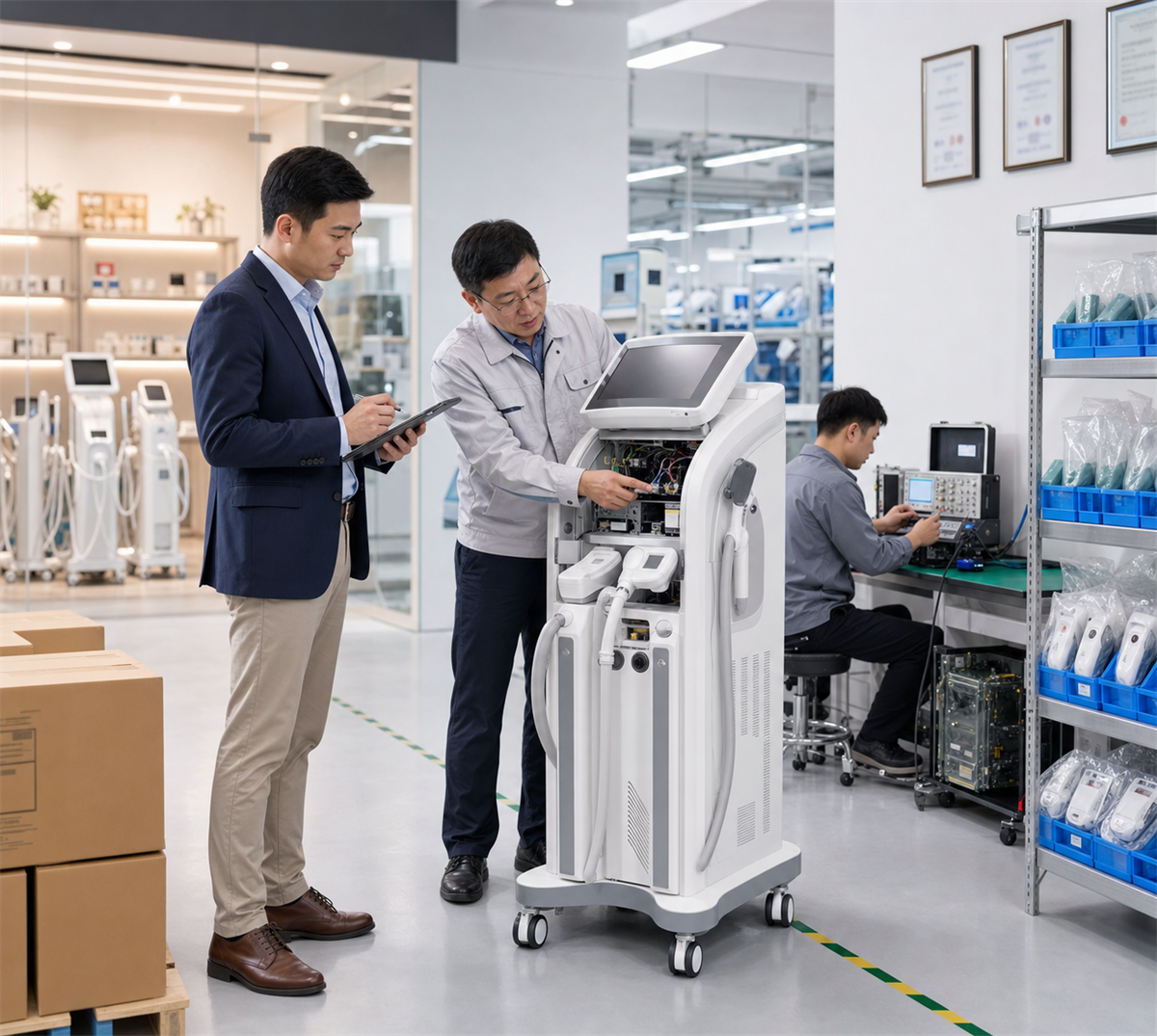
5. Manufacturing Capability
The distributor should evaluate whether the manufacturer can produce stable products repeatedly.
Wichtige Prüfungen umfassen:
- Production line organization.
- Component sourcing.
- Incoming material inspection.
- Assembly process.
- Aging test.
- Energy output test.
- Safety test.
- Software test.
- Packaging test.
- Final inspection.
- Seriennummernverfolgung.
- Repair records.
A factory with a clean showroom but weak production control may still create quality problems. Distributors should ask to see actual testing procedures, not only product displays.
6. Quality Management System
Quality management is one of the most important signs of reliability. For medical-device-related products, FDA QMSR and ISO 13485 are relevant references in regulated contexts. ISO describes ISO 13485 as an internationally recognized standard for quality management systems in the design and manufacture of medical devices.
Not every beauty device is a medical device, and not every salon-use machine requires the same regulatory pathway. But even for non-medical beauty equipment, a serious manufacturer should still have basic quality management.
Ask for evidence of:
- Quality manual or quality process.
- Supplier control.
- Inspection records.
- Nonconforming product handling.
- Corrective and preventive action process.
- Customer complaint records.
- Repair analysis.
- Production traceability.
- Calibration records for testing equipment.
- Batch records.
If a factory cannot explain quality control, the distributor should not rely only on certificates.
7. Certificates Must Be Verified
Certificates are useful, but they are not enough. Some suppliers use expired, unrelated, fake, or model-mismatched documents.
Händler sollten Folgendes prüfen:
- Certificate issuer.
- Certificate number.
- Gültigkeitszeitraum.
- Product model covered.
- Herstellername.
- Standard referenced.
- Test report details.
- Whether the certificate matches the actual product.
- Whether the certificate applies to the target market.
Common documents may include CE-related documents, ISO 13485, ISO 9001, electrical safety test reports, EMC reports, FDA registration or listing information where relevant, NMPA documents where relevant, and local market documents. But the exact requirement depends on product type and destination country.
Do not accept a certificate only because it has a logo. Verify it.
8. Understand Regulatory Positioning
Beauty equipment can fall into different regulatory categories depending on intended use, claims, energy type, and market. FDA guidance states that aesthetic devices may be regulated depending on intended use and whether they affect the structure or function of the body. The European Commission notes that the EU MDR covers some devices without an intended medical purpose when they are similar to medical devices in functioning and risk profile. NMPA registration and filing provisions require medical device registration and filing processes to support safety, effectiveness, and quality control.
For distributors, the practical point is:
- Ask what the product is claimed to do.
- Ask whether it is cosmetic, general wellness, or medical-device-related.
- Ask which markets it can legally enter.
- Ask whether the certificates support the intended claims.
- Ask whether the manual, label, and marketing materials are aligned.
- Ask whether the manufacturer can support local registration.
If a supplier says “no regulation needed anywhere” for a high-energy device, be careful.
9. Claims And Advertising Responsibility
A reliable manufacturer should not push exaggerated claims to help distributors sell quickly. FTC guidance states that health product claims should be truthful, not misleading, and properly supported.
Seien Sie vorsichtig mit Behauptungen wie:
- Garantierter Gewichtsverlust.
- Akne heilen.
- Dauerhafte Hebevorrichtung.
- Alle Falten entfernen.
- Medizinische Diagnose.
- Narbenentfernung.
- Keine Nebenwirkungen.
- Transformation in nur einer Sitzung.
- FDA approved if only registration exists.
A reliable manufacturer provides responsible claim language, treatment limitations, contraindications, and aftercare guidance. A risky manufacturer sells fantasy.
10. Sample Testing Is Essential
Distributors should test samples before large orders. A product photo cannot reveal real performance.
Sample testing should include:
- Geräteaussehen.
- Screen and software.
- Handle quality.
- Energy stability.
- Treatment comfort.
- Noise and heat.
- Cooling performance.
- Cable durability.
- Button and connector quality.
- Packaging protection.
- Manual clarity.
- Cleaning and maintenance process.
- Demo feedback from salon users.
The distributor should test the machine for several days or weeks if possible. Many product issues appear only after repeated use.
11. Compare Sample And Bulk Goods
Some suppliers send a good sample but deliver weaker bulk goods. To avoid this, distributors should set inspection rules.
Practical methods include:
- Keep the approved sample.
- Define model configuration in writing.
- Record handle type, software version, voltage, accessories, and packaging.
- Require pre-shipment photos and videos.
- Use third-party inspection if order value is high.
- Randomly test bulk units.
- Verfolgung der Seriennummern.
The sample is not the end of due diligence. It is the baseline for future orders.
12. Check Product Stability
Reliability is not only first impression. It is long-term stability.
Fragen Sie den Hersteller:
- What is the failure rate by model?
- Welche Teile fallen am häufigsten aus?
- How many warranty claims occurred last year?
- How long is the average repair time?
- Which models are most stable?
- Which models are being upgraded?
- What is the expected product life cycle?
If the manufacturer cannot provide exact numbers, it should at least provide honest service experience. A factory that says every product has zero problems is not credible.
13. After-Sales Service Is A Core Test
After-sales service is one of the strongest indicators of whether a manufacturer is reliable. Beauty salons cannot tolerate long machine downtime after selling treatment packages.
Check whether the manufacturer provides:
- Written warranty terms.
- Technical support contact.
- Fehlerbehebung per Fernzugriff.
- Reparaturvideos.
- Ersatzteile.
- Spare handle supply.
- Circuit board support.
- Software updates.
- Fehlercode-Erklärung.
- Response-time commitment.
- Clear responsibility for freight.
The distributor should test after-sales response before large cooperation. Ask a technical question and see how quickly and clearly the supplier answers.
14. Spare Parts Supply
A beauty equipment manufacturer is not reliable if it cannot supply spare parts. Spare parts protect the distributor’s customer relationships.
Important spare parts include:
- Griffe.
- Sonden.
- Kabel.
- Steckdosenleisten.
- Bildschirme.
- Filter.
- Pumps.
- Steckverbinder.
- Cooling components.
- Lampen oder Module.
- Einwegzubehör.
Fragen:
- Which spare parts are in stock?
- Wie sieht die Preisliste aus?
- How long can parts be supplied after model discontinuation?
- Are parts compatible across versions?
- Can the distributor buy a spare-parts kit?
No spare parts means no long-term business.
15. Training Support
A reliable beauty equipment manufacturer helps distributors and salons use the machine correctly. Training is not optional for professional equipment.
Useful training materials include:
- Operation manual.
- Behandlungsprotokoll.
- Contraindication list.
- Setup video.
- Wartungsvideo.
- Leitfaden zur Fehlerbehebung.
- Sales consultation script.
- Vorlage für ein Projektpaket.
- Sicherheitshinweise.
- Staff training certificate where appropriate.
If a manufacturer only sends a machine and says “easy to use,” the distributor should be cautious.
16. Salon Project Support
Distributors sell to salons, and salons sell treatments to consumers. A reliable manufacturer understands this chain.
Good project support includes:
- Treatment menu suggestions.
- Price package examples.
- Vorher-Nachher-Tracking-Vorlagen.
- Customer consultation language.
- FAQ for salon customers.
- Marketing image or video materials.
- ROI calculation examples.
- Suggested treatment course.
- Hinweise zur Nachsorge.
This support helps distributors sell more effectively. It also reduces unrealistic customer expectations.
17. Delivery Stability
A manufacturer may have a good product but poor delivery. Late delivery can damage distributor trust.
Überprüfen:
- Normal production lead time.
- Stock availability.
- Peak-season capacity.
- Lieferzeit für Muster.
- Bulk order lead time.
- Packaging time.
- Export documentation speed.
- Shipping coordination.
- Delay handling.
For high-ticket devices, the distributor should get delivery time in writing. For recurring orders, track whether the manufacturer delivers consistently.
18. Price Stability
A reliable manufacturer should have a stable and explainable price system. Constant price changes create channel distrust.
Fragen:
- What is the distributor price?
- What is the volume discount?
- Is there a dealer price policy?
- Does the factory sell online?
- Does it sell to other agents in the same market?
- Are there regional protection rules?
- Are old models discounted publicly?
- Is there a minimum order quantity?
If a manufacturer gives different prices to every buyer with no logic, channel conflict is likely.
19. Channel Protection
Distributors need channel protection if they invest in market development. Protection may include territory, customer registration, dealer authorization, online sales rules, and price policy where legally appropriate.
A reliable manufacturer should explain:
- Whether regional protection is available.
- What sales target is required.
- Whether customer registration is available.
- How cross-region sales are handled.
- Whether online low-price sales are controlled.
- How warranty is handled for unauthorized sales.
No manufacturer can perfectly control every channel, but serious suppliers should have a policy.
20. Real Customer Cases
A manufacturer should be able to provide real use cases. These may include salon customers, distributor references, export markets, trade show history, training events, or project photos.
Bitten Sie um:
- Case studies.
- Distributor references.
- Salon feedback.
- Product videos.
- Before-and-after examples if claims are properly supported.
- Serviceberichte.
- Repeat order evidence.
Be careful with fake cases, stolen photos, or overly dramatic before-and-after images. Ask for context and permission status.
21. Communication Quality
Communication quality often predicts future cooperation quality. A reliable manufacturer answers clearly, does not avoid difficult questions, and keeps records.
Good signs:
- Schnelle Reaktion.
- Clear written quotation.
- Technical explanations.
- Honest limitations.
- Organized documents.
- Vertragsklarheit.
- Stable contact person.
- Good problem-solving attitude.
Bad signs:
- Only emotional sales language.
- Avoiding technical questions.
- Constantly changing price.
- Refusing video calls.
- No written terms.
- Pushing payment before answering.
- Blaming customers for every issue.
Communication is part of reliability.
22. Contract And Warranty Terms
Before placing large orders, the distributor should review written terms.
Wichtige Begriffe sind unter anderem:
- Product model and configuration.
- Stückpreis.
- Zahlungsbedingungen.
- Lieferzeit.
- Garantiezeitraum.
- Warranty coverage.
- Preis für Ersatzteile.
- Schulungsunterstützung.
- Technische Unterstützung.
- Return or replacement conditions.
- Defect handling.
- Regionaler Schutz.
- Vertraulichkeit.
- OEM or ODM ownership.
- Streitbeilegung.
If the manufacturer refuses any written agreement, the distributor should avoid large exposure.
23. OEM And ODM Reliability
For OEM and ODM cooperation, reliability requirements are higher because the distributor may sell under its own brand.
Überprüfen:
- Logo and packaging quality.
- Software customization.
- Sprachschnittstelle.
- Manuelle Anpassung.
- Mindestbestellmenge.
- Mold or tooling ownership.
- Exclusivity terms.
- Genehmigung der Produktänderung.
- Quality inspection process.
- Kundendienstverantwortung.
Private label can create better profit, but it also increases risk if the manufacturer is weak.
24. Factory Visit Or Video Audit
If possible, visit the factory. If travel is not possible, request a live video audit.
Überprüfen:
- Production area.
- Testing area.
- Warehouse.
- Spare parts shelf.
- Repair area.
- Quality inspection records.
- Product samples.
- Packaging area.
- Staff familiarity with products.
A scripted showroom video is not enough. Ask spontaneous questions during the video call.
25. Third-Party Inspection
For larger orders, third-party inspection can reduce risk. Inspection may include:
- Quantity check.
- Appearance check.
- Function test.
- Packaging check.
- Label check.
- Accessory check.
- Power-on test.
- Random sample testing.
- Photo and video report.
Inspection cannot guarantee long-term quality, but it can catch obvious problems before shipment.
26. Payment Risk Control
Reliable manufacturers usually accept reasonable payment structures. New cooperation should avoid paying 100 percent upfront for large orders unless trust is already established.
Possible terms include:
- Deposit plus balance before shipment.
- Balance after inspection.
- Small trial order first.
- Trade assurance or escrow where available.
- Letter of credit for large international orders.
- Milestone payment for ODM projects.
Payment terms should match trust level.
27. Scoring Framework For Distributors
Distributors can use a simple 100-point scoring system:
- Business identity: 10 points.
- Factory transparency: 10 points.
- Product quality: 15 points.
- Certificates and compliance: 15 points.
- Sample testing: 10 points.
- After-sales service: 15 points.
- Spare parts supply: 10 points.
- Training and marketing support: 5 points.
- Delivery and pricing stability: 5 points.
- Channel protection and contract clarity: 5 points.
Suggested interpretation:
- 85 to 100: strong candidate.
- 70 to 84: workable, but verify weak points.
- 55 to 69: trial order only.
- Below 55: high risk.
The score is not a guarantee. It is a decision tool.
28. Red Flags
Major red flags include:
- No business license or unclear company identity.
- Refuses factory visit or video audit.
- Certificates do not match product models.
- Claims every product is FDA approved without evidence.
- Pushes large first order.
- No written warranty.
- No spare parts plan.
- Keine Schulungsunterlagen.
- Unrealistically low price.
- Online price chaos.
- Frequent model changes.
- Poor communication after payment.
- Cannot explain technical details.
- Uses stolen cases or fake before-and-after photos.
- No product testing process.
- No contract clarity.
One red flag may be manageable. Multiple red flags mean the distributor should walk away.
29. Step-By-Step Manufacturer Due Diligence
A practical due diligence process:
- Step 1: Shortlist 5 to 10 suppliers.
- Step 2: Verify company identity and product focus.
- Step 3: Request certificates, manuals, warranty terms, and price list.
- Step 4: Ask technical and after-sales questions.
- Step 5: Conduct video audit or factory visit.
- Step 6: Order sample.
- Step 7: Test sample with salon users.
- Step 8: Compare sample with documents and claims.
- Step 9: Negotiate warranty, spare parts, channel policy, and payment terms.
- Step 10: Place small trial order.
- Step 11: Track delivery, quality, and after-sales response.
- Step 12: Increase order only after successful repeat cooperation.
This process protects cash flow and reputation.
30. Questions Distributors Should Ask
Wichtige Fragen sind unter anderem:
- Are you the actual manufacturer?
- Which products are your strongest categories?
- Can you provide model-specific certificates?
- Wie lange ist die Garantiezeit?
- What parts are not covered by warranty?
- What is the failure rate of this model?
- Can you provide spare parts list and prices?
- How do you handle defective units?
- What training materials do you provide?
- Can you support regional protection?
- Do you sell online at public prices?
- How long is delivery time?
- What markets have you exported to?
- Can I contact existing distributor references?
- What claims are allowed for this device?
The answers reveal the supplier’s maturity.
31. Strategic Recommendations For New Distributors
New distributors should reduce risk.
Empfohlene Maßnahmen:
- Avoid large first orders.
- Start with sample testing.
- Choose focused manufacturers.
- Check documents carefully.
- Test der Kundendienstreaktion.
- Keep written records.
- Nutzen Sie die Vorbestellung für teure Geräte.
- Avoid suppliers with exaggerated claims.
- Build one reliable product line before expanding.
The first goal is not the lowest price. The first goal is to avoid a bad supplier.
32. Strategic Recommendations For Regional Distributors
Regional distributors should evaluate manufacturers more deeply.
Empfohlene Maßnahmen:
- Visit the factory or conduct video audit.
- Negotiate territory policy.
- Require spare parts support.
- Build training cooperation.
- Verfolgung der Seriennummern.
- Request stable model life cycle.
- Use third-party inspection for large orders.
- Review warranty claims quarterly.
- Build joint marketing plan.
Regional distributors need manufacturers that can support long-term channel development.
33. Strategische Empfehlungen für Hersteller
Manufacturers that want strong distributors should improve transparency and support.
Empfohlene Maßnahmen:
- Organize clear product documentation.
- Provide model-specific certificates.
- Maintain quality records.
- Offer sample testing.
- Build spare parts kits.
- Provide training materials.
- Use responsible claim language.
- Protect channels.
- Respond quickly after sale.
- Share product update plans.
Reliable manufacturers win better distributors and higher-quality customers.
Abschluss
Distributors should judge a beauty equipment manufacturer by evidence, not promises. A reliable manufacturer should have clear business identity, transparent factory capability, stable product quality, verified certificates, realistic claims, sample testing support, spare parts, after-sales service, training materials, delivery discipline, channel protection, and written terms.
The best manufacturer is not always the cheapest one. It is the one that helps the distributor sell safely, support salons properly, protect customer trust, and build repeat business. A low price can create a quick sale, but reliability creates long-term profit.
For beauty equipment distributors, supplier due diligence is not extra work. It is the foundation of the business.
Häufig gestellte Fragen
How can distributors quickly judge whether a beauty equipment manufacturer is reliable?
Start by checking business identity, factory transparency, product focus, certificates, sample quality, warranty terms, spare parts, training materials, delivery history, and after-sales response.
Are certificates enough to prove a beauty equipment manufacturer is reliable?
No. Certificates must be verified, model-specific, valid, and relevant to the target market. Distributors should also test samples, inspect quality control, and review after-sales capability.
What is the biggest red flag when choosing a beauty equipment factory?
Major red flags include unclear company identity, fake or mismatched certificates, no written warranty, no spare parts, exaggerated claims, refusal to provide samples, and pressure to place a large first order.
Should distributors visit the factory before cooperation?
For large or long-term cooperation, yes. If an in-person visit is not possible, distributors should request a live video audit and consider third-party inspection for larger orders.
What makes a beauty equipment manufacturer worth long-term cooperation?
A manufacturer is worth long-term cooperation when it provides stable quality, honest documents, responsible claims, fast after-sales support, spare parts, training, channel protection, and consistent communication.