







ملخص تنفيذي
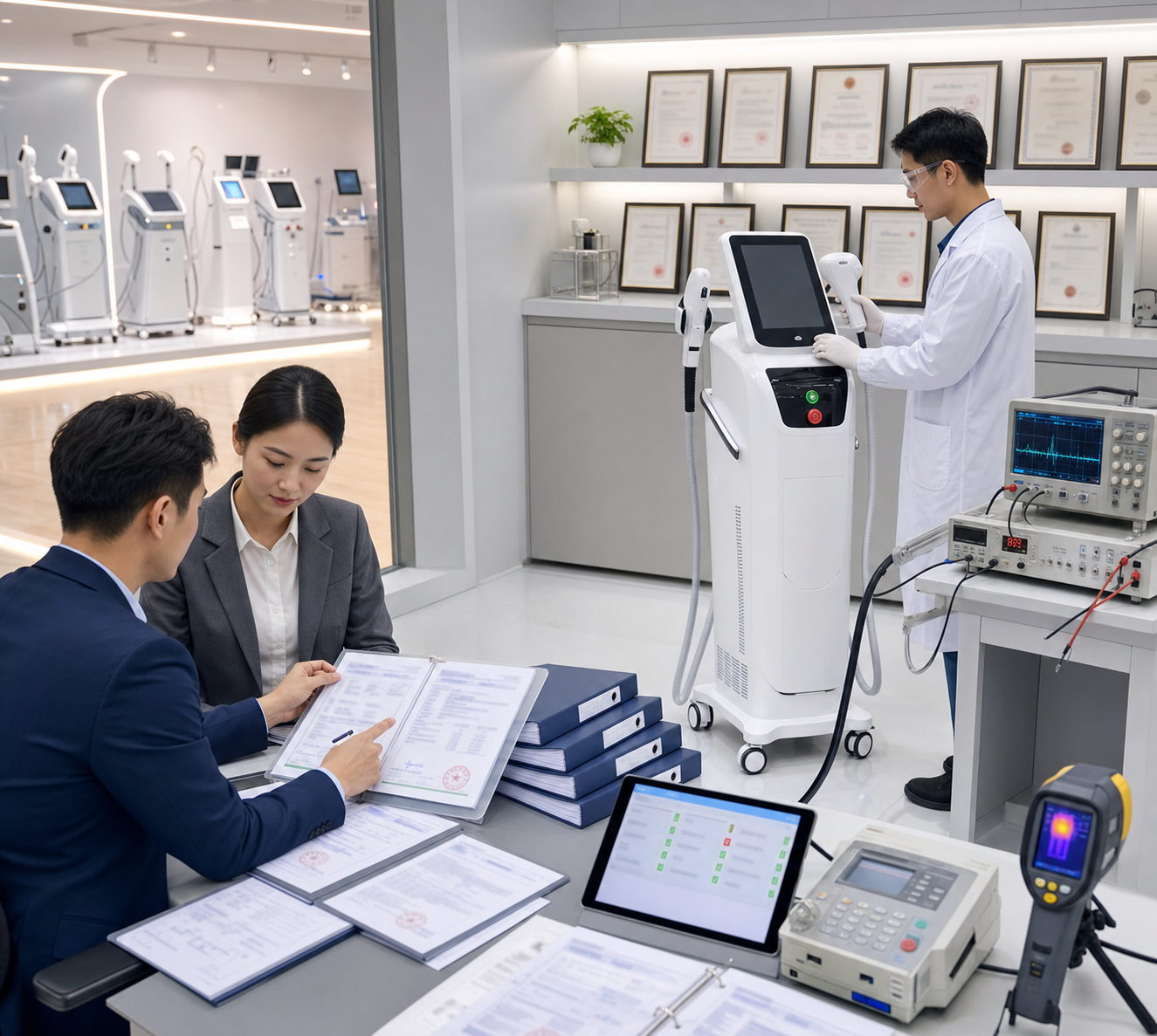
قد تتضمن منتجات معدات التجميل تقارير اختبار وشهادات وإقرارات وتسجيلات ووثائق نظام الجودة وغيرها من المؤهلات ذات الصلة. ومع ذلك، لا توجد شهادة عالمية واحدة تثبت إمكانية بيع كل جهاز تجميل في كل سوق.
تعتمد المستندات المطلوبة على تكنولوجيا المنتج، والاستخدام المقصود، والمطالبات التسويقية، والبلد المستهدف، وقناة البيع، والجهد الكهربائي، والوظيفة اللاسلكية، ووظيفة انبعاث الإشعاع، وما إذا كان المنتج يُعامل كمنتج إلكتروني عام، أو جهاز للاستخدام التجميلي، أو منتج إلكتروني باعث للإشعاع، أو جهاز طبي.
بالنسبة للموزعين، لا يكمن المفتاح في مجرد سؤال الشركة المصنعة: "هل لديكم شهادات؟" بل السؤال الأفضل هو: "ما هي الوثائق التي تتطابق مع هذا النموذج تحديداً، وما هو المعيار الذي تغطيه، وما هو السوق الذي تدعمه، ومن أصدرها، ومتى تم إصدارها، وهل يمكن التحقق منها؟"“
قد تشمل وثائق معدات التجميل الشائعة وثائق متعلقة بعلامة CE، وإعلان المطابقة للاتحاد الأوروبي، وتقارير اختبار EMC، وتقارير اختبار السلامة الكهربائية، وتقارير RoHS، وترخيص FCC أو سجلات الاختبار للسوق الأمريكية، ووثائق التسجيل أو الإدراج أو التخليص أو الموافقة أو الاستيراد المتعلقة بإدارة الغذاء والدواء عند الاقتضاء، ووثائق التسجيل أو الإيداع لدى NMPA عند الاقتضاء، وشهادة نظام إدارة الجودة ISO 13485، ودليل المستخدم، والملصقات، وتحذير المخاطر، ووثائق الضمان، وسجلات مراقبة الجودة في المصنع.
أهم نقطة هي أن الشهادة لا تكون مفيدة إلا عندما تكون حقيقية وذات صلة وحديثة ومخصصة لنموذج معين ومناسبة للسوق المستهدف.
1. الإجابة المختصرة
نعم، يمكن أن تحتوي العديد من منتجات معدات التجميل على تقارير اختبار أو مؤهلات ذات صلة.
لكن الإجابة تعتمد على فئة المنتج.
قد لا تحتاج معدات الصالون الأساسية إلا إلى وثائق السلامة الكهربائية العامة، والتوافق الكهرومغناطيسي، وتوجيهات الحد من المواد الخطرة، ووثائق المطابقة الأوروبية، ووثائق لجنة الاتصالات الفيدرالية عند الاقتضاء، وسجلات فحص الجودة، ووثائق الضمان، ووثائق التصدير.
قد تتطلب معدات التجميل عالية الخطورة وثائق تنظيمية أكثر صرامة. قد تشمل هذه الوثائق تقارير منتجات الليزر، وإقرارات المنتجات التي تصدر إشعاعات، وتسجيل أو إدراج الأجهزة الطبية، وموافقة ما قبل التسويق، وأدلة سريرية أو أدلة على الأداء، وسجلات نظام إدارة الجودة، ووثائق الاستيراد الخاصة بكل دولة.
لذلك، لا ينبغي للموزع أن يقبل أبدًا إجابة بسيطة مثل "لدينا جميع الشهادات". النهج الصحيح هو التحقق من كل وثيقة على حدة.
2. تقرير الاختبار والشهادة والتسجيل والموافقة ليست متطابقة
يخلط العديد من الموردين بين المصطلحات المختلفة، مما يخلق ارتباكاً لدى الموزعين والمشترين من صالونات التجميل.
يشير تقرير الاختبار عادةً إلى أن عينة من المنتج قد تم اختبارها وفقًا لمعيار محدد في أحد المختبرات. وقد يشمل ذلك السلامة الكهربائية، والتوافق الكهرومغناطيسي، وانبعاثات الترددات اللاسلكية، ومواد RoHS، والسلامة البصرية، أو أي مجال تقني آخر.
قد تُصدر الشهادة من قِبل جهة اعتماد أو منظمة تفتيش. وقد تدعم عملية الامتثال، لكنها لا تعني بالضرورة أن المنتج معتمد من قِبل جهة حكومية.
عادةً ما يكون إعلان المطابقة بيانًا من الشركة المصنعة يفيد بأن المنتج يفي بالقواعد المعمول بها. في الاتحاد الأوروبي، تقع مسؤولية إصدار إعلان المطابقة على عاتق الشركة المصنعة بعد استيفاء المتطلبات القانونية وإعداد الوثائق الفنية الداعمة.
قد يعني التسجيل أو الإدراج إدخال شركة أو منتج في قاعدة بيانات جهة تنظيمية. قد يكون ذلك مطلوبًا، ولكنه لا يعني بالضرورة الموافقة على المنتج.
قد يكون لنتيجة الموافقة أو التصريح أو الترخيص أو تقييم المطابقة معنى تنظيمي أكثر تحديدًا اعتمادًا على البلد ونوع المنتج.
يجب على الموزعين فهم هذه الاختلافات قبل استخدام أي شهادة في مواد المبيعات.
3. لماذا لا يمكن لشهادة واحدة أن تغطي جميع معدات التجميل
تشمل معدات التجميل العديد من التقنيات المختلفة. فجهاز تنظيف الوجه بالماء، وجهاز الترددات الراديوية، وجهاز إزالة الشعر بتقنية IPL، وجهاز إزالة الوشم بالليزر، ولوحة العلاج بضوء LED، وجهاز EMS، وجهاز تحليل البشرة بالذكاء الاصطناعي، وأدوات التجميل المنزلية، لا تحمل جميعها نفس مستوى المخاطر.
قد تتغير المستندات المطلوبة بناءً على:
- دالة الضرب
- نوع الطاقة
- انتاج الطاقة
- طريقة التلامس مع الجلد
- الاستخدام المقصود
- ادعاءات العلاج
- ما إذا كان الجهاز يصدر إشعاعاً
- سواء كان يستخدم الاتصالات اللاسلكية
- سواء كان يخزن بيانات العملاء
- سواء كان مستوردًا أو يُباع محليًا
- قواعد الدولة المستهدفة
- وضعية للاستخدام في الصالونات أو للاستخدام المنزلي
- الوضع الطبي أو غير الطبي
ولهذا السبب ينبغي على الموزعين طلب حزمة وثائق خاصة بنموذج المنتج المحدد والسوق المستهدف المحدد.
4. المستندات الشائعة التي قد يقدمها مصنّعو معدات التجميل
قد تتضمن حزمة المستندات الأساسية ما يلي:
- ورقة مواصفات المنتج
- دليل المستخدم
- دليل التشغيل
- ملصق المنتج
- قائمة التعبئة
- وثيقة الضمان
- تقرير فحص الجودة
- قائمة فحص المصنع
- قائمة الأرقام التسلسلية
- إعلان أو شهادة متعلقة بعلامة المطابقة الأوروبية (CE) عند الاقتضاء
- تقرير اختبار التوافق الكهرومغناطيسي
- تقرير اختبار السلامة الكهربائية
- تقرير RoHS
- تقرير أو ترخيص متعلق بلجنة الاتصالات الفيدرالية (FCC) عند الاقتضاء
- صور وفيديوهات المنتجات
- مواد تدريبية
- دليل الصيانة
- قائمة قطع الغيار
بالنسبة للمنتجات ذات المخاطر العالية، قد تتضمن العبوة أيضاً ما يلي:
- ملخص الملف الفني
- وثائق إدارة المخاطر
- تقديم الدعم السريري أو دعم الأداء عند الحاجة
- تقرير السلامة الليزرية أو البصرية
- وثائق المنتج المشع
- معلومات إدراج الأجهزة لدى إدارة الغذاء والدواء الأمريكية أو معلومات تقديم ما قبل التسويق، عند الاقتضاء.
- مستندات التسجيل أو تقديمها لدى الهيئة الوطنية للمنتجات الطبية (NMPA) عند الاقتضاء.
- وثائق المطابقة الخاصة بلوائح الأجهزة الطبية الأوروبية (EU MDR) عند الاقتضاء
- شهادة ISO 13485
- معلومات الممثل المعتمد
- مستندات الاستيراد
- إجراءات معالجة الشكاوى
لا يحتاج كل منتج إلى كل المستندات. ولكن ينبغي أن يكون المورد الجاد قادراً على شرح المستندات المطلوبة وأسبابها.
5. ما الذي يُظهره تقرير اختبار المنتج عادةً
قد يُظهر تقرير الاختبار أن العينة قد تم اختبارها في ظل ظروف معينة.
قد يشمل ذلك ما يلي:
- اسم المنتج
- رقم الطراز
- اسم مقدم الطلب أو الشركة المصنعة
- مختبر اختبار
- تاريخ الاختبار
- معيار الاختبار
- وصف العينة
- طريقة الاختبار
- نتيجة الاختبار
- صور العينة المختبرة
- نتيجة النجاح أو الفشل
- توقيع أو ختم المختبر
ينبغي على الموزع التحقق من تطابق المنتج الذي يتم شراؤه مع المنتج الذي تم اختباره. فإذا كان تقرير الاختبار يغطي طرازًا معينًا، بينما يشتري الموزع طرازًا آخر، فقد لا ينطبق التقرير.
6. ما لا يثبته تقرير الاختبار
لا يثبت تقرير الاختبار تلقائياً أن كل دفعة مستقبلية لها نفس الجودة.
وقد لا يثبت ذلك أيضاً:
- المنتج قابل للبيع قانونياً في كل دولة
- المنتج حاصل على موافقة الحكومة
- أثبت المنتج نتائج علاجية فعّالة.
- المنتج فعال طبياً
- تتمتع الشركة المصنعة بدعم قوي لما بعد البيع
- المنتج آمن عند استخدامه خارج نطاق التعليمات
- يمكن للمنتج أن يدعم جميع الادعاءات التسويقية.
- لم يطرأ أي تغيير على المنتج مقارنةً بالعينة المختبرة.
ولهذا السبب يجب دمج تقارير الاختبار مع التحقق من المورد، وفحص الدفعات، ومراقبة الجودة، وتدريب المستخدمين، والمطالبات الواقعية.
7. علامة CE وإعلان المطابقة للاتحاد الأوروبي
بالنسبة للمنتجات المباعة في المنطقة الاقتصادية الأوروبية، قد يكون وضع علامة CE مطلوبًا إذا كان المنتج يندرج تحت قواعد المنتجات المعمول بها في الاتحاد الأوروبي.
توضح المفوضية الأوروبية أن وضع علامة CE على المنتج يُعدّ بمثابة إقرار من الشركة المصنعة بأن المنتج يستوفي جميع المتطلبات القانونية لعلامة CE، وبالتالي يُمكن بيعه في جميع أنحاء المنطقة الاقتصادية الأوروبية. كما تُشير إلى أنه ليس من الضروري أن تحمل جميع المنتجات علامة CE، وأن وجود هذه العلامة لا يعني بالضرورة أن المنتج قد حصل على موافقة الاتحاد الأوروبي أو أي جهة أخرى على سلامته.
بالنسبة للموزعين، هذا يعني أن شهادة المطابقة الأوروبية (CE) ليست مجرد ملصق. يجب أن تتضمن حزمة شهادة المطابقة الأوروبية (CE) المناسبة المنتج، والتوجيهات أو اللوائح المعمول بها، والمعايير، وتقارير الاختبار، والوثائق الفنية، وإعلان المطابقة.
عند مراجعة المستندات المتعلقة بعلامة CE، تأكد مما يلي:
- نموذج المنتج
- اسم الشركة المصنعة
- إعلان المطابقة للاتحاد الأوروبي
- التوجيهات أو اللوائح المعمول بها
- المعايير المطبقة
- تقارير الاختبارات التي تدعم هذا الإعلان
- ممثل معتمد عند الحاجة
- توافر الوثائق الفنية
- تدخل الهيئة المُخوّلة عند الاقتضاء
- متطلبات اللغة للدولة المستهدفة في الاتحاد الأوروبي
إذا أرسل المورد صورة شعار CE فقط أو شهادة عامة بدون نموذج مطابق، فلا ينبغي للموزع الاعتماد عليها.
8. لائحة الأجهزة الطبية الأوروبية والأجهزة التجميلية غير الطبية
قد لا تدعي بعض أجهزة التجميل والجمال وجود غرض طبي، ولكن لا يزال من الممكن أن تندرج تحت الملحق السادس عشر من لائحة الأجهزة الطبية للاتحاد الأوروبي إذا كانت مشابهة للأجهزة الطبية في الوظيفة وملف المخاطر.
تُشير المفوضية الأوروبية إلى أن لائحة الأجهزة الطبية (MDR) تشمل بعض الأجهزة التي لا تُستخدم لأغراض طبية، وأن الملحق السادس عشر يتضمن مجموعات الأجهزة المعنية. وهذا أمرٌ بالغ الأهمية بالنسبة لأجهزة التجميل، مثل بعض أجهزة نحت الجسم، وعلاجات البشرة، والليزر، والضوء النبضي المكثف، والتقنيات التجميلية المماثلة.
بالنسبة للمبيعات في الاتحاد الأوروبي، يجب على الموزعين توخي الحذر فيما يلي:
- أجهزة تجميل عالية الطاقة
- ادعاءات تجديد البشرة
- مزاعم تقليل الدهون
- ادعاءات إزالة الوشم
- منتجات الليزر و IPL
- الأجهزة ذات التأثيرات الفسيولوجية الغازية أو القوية
- أجهزة يتم الترويج لها بادعاءات طبية
إذا كان نظام MDR ينطبق، فقد لا يكون تقرير التوافق الكهرومغناطيسي CE البسيط كافياً. قد يحتاج المنتج إلى عملية مطابقة أكثر شمولاً للأجهزة الطبية.
9. الوثائق المتعلقة بإدارة الغذاء والدواء الأمريكية للسوق الأمريكية
بالنسبة للولايات المتحدة، تعتمد الوثائق المتعلقة بإدارة الغذاء والدواء على ما إذا كان المنتج جهازًا طبيًا أو منتجًا إلكترونيًا ينبعث منه إشعاع أو كليهما.
تنص إرشادات إدارة الغذاء والدواء الأمريكية على أنه يجب على الشركات المصنعة الأجنبية للأجهزة الطبية استيفاء اللوائح الأمريكية المعمول بها لاستيراد أي جهاز إلى الولايات المتحدة. وتشمل المتطلبات التنظيمية الأساسية تسجيل المنشأة، وإدراج الأجهزة الطبية في قوائمها، ونظام إدارة الجودة، وإخطار ما قبل التسويق (510(k)) ما لم يكن معفياً، والموافقة المسبقة على التسويق عند الاقتضاء، ووضع الملصقات، والإبلاغ عن الأجهزة الطبية.
لا يعني هذا أن كل جهاز تجميل يحتاج إلى موافقة إدارة الغذاء والدواء الأمريكية. بل يعني أنه يجب التحقق من الاستخدام المقصود للمنتج، وتقنيته، ومزاعمه، وتصنيفه.
قد تتضمن أمثلة الوثائق أو المعلومات المتعلقة بإدارة الغذاء والدواء ما يلي:
- تسجيل المنشأة
- قائمة الأجهزة
- تصريح 510(k) عند الاقتضاء
- موافقة إدارة التسويق المسبق (PMA) حيثما ينطبق ذلك
- الترخيص الجديد حيثما ينطبق
- معلومات تصنيف المنتج
- معلومات الوكيل الأمريكي للمصنعين الأجانب
- معلومات التسمية
- Quality system documentation
- Import Affirmation of Compliance codes where applicable
- Radiation-emitting product reports where applicable
Distributors should not use the phrase FDA approved unless the product truly has FDA approval. Many products are only registered, listed, cleared, authorized, or not subject to a premarket pathway.
10. FDA Registration Is Not FDA Approval
This is one of the most common mistakes in beauty equipment marketing.
FDA clearly states that when a facility registers and lists devices, the database entry does not denote approval, clearance, or authorization of that facility or its medical devices. FDA also states that it does not issue device registration certificates.
بالنسبة للموزعين، هذا يعني:
- FDA registered is not the same as FDA approved.
- FDA listed is not the same as FDA approved.
- A certificate that looks like an FDA registration certificate may be misleading.
- FDA logos should not be misused in marketing.
- If a supplier claims FDA approval, ask for the exact approval, clearance, or authorization record.
This distinction protects the distributor from false advertising risk and customer disputes.
11. FDA Radiation-Emitting Product Requirements
Some beauty devices emit radiation in a regulatory sense. This can include laser products and certain light-based products.
FDA explains that radiation-emitting electronic products may be medical or non-medical products. Radiation-emitting electronic products subject to U.S. federal performance standards require Form FDA-2877 at the time of entry. FDA also verifies radiation-emitting electronic product requirements at import.
For laser and IPL-related beauty equipment, distributors should ask:
- Does the product emit laser, intense light, UV, infrared, or other radiation?
- Is it subject to a U.S. federal performance standard?
- Is Form FDA-2877 required for import?
- Does the manufacturer have a radiation product report?
- Are warning labels correct?
- Is the product classified correctly?
- Are eye protection and user warnings included?
- Are import documents prepared?
This area is more technical than normal salon equipment purchasing. It should not be handled only by sales staff.
12. FCC Documents For Electronic Products In The U.S.
Beauty equipment with electronic circuits, radiofrequency emissions, wireless modules, Bluetooth, Wi-Fi, touch screens, or digital control systems may need FCC-related review for the U.S. market.
FCC explains that radiofrequency devices must be properly authorized before being marketed or imported into the United States. Authorization routes may include Supplier’s Declaration of Conformity or Certification depending on the product.
ينبغي على الموزعين التحقق مما يلي:
- Whether the product is an RF device
- Whether it has wireless communication
- Whether an FCC test report exists
- Whether FCC ID is needed
- Whether SDoC applies
- Whether the responsible party information is available
- Whether labels and manual language match FCC requirements
For the U.S. market, FCC compliance is separate from FDA compliance. A product may need both, one, or neither depending on product type.
13. RoHS Reports And Material Compliance
Beauty equipment is usually electrical or electronic equipment. For the EU and some other markets, hazardous substance restrictions may apply.
RoHS rules restrict certain hazardous substances in electrical and electronic equipment. A RoHS report can help show that the product or components were tested for restricted substances.
ينبغي على الموزعين التحقق مما يلي:
- Whether the RoHS report matches the model or component
- Which substances were tested
- Which standard or directive is referenced
- Whether the test date is current enough
- Whether the report covers the full product or only parts
- Whether product materials changed after testing
RoHS is not a treatment-effect certificate. It is a material compliance document.
14. ISO 13485 And Factory Quality Management
ISO 13485 is an internationally recognized quality management system standard for medical devices. It is often used by manufacturers involved in medical device design, production, installation, and servicing.
For beauty equipment distributors, ISO 13485 can be useful when buying higher-risk or medical-device-related products. But it should not be misunderstood.
ISO 13485 usually shows that the company has a quality management system within a defined scope. It does not automatically prove that every product model is approved, safe for every use, or legally sellable in every country.
When checking ISO 13485, confirm:
- اسم صاحب الشهادة
- Site address
- Scope of certification
- Expiry date
- Certification body
- Product category relevance
- Whether the factory producing the device is covered
If the certificate belongs to another company or does not cover the product category, it has limited value for the distributor.
15. NMPA Documents For China-Related Medical Device Categories
In China, NMPA rules may apply when a beauty device is regulated as a medical device. NMPA provisions state that medical device registration and filing should prove that devices are safe, effective, and quality controlled, and that related information should be authentic, accurate, complete, and traceable.
NMPA-related documents may include:
- Medical device registration certificate
- Filing information
- Product technical requirements
- Inspection or testing report
- Manufacturing quality system records
- Label and manual review information
- Change registration or renewal documents where applicable
Not every beauty device is an NMPA-regulated medical device. But when the product has medical-device attributes, distributors should check NMPA status carefully.
16. Factory QC Report Is Different From Third-Party Test Report
A factory QC report is usually created by the manufacturer before shipment. It may include visual inspection, function test, aging test, packaging check, and serial number records.
A third-party test report is usually issued by an external laboratory under a defined standard.
Both documents are useful, but they serve different purposes.
Factory QC reports help check batch consistency and shipment quality. Third-party test reports help support compliance with technical standards.
Distributors should ask for both when the order size, product risk, or target market justifies it.
17. Which Documents Are Common For Basic Salon Equipment?
For basic salon machines such as hydro facial equipment, small bubble machines, cold and hot hammer, oxygen spray, ultrasonic beauty devices, simple EMS machines, or entry-level multifunction facial equipment, common documents may include:
- مواصفات المنتج
- دليل المستخدم
- تقرير مراقبة الجودة في المصنع
- وثيقة الضمان
- CE-related documents for EU sales
- تقرير اختبار التوافق الكهرومغناطيسي
- Electrical safety report where applicable
- تقرير RoHS
- FCC-related documents for U.S. electronic products where applicable
- قائمة التعبئة
- قائمة قطع الغيار
- Training guide
These products may be easier to document than high-energy devices, but the distributor should still confirm model, voltage, plug, labels, manuals, and claims.
18. Which Documents Are Important For RF Beauty Equipment?
RF beauty equipment may need closer review because the device delivers energy into or onto the skin.
Useful documents may include:
- تقرير EMC
- تقرير السلامة الكهربائية
- مواصفات المنتج
- Output parameter information
- Temperature control information
- دليل المستخدم
- إرشادات موانع الاستعمال
- تقرير مراقبة الجودة في المصنع
- CE-related documentation where applicable
- FDA or MDR review where claims and target market require it
- بروتوكول التدريب
- Warranty and spare parts list
For RF devices, do not look only at certificates. Also check real output stability, handpiece temperature, comfort, treatment logic, and safety instructions.
19. Which Documents Are Important For Laser And IPL Devices?
Laser and IPL products usually require the most careful document review.
اطلب:
- Laser or optical safety documentation
- Radiation-emitting product documents where applicable
- Product report or accession information where applicable
- FDA Form 2877 support where applicable
- Eye protection information
- Warning label samples
- دليل المستخدم
- مواد تدريبية
- Treatment parameter guidance
- EMC and electrical safety reports
- CE or MDR-related documents for EU sales where applicable
- Warranty and lamp or handpiece life information
A cheap laser or IPL device with weak documents can create serious import, safety, and after-sales risk.
20. Which Documents Are Important For LED Light Therapy Devices?
For LED light therapy products, distributors should check both electrical compliance and light performance.
Useful documents may include:
- معلومات عن الطول الموجي
- Optical performance data
- تقرير السلامة الكهربائية
- تقرير EMC
- تقرير RoHS
- إرشادات حماية العين
- دليل المستخدم
- بروتوكول العلاج
- Product labeling
- Claims support
If the product is marketed with treatment claims, acne claims, wound healing claims, disease claims, or strong medical-like claims, regulatory review may become more important.
21. Which Documents Are Important For AI Skin Analyzers?
AI skin analyzers combine device hardware, imaging software, and data processing. Their document needs are different from ordinary beauty machines.
Useful documents may include:
- مواصفات المنتج
- Camera and lighting information
- Software version information
- تقرير EMC
- تقرير السلامة الكهربائية
- FCC-related documents where wireless modules are used
- Privacy policy or data handling explanation
- Cloud service terms
- دليل المستخدم
- Report template
- Account and access control explanation
- AI analysis limitation statement
If the device stores customer facial images or personal information, distributors should also review privacy and data protection requirements in the target market.
22. How Distributors Should Request Documents From A Manufacturer
Do not ask only, “Do you have CE?”
Use a more specific request:
- Please provide documents for the exact model number.
- Please confirm the target market covered by each document.
- Please provide the test standard for each report.
- Please provide the issuing laboratory or certification body.
- Please provide the issue date and expiry date where applicable.
- Please confirm whether the product has changed after testing.
- Please provide the EU Declaration of Conformity if selling in the EU.
- Please provide FDA registration, listing, clearance, or approval information only if applicable.
- Please explain whether the product is a medical device or non-medical device in the target market.
- Please provide warranty, spare parts, and QC report templates.
Specific questions make it harder for weak suppliers to hide behind generic answers.
23. How To Check Whether A Certificate Matches The Product
Use a model-matching checklist:
- Does the model number match the machine label?
- Does the product photo in the report match the actual machine?
- Does the applicant name match the supplier or manufacturer?
- Does the factory address match the production site?
- Does the standard apply to the product category?
- Does the date make sense?
- Does the report cover the same voltage and configuration?
- Does the report include all handpieces or accessories?
- Does the certificate reference the test report number?
- Can the issuing organization be verified?
If a certificate has no model number, no standard, no issue date, or no traceable issuer, it is weak evidence.
24. How To Check Whether A Certificate Is Real
Distributors can reduce fake-certificate risk by checking:
- Issuer website
- Certificate number
- Laboratory accreditation information
- Issuer contact details
- Report format consistency
- QR code or online verification link
- صور المنتجات في التقرير
- Signature and seal
- Applicant company name
- Whether the same certificate appears online under another product
If the order is large, contact the issuing body directly or use a third-party compliance consultant.
25. Common Certificate Red Flags
Be cautious when:
- The supplier sends only a CE logo
- The certificate belongs to a different model
- The certificate belongs to a different company
- The report is expired
- The test standard is irrelevant
- The report covers only a component but is used for the whole machine
- The supplier says one certificate covers every model
- The FDA certificate looks like a registration certificate
- The issuer cannot be found
- The certificate has obvious editing marks
- The lab name is missing
- The product photo is absent
- The document is not in the language required by the target market
- The supplier refuses verification
Good suppliers are usually comfortable with document checking. Weak suppliers often rush the buyer to pay first.
26. What Documents Should Be Checked Before OEM Or Private Label?
OEM and private-label projects need special care. If the distributor places its own brand on the device, the distributor may become more visible to customers, regulators, and market surveillance authorities.
Before private labeling, confirm:
- Whether existing reports remain valid after branding changes
- Whether label changes affect compliance
- Whether manual language changes require review
- Whether model number changes are reflected in documents
- Whether packaging claims match approved documents
- Whether technical files can support the private-label version
- Whether the distributor is considered manufacturer, importer, or responsible party in the target market
- Whether certificates list the correct company or product identity
Private label can build brand value, but it also increases documentation responsibility.
27. Why Product Claims Affect Required Qualifications
The same physical product can face different document requirements depending on how it is described.
For example, a device described as supporting general facial care may be treated differently from a device claiming to treat acne, remove scars, cure skin disease, permanently reduce fat, or medically tighten tissue.
Distributors should review:
- Website copy
- Brochures
- Training scripts
- صور قبل وبعد
- Social media videos
- Salesperson claims
- Salon project names
- User manual claims
- Package claims
Marketing language can turn a simple beauty product into a higher-risk product. Claim control is part of compliance.
28. What Salons Should Ask Distributors
Beauty salons do not need to understand every regulation, but they should ask practical questions before buying.
ينبغي على الصالونات أن تسأل:
- Does this model have a test report?
- Which certificates are available?
- Do the documents match this exact machine?
- Is the machine suitable for local salon use?
- What claims can we make to customers?
- هل يشمل ذلك التدريب؟
- Is warranty written clearly?
- هل قطع الغيار متوفرة؟
- ماذا يحدث إذا تعطلت الآلة؟
- Is the machine safe for the planned project?
If the distributor cannot answer these questions, the salon should be cautious.
29. What Distributors Should Ask Manufacturers
Distributors should ask deeper questions:
- What is the product classification in the target market?
- Which test reports are available for this model?
- Which certificates are current?
- Which documents are needed for customs?
- Can the reports be verified?
- Has the product changed after testing?
- Are all handpieces covered by the report?
- Is there a technical file?
- Is there a factory QC report for each batch?
- Can serial numbers be traced?
- Does the factory have ISO 13485 or another quality system certificate?
- What claims are supported?
- What claims should not be used?
- Who is responsible for regulatory issues in the target market?
These questions separate serious manufacturers from price-only suppliers.
30. Why Batch QC Still Matters Even With Certificates
Certificates are usually based on reviewed documentation or tested samples. They do not automatically inspect every unit in every shipment.
Distributors should still require:
- تقرير مراقبة الجودة في المصنع
- Aging test record
- Random function test
- قائمة الأرقام التسلسلية
- Packaging photos
- Pre-shipment inspection
- Incoming inspection after arrival
- Defect tracking
- Corrective action for repeated failures
A product can have documents and still suffer from poor batch control. Documentation and physical inspection should work together.
31. How To Build A Distributor Document File
Every distributor should maintain a document file for each model.
The file should include:
- Supplier information
- مواصفات المنتج
- Photos
- Label artwork
- دليل المستخدم
- مواد تدريبية
- تقارير الاختبار
- الشهادات
- Declaration of Conformity
- FDA, NMPA, MDR, or other regulatory information where applicable
- شروط الضمان
- قائمة قطع الغيار
- QC report
- Serial number records
- Import documents
- Marketing claim review
- Customer complaint records
This file helps sales, training, after-sales, customs, and future repeat orders.
32. How Often Should Documents Be Updated?
Documents should be reviewed when:
- A product is modified
- Components are changed
- Software is updated
- Handpieces are changed
- Labeling is changed
- Target market changes
- Standards are updated
- Laws or regulations change
- Certificate expiry date approaches
- Manufacturer address changes
- Private label version is created
- Customer complaint suggests safety or performance issues
Do not assume a certificate from several years ago still covers the current product.
33. The Right Way To Use Qualifications In Sales
Distributors can mention certificates and test reports, but the language must be accurate.
صياغة أفضل:
- This model has an EMC test report.
- This model has RoHS test documentation.
- The manufacturer has provided CE-related documents for EU review.
- The manufacturer states that this model is listed with FDA where applicable.
- The product has supporting documents for the target market.
- We can provide document copies for buyer review.
صياغة محفوفة بالمخاطر:
- FDA approved, when it is only registered or listed
- EU approved, when it only has CE marking
- Medical grade, without support
- Guaranteed results, without evidence
- Certified safe by the government, without real approval
- All documents cover all countries, without review
Accurate language protects the distributor’s brand.
34. Practical Document Checklist Before Purchase
Before buying, confirm:
- رقم الطراز الدقيق
- مواصفات المنتج
- دليل المستخدم
- Label
- شروط الضمان
- تقرير مراقبة الجودة في المصنع
- Electrical safety report where applicable
- EMC report where applicable
- تقرير RoHS عند الاقتضاء
- FCC report or authorization where applicable
- CE Declaration of Conformity where applicable
- FDA status where applicable
- Radiation-emitting product documents where applicable
- MDR documents where applicable
- NMPA documents where applicable
- ISO 13485 or quality system certificate where applicable
- قائمة قطع الغيار
- مواد تدريبية
- إرشادات الادعاءات التسويقية
- Import documents
If the product is high-value or high-risk, use a third-party compliance review before placing a large order.
35. Strategic Advice For New Distributors
New distributors should not start with products that have complex regulatory requirements unless they already have compliance support.
Safer entry categories may include:
- Basic facial care machines
- أجهزة تنظيف الوجه بالماء
- أجهزة الفقاعات الصغيرة
- مطرقة باردة وساخنة
- Oxygen spray equipment
- Entry-level ultrasonic devices
- Basic LED beauty equipment
- Low-risk multifunction facial machines
More cautious categories include:
- أجهزة الليزر
- أجهزة IPL
- أنظمة ترددات لاسلكية قوية
- أنظمة الموجات فوق الصوتية المركزة
- Tattoo removal devices
- Cryolipolysis-style systems
- High-claim body contouring equipment
- محللات البشرة بالذكاء الاصطناعي مع بيانات سحابية
Start with products whose documents, operation, claims, and after-sales process are easier to manage.
خاتمة
Beauty equipment can have test reports and related qualifications, but distributors must understand what each document actually means.
A complete document package may include test reports, CE-related documents, EU Declaration of Conformity, FCC documents, RoHS reports, FDA information, NMPA documents, MDR documents, ISO 13485 certificate, factory QC records, manuals, labels, warranty terms, and spare parts lists. But not every device needs the same package.
The safest purchasing principle is to verify the exact model, exact market, exact standard, exact issuer, exact date, and exact product claims. Do not rely on certificate photos, sales promises, or generic PDF files.
For distributors and salons, the real goal is not collecting certificates for display. The real goal is choosing beauty equipment that can be imported, sold, used, marketed, maintained, and supported responsibly.
التعليمات
Do all beauty equipment products have test reports?
No. Many professional manufacturers provide test reports, but not every supplier or product has complete documents. The distributor should request model-specific reports before buying.
Is CE the same as government approval?
No. CE marking is a manufacturer declaration that the product meets applicable EU requirements. The European Commission states that CE marking does not indicate that a product has been approved as safe by the EU or another authority.
Is FDA registration the same as FDA approval?
No. FDA states that registration and listing do not denote approval, clearance, or authorization. FDA also states that it does not issue device registration certificates.
What reports are common for basic salon beauty machines?
Common reports may include EMC, electrical safety, RoHS, factory QC, and CE-related documentation where applicable. FCC-related documents may be needed for certain U.S. electronic or wireless products.
What documents are important for laser or IPL beauty equipment?
Laser and IPL devices may need optical safety documents, radiation-emitting product information, FDA import support where applicable, warning labels, protective eyewear information, user manuals, training materials, and market-specific regulatory documents.
How can a distributor check whether a certificate is real?
The distributor should check the model number, company name, issuer, certificate number, test standard, date, product photo, online verification link, and whether the issuing body can confirm the document.
Should salons ask distributors for certificates before buying?
Yes. Salons should ask whether the machine has test reports, which certificates are available, whether the documents match the exact model, what claims can be used, and how warranty and after-sales service work.