









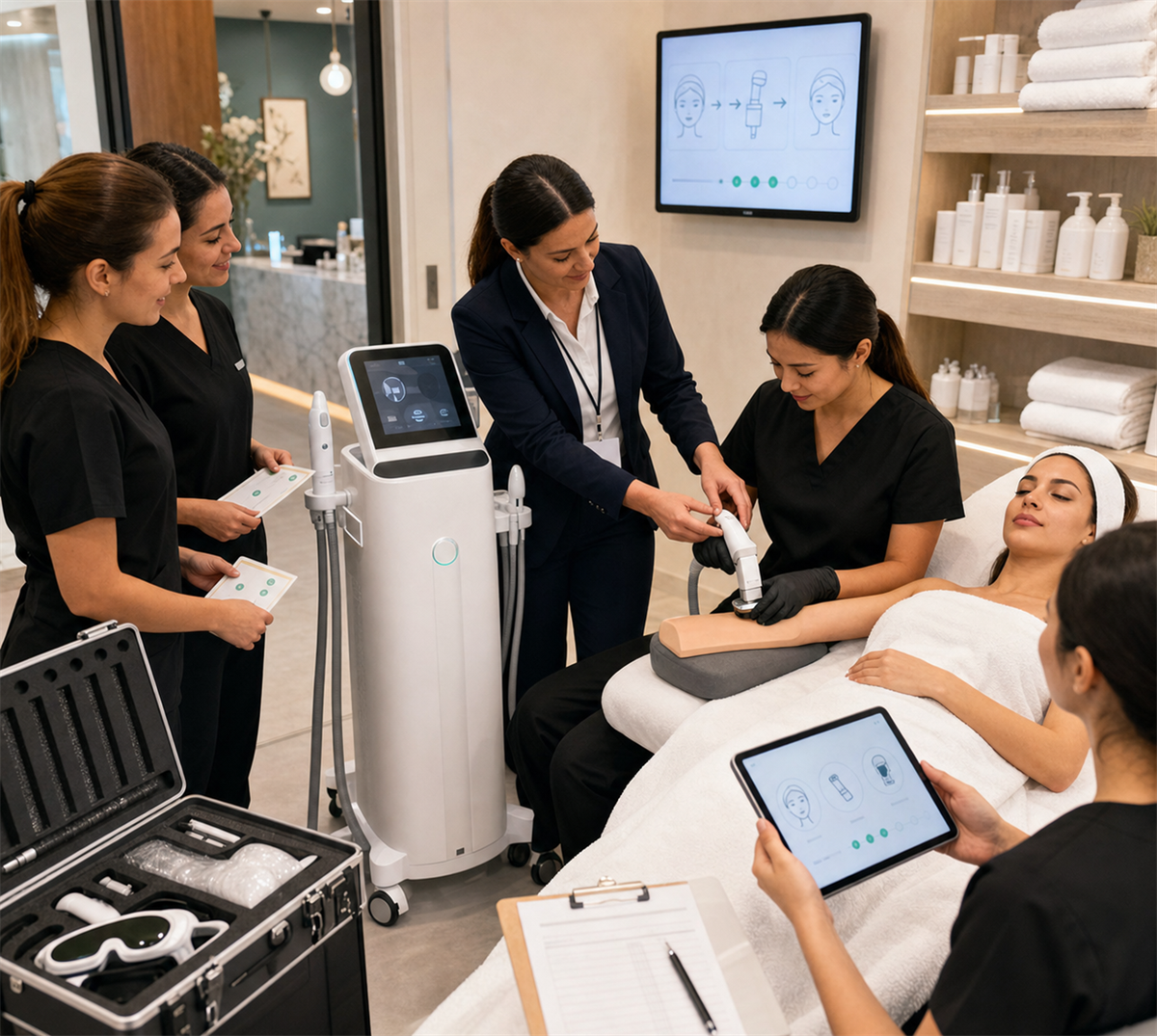
Executive Summary
Many beauty equipment manufacturers can provide training for beauticians, but on-site training is not always included by default. Whether the manufacturer sends a trainer to the salon depends on the equipment type, order value, purchase quantity, location, distributor arrangement, training difficulty, and after-sales policy.
In practice, beauty equipment training is usually provided in one of these forms:
- Factory training before delivery
- On-site installation and operation training
- Online video training
- Live video call training
- Distributor or local agent training
- Training manuals and operation videos
- Paid advanced training
- Refresher training for new staff
- Certification or attendance record where applicable
For basic salon machines, manufacturers may provide online training, manuals, and videos instead of sending a trainer. For higher-value machines, complex multifunction systems, RF devices, laser or IPL devices, body contouring systems, and large distributor orders, on-site training is more common.
The safest answer for salons is:
Yes, some manufacturers provide on-site training, but salons should confirm it in writing before purchase. They should ask what is included, who pays travel cost, how many staff can attend, how long the training lasts, whether hands-on practice is included, whether cleaning and contraindications are covered, and whether retraining is available after staff turnover.
On-site training is valuable only when it teaches beauticians how to operate safely, standardize service workflow, explain projects correctly, avoid exaggerated claims, clean equipment properly, and handle common customer questions.
1. Why Salons Ask About On-Site Training
Beauty salons do not buy equipment only to place it in a treatment room. They buy equipment to create services, improve customer experience, increase project value, and generate repeat revenue.
But a machine cannot create revenue if the staff do not know how to use it.
Salons ask about on-site training because they worry about:
- Whether beauticians can learn the machine quickly
- Whether operation mistakes may hurt customer experience
- Whether the machine can be used safely
- Whether staff can explain the project to customers
- Whether the machine will sit idle after purchase
- Whether new employees can be trained later
- Whether the supplier will still support the salon after payment
- Whether the salon can recover investment on time
These concerns are reasonable. Training quality can affect utilization, customer trust, treatment consistency, payback period, and repeat purchase.
2. The Short Answer
Do manufacturers provide on-site training for beauticians?
Often yes, but not always automatically.
For many manufacturers, basic training is included in the purchase, but on-site training may depend on the contract.
Common policies include:
- Free online training for all buyers
- Free on-site training for high-value machines
- Free on-site training for bulk orders
- Paid on-site training for small orders
- Local distributor training instead of factory trainer visits
- Factory training if the buyer visits the manufacturer
- Remote training for overseas buyers
- Mixed training with videos before delivery and live support after installation
This means salons should not assume that “training included” means “trainer comes to the salon.” They should ask directly.
3. Training Included Does Not Always Mean On-Site Training
In beauty equipment sales, the phrase “training included” can mean different things.
It may mean:
- A PDF user manual
- A short operation video
- A live online demonstration
- A recorded training course
- One group video call
- A trainer visiting the salon
- A local agent training the staff
- A factory training session at the manufacturer location
- A full launch training program with operation, consultation, sales, cleaning, and maintenance
These are very different levels of support.
Before paying a deposit, salons should ask the supplier to define the training method clearly.
For example:
- Is training online or on-site?
- How many hours are included?
- Is hands-on practice included?
- Will the trainer train beauticians, managers, or both?
- Is travel included?
- Are hotel and transport costs charged separately?
- Is retraining included if staff leave?
- Are training materials provided after the session?
Clear answers prevent conflict later.
4. When Manufacturers Usually Provide Free On-Site Training
Manufacturers are more likely to provide free on-site training when the purchase value is high or the business relationship is strategic.
Free on-site training is more common when:
- The salon buys a high-end device
- The order includes several machines
- The buyer is a distributor or regional agent
- The machine requires installation
- The machine has multiple handles and complex protocols
- The manufacturer has a local service team
- The salon is in the same city or region as the supplier
- The supplier wants to build a case study or demonstration site
- The purchase contract includes launch support
For example, a manufacturer may not send a trainer for one low-cost LED device, but may provide on-site installation and training for a laser hair removal system, body contouring machine, or large multifunction platform.
5. When On-Site Training May Be Charged Separately
On-site training may be charged separately when the order is small, the salon is far away, or the manufacturer does not have a local service team.
Extra charges may include:
- Trainer service fee
- Travel cost
- Hotel cost
- Local transport
- Translation cost
- Additional training days
- Training for extra staff
- Weekend or holiday service
- Repeated training after staff turnover
- Training outside the original contract area
This does not always mean the supplier is unreliable. On-site training costs real time and travel expense. The issue is whether the fee is transparent before purchase.
Salons should ask for a written quotation if on-site training is paid.
6. Online Training Is Common For Basic Equipment
For basic beauty equipment, online training may be enough if the device is simple, low-risk, and supported by clear protocols.
Online training is common for:
- Skin analyzers
- LED light therapy devices
- Basic hydro facial machines
- Small bubble machines
- Oxygen spray devices
- Cold hammer devices
- Simple ultrasound facial devices
- Basic EMS or microcurrent devices
Online training may include:
- Operation videos
- Live video calls
- Screen sharing for software
- Protocol PDF
- Maintenance instructions
- Cleaning checklist
- Troubleshooting support
- Chat group support
For simple machines, the main challenge is often not pressing buttons. It is standardizing the service process and teaching staff how to explain the project.
7. On-Site Training Is More Important For Complex Equipment
On-site training becomes more important when the machine has higher operation difficulty, higher energy level, more safety considerations, or more complex customer assessment.
On-site training is especially useful for:
- RF beauty equipment
- IPL devices
- Laser hair removal devices
- Body contouring machines
- Cryolipolysis systems
- HIFU devices
- Multifunction energy-based platforms
- Large spa or skin management systems
- Devices with software setup and calibration
- Devices with complex consumables or handpieces
For these categories, a trainer can observe hand movements, customer positioning, safety steps, cleaning process, room setup, and staff mistakes in real time.
Remote video can help, but it cannot always replace hands-on correction.
8. Domestic Buyers Versus Overseas Buyers
Training policies may differ for domestic and overseas buyers.
For domestic buyers, manufacturers may provide:
- Direct on-site installation
- Local trainer visit
- Regional distributor support
- Factory training
- Offline launch event support
For overseas buyers, manufacturers may provide:
- Online video training
- English operation manuals
- Recorded videos
- Live video call support
- Remote troubleshooting
- Training for local distributors
- Paid international on-site training for large orders
- Local partner service if available
International on-site training is often more expensive because of travel, visa, accommodation, language, and scheduling costs. For overseas salons, it is especially important to confirm whether training is direct from the factory, from a local distributor, or only remote.
9. Manufacturer Training Versus Distributor Training
Some salons buy from manufacturers directly. Others buy from distributors or regional agents.
In many markets, the distributor is responsible for local training and after-sales service.
Manufacturer training may be stronger for:
- Technical product details
- Machine structure
- Maintenance logic
- Core operation protocols
- Software setup
- Factory warranty procedures
Distributor training may be stronger for:
- Local language communication
- Local customer preferences
- Local service pricing
- Local salon sales scripts
- Faster on-site response
- Regional compliance reminders
- Ongoing relationship support
The best situation is cooperation between both sides. The manufacturer trains the distributor deeply, and the distributor trains salons locally.
10. What Good On-Site Training Should Include
Good on-site training should include more than a quick machine demonstration.
It should cover:
- Unboxing and installation
- Parts and accessories
- Machine startup and shutdown
- Handle use
- Parameter settings
- Treatment protocols
- Suitable customer groups
- Contraindications
- Safety warnings
- Eye protection if applicable
- Skin or body assessment
- Customer comfort monitoring
- Cleaning and disinfection
- Consumable replacement
- Troubleshooting
- Maintenance schedule
- Recordkeeping
- Aftercare instructions
- Service menu design
- Staff consultation scripts
- Realistic result explanation
- Claims that should not be made
If training only teaches where the power button is, it is not enough for a professional salon launch.
11. Training Should Include Hands-On Practice
Beauticians usually learn faster when they can practice under supervision.
A useful on-site session should include:
- Trainer demonstration
- Staff operation practice
- Correction of hand technique
- Customer positioning practice
- Treatment timing practice
- Cleaning practice
- Role-play consultation
- Question and answer session
- Manager assessment
For energy-based devices, supervised practice is especially important. The trainer should watch how staff move the handpiece, set parameters, monitor customer feedback, and stop when needed.
Hands-on practice is what turns product explanation into working skill.
12. How Long Does On-Site Training Usually Take?
Training time depends on device difficulty and salon goals.
Practical ranges:
- Simple skin analyzer or LED device: half a day to 1 day
- Hydro facial or small bubble machine: 1 to 2 days
- Basic multifunction facial machine: 1 to 3 days
- EMS, microcurrent, or ultrasound device: 1 to 3 days
- RF beauty equipment: 2 to 5 days plus supervised practice
- Hair removal, IPL, laser, and body devices: 3 to 7 days plus ongoing supervised practice
- HIFU and higher-risk devices: depends on device type, local rules, and qualified operator requirements
These timelines are only the beginning. Staff may still need 2 to 8 weeks of real service practice to become fluent and confident.
13. Who Should Attend The Training?
Salons should not train only one beautician.
At minimum, training should include:
- Store owner or manager
- Lead beautician
- Main operators
- Consultant or front desk staff
- Staff responsible for cleaning and maintenance
- Sales or membership consultant if the salon has one
Why include managers?
Managers need to understand safety rules, service time, project pricing, staff assessment, and customer complaint handling.
Why include consultants?
Consultants need to explain the project and manage expectations before the customer enters the treatment room.
Why include more than one operator?
If only one staff member knows the machine and then leaves, the salon loses operational capacity immediately.
14. Training Should Cover Sales Scripts
For beauty salons, training is not only technical. It is also commercial.
Beauticians should learn how to explain:
- What the project is
- Who it is suitable for
- What the customer may feel
- How many sessions may be recommended
- What results are realistic
- Why the project is priced differently from basic care
- How it fits with other facial or body services
- What aftercare is needed
- Why repeat sessions may be useful
This does not mean staff should overpromise. It means they should explain value clearly and honestly.
If beauticians can operate the machine but cannot explain it, the salon may still fail to sell the project.
15. Training Should Include What Not To Say
A reliable manufacturer should also train salons on claim control.
Staff should avoid unsupported claims such as:
- Guaranteed results
- Permanent lifting
- Medical treatment effects
- Cure of disease
- Guaranteed fat loss
- No risk for every customer
- Same result for every customer
- Instant permanent transformation
Instead, staff should use realistic explanations:
- Results vary by customer condition
- A course plan may be needed
- Maintenance may be needed
- The project is suitable for selected customers
- Contraindications must be checked
- Treatment should follow approved protocols
Training that ignores claim control can create short-term sales but long-term complaints and regulatory risk.
16. Cleaning And Disinfection Training Is Necessary
On-site training should include cleaning and disinfection, especially for machines with skin contact parts, reusable accessories, bottles, probes, masks, tips, or handpieces.
Staff should learn:
- Which parts need cleaning after each customer
- Which parts need disinfection
- Which parts are disposable
- Which cleaning products are compatible with the device
- How long disinfectant contact time should be if applicable
- How to clean bottles, tubes, filters, or suction lines
- How to store handpieces
- How to avoid damaging probes or screens
- How to record daily and weekly cleaning
Cleaning is not a minor detail. It affects customer trust, equipment life, and service safety.
17. Training Should Include Contraindication Screening
Every equipment project should have a contraindication checklist.
The checklist may include:
- Pregnancy or breastfeeding where relevant
- Pacemaker or implanted electronic device where relevant
- Active skin infection
- Open wound
- Recent surgery
- Severe skin sensitivity
- Photosensitivity for light-based treatments
- Certain medications
- Metal implants where relevant
- Recent sun exposure for some light-based treatments
- Medical conditions requiring professional clearance
The exact checklist depends on the device and local rules. Salons should not use one generic checklist for every machine.
Good manufacturer training should explain what staff should ask before treatment and when they should refuse service or request professional advice.
18. Training Should Include Maintenance
Maintenance training helps reduce downtime and repair cost.
Staff should learn:
- Daily startup check
- Shutdown procedure
- Cleaning after use
- Filter replacement
- Water or solution system care
- Handpiece storage
- Cable and connector inspection
- Software update process if applicable
- Warning messages
- Common troubleshooting
- When to stop using the machine
- How to contact technical support
The salon should keep a simple maintenance log. This helps with warranty claims and internal management.
19. Is A Training Certificate Necessary?
A training certificate can be useful, but it is not always legally meaningful by itself.
Certificates may be used to show:
- Staff attended supplier training
- The salon completed product introduction
- Operators understand basic use
- The supplier provided launch support
However, salons should not confuse a supplier certificate with a professional license unless local rules clearly recognize it.
For higher-risk or regulated devices, the salon should confirm:
- Local licensing requirements
- Who can legally operate the device
- Whether medical supervision is required
- Whether a supplier certificate is enough
- Whether separate professional training is required
Certificates are helpful records, but they do not replace legal compliance.
20. Should Training Be Written Into The Contract?
Yes. Training should be written into the purchase contract or invoice terms.
The contract should state:
- Whether training is included
- Whether training is on-site, online, or factory-based
- Training location
- Training date or scheduling rule
- Number of training hours or days
- Number of staff included
- Training language
- Trainer qualification
- Training scope
- Whether hands-on practice is included
- Whether installation is included
- Whether travel cost is included
- Whether hotel cost is included
- Whether retraining is included
- Whether training materials are provided
- Whether after-sales support is included
If the supplier only says “do not worry, we will train you” without written details, the salon should ask for clarification before paying.
21. How Salons Should Prepare Before The Trainer Arrives
On-site training works best when the salon is ready.
Before the trainer arrives, the salon should prepare:
- Treatment room
- Stable power supply
- Water supply if needed
- Ventilation if needed
- Treatment bed and trolley
- Consumables
- Disposable supplies
- Cleaning and disinfection products
- Model customers or internal staff for practice
- Staff schedule
- Printed protocols
- Customer consultation forms
- Maintenance log
- Questions from staff
If the salon is not prepared, the trainer may spend half the time solving room setup problems instead of training staff.
22. How Distributors Can Use Manufacturer Training
For distributors, manufacturer training is a sales advantage.
Distributors can use it to:
- Build trust with salon buyers
- Reduce customer fear of operation difficulty
- Improve after-sales satisfaction
- Lower return and complaint risk
- Help salons launch projects faster
- Create standardized regional training
- Train their own technical service team
- Provide value beyond machine price
However, distributors should not overpromise on-site training if the manufacturer does not actually provide it. They should create a clear training policy for different order sizes and regions.
23. What If The Manufacturer Cannot Provide On-Site Training?
If the manufacturer cannot provide on-site training, it does not automatically mean the manufacturer is bad. Some suppliers may still provide strong remote support.
But the salon should check whether remote training is enough for the device category.
Remote training may be acceptable for:
- Simple LED devices
- Skin analyzers
- Basic hydro facial machines
- Small bubble machines
- Basic facial accessories
Remote training may not be enough for:
- Laser or IPL systems
- HIFU devices
- Higher-energy RF systems
- Body contouring systems with strict protocols
- Machines requiring complex setup
- Devices with local licensing requirements
If on-site training is not available, salons should ask for detailed videos, live calls, local technician support, and written protocols.
24. Red Flags In Training Support
Be cautious if a supplier:
- Refuses to explain training details
- Says no training is needed for a complex device
- Provides only a short video for a high-risk machine
- Cannot provide contraindication guidance
- Cannot explain cleaning requirements
- Cannot provide operation manuals
- Has no after-sales contact
- Promises guaranteed results during training
- Encourages staff to ignore local regulations
- Cannot explain warranty and maintenance
- Charges hidden travel fees after payment
- Trains only sales talk and not safe operation
Training support shows how serious the supplier is after the sale.
25. Questions Salons Should Ask Before Buying
Before purchasing beauty equipment, salons should ask:
- Do you provide on-site training?
- Is on-site training free or paid?
- If paid, what is the full cost?
- Who pays travel, hotel, and local transport?
- How many staff can attend?
- How many days or hours are included?
- Is installation included?
- Is hands-on practice included?
- Do you provide operation videos?
- Do you provide written protocols?
- Do you provide contraindication checklists?
- Do you teach cleaning and disinfection?
- Do you teach maintenance?
- Do you provide sales scripts?
- Do you provide claim guidance?
- Is retraining available for new staff?
- Do you provide training certificates?
- Who provides training, manufacturer or distributor?
- What after-sales support is available after training?
These questions should be asked before the deposit is paid.
26. Questions Distributors Should Ask Manufacturers
Distributors should ask manufacturers:
- Can you train our technical team?
- Can you provide train-the-trainer support?
- Can you provide English or local language materials?
- Can you provide operation videos without branding if needed?
- Can you support online training for our salon clients?
- Can you send engineers for large projects?
- What order value qualifies for free on-site training?
- What is the cost of paid on-site training?
- How many training days are recommended for each model?
- Can you provide maintenance and troubleshooting training?
- Can you provide marketing claim guidelines?
- Can you support recurring training for new distributors?
For distributors, training capability can become a major competitive advantage.
27. How To Measure Whether Training Worked
Training should produce measurable results.
After training, the salon should check:
- Can staff start and shut down the machine correctly?
- Can staff complete the full treatment protocol?
- Can staff identify unsuitable customers?
- Can staff explain treatment value clearly?
- Can staff clean and disinfect correctly?
- Can staff replace consumables correctly?
- Can staff answer common customer questions?
- Can staff handle customer discomfort?
- Can staff record treatment information?
- Can staff avoid unsupported claims?
- Is the machine being used regularly?
- Are customers satisfied?
- Are repeat bookings improving?
If staff still avoid using the machine after training, the salon should request follow-up support.
28. A Practical Training Package Standard
A complete manufacturer training package should ideally include:
- Pre-delivery operation video
- User manual
- Installation guide
- On-site or live online training
- Treatment protocol
- Contraindication checklist
- Cleaning and disinfection checklist
- Maintenance checklist
- Troubleshooting guide
- Staff assessment form
- Sales script
- FAQ for customer questions
- Marketing claim guidance
- After-sales support channel
- Refresher training option
Not every low-cost device will include all of these items, but the more complex the machine, the more complete the training package should be.
29. Final Practical Answer
Do manufacturers provide on-site training for beauticians?
Yes, many manufacturers do, especially for high-value machines, bulk orders, complex equipment, distributor cooperation, and local buyers. But on-site training is not always standard for every machine or every order.
For simple machines, manufacturers often provide online training, manuals, and videos. For complex machines, salons should request on-site training or at least live supervised remote training.
The most important thing is to confirm training details before purchase. Salons should not rely on vague promises. They should write training method, cost, duration, staff number, training scope, and after-sales support into the agreement.
Good training should help beauticians operate safely, serve customers consistently, explain projects honestly, maintain the machine properly, and launch the project with confidence.
Conclusion
Manufacturer on-site training can be a strong advantage when buying beauty equipment, but salons should treat it as a contract item, not an assumption.
Some suppliers include on-site training for high-value or complex machines. Others provide online training as standard and charge separately for travel. Some rely on local distributors. For overseas buyers, remote training or local partner support may be more common unless the order is large enough to justify international travel.
The salon should focus on training quality, not only training location. A good on-site session should include operation, hands-on practice, contraindications, cleaning, maintenance, troubleshooting, customer consultation, claim control, and service package design.
If the manufacturer can support training clearly and continuously, the salon has a better chance of using the machine correctly, selling the project confidently, and protecting its investment.
FAQ
Do beauty equipment manufacturers usually provide on-site training?
Many manufacturers provide on-site training, especially for high-value, complex, or bulk equipment orders. For simple machines, online training and operation videos are more common.
Is on-site training free?
It depends on the supplier policy, order value, location, and equipment type. Some suppliers include it for large orders. Others charge for trainer time, travel, hotel, or additional training days.
What should on-site training include?
It should include installation, startup, operation, treatment protocols, contraindications, hands-on practice, cleaning, disinfection, maintenance, troubleshooting, customer consultation, and claim control.
Is online training enough for beauty equipment?
Online training may be enough for simple devices such as LED, skin analyzers, and basic facial machines. For RF, laser, IPL, HIFU, body contouring, and higher-risk devices, supervised hands-on training is safer.
Should beauticians receive certificates after training?
A supplier certificate can be useful as a training record, but it may not replace local licenses or professional qualifications for regulated devices.
What should salons confirm before purchase?
Salons should confirm whether training is on-site or online, whether it is free or paid, how many staff can attend, how long it lasts, what topics are covered, and whether retraining is available.
Can distributors provide training instead of manufacturers?
Yes. In many markets, local distributors provide training and after-sales service. The manufacturer should still train the distributor properly and provide complete materials.