Executive Summary
New beauty salons should buy practical, high-frequency, easy-to-operate, easy-to-sell, and lower-risk beauty equipment first. The first batch of machines should help the salon open smoothly, build customer trust, create basic service revenue, train staff quickly, and recover investment within a realistic period.
For most new salons, the most practical first equipment includes hydro facial or small bubble machines, oxygen spray or oxygen infusion devices, ultrasonic beauty devices, cold and hot hammer, basic LED light therapy, entry-level EMS microcurrent devices, entry-level RF facial devices, basic skin analyzers, multifunction facial machines, and essential consumables.
New salons should be cautious about starting with expensive or high-risk devices such as laser, IPL, strong RF, focused ultrasound, tattoo removal, cryolipolysis-style body contouring, private care equipment, or medical-like skin treatment devices. These machines can have market value, but they usually require stronger training, documents, compliance review, safety management, room planning, marketing ability, and after-sales support.
The best first equipment set is not the most complete or most luxurious setup. It is the setup that matches the salon’s local customer demand, budget, room space, staff skills, service positioning, pricing ability, and cash flow.
The core principle is simple: open with machines that can be used every day, explained clearly, packaged into services, and supported reliably.
1. The Short Answer
For a new beauty salon, the first practical equipment list usually includes:
- Hydro facial machine or small bubble machine
- Oxygen spray or oxygen infusion device
- Ultrasonic beauty device
- Cold and hot hammer
- Basic LED light therapy device
- Entry-level EMS microcurrent device
- Entry-level RF facial device
- Basic skin analyzer
- Multifunction facial machine
- Essential consumables and accessories
This first batch supports cleansing, hydration, soothing, skin consultation, facial care, entry anti-aging, customer experience, and repeat service packages. It also avoids over-investing in machines that may sit idle during the early opening stage.
2. What A New Salon Should Prioritize
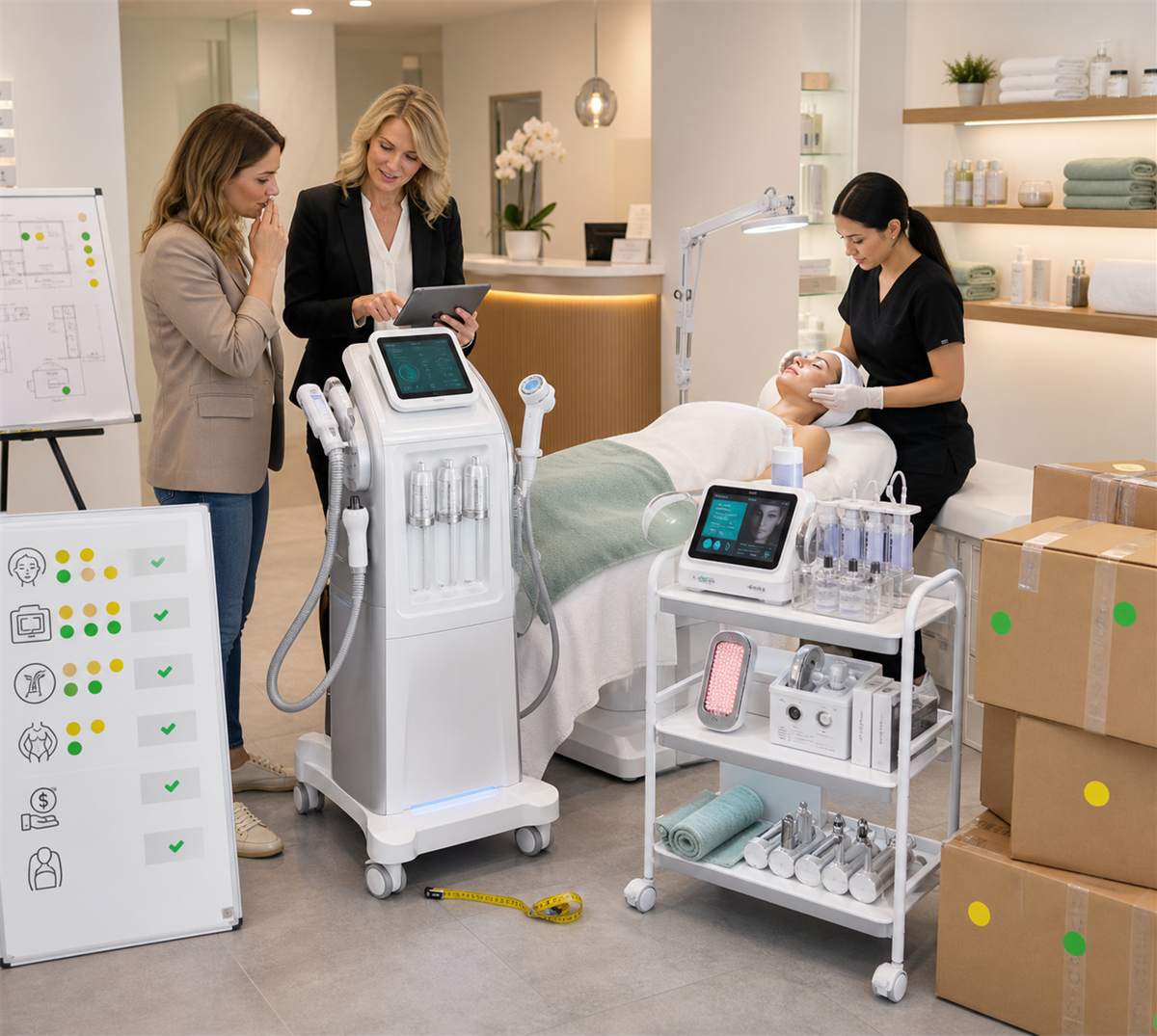
A new salon is not only buying machines. It is building a service menu.
The first batch of equipment should meet these criteria:
- Clear customer demand
- Moderate purchase cost
- Easy operation
- Short staff training time
- High treatment frequency
- Easy project packaging
- Low safety complexity
- Low after-sales risk
- Affordable consumables
- Small room footprint
- Realistic payback period
- Supplier training and warranty support
If a machine looks advanced but cannot be used often, cannot be explained clearly, or requires high customer trust before purchase, it may not be the best opening-stage choice.
3. Start With Market Demand, Not Supplier Catalogues
Before buying machines, a new salon should research local demand.
Ask:
- What age group will the salon mainly serve?
- What facial concerns are common locally?
- What prices do nearby salons charge?
- Which projects are already common?
- Which services are missing in the area?
- Do customers prefer basic care, skin management, anti-aging, hair removal, or body care?
- What service price can customers accept?
- How often are customers likely to return?
The U.S. Small Business Administration explains that market research helps businesses find customers and competitive analysis helps them find a unique position. For a new salon, equipment purchase should be based on customer demand, not only on what manufacturers promote.
4. Do Not Buy Too Many Machines At Opening
Many new salons make the mistake of buying too many machines before real customer demand is proven.
Too many machines can create:
- Cash flow pressure
- Idle equipment
- Staff training confusion
- Higher maintenance burden
- More consumable inventory
- Harder service menu design
- Slow payback
- More after-sales questions
A new salon should start with a focused, practical equipment set and expand after customer feedback is clear.
5. First Priority: Cleansing And Hydration Equipment
Cleansing and hydration projects are usually strong first services because customers understand them easily and can repeat them frequently.
Suitable equipment includes:
- Hydro facial machine
- Small bubble machine
- Oxygen spray device
- Oxygen infusion device
- Ultrasonic beauty device
These devices help build basic facial care projects such as deep cleansing, hydration facial, pore care, soothing care, and seasonal skin maintenance.
For a new salon, these projects are useful because they are easy to demonstrate, easier to sell, and less intimidating than advanced energy-based treatments.
6. Hydro Facial Machine
A hydro facial machine is one of the most practical first machines for many new salons.
Why it is useful:
- Customers understand cleansing and hydration
- It supports frequent services
- It can be sold as trial treatment, course, or membership service
- It fits small and mid-size salons
- It combines well with LED, oxygen spray, and skincare products
- Consumables can support repeat revenue
Check before buying:
- Pump strength
- Suction stability
- Water flow
- Bottle quality
- Tip fit
- Tube durability
- Cleaning convenience
- Noise level
- Consumable cost
- Spare parts availability
This machine is often a good traffic product for opening-stage salons.
7. Small Bubble Machine
Small bubble machines are similar in practical value to hydro facial machines. They support entry-level facial cleansing and skin management services.
Advantages:
- Moderate cost
- Easy to explain
- Easy to demonstrate
- Good for community salons
- Useful for first-time customer trials
- Fits basic facial packages
New salons should avoid extremely cheap models with weak pumps, leaking tubes, poor bottles, or unstable suction. These problems can hurt the opening reputation quickly.
8. Oxygen Spray Or Oxygen Infusion Device
Oxygen spray and infusion devices are useful as comfort-oriented add-ons.
They can support:
- Hydration care
- Soothing care
- Post-treatment comfort
- Sensitive skin care support
- Seasonal repair packages
- Add-on services after cleansing
Check spray stability, pressure control, nozzle quality, bottle design, cleaning method, and noise level.
This type of device is usually not the only core machine, but it is useful inside a starter facial care package.
9. Ultrasonic Beauty Device
Ultrasonic devices are practical because they are compact, affordable, and familiar to many salons.
They can be used for:
- Basic facial care
- Product absorption support
- Cleansing support
- Add-on services
- Entry skin management packages
Check vibration strength, handpiece quality, cable durability, heat level, output stability, and user manual clarity.
Ultrasonic equipment is not always a high-ticket project, but it helps complete the salon’s basic service workflow.
10. Cold And Hot Hammer
Cold and hot hammer devices are simple, but they can improve facial care experience.
They are useful for:
- Cooling
- Soothing
- Calming
- Post-care comfort
- Basic facial workflow
- Add-on service value
Check temperature change speed, temperature stability, handpiece comfort, cable quality, and shell durability.
For a new salon, this is a low-cost support tool that can make basic facial projects feel more complete.
11. Second Priority: LED Light Therapy
Basic LED light therapy is a strong first-batch option because it is easy for customers to accept and easy for salons to combine with other services.
It can support:
- Soothing care
- Repair-style packages
- Post-cleansing care
- Maintenance facial services
- Skin management packages
- Add-on sessions
Check:
- Wavelength information
- Lamp bead quality
- Light uniformity
- Treatment distance
- Timer
- Heat control
- Eye protection
- Stand quality
- User manual
- Supported claims
New salons should avoid unsupported medical, acne cure, disease, or guaranteed-result claims. FTC health product guidance supports the need for truthful, not misleading, and supported claims.
12. Third Priority: Basic Skin Analyzer
A skin analyzer can help a new salon build trust during consultation.
Benefits:
- Makes skin concerns easier to explain
- Helps staff recommend projects
- Improves customer confidence
- Supports before-and-after tracking
- Helps sell course packages
- Helps sell skincare products and add-on treatments
Check:
- Camera clarity
- Lighting consistency
- Report quality
- Software language
- Analysis categories
- Report export
- Account system
- Update policy
- Training support
- Data privacy and image storage
A skin analyzer may not directly perform treatment, but it can improve conversion and professional image.
13. Fourth Priority: Entry-Level EMS Microcurrent
EMS and microcurrent devices can help new salons add entry-level facial contour and anti-aging maintenance projects.
They are suitable when:
- Output is stable
- Customer sensation is comfortable
- Staff can learn operation quickly
- Conductive gel is easy to source
- Treatment protocol is clear
- Claims are realistic
Check adjustable intensity, handpiece quality, cable durability, mode logic, contraindications, gel cost, and training support.
Avoid selling EMS as a guaranteed lifting miracle. It is better positioned as part of a course-based facial care and maintenance project.
14. Fifth Priority: Entry-Level RF Facial Device
Entry-level RF facial devices can help a new salon create higher-ticket anti-aging and firming-style projects.
Advantages:
- Anti-aging demand is common
- Course packages are easier to design
- Service price can be higher than basic cleansing
- Customers understand firming and maintenance language
Check:
- Output stability
- Adjustable levels
- Temperature control
- Handpiece quality
- Treatment comfort
- Safety warnings
- Contraindications
- Training protocol
- Warranty for handpieces
FDA states that aesthetic devices may be regulated depending on intended use and whether they affect the structure or function of the body. New salons should avoid medical-like claims and stay within supported product positioning.
15. Multifunction Facial Machine
For a new salon with limited room and budget, a multifunction facial machine can be practical.
It may combine:
- Hydro facial
- Spray
- Ultrasonic
- RF
- EMS
- Cold and hot hammer
- Vacuum
- Skin scrubber
- Oxygen infusion
Advantages:
- Saves space
- Covers multiple basic projects
- Reduces first-batch purchase complexity
- Suitable for smaller rooms
- Supports flexible service packages
Risk:
- Some multifunction machines have many weak functions.
- Repairs may affect several services at once.
- Handpiece quality can vary.
Test every function before buying.
16. Essential Consumables And Accessories
New salons often forget consumables when budgeting.
Prepare:
- Hydro facial tips
- Filters
- Conductive gel
- RF gel
- Disposable covers
- Cleaning solution
- LED eye protection
- Replacement tubes
- Treatment heads
- Cotton pads
- Masks or skincare support products
- Warranty and maintenance accessories
Consumables affect treatment cost, pricing, project continuity, and payback.
17. Suggested Minimum Opening Set
For a new salon with a tight budget, a minimum practical set can include:
- Small bubble or hydro facial machine
- Cold and hot hammer
- Ultrasonic beauty device
- Basic LED light therapy device
- Starter consumables
This setup supports cleansing, hydration, soothing, repair, and basic facial projects. It is easier to train and less risky than a high-priced advanced device.
18. Suggested Standard Opening Set
For a new salon with a moderate budget, a standard first set can include:
- Hydro facial machine
- Basic skin analyzer
- LED light therapy device
- Oxygen spray or infusion device
- Entry-level EMS microcurrent device
- Starter consumables and accessories
This set supports consultation, cleansing, hydration, soothing, repair, and entry facial contour projects.
19. Suggested Upgrade Opening Set
For a new salon with stronger budget and trained staff, an upgraded set can include:
- Premium hydro facial machine
- Better skin analyzer
- Professional LED light therapy panel
- Entry-level RF facial device
- EMS microcurrent device
- Oxygen infusion device
- Consumables and maintenance kit
This setup can create a more complete skin management menu, but the salon should still avoid buying too many high-risk machines at once.
20. What Not To Buy Too Early
New salons should be careful with:
- Laser hair removal systems
- IPL devices
- Tattoo removal lasers
- Strong RF systems
- Focused ultrasound systems
- Cryolipolysis-style body contouring machines
- High-claim slimming devices
- Private care devices
- Large floor-standing high-cost machines
- Devices requiring complex compliance or medical-like claims
These categories may be added later after demand, staff training, documents, and after-sales are ready.
21. Why Laser And IPL Are Usually Not First-Batch Choices
Laser and IPL can be profitable, but they require stronger preparation.
They may require:
- Safety training
- Eye protection
- Skin type guidance
- Cooling performance
- Handpiece or lamp life management
- Better documents
- Stronger after-sales support
- More careful advertising claims
- Higher customer trust
If a new salon does not already have clear hair removal demand, it may be safer to start with facial care and skin management.
22. Why Body Contouring Should Wait
Body contouring can create high-ticket services, but it also creates higher operating pressure.
Challenges:
- Larger machine size
- Higher purchase cost
- Longer treatment time
- Stronger marketing need
- Higher customer expectation risk
- Slimming claim risk
- More training
- More maintenance
New salons should add body projects after they understand local customer demand and have stable cash flow.
23. Choose Machines That Support Opening Promotions
New salons need opening promotions that customers can understand quickly.
Good opening projects include:
- New customer cleansing trial
- Hydration facial package
- Skin analysis plus care plan
- LED soothing add-on
- Seasonal repair package
- Entry anti-aging maintenance course
Machines that support simple opening promotions are more useful than machines that require long technical education.
24. Match Equipment To Staff Training
New salons often have new staff. Choose equipment that can be learned quickly.
Good first-batch machines should have:
- Clear interface
- Simple steps
- Short training time
- Low safety complexity
- Easy cleaning
- Stable accessories
- Clear troubleshooting
- Supplier training support
Training is part of the purchase. Do not buy machines without operation guidance and service scripts.
25. Match Equipment To Room Space
Opening-stage salons may have limited rooms.
Check:
- Machine size
- Weight
- Desktop or floor-standing design
- Wheels
- Cable storage
- Handpiece storage
- Ventilation
- Noise
- Doorway clearance
- Distance from treatment bed
For small spaces, compact and multifunction machines may be better than several large devices.
26. Calculate Payback Before Buying
New salons must protect cash flow.
Calculate:
- Machine price
- Freight and tax
- Installation
- Training
- Starter consumables
- Marketing launch cost
- Treatment price
- Consumable cost per treatment
- Staff cost
- Expected monthly sessions
- Monthly net contribution
- Payback months
SBA break-even guidance uses fixed costs divided by price minus variable costs to calculate break-even units. For salon equipment, the unit can be one treatment session. Salons should use net contribution, not revenue alone.
27. Recommended Payback Logic For Opening Stage
A new salon should prefer machines that can recover investment through:
- High-frequency treatments
- Package sales
- Membership add-ons
- Consumable-supported services
- Repeat customers
- Cross-selling skincare products
- Consultation-driven project upgrades
If a machine requires a large number of new high-ticket customers before it can pay back, it may be risky for a new salon.
28. Budget Planning For First-Batch Equipment
A practical opening budget should include:
- Equipment cost
- Delivery and installation
- Training
- Starter consumables
- Spare parts kit
- Marketing materials
- Room setup
- Maintenance reserve
- Emergency repair reserve
SBA startup cost guidance supports estimating all costs needed before and during launch. Do not use the machine price alone as the opening equipment budget.
29. Check Warranty And After-Sales Before Paying
New salons should ask:
- What is the warranty period?
- Are handpieces covered?
- Are consumables excluded?
- Who pays repair freight?
- Is local repair available?
- Are spare parts available?
- How fast is technical support?
- Are repair videos provided?
- Is training included?
- What happens if the machine arrives damaged?
Unclear after-sales can turn a useful machine into an opening-stage problem.
30. Check Documents And Claims
Before buying, ask for:
- Product specification
- User manual
- Warranty terms
- Factory QC report
- Test reports where applicable
- CE-related documents where applicable
- FCC or RoHS documents where applicable
- FDA or local regulatory information where applicable
- Spare parts list
- Consumables list
- Training protocol
Avoid unsupported claims such as guaranteed lifting, acne cure, permanent fat loss, reverse aging, no side effects, safe for everyone, or one-session transformation.
31. Build A Service Menu Around The Machines
The first machines should support a clear opening service menu.
Example opening menu:
- Skin analysis consultation
- Deep cleansing facial
- Hydration facial
- LED soothing care
- Oxygen repair care
- EMS facial contour care
- Entry RF firming maintenance
- Seasonal skin repair package
- Monthly facial membership
This turns machines into services customers can buy.
32. Build A Starter Package Instead Of Single Services
New salons should not rely only on single treatments.
Possible packages:
- New customer trial package
- Hydration and cleansing 4-session package
- Skin analysis plus monthly care package
- LED repair 6-session course
- Entry anti-aging maintenance course
- Seasonal repair membership
Packages help improve cash flow and customer retention.
33. Use Skin Analyzer To Sell Better
A skin analyzer can help opening-stage salons appear more professional.
It supports:
- Customer consultation
- Skin problem explanation
- Service recommendation
- Course package design
- Progress tracking
- Membership renewal
For a new salon, consultation tools can make sales less dependent on hard selling.
34. Use LED As A Flexible Add-On
LED light therapy can be used with many facial projects.
It can be positioned as:
- Add-on care after cleansing
- Soothing support
- Repair-style step
- Package value booster
- Membership benefit
Because it is comfortable and visual, it can help the salon make basic projects feel more professional.
35. Use Hydro Facial As A Traffic Project
Hydro facial or small bubble service can be used as a traffic project.
Opening strategy:
- Offer a first-time trial
- Use it to introduce skin analysis
- Recommend hydration or repair packages
- Pair with LED or oxygen spray
- Sell monthly care membership
This creates a pathway from low-barrier trial to repeat service.
36. Use EMS Or RF As Upgrade Projects
EMS and RF can help the salon move customers from basic care to higher-value care.
Use them for:
- Entry anti-aging packages
- Facial contour maintenance
- Firming-style care
- Course-based services
- Premium membership upgrade
Keep claims realistic and explain that results may depend on customer condition, treatment frequency, and correct operation.
37. Opening Equipment Purchase Workflow
A practical workflow:
1. Define target customers.
2. Study nearby salon prices.
3. Choose first service menu.
4. Select practical equipment categories.
5. Request supplier documents.
6. Test sample or demo machines.
7. Calculate payback.
8. Confirm warranty and after-sales.
9. Buy a focused first batch.
10. Train staff.
11. Launch opening packages.
12. Track customer feedback.
13. Add advanced machines after demand is proven.
This process reduces waste and purchasing regret.
38. Common Opening Purchase Mistakes
Common mistakes include:
- Buying too many machines
- Buying the most expensive machine first
- Buying only by low price
- Ignoring local demand
- Ignoring training
- Ignoring consumables
- Ignoring warranty
- Not calculating payback
- Choosing machines that do not fit room space
- Trusting exaggerated supplier claims
- Buying high-risk devices without documents
- Creating a service menu after machines arrive
The service menu should guide equipment purchase, not the other way around.
39. Red Flags Before Buying
Be cautious if:
- Supplier cannot provide model-specific documents
- Warranty is vague
- No training is provided
- Spare parts are unavailable
- Consumables are unstable
- Machine overheats during demo
- Handpieces feel weak
- Software language is poor
- Supplier pushes too many machines at once
- Claims sound unrealistic
- Price is far below market without explanation
- After-sales process is unclear
Several red flags together should stop the purchase.
40. Final Checklist
Before buying first-batch equipment for a new salon, confirm:
- Target customer group is clear.
- Opening service menu is clear.
- Machines support high-frequency projects.
- Staff can learn operation quickly.
- Treatment time fits room capacity.
- Consumable cost is known.
- Warranty terms are written.
- Spare parts are available.
- Training is included.
- Documents match the model.
- Claims are realistic.
- Payback is calculated.
- Sample or demo testing is passed.
- Supplier after-sales is reliable.
- Advanced machines can wait until demand is proven.
If these points are clear, the salon can open with a practical and manageable equipment setup.
Conclusion
For a new beauty salon, the most practical first machines are usually hydro facial or small bubble machines, oxygen spray or infusion devices, ultrasonic beauty devices, cold and hot hammer, basic LED light therapy, entry-level EMS microcurrent, entry-level RF facial devices, basic skin analyzers, multifunction facial machines, and essential consumables.
These machines help the salon build basic facial care, skin consultation, hydration, soothing, repair, and entry anti-aging services. They are easier to train, easier to explain, easier to package, and more realistic for early cash flow.
More expensive or high-risk devices such as laser, IPL, strong RF, focused ultrasound, tattoo removal, body contouring, and private care equipment should usually be added after the salon has stable customers, trained staff, stronger service processes, and reliable after-sales support.
New salon equipment purchasing should be practical, not impulsive. Start with what can be used often, sold clearly, and paid back realistically. Then upgrade step by step.
FAQ
What instruments should a new beauty salon buy first?
A new beauty salon should usually start with hydro facial or small bubble machines, oxygen spray, ultrasonic beauty devices, cold and hot hammer, basic LED light therapy, entry-level EMS, entry-level RF, basic skin analyzer, multifunction facial machine, and essential consumables.
Should a new salon buy laser or IPL machines first?
Usually not unless the salon already has clear hair removal demand, trained staff, safety procedures, documents, and reliable after-sales support. Facial care and skin management machines are usually safer first choices.
Is a skin analyzer practical for a new salon?
Yes. A skin analyzer can improve consultation, help explain customer skin concerns, support service recommendations, and increase course package conversion.
Are multifunction facial machines suitable for opening-stage salons?
They can be suitable if the functions are practical and stable. New salons should test every function and avoid machines with many weak functions added only for catalogue appeal.
How should a new salon control equipment budget?
The salon should calculate machine price, freight, tax, installation, training, consumables, spare parts, room setup, marketing launch, maintenance reserve, and payback period before buying.
What equipment should a new salon avoid buying too early?
New salons should be cautious with laser, IPL, tattoo removal, strong RF, focused ultrasound, cryolipolysis-style body contouring, private care devices, and high-claim slimming machines.
How can a new salon know whether a machine is worth buying?
The salon should check customer demand, treatment price, consumable cost, staff training, warranty, documents, sample testing, after-sales support, and payback period before buying.