









A woman describes leakage when she coughs or lifts a child. Another cannot reach the bathroom after a sudden urge. Both may use the words “urinary incontinence,” but they need different assessments and may need different care. A pelvic floor chair should enter the conversation only after someone qualified has identified the problem, discussed established treatment options, and checked whether the specific device can lawfully be used for that purpose.
For clinics, pelvic health practices and distributors searching for equipment to support urinary incontinence services, this is the crucial distinction: a chair that stimulates pelvic muscles is a technology description; “treating urinary incontinence” is a medical claim about a particular device, patient group and market. This article examines the clinical pathway, the evidence for extracorporeal magnetic stimulation, and the three relevant chairs in SHEFMON’s Emslim category.
First identify the kind of leakage
Stress urinary incontinence is leakage during increased abdominal pressure, such as coughing, jumping or lifting. Urgency urinary incontinence involves leakage associated with a sudden compelling need to void. Mixed incontinence has features of both. These labels are not interchangeable sales segments: symptoms can also reflect infection, medication effects or another condition that needs medical attention.
The NICE guideline on urinary incontinence in women calls for a clinical assessment that identifies the type of incontinence, relevant history and other diagnoses requiring referral. Its recommended first steps differ by presentation. For stress or mixed urinary incontinence, it recommends at least three months of supervised pelvic floor muscle training as first-line treatment. For urgency or mixed symptoms, it recommends bladder training for at least six weeks as first-line care. A shopfront promise that one chair “treats all bladder leakage” obscures these decisions.
Consider a postpartum client who reports small leaks when lifting and has not yet had a pelvic floor assessment. The appropriate first appointment is a qualified evaluation and a plan for supervised training, not a prepaid chair package. By contrast, a pelvic health clinic may be reviewing additional options for someone already assessed who struggles to produce an effective voluntary pelvic floor contraction. The clinical rationale, documentation and follow-up are clearer in the second setting.
What the chair does—and what it cannot establish on its own
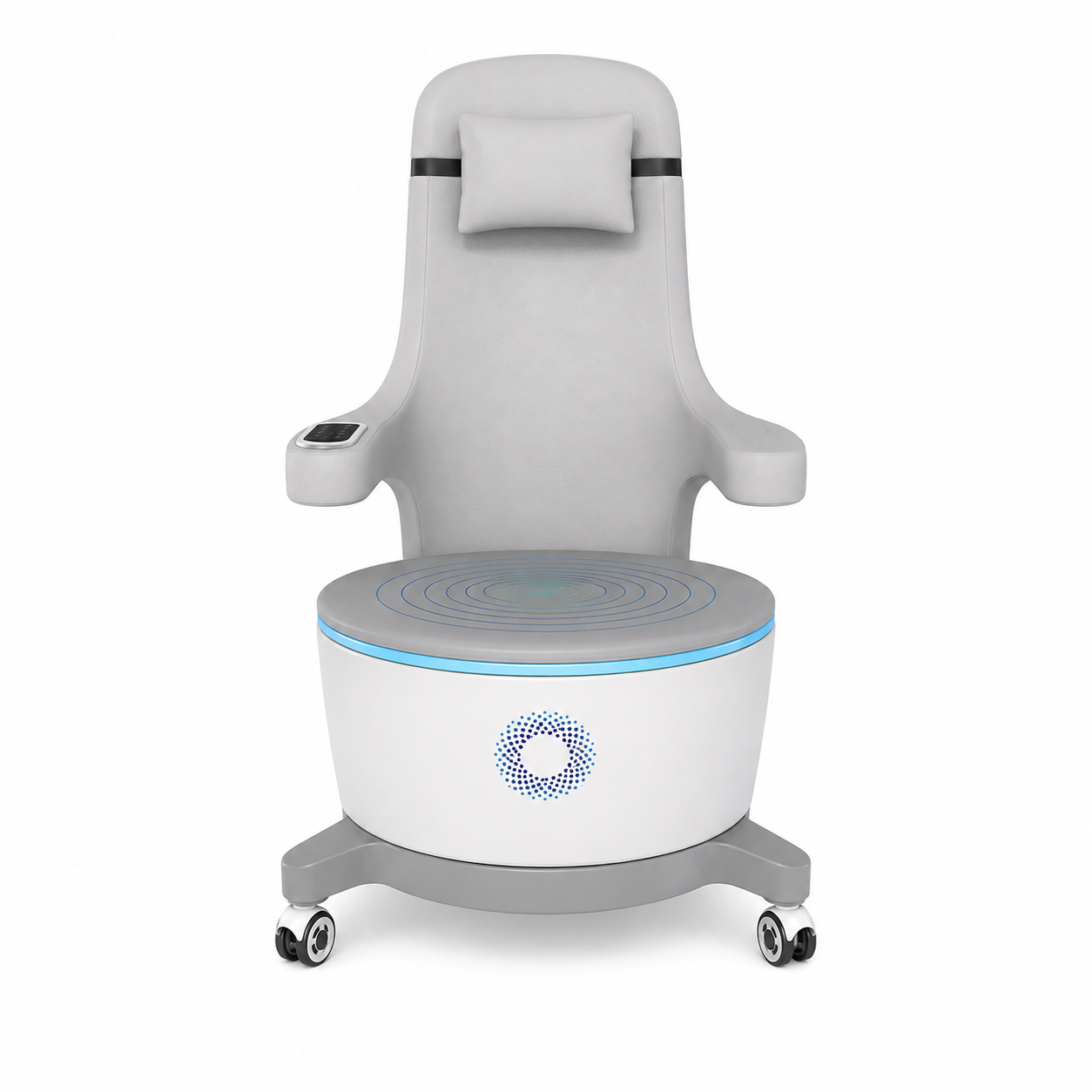
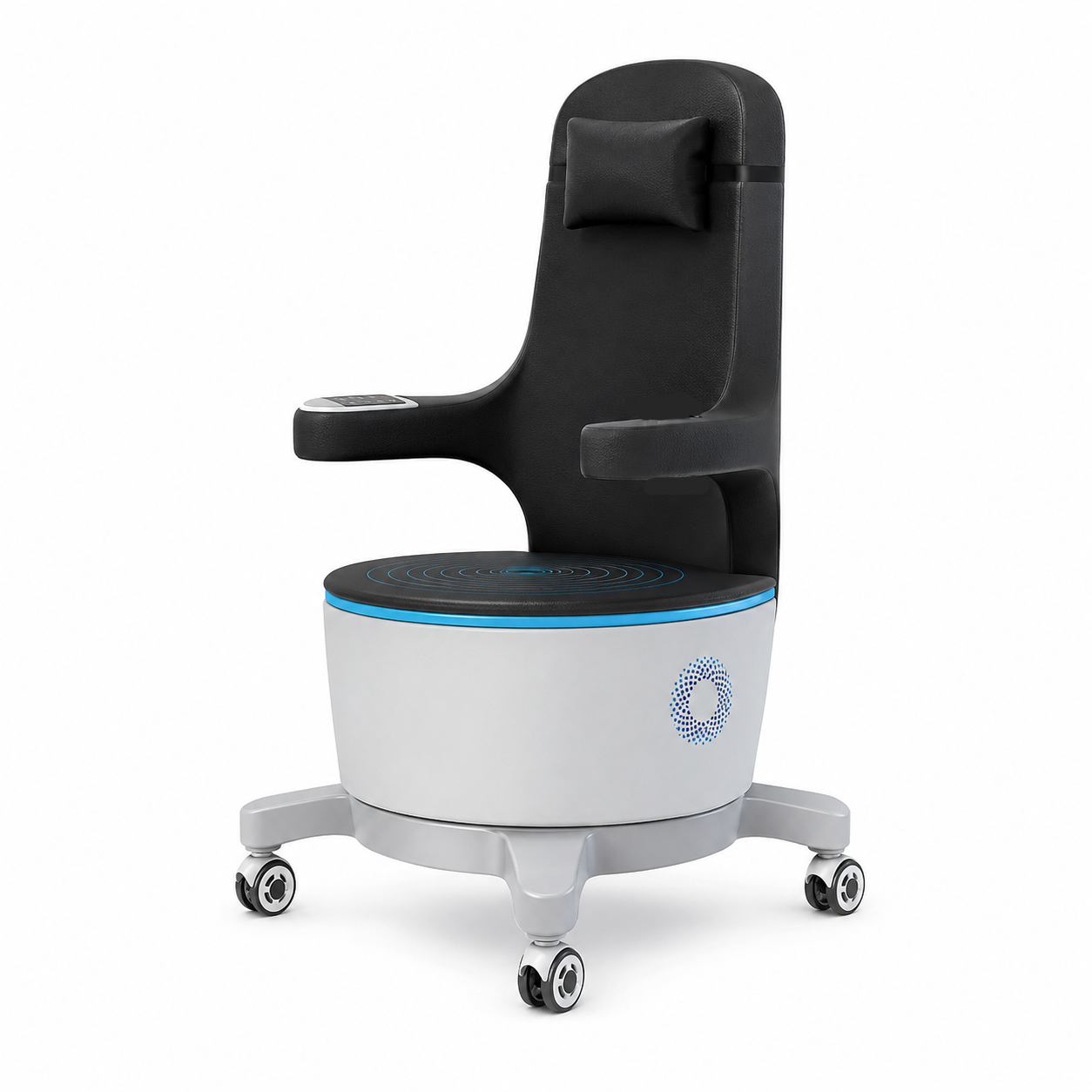
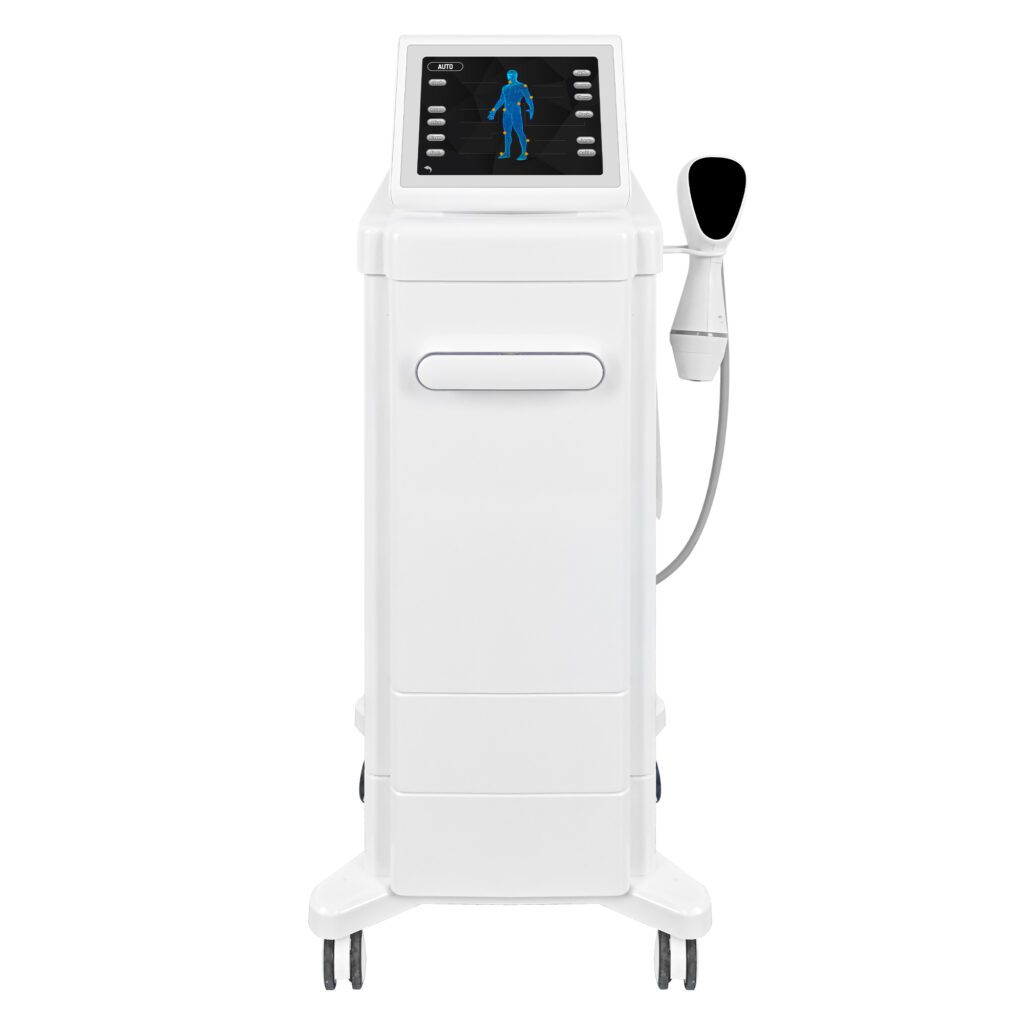
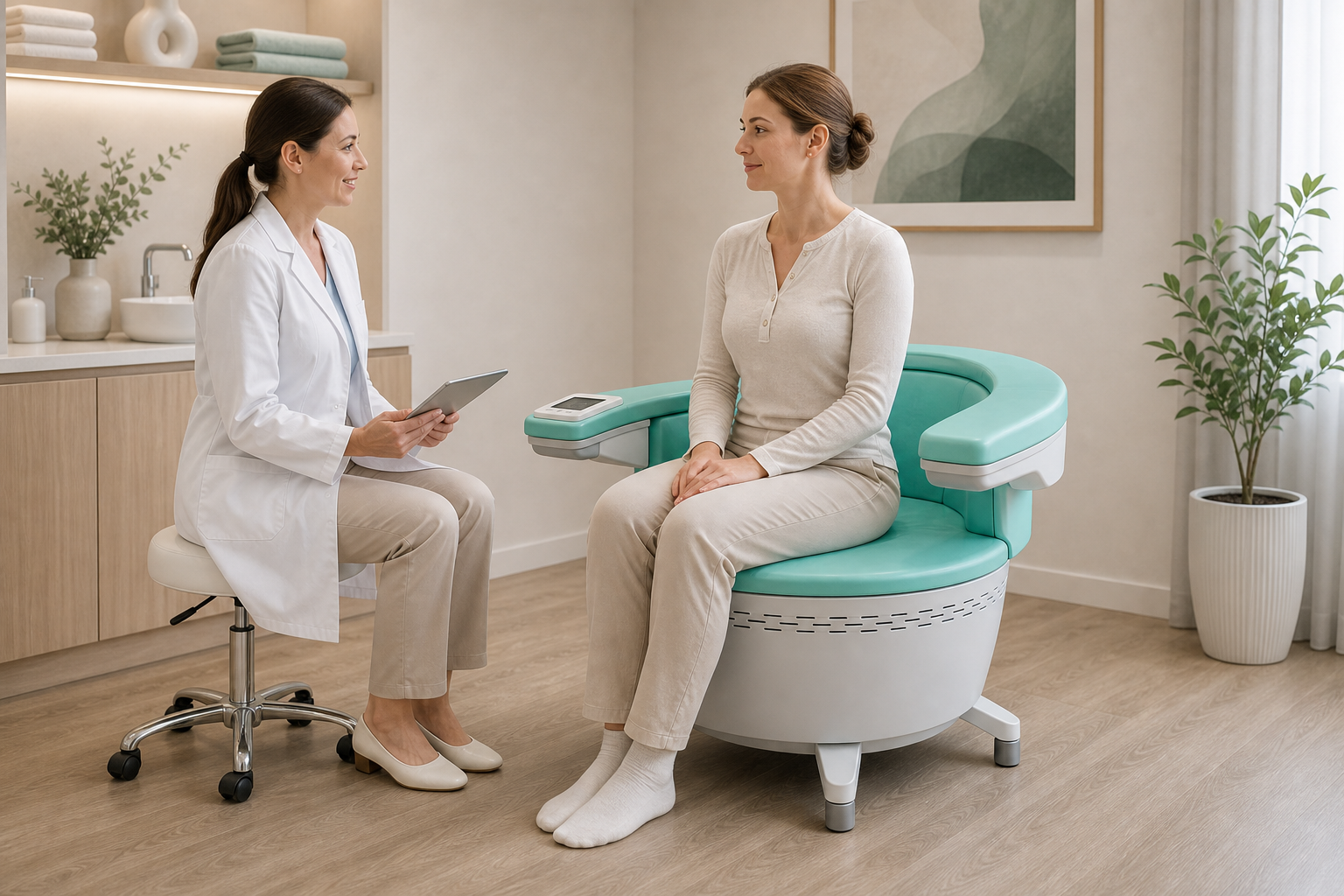
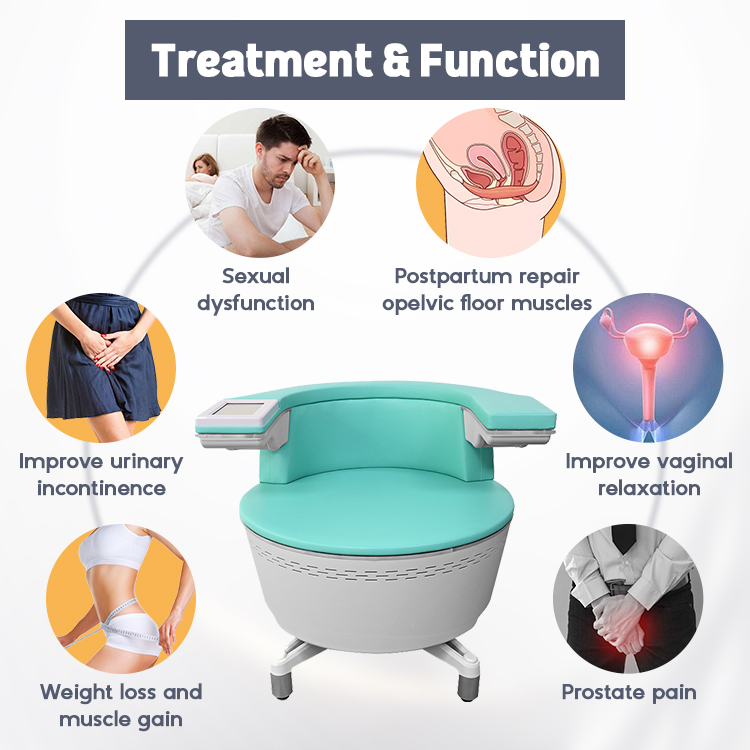
An extracorporeal magnetic stimulation chair places a pulsed electromagnetic field near the pelvic floor while the patient sits on the seat. The changing field can induce neuromuscular activity and pelvic muscle contractions without an internal probe. That differs from voluntary pelvic floor muscle training, which teaches a person to identify, contract and relax the muscles and to continue exercising outside the clinic.
The mechanism explains why chair-based stimulation attracts interest, especially when a patient has difficulty recruiting the pelvic floor. It does not show that every electromagnetic chair has the same field distribution, treatment dose, patient suitability or measured outcome. Claims such as “10,000 Kegels in 30 minutes” are a marketing analogy, not a validated equivalence to a supervised exercise programme. A high Tesla figure alone is equally inadequate as a clinical comparison: coil geometry, position, pulse pattern, duty cycle and the delivered field matter.
NICE does not recommend routine electrical stimulation as an addition to pelvic floor muscle training, though it says electrical stimulation and/or biofeedback may be considered to help women who cannot actively contract the muscles. Its pelvic floor dysfunction guidance likewise places supervised training first. Electrical stimulation in those recommendations should not be silently treated as identical to every magnetic chair; a clinic must examine the evidence and instructions for its own technology.
How strong is the evidence for magnetic stimulation?
There is published evidence, but the answer depends on which studies and outcomes are examined. A 2020 systematic review and meta-analysis reported improvements in measures including leakage and quality of life and concluded that extracorporeal magnetic stimulation may help urinary incontinence. An earlier review of 20 studies and 1,019 participants judged the evidence low quality and found no convincing benefit across several pooled sham-controlled outcomes. More recently, a review of 17 randomized trials involving 1,389 women with stress urinary incontinence reported improvements in some symptom and quality-of-life measures, but not a significant difference in 24-hour pad tests or pelvic floor strength; the authors cautioned about heterogeneity and limited evidence for some outcomes.
Taken together, these results support careful clinical interest, not a universal cure claim. Studies differ in patient selection, comparator, protocol, follow-up and device. A supplier cannot transfer pooled findings to the SHEFMON E0436 simply because it uses electromagnetic stimulation. Ask whether there are studies on the exact model and version, with a defined incontinence type, validated symptom measures and meaningful follow-up.
A comparison that starts with service design
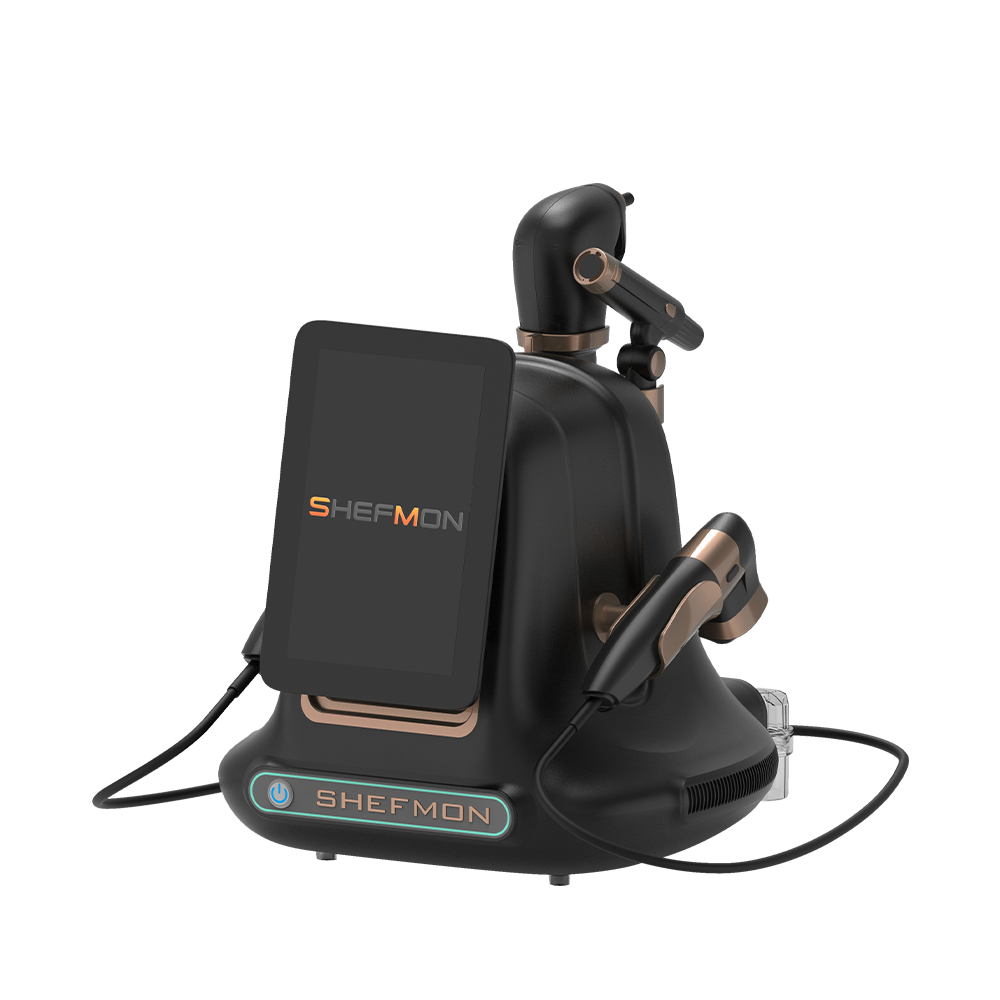
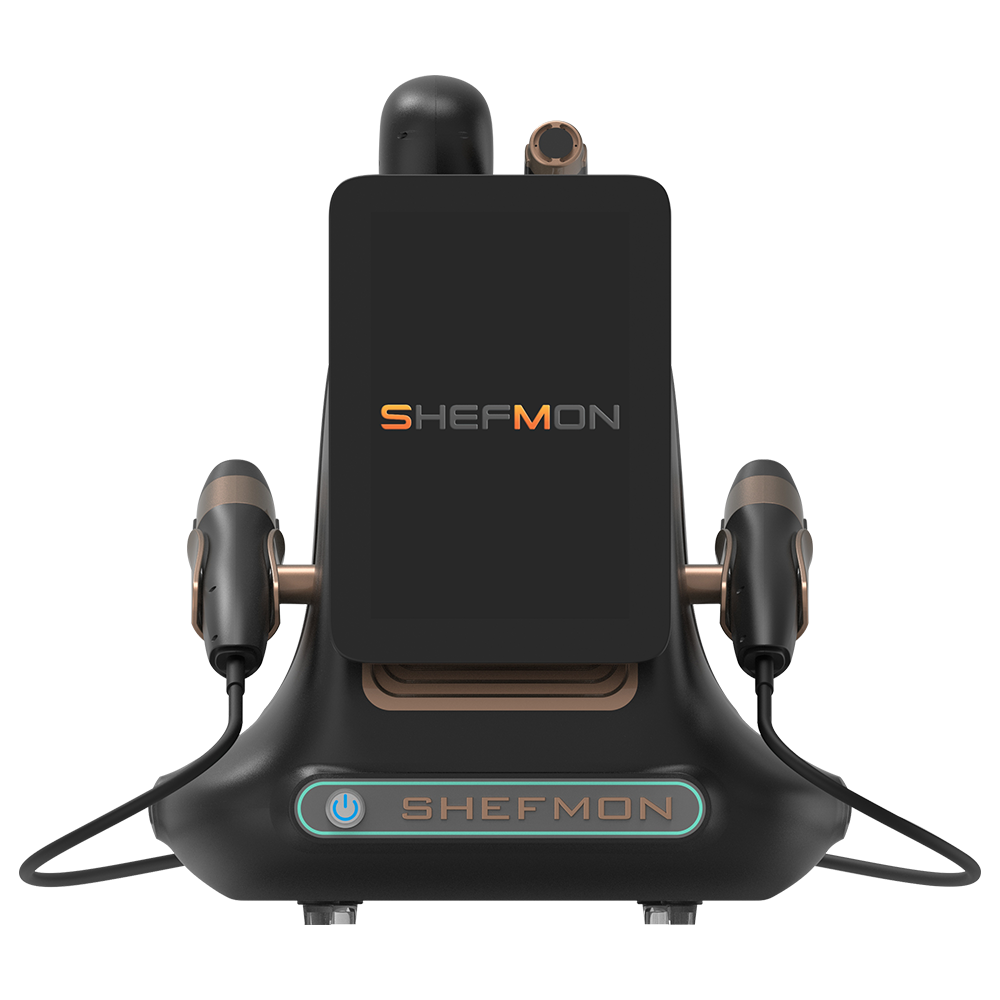
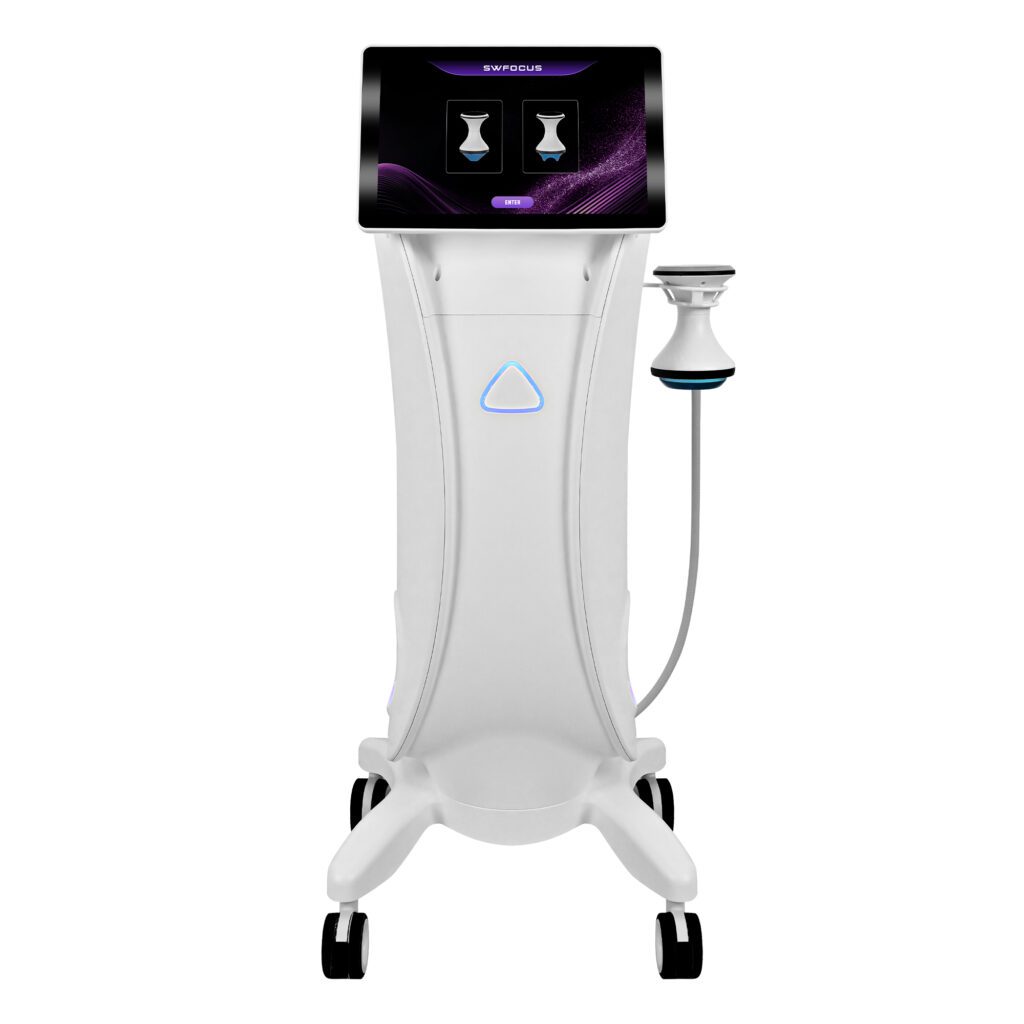
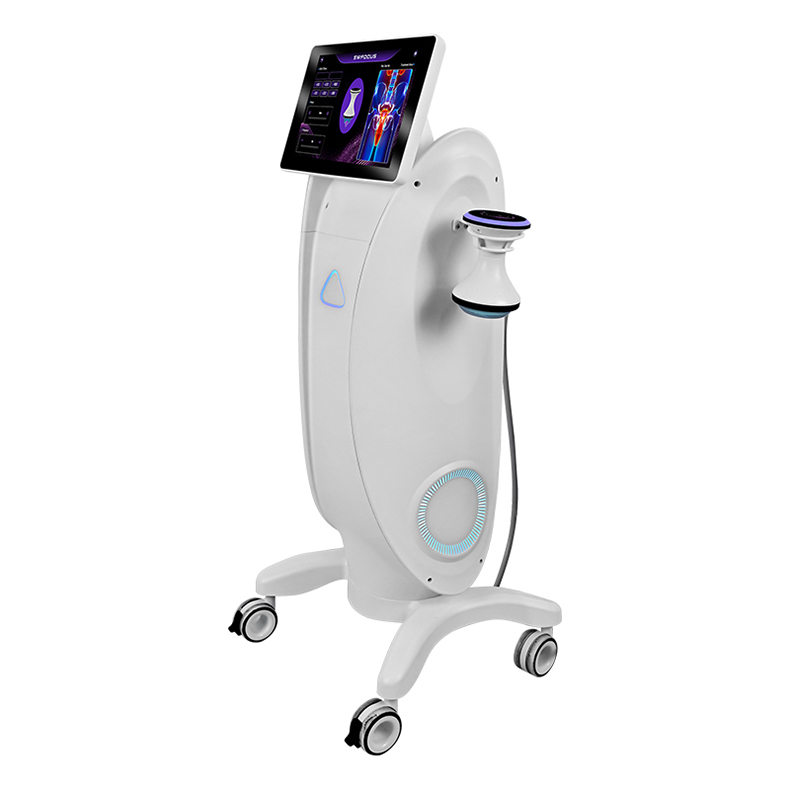
The SHEFMON Emslim collection contains body sculpting, facial muscle and pelvic floor devices. For this topic, the relevant products are the three pelvic floor chairs. Ordinary abdominal EMS sculpting machines are not a substitute for a chair intended to target pelvic floor musculature.
| SHEFMON model | What the current public page emphasizes | Sensible buyer question |
|---|---|---|
| E0435 pelvic floor chair | Postpartum and pelvic floor positioning; the page also makes stress incontinence claims | What exact intended use, patient group and local authorization are documented for the delivered version? |
| E0436 electromagnetic pelvic floor chair | Pelvic floor rehabilitation positioning and a seated electromagnetic stimulation workflow; this is the model in the product video below | Which clinical protocol, screening materials, operator training and model-specific evidence accompany the chair? |
| E0437 pelvic floor and back training chair | Pelvic floor strengthening plus back muscle training on one platform | Are the pelvic and back modes separately documented, and is an incontinence indication actually authorized in the destination market? |
The choice is not a ranking by advertised field strength. A pelvic physiotherapy practice may prefer a focused E0436 discussion because its workflow and video are clearly centered on seated pelvic floor stimulation. A postpartum service might ask about E0435, but it still needs qualified assessment and an exact, lawful claim set. E0437 may appeal to a broader rehabilitation business; its back-training feature adds a separate service, not evidence that it treats a wider range of urinary symptoms.
The public E0435 and E0436 pages contain ambitious claims, including rapid improvement and a numerical “Kegel equivalent.” Do not copy those lines into a clinic’s patient materials without model-specific substantiation and legal review. Request the current user manual and technical file rather than relying on a website paragraph or an older blog’s parameter table.
What a responsible clinic pathway looks like
A pelvic health service can make the equipment useful without turning the chair into the whole treatment plan.
- Assessment: A qualified clinician identifies stress, urgency or mixed symptoms, checks relevant history and red flags, and establishes baseline measures. The assessment determines whether referral, investigation or another first-line intervention is needed.
- A documented conservative plan: For stress or mixed urinary incontinence, supervised pelvic floor muscle training remains the reference pathway in NICE guidance. For urgency symptoms, bladder training has its own role. The patient learns what to do between visits.
- Device suitability decision: If magnetic stimulation is being considered, the clinician checks the exact chair’s indications, exclusions, precautions, local authorization and how it fits the individual plan. The chair is not presented as a replacement for all other care.
- Observed session and record: Staff use the delivered manual for positioning and settings, monitor tolerance, record the device/version and session details, and respond to discomfort or faults. This article supplies no universal treatment schedule or intensity.
- Outcome review: Use consistent measures such as a bladder diary, leakage frequency, pad use or a validated questionnaire appropriate to the practice. Reassess whether the intervention is helping rather than selling an indefinite series in advance.
A beauty salon without licensed pelvic health assessment or a medical referral relationship should not independently diagnose and advertise treatment of urinary incontinence. A distributor should qualify the buyer’s facility, operator and market before proposing a disease-claim brochure.
Safety and compliance belong in the quotation
Magnetic stimulation can interact with implanted electronic devices and may be unsuitable for people with certain implants or other conditions. Pregnancy, recent procedures, infection, pain or unexpected urinary symptoms call for careful evaluation under the exact device labeling and local clinical rules. The absence of an internal probe does not make screening optional. Staff should know how to stop a session, document adverse symptoms and direct the patient for assessment.
For a U.S. buyer, “FDA registered” and “FDA cleared to treat urinary incontinence” are different statements. The FDA 510(k) record for another manufacturer’s pelvic magnetic stimulation chair illustrates how a clearance names a specific legal manufacturer, model and intended use. It is not a clearance for a SHEFMON chair. Before any disease treatment claim in the United States, obtain and verify the exact SHEFMON model’s authorization and labeling. Apply the same model-specific check to the registration, professional scope and advertising rules of any other destination country.
An equipment quotation should therefore identify the model and hardware/software revision, intended use, seat and coil configuration, electrical requirements, operator manual, screening and cleaning instructions, training, maintenance, warranty, replacement parts and destination-market documents. Ask how the chair behaves after a fault and whether the delivered unit matches the demonstrated unit. Price and session capacity only become meaningful after those items are specified.
Conclusion
“Treating urinary incontinence” is a high-intent search because the reader is looking for a real solution. An honest article should help a clinic place pelvic floor magnetic stimulation in a clinical pathway: first characterize the leakage, use established conservative care, evaluate the evidence for the proposed intervention, and verify the exact device’s legal intended use. This approach also gives an equipment buyer clearer questions to ask than a promise of instant results.
Explore the SHEFMON Emslim category and the E0436 pelvic floor chair if your practice is equipped to assess and manage pelvic health patients. Contact SHEFMON with your destination market and intended clinical setting to request the current model-specific manual, indication documents and configuration before placing an order.
See the E0436 chair
The following SHEFMON product video shows the E0436 chair’s appearance and operation. It is a device demonstration, not clinical evidence of symptom improvement.