









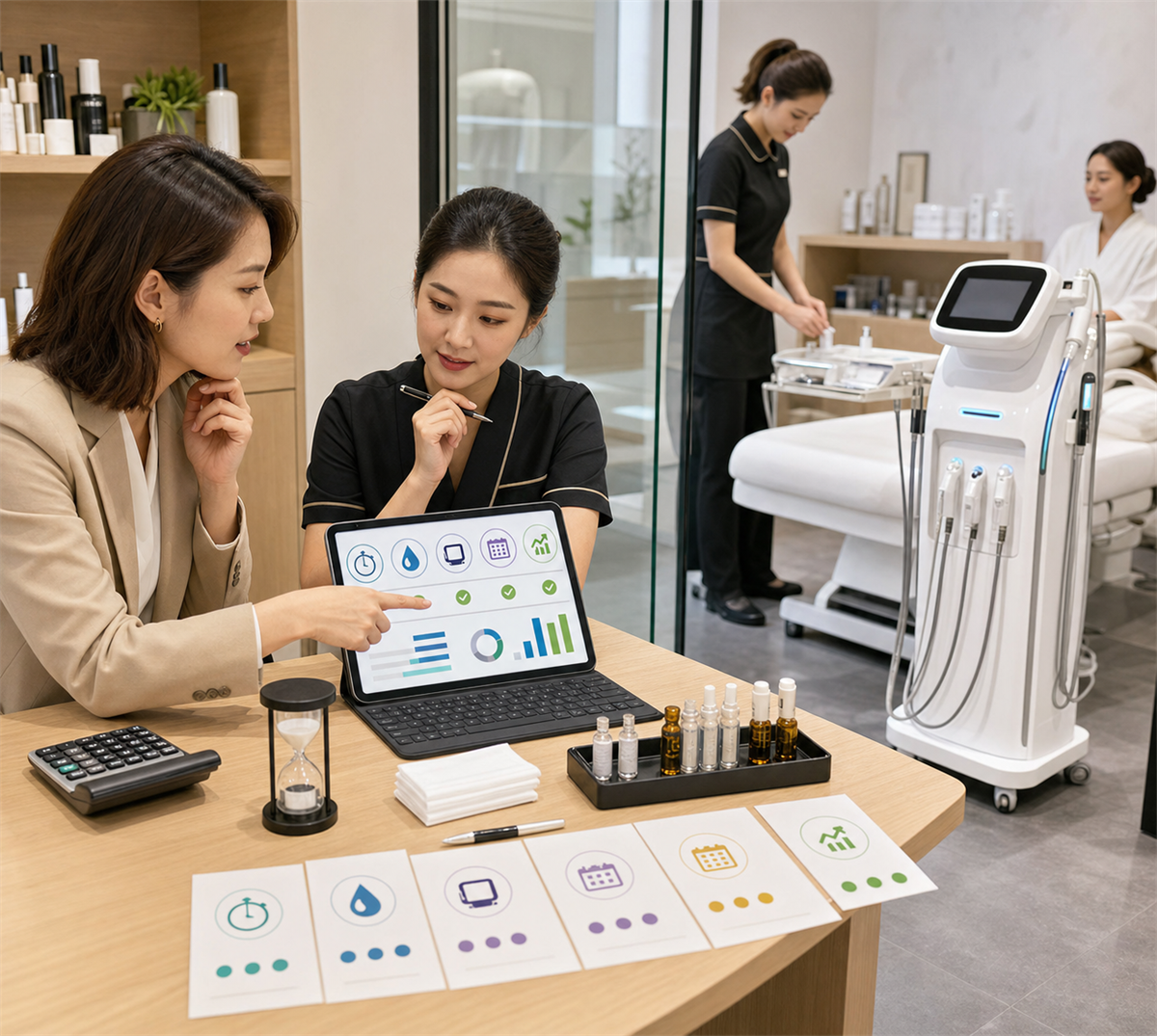
Beauty salons should set equipment trial prices by calculating real treatment cost first, then designing the trial as a controlled conversion tool. A trial price should not be chosen only because competitors charge a low price or because the salon wants more traffic. If the price is too low, the salon may fill the schedule with discount customers, consume expensive consumables, exhaust staff, reduce premium positioning, and still fail to sell packages.
The purpose of a beauty equipment trial is not only to let customers try the machine. It should help the salon attract suitable customers, complete consultation, show professional value, collect feedback, and guide customers into a course package or membership plan.
The safest pricing principle is simple: know your cost, control your discount, connect the trial with a next-step package, and track conversion data every week.
Why Many Beauty Equipment Trial Prices Lose Money
Many salons set trial prices by feeling. They see another store offering a low-price RF trial, small bubble trial, hydro facial trial, or body contouring trial, then they copy the price without knowing the real cost.
This creates several problems:
- The trial price does not cover consumables.
- Staff time is not included in the cost.
- Machine depreciation and handpiece wear are ignored.
- Customer acquisition cost is not calculated.
- Cleaning and room turnover time are forgotten.
- Trial customers are not screened.
- Customers buy only cheap trials and do not convert.
- Staff become busy but revenue does not improve.
- High-end projects lose perceived value.
A trial can be priced below the normal service price, but it should not be financially blind. Even when a salon accepts a small loss on the first visit, the expected package conversion must be realistic and measurable.
The Core Formula: Trial Price Must Be Based On Unit Economics
Before setting any trial price, calculate the real cost of one trial.
Basic trial cost formula:
Trial cost = consumables + staff labor + room cost + machine wear + cleaning and preparation + marketing cost + payment fee + follow-up cost.
Then compare:
Trial gross result = trial price – trial cost.
If the trial price is lower than the trial cost, the salon is losing money on the first visit. That is not always wrong, but it must be intentional. The salon must know how many trial customers convert into packages and how much gross profit each package creates.
Expected trial value formula:
Expected trial value = trial price – trial cost + conversion rate x package gross profit.
If expected trial value is positive, the trial can be a profitable marketing tool. If it is negative, the salon is paying to serve discount customers.
Step 1: Calculate Consumable Cost Per Trial
Consumables are the easiest cost to ignore. Equipment projects may use tips, filters, tubes, gels, serums, masks, protective covers, membranes, cartridges, lamps, pads, cotton, sheets, gloves, and cleaning supplies.
Examples of consumable cost items:
- Проводящий гель.
- Hydro facial solutions.
- Одноразовые наконечники.
- Фильтры.
- Tubes and seals.
- LED eye protection covers.
- Cryolipolysis membranes.
- HIFU cartridge lines or shots.
- IPL lamp shots.
- Towels, sheets, cotton, and gloves.
- Cleaning and disinfection products.
For shot-count or line-count machines, calculate cost by usage.
Пример:
If a HIFU cartridge costs 300 dollars and supports 600 lines, the cartridge cost is 0.50 dollars per line. If a trial uses 100 lines, the cartridge cost is 50 dollars before labor, room, and machine cost.
If an IPL lamp costs 500 dollars and supports 100,000 shots, the lamp cost is 0.005 dollars per shot. If a trial uses 1,000 shots, the lamp cost is 5 dollars before other costs.
Every salon should know these numbers before promoting trial offers.
Step 2: Include Staff Time
Equipment trials usually take more time than the treatment itself. Staff may need to consult, explain, prepare, operate, clean, summarize, recommend a package, and follow up.
Staff time may include:
- Подтверждение записи на прием.
- Консультация.
- Оценка состояния кожи или тела.
- Проверка на соответствие требованиям.
- Treatment preparation.
- Equipment operation.
- Очистка и дезинфекция.
- Aftercare explanation.
- Рекомендация по упаковке.
- Дополнительное сообщение.
If the treatment takes 40 minutes but the full service flow takes 70 minutes, pricing should be based on 70 minutes of staff and room time.
Formula:
Staff cost per trial = staff hourly cost x total service time in hours.
Even if the staff is paid monthly, the time still has opportunity cost. If a low-price trial occupies a room and beautician during peak hours, the salon may lose a higher-value appointment.
Step 3: Add Machine Wear And Maintenance Reserve
Beauty equipment has replacement and maintenance costs. Trial pricing should include a small reserve for machine wear, handpiece life, filters, tubes, lamps, cartridges, repairs, and future maintenance.
Machine wear can be estimated in different ways:
- Cost per treatment based on expected machine life.
- Cost per shot for IPL or laser lamps.
- Cost per line for HIFU cartridges.
- Cost per month for maintenance reserve.
- Cost per session for handpiece replacement reserve.
Simple method:
Machine reserve per trial = estimated monthly maintenance and replacement reserve divided by expected monthly treatments.
Пример:
If the salon sets aside 200 dollars per month for maintenance and replacement parts, and the machine is expected to perform 100 treatments per month, the reserve is 2 dollars per treatment.
For high-value machines, ignoring this reserve can make trial pricing look profitable while silently consuming equipment life.
Step 4: Add Customer Acquisition Cost
If the salon uses paid ads, influencer posts, group buying, local promotions, or referral rewards to bring trial customers, the acquisition cost must be included.
Customer acquisition cost can include:
- Online advertising.
- Short video promotion.
- Influencer fee.
- Platform commission.
- Referral reward.
- Poster or flyer cost.
- Staff time spent responding to inquiries.
- Booking system or payment fee.
Formula:
Acquisition cost per trial customer = total campaign cost divided by number of completed trial visits.
Do not divide by inquiries only. Many inquiries do not show up. Use completed visits or qualified appointments for a more realistic number.
Step 5: Decide Whether The Trial Must Break Even
Not every trial has to make profit on the first visit. There are three common pricing strategies.
Break-Even Trial
The trial price covers the full trial cost. This is safer for salons that are still testing a project or have weak conversion data.
Лучше всего подходит для:
- New machines.
- New staff.
- Unknown local demand.
- Higher-cost consumables.
- Salons with limited cash flow.
Controlled-Loss Trial
The trial price is slightly below cost, but the salon expects package conversion to cover the gap. This requires strict tracking.
Лучше всего подходит для:
- Projects with high package profit.
- Stores with strong sales process.
- Qualified customer traffic.
- Paid trial fee deduction.
Profit Trial
The trial price is lower than normal price but still profitable. This is ideal when the salon has strong positioning and customers accept value-based pricing.
Лучше всего подходит для:
- Premium salons.
- High-end equipment projects.
- Existing members.
- Professional consultation-based services.
For most salons, a break-even or small-profit trial is more sustainable than a very low trial price.
Step 6: Use Trial Fee Deduction To Protect Value
A deductible trial fee is often better than a very low trial price.
Пример структуры:
- Customer pays a professional trial fee.
- The trial includes consultation, assessment, and one focused equipment session.
- If the customer buys a package within 48 to 72 hours, the trial fee can be deducted.
- If the customer does not buy, the salon still receives enough payment to cover most or all trial cost.
This structure helps because:
- Customers take the appointment more seriously.
- No-show rate may decrease.
- The project does not look too cheap.
- Staff have a clear closing path.
- The salon protects cost.
- Customers feel the trial payment has value.
The deduction rule must be clear: amount, deadline, eligible packages, whether it can be combined with other promotions, and whether it applies to membership cards.
Step 7: Do Not Make The Trial Price Too Low For High-End Projects
Very low trial prices may increase bookings, but they can also attract customers who are not suitable for high-value packages.
Low trial prices can cause:
- Low-quality traffic.
- High no-show rate.
- Некачественное преобразование пакета.
- Customer price anchoring.
- Staff fatigue.
- Difficult premium positioning.
- Low perceived value.
- More negotiation during closing.
For high-end anti-aging, RF, HIFU, IPL, laser-related services, body contouring, or AI skin management projects, the trial should feel like a professional entry experience, not a clearance sale.
Instead of selling a cheap machine trial, sell:
- Assessment.
- Проверка на соответствие требованиям.
- Специализированный опыт работы с оборудованием.
- Professional explanation.
- Рекомендации по послеоперационному уходу.
- Рекомендация по упаковке.
Customers should feel the trial is part of a professional process.
Step 8: Match Trial Price To Project Category
Different equipment categories need different trial pricing logic.
Small Bubble And Hydro Facial Trials
These projects are suitable for entry-level trials because customers understand cleansing and hydration easily. Consumable cost is usually manageable, but tips, solutions, filters, towels, and cleaning time must be included.
Pricing advice:
- Avoid extremely low prices that only attract discount customers.
- Include consultation or skin check to increase value.
- Connect the trial to a monthly skin management card.
- Use a 3 or 4 session starter package after trial.
LED Light Therapy Trials
LED is often better as an add-on or combined project than a standalone low-price trial. It can support soothing, post-cleansing, or sensitive skin maintenance.
Pricing advice:
- Use it as a member benefit or upgrade.
- Combine with cleansing, hydration, or analysis.
- Do not overpromise dramatic one-session results.
RF, EMS, And Ultrasound Trials
These projects are good for upgrade trials because they can connect with firmness, contour, hydration, or maintenance concerns.
Pricing advice:
- Include a consultation and targeted area.
- Price above basic facial trial level.
- Offer starter, standard, and premium packages.
- Use trial fee deduction to guide course purchase.
IPL, Laser, HIFU, And High-Energy Trials
These projects require more caution. Consumable cost, staff skill, suitability screening, eye protection, cooling checks, and local rules may affect pricing and operation.
Pricing advice:
- Do not use very low public trial pricing.
- Consider consultation plus area test instead of full treatment.
- Include professional screening.
- Confirm cost per shot, line, or cartridge.
- Avoid exaggerated effect claims.
Body Contouring Trials
Body projects usually need repeated sessions and measurement. A trial should focus on suitability, comfort, and plan explanation.
Pricing advice:
- Charge enough to cover room and staff time.
- Use selected-area trial.
- Connect trial to 6 to 10 session package.
- Include measurement or progress tracking if appropriate.
AI Skin Detection Trials
Skin analysis can be free, paid, or bundled depending on salon positioning. If it is free, it should still lead to a clear consultation and project plan.
Pricing advice:
- Use free analysis only when follow-up is strong.
- Use paid analysis for premium positioning.
- Deduct analysis fee from customized package.
- Avoid using analysis only to scare customers.
Step 9: Use Customer Segmentation To Set Different Trial Prices
One trial price does not fit every customer.
Новые клиенты
Need lower barrier but still must be qualified. Use paid value trial or first-visit package.
Действующие члены
Can receive member-only upgrade trials. These customers already trust the salon, so the trial does not need to be extremely cheap.
Dormant Customers
Use return invitation pricing, such as skin review plus equipment experience. Focus on reactivation, not deep discount.
VIP Customers
Use private consultation and premium trial. Avoid public low-price offers that reduce exclusivity.
Price-Sensitive Customers
Offer starter packages rather than extremely low trials. This keeps the path manageable without damaging value.
Segmented pricing helps the salon protect profit and positioning.
Step 10: Control Trial Quantity
Even a good trial price can lose money if the salon sells too many low-margin appointments and blocks full-price customers.
Control methods:
- Limit trial slots per day.
- Avoid peak hours for low-price trials.
- Require appointment deposit.
- Use qualification questions before booking.
- Limit one trial per customer.
- Set a deadline for package deduction.
- Do not let trial customers repeatedly buy different trial cards.
- Track no-show rate.
The salon should treat trial appointments as sales opportunities, not only service appointments.
Step 11: Build The Trial Around Conversion
A trial should have a designed conversion path.
Suggested trial flow:
- Customer inquiry.
- Qualification questions.
- Appointment deposit if needed.
- Консультация.
- Оценка состояния кожи или тела.
- Проверка на соответствие требованиям.
- Trial treatment.
- Comfort and result review.
- Рекомендация по упаковке.
- Trial fee deduction explanation.
- Follow-up within 24 hours.
If the trial ends with thank you, see you next time, the conversion opportunity is wasted. Staff should know the exact next-step package before the trial begins.
Step 12: Prepare Three Package Options
After the trial, customers need choices.
Подготовить:
- Starter package: 3 sessions.
- Standard package: 6 sessions.
- Premium package: 10 to 12 sessions or membership plan.
This helps staff avoid all-or-nothing closing. If the premium package is too expensive, the customer can still choose a starter plan.
Пример:
Starter: 3 sessions for suitability and early management.
Standard: 6 sessions for a complete course.
Premium: 10 sessions plus skin analysis review and aftercare support.
The trial price should be designed to lead into these packages.
Step 13: Calculate Break-Even Conversion Rate
If the salon prices a trial below cost, it must know the conversion rate needed to break even.
Formula:
Break-even conversion rate = loss per trial divided by package gross profit.
Пример:
Trial cost is 50 dollars.
Trial price is 30 dollars.
Loss per trial is 20 dollars.
Package gross profit is 200 dollars.
Break-even conversion rate is 20 divided by 200 = 10 percent.
This means at least 10 percent of trial customers must buy the package just to cover the trial loss. If conversion is lower, the salon loses money.
Use conservative numbers. Do not assume a high conversion rate before staff have proven it.
Step 14: Track Trial Data Weekly
Trial pricing should be adjusted based on data.
Отслеживать:
- Number of inquiries.
- Booking rate.
- Уровень явки.
- Процент завершения испытаний.
- Trial price collected.
- Trial cost.
- Коэффициент конверсии посылок.
- Средняя стоимость посылки.
- Последующая конверсия.
- No-show rate.
- Жалобы клиентов.
- Показатель закрытия сделок сотрудниками.
- Profit by trial type.
If bookings are high but conversion is low, the trial may be too cheap or the customer targeting is wrong. If conversion is high but bookings are low, the trial offer may need clearer value communication. If many customers no-show, use a deposit or higher trial price.
Step 15: Avoid False Savings In Trial Pricing
Some salons think they are not losing money because the machine is already bought or staff are already paid. This is misleading.
Even if the machine is already in the store:
- It still wears out.
- Handpieces still age.
- Lamps and cartridges still consume counts.
- Staff time still has opportunity cost.
- Rooms could be used for other services.
- Consumables still cost money.
- Low-quality customers still consume follow-up time.
Trial pricing should consider real business cost, not only cash paid that day.
Step 16: Keep Advertising Truthful
Trial offers must be marketed carefully. Avoid using low prices with exaggerated promises.
Избегайте таких утверждений, как:
- Один сеанс устраняет морщины.
- Гарантированное похудение.
- Постоянный подъем.
- Medical treatment effect.
- Безопасно для всех.
- Риска нет.
- Результат одинаков для всех клиентов.
Более удачная формулировка:
- First-time equipment experience.
- Для привлечения подходящих клиентов необходима консультация.
- Результаты могут различаться в зависимости от индивидуальных особенностей.
- Для поддержания конюшни в надлежащем состоянии может быть рекомендован соответствующий курс.
- Trial fee can be deducted from selected packages within the stated period.
Also make pricing rules clear. If a trial price has conditions, customers should understand them before booking.
Step 17: Use Clear Terms To Prevent Disputes
Every trial offer should state:
- Пробная цена.
- Included services.
- Время лечения.
- Whether consultation is included.
- Whether consumables are included.
- Whether the offer is first-time only.
- Whether it is limited to one customer.
- Whether appointment is required.
- Cancellation or no-show policy.
- Правило вычета.
- Deduction deadline.
- Eligible packages.
- Whether it can combine with other promotions.
- Suitability screening requirement.
Clear rules make the trial feel professional and reduce customer complaints.
Step 18: Staff Script For Explaining Trial Price
Staff should be able to explain why the trial is priced this way.
Sample script:
This trial is not just a discounted machine session. It includes consultation, suitability check, equipment experience, aftercare advice, and a package recommendation based on your condition. If you decide to continue within 72 hours, today’s trial fee can be deducted from the course. This lets you experience the project first while keeping the service professional.
This script protects value and reduces price-only comparison.
Step 19: When Free Trials Make Sense
Free trials are not always wrong, but they should be used carefully.
Free trials may work for:
- VIP member appreciation.
- Internal customer feedback before launch.
- Staff practice with invited models.
- Very low-cost add-on experiences.
- Event-based consultation where the sale process is strong.
Free trials should still have limits:
- Appointment required.
- Suitable customer only.
- Limited time slots.
- Clear next-step package.
- No repeated free trials.
- Follow-up required.
If the salon has no conversion process, free trials usually become free labor.
Step 20: How Distributors Can Help Salons Set Trial Prices
Distributors and manufacturers can support salons by providing pricing tools.
В число полезных справочных материалов входят:
- Consumable cost sheet.
- Cost per shot or line calculator.
- Trial pricing examples.
- Experience card templates.
- Package tier templates.
- Staff scripts.
- Обработка возражений.
- Follow-up messages.
- Таблица отслеживания конверсий.
- Case examples by salon type.
When salons know how to price trials correctly, they are more likely to keep using the equipment and ordering consumables.
Распространенные ошибки, которых следует избегать
The first mistake is copying competitor prices without knowing costs.
The second mistake is pricing trials too low and attracting customers who only want discounts.
The third mistake is not connecting the trial to a package.
The fourth mistake is forgetting staff time and room turnover.
The fifth mistake is ignoring consumable and handpiece wear.
The sixth mistake is not tracking conversion rate.
The seventh mistake is offering free trials without screening.
The eighth mistake is making unclear deduction rules.
The ninth mistake is using exaggerated result claims to make a low-price trial look powerful.
Часто задаваемые вопросы
Should beauty equipment trial prices cover full cost?
Ideally, yes, especially for new salons or new projects. A salon can accept a small controlled loss only if it tracks conversion rate and package profit carefully.
Is a very low trial price good for attracting customers?
It can attract bookings, but it may also attract low-quality traffic, increase no-shows, reduce perceived value, and hurt package conversion. Low price alone is not a good strategy.
How can salons calculate whether a trial is losing money?
Calculate trial cost, including consumables, staff time, room cost, machine wear, cleaning, marketing, and follow-up. Then compare it with trial price and package conversion profit.
Should the trial fee be deductible from a package?
Often yes. A deductible trial fee protects project value, reduces customer hesitation, and gives staff a clear closing path. The deduction rule should be clear and time-limited.
When should salons raise the trial price?
Raise the trial price when no-show rate is high, conversion quality is low, consumable cost is high, staff are overloaded, premium positioning is weakened, or trial demand is strong enough to support higher value.
Заключение
Beauty equipment trial prices should be set by calculation, not guesswork. Salons should calculate consumables, staff time, room cost, machine wear, marketing cost, cleaning, and follow-up before setting the price. Then they should connect the trial to a clear package, use deductible trial fees, control trial quantity, track conversion rate, and keep advertising claims truthful.
The best trial price is not always the lowest price. It is the price that attracts suitable customers, protects project value, covers cost or supports a measurable conversion plan, and helps the salon turn equipment projects into profitable long-term services.