







Laser beauty equipment should never be sold with the message:
“Anyone can operate it after five minutes.”
That kind of statement may make a sale faster, but it creates risk for the buyer, the distributor and the supplier.
A better sales message is:
“Laser equipment can create strong business value, but it must be matched with proper operator training, client screening, treatment room control, eye protection, aftercare guidance and local compliance.”
For distributors, this is not a weak message. It is a professional message.
Laser devices are used for many aesthetic services:
- hair reduction
- tattoo and pigmentation removal
- acne scar appearance management
- skin resurfacing
- skin rejuvenation
- vascular and redness-related service menus
These applications may use different laser categories, including diode laser, IPL, Q-switched laser, picosecond laser, fractional CO2 laser, thulium laser and other platforms.
The operation threshold is not the same for every device.
A diode laser hair removal machine has a different training requirement from a CO2 fractional resurfacing laser. A picosecond tattoo removal device has different safety priorities from a basic skin care machine. A clinic selling resurfacing packages needs more aftercare and complication-response planning than a salon selling basic facials.
This guide explains how distributors should describe laser safety training and operation requirements in a responsible, sales-friendly and compliance-aware way.
Recommended SHEFMON category:
Why Laser Safety Training Is a Sales Advantage
Many distributors avoid discussing safety because they worry it will scare the customer.
In reality, good buyers appreciate clear safety guidance.
Professional training helps buyers:
- reduce first-time operation mistakes
- understand the difference between wavelengths and indications
- select conservative starting parameters
- protect client and operator eyes
- reduce burn, blister, pigmentation and complaint risk
- build more realistic service packages
- explain downtime and aftercare more confidently
- maintain the device correctly
- avoid exaggerated advertising claims
- protect the long-term reputation of the clinic or salon
Training also helps distributors.
A trained buyer is more likely to:
- use the device regularly
- avoid careless damage
- buy accessories and spare parts correctly
- order additional machines
- refer other customers
- trust the supplier during technical support
Laser safety training should be presented as part of the product value, not as an optional burden.
Start With One Principle: Local Rules Come First
The most important thing a distributor should explain is:
Laser operation rules vary by country, state, province and institution type.
Some markets allow trained beauty therapists to operate certain hair-removal lasers. Other markets require medical supervision, physician delegation, specific licensing, facility registration or certified laser safety officers. Some procedures may be restricted to medical professionals.
Distributors should avoid saying:
- no license is needed anywhere
- any salon can operate it
- it is approved for all countries
- no local registration is required
- staff can start immediately without training
Safer wording:
“SHEFMON can provide product training and technical support, but the buyer should confirm local licensing, operator scope, facility requirements and advertising rules before launching laser services.”
This wording protects the distributor and sounds more credible to serious buyers.
Explain That Laser Safety Is About Risk Control, Not Fear
The FDA explains that laser products are classified by hazard level, and higher classes have greater potential for serious injury if used improperly. OSHA also identifies Class 4 laser products as immediate eye and skin hazards from direct or reflected beam exposure, and medical device lasers for skin treatments are included among examples of Class 4 products.
For distributors, the sales message should be simple:
The goal is not to make customers afraid of lasers. The goal is to make sure the buyer knows how to control the risk.
Laser safety depends on:
- equipment design
- correct wavelength selection
- correct parameter selection
- skin and hair assessment
- eye protection
- treatment room control
- cooling or epidermal protection
- operator skill
- emergency response
- maintenance
- realistic client communication
When these areas are managed well, the buyer can build a more professional and stable service.
What Should Be Included in Laser Safety Training?
Distributors should not describe training as only “how to turn on the machine.”
A complete laser training program should include several layers.
| Training area | What the buyer should understand | Why it matters |
|---|---|---|
| Laser basics | Wavelength, energy, pulse duration, spot size and repetition rate | Helps operators understand why settings matter |
| Tissue interaction | Hair, pigment, water absorption, heat response and skin type differences | Helps avoid using the same setting for everyone |
| Indications and limits | What the device is commonly used for and what it should not be used for | Prevents unrealistic claims and misuse |
| Client screening | Skin tone, tanning, medication history, pregnancy, active infection, photosensitivity and prior procedures | Reduces unsuitable treatment risk |
| Parameter selection | Conservative starting settings, gradual adjustment and patch testing when appropriate | Reduces burn and pigmentation risk |
| Eye protection | Wavelength-specific laser protective eyewear for operators and clients | Protects against serious eye injury |
| Treatment room control | Warning signs, restricted access, reflective surface control and emergency stop | Reduces accidental exposure |
| Pre-care and aftercare | Sun avoidance, skin preparation, cooling, hydration, redness care and downtime explanation | Improves client experience and expectation management |
| Emergency response | What to do if unexpected pain, blistering, burn, eye exposure or device alarm occurs | Helps staff respond quickly |
| Maintenance | Cleaning, water replacement, filter care, handpiece care, calibration or service reminders | Protects device performance |
| Documentation | Consent forms, treatment records, parameter records and follow-up notes | Supports quality control and complaint handling |
This table helps distributors explain that training is a system.
Device-Specific Threshold: Not All Lasers Are Equal
Distributors should avoid putting every laser machine into one simple category.
The training threshold should match the device.
Diode Laser Hair Removal
Diode laser hair removal is one of the most common laser categories for salons, skin centers and hair removal studios.
SHEFMON product example:
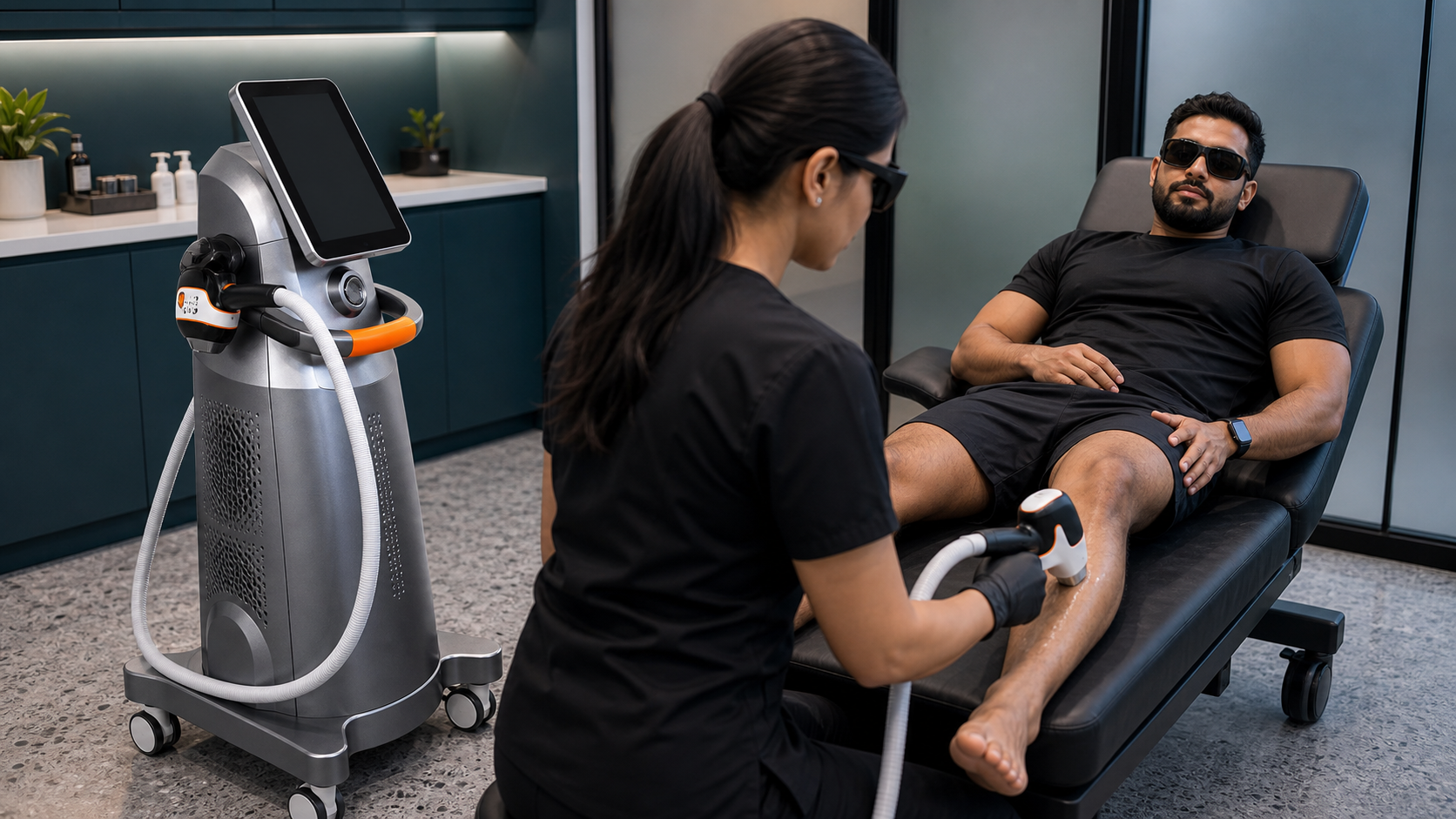
Key safety topics:
- skin type assessment
- recent tanning and sun exposure
- hair color and hair thickness
- treatment area sensitivity
- fluence and pulse width selection
- cooling performance
- handpiece contact
- eye protection
- contraindication screening
- patch testing when appropriate
- aftercare and sun protection
Sales positioning:
“Diode laser hair removal is a strong entry category for salons and hair removal studios, but it still requires structured training, client screening, cooling management and realistic claims.”
Avoid saying:
“It is completely safe for all skin types and all clients.”
Safer wording:
“Multi-wavelength diode laser equipment can help operators manage different hair-removal service scenarios, but settings and client selection should follow training and local rules.”
IPL / SHR Hair Removal and Photofacial Devices
IPL is often used in salons and skin centers, but it is not “just a lamp.”
It uses broad-spectrum light and requires training around filters, pulse settings, skin type, tanning, pigment response and eye protection.
Best buyer fit:
- beauty salons with trained staff
- skin management centers
- hair removal studios
- med spas with entry-level light-based menus
Training focus:
- filter selection
- skin type and pigment screening
- conservative starting settings
- cooling gel and contact technique
- avoiding treatment over unsuitable lesions
- eye protection
- realistic hair-reduction and skin rejuvenation language
Sales positioning:
“IPL can be a practical entry light-based platform, but it still needs professional operation training and clear contraindication screening.”
Picosecond and Q-Switched Laser
Picosecond and Q-switched lasers are commonly positioned for tattoo removal, pigmentation appearance and certain skin rejuvenation menus.
SHEFMON product example:
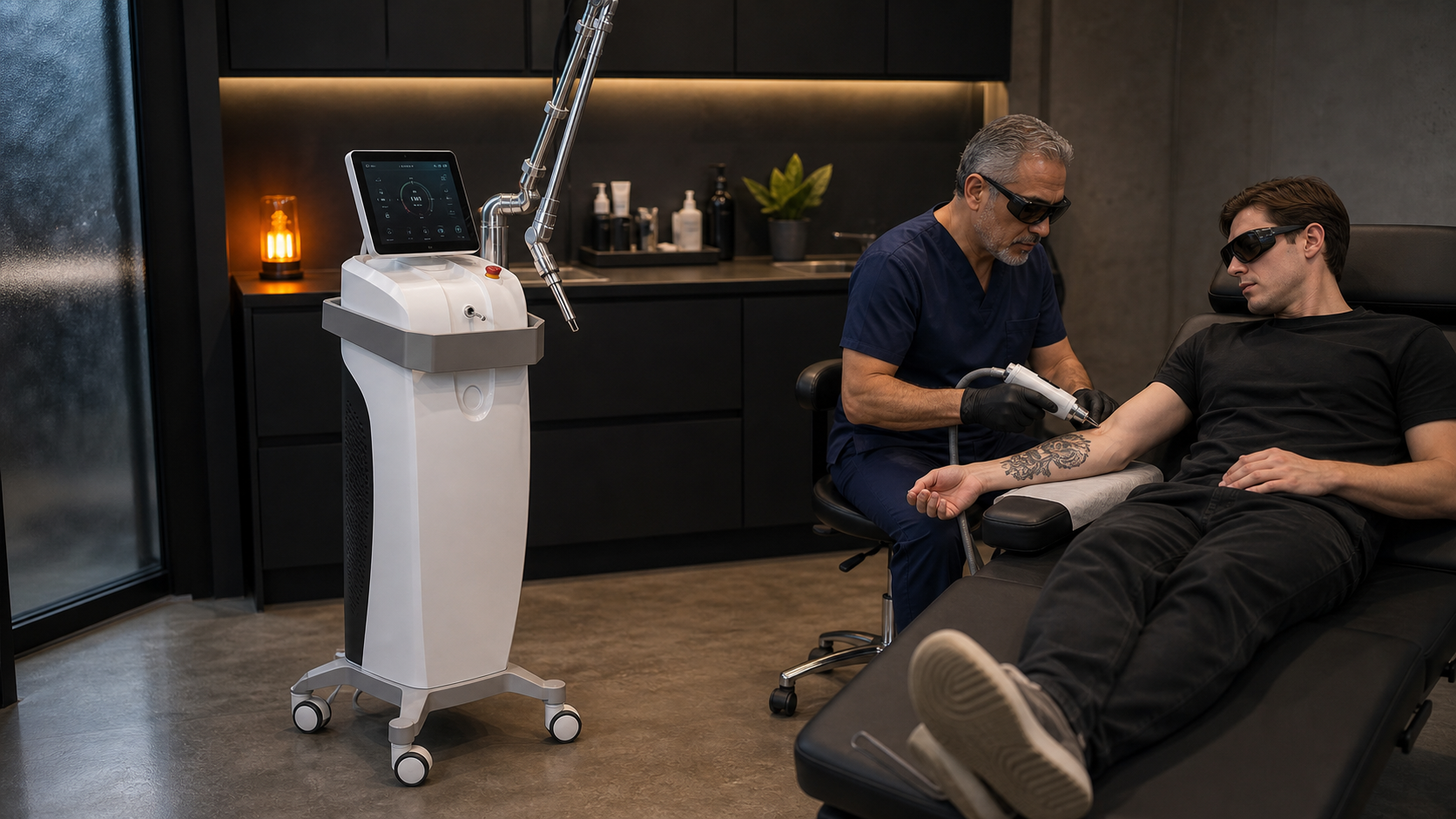
Key safety topics:
- tattoo ink color and depth
- pigment type assessment
- 532nm and 1064nm wavelength differences
- spot size and fluence control
- test spot strategy
- eye protection matched to wavelength
- avoiding treatment too close to the eye without proper professional protocols
- smoke or plume considerations when relevant
- post-treatment whitening, redness, crusting and aftercare explanation
- realistic multi-session expectations
Sales positioning:
“Pico and Q-switched laser devices are professional pigment and tattoo platforms. They are not simple plug-and-play salon machines.”
Avoid saying:
“One session removes any tattoo.”
Safer wording:
“Tattoo and pigment response varies by ink, depth, color, skin type and treatment plan. Operators need training in wavelength selection, test spots, aftercare and realistic expectations.”
Fractional CO2 Laser
Fractional CO2 laser usually has a higher operation threshold than hair removal laser or entry IPL.
SHEFMON product example:
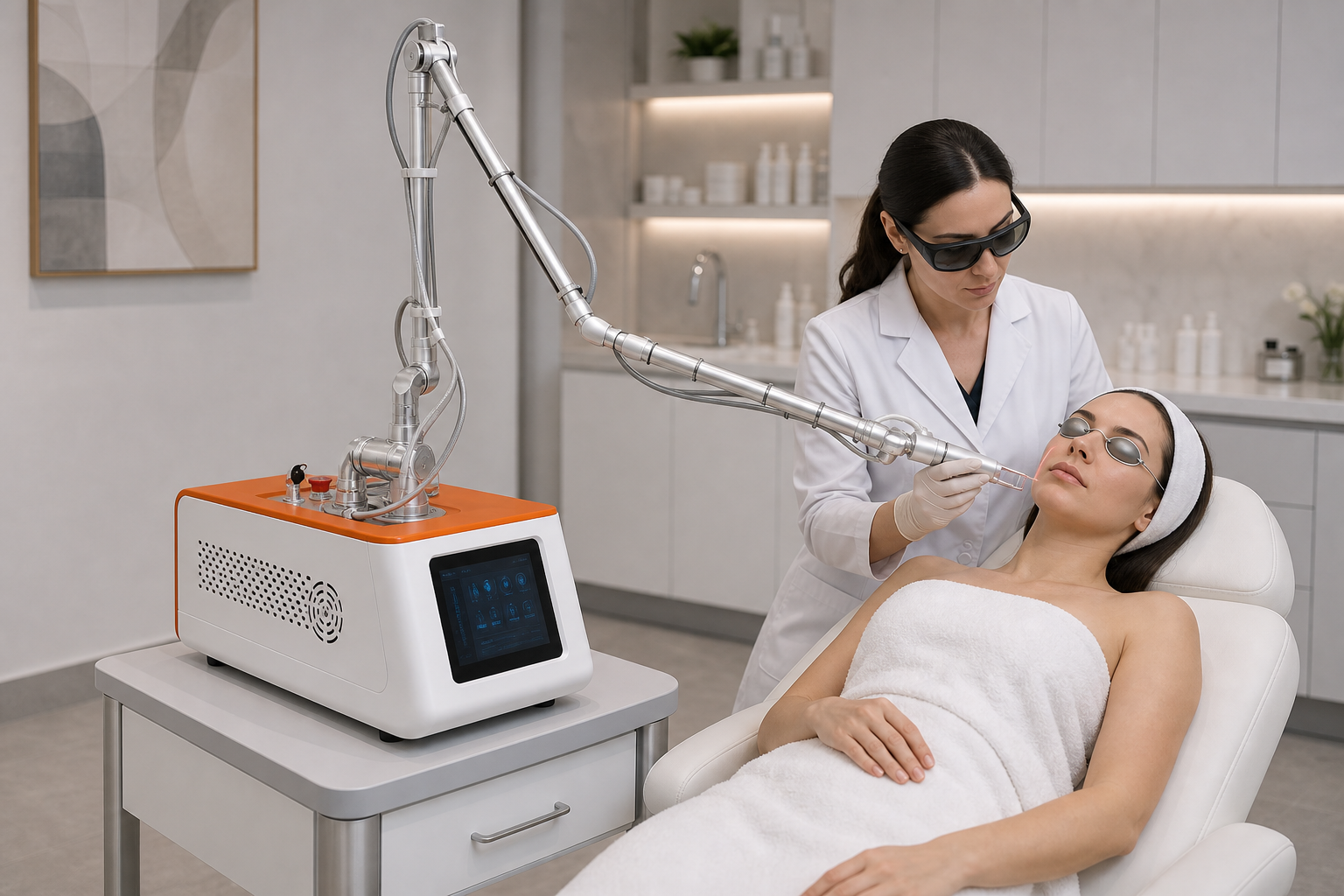
CO2 fractional laser is commonly positioned for:
- acne scar appearance
- skin resurfacing
- texture improvement
- fine line appearance
- sun-damaged skin appearance
- professional skin reconstruction menus
Key safety topics:
- ablative vs fractional resurfacing concept
- skin type and pigmentation risk
- acne activity and infection screening
- history of keloid or hypertrophic scarring
- energy, density and scan shape selection
- smoke or plume management
- eye protection
- treatment room hygiene
- pain control planning according to local rules
- downtime explanation
- crusting, redness and wound-care style aftercare
- follow-up and complication referral
Sales positioning:
“CO2 fractional laser is an advanced professional resurfacing device for trained clinics, medical aesthetic institutions and high-level skin centers that can manage consultation, downtime and aftercare.”
Avoid saying:
“No downtime, no risk, no professional training needed.”
Safer wording:
“CO2 fractional laser can support high-value resurfacing service menus, but buyers should have trained operators, treatment room control, aftercare protocols and local compliance confirmation.”
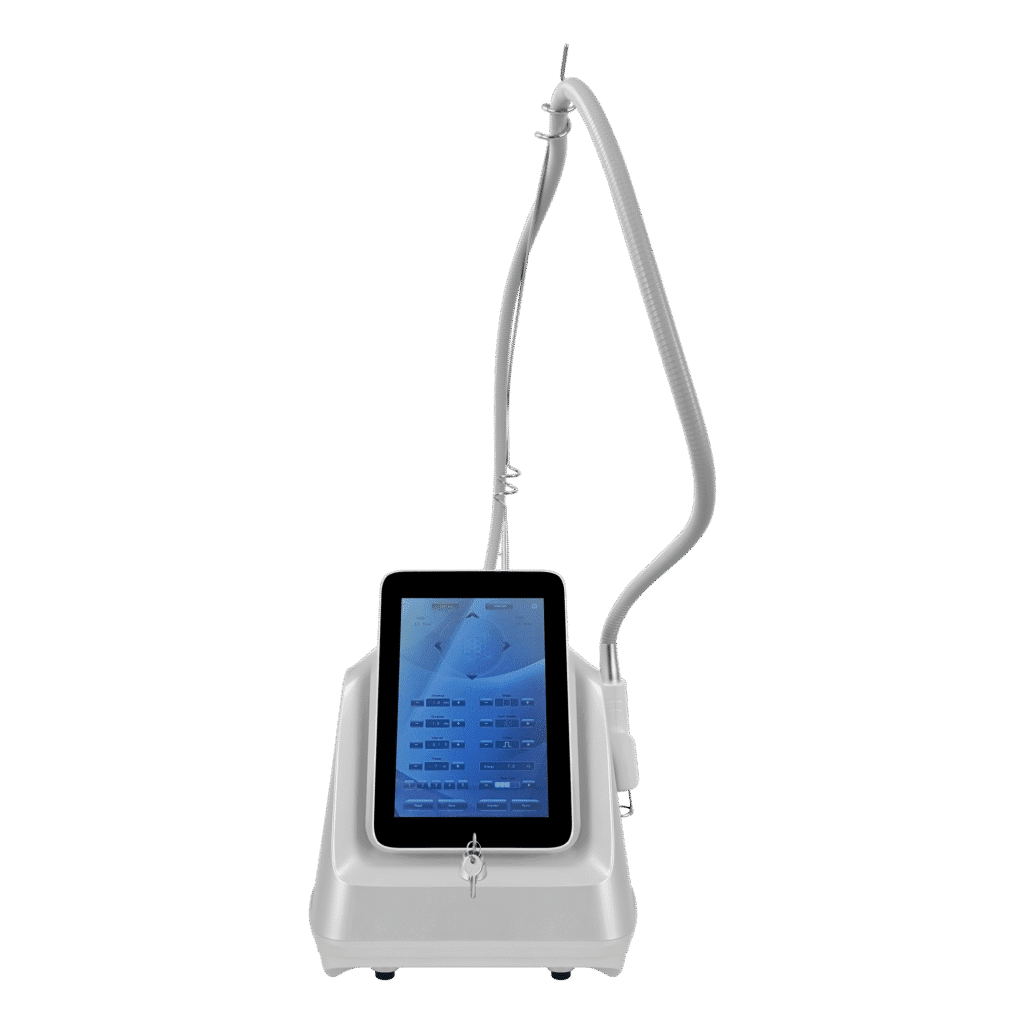
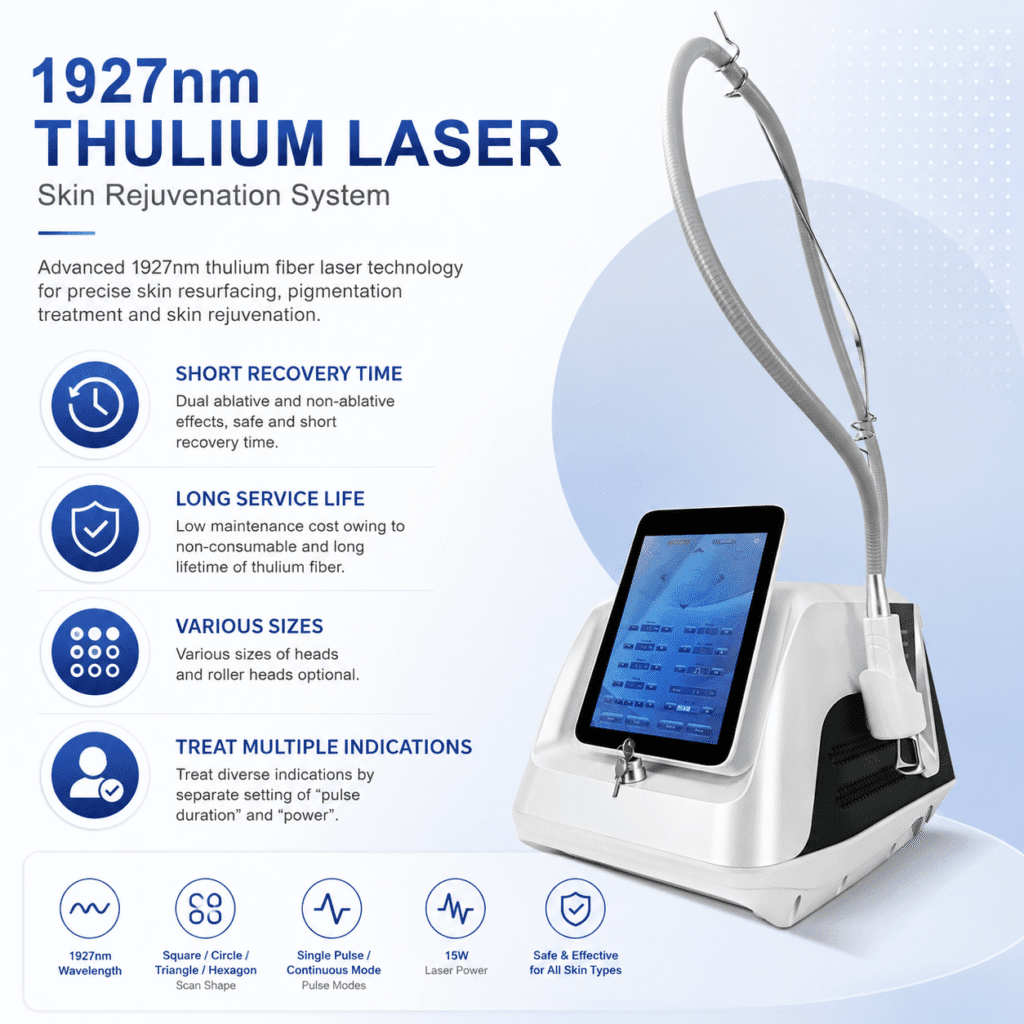
Thulium, 1550nm and Other Fractional Laser Platforms
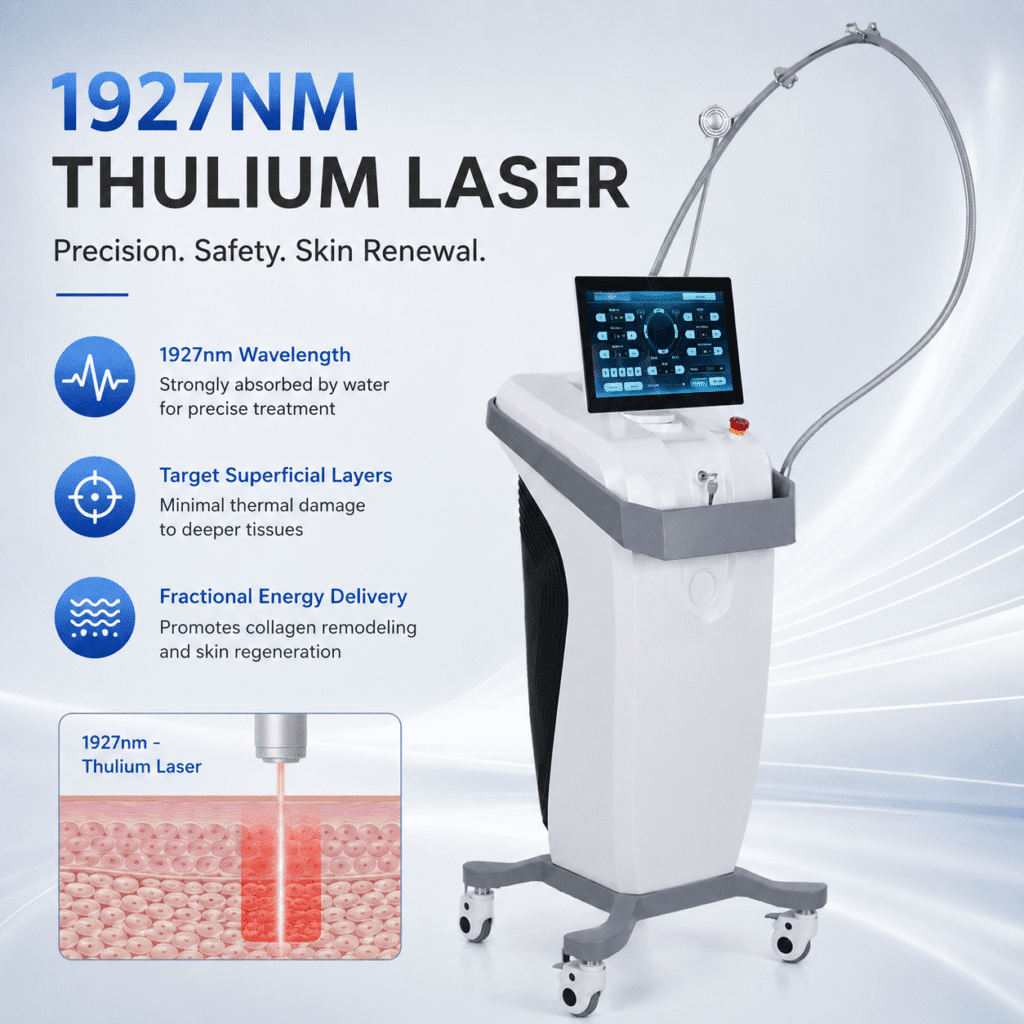
SHEFMON’s laser category also includes thulium and other fractional laser platforms for skin rejuvenation, pigmentation appearance and acne scar-related positioning.
These devices may have different wavelengths and tissue targets, so the distributor should not copy training content from one machine to another.
Training focus:
- wavelength-specific indications
- parameter range
- energy delivery mode
- eye protection
- skin type assessment
- pigmentation risk
- treatment interval
- aftercare
Sales positioning:
“Each fractional laser platform needs model-specific training because wavelength, penetration, energy delivery and expected skin response are different.”
How to Explain the Operator Requirement
The distributor should explain operator requirements in three levels.
Level 1: Basic Operator Knowledge
The operator should understand:
- device startup and shutdown
- handpiece connection
- emergency stop
- treatment mode selection
- screen settings
- cleaning and disinfection
- consumables
- daily maintenance
This is necessary but not enough.
Level 2: Treatment Decision Ability
The operator should also understand:
- which clients are suitable
- which clients should be postponed
- which clients should be referred
- how to choose starting parameters
- when to reduce energy
- when to stop treatment
- how to explain expected skin response
- how to document treatment settings
This level separates a trained operator from someone who only knows buttons.
Level 3: Professional Supervision and Compliance
Depending on local rules and device category, the buyer may need:
- physician supervision
- medical director oversight
- certified laser operator
- laser safety officer
- facility registration
- written SOPs
- staff competency records
- service and maintenance records
- incident reporting process
Distributors should never guess these requirements for every market.
Safe wording:
“Our product training explains device operation and maintenance. Your clinic or salon should confirm who is legally allowed to perform the procedure in your local market.”
Treatment Room Requirements Distributors Should Explain
Laser safety is not only about the operator.
The room matters.
A professional laser treatment room should consider:
- restricted access during operation
- visible warning signs when required
- non-reflective surfaces where possible
- correct eyewear storage
- clean treatment bed and surface disinfection
- emergency stop access
- smoke evacuation or plume control for procedures that generate plume
- safe cable layout
- stable power supply
- ventilation
- fire safety awareness for high-power systems
- no unnecessary spectators
OSHA guidance notes that unnecessary persons should be kept away from laser operation areas, and people who enter areas with open Class IIIB or Class IV beam paths need appropriate eye protection and instruction.
Distributor explanation:
“Before delivery, we should help the buyer prepare the treatment room, power requirements, eyewear, warning process and basic safety workflow.”
This turns safety into a value-added support service.
Eye Protection: The Non-Negotiable Topic
Eye protection is one of the most important laser safety topics.
The key point is:
Laser eyewear must match the wavelength and protection requirement of the device.
One pair of glasses is not automatically suitable for all lasers.
For example:
- 808nm diode laser eyewear is not automatically suitable for 10600nm CO2 laser.
- 532nm and 1064nm pigment laser use should be matched with appropriate protection.
- Client eye protection may differ from operator eyewear depending on treatment area and device.
- Eyewear should be inspected, labeled and stored properly.
Distributor sales message:
“We provide machine training and can help you confirm the eyewear category supplied with the device, but your team should use wavelength-appropriate laser protective eyewear according to local safety rules and procedure type.”
Avoid saying:
“Any dark glasses are fine.”
That is not acceptable.
Parameter Training: The Most Common Practical Gap
Many customer problems happen because staff misunderstand parameters.
They may think:
- higher energy always means better results
- faster treatment is always better
- the same setting works for everyone
- darker skin only needs one small adjustment
- strong redness means a better result
- cooling temperature on the screen guarantees skin protection
Distributors should teach the buyer that parameters must be selected according to:
- device type
- wavelength
- skin type
- tanning status
- hair or pigment target
- treatment area
- pain tolerance
- previous response
- cooling quality
- treatment goal
Important parameters include:
- fluence or energy
- pulse width
- frequency
- spot size
- scan density
- treatment passes
- cooling setting
- contact technique
Practical sales wording:
“The machine gives the clinic adjustable control, but safe use depends on trained parameter selection and conservative first-session planning.”
Client Screening Should Be Part of Training
Laser equipment training should include client screening, because many risks appear before the device is even switched on.
Common screening areas:
- recent tanning or sun exposure
- photosensitive medication
- active infection
- open wounds
- pregnancy or breastfeeding where local protocols apply
- history of keloid or abnormal scarring
- recent chemical peel or strong exfoliation
- isotretinoin or other relevant medication history according to professional guidance
- immune conditions or poor wound healing
- tattoo or pigment history
- unrealistic expectations
Distributors do not need to act as doctors, but they should teach customers that screening is required.
Safe wording:
“The operator should screen clients before treatment and refer unsuitable or uncertain cases according to local professional protocols.”
Aftercare Training Protects Both Results and Reputation
Laser safety does not end when the session ends.
Aftercare is especially important for:
- CO2 fractional laser
- pigment laser
- tattoo removal laser
- hair removal on sensitive areas
- darker skin types
- clients with sun exposure habits
Aftercare training should cover:
- expected redness, swelling or warmth
- sun avoidance
- sunscreen use when appropriate
- avoiding harsh skincare actives for a period
- hydration and barrier support
- avoiding picking crusts after resurfacing
- when to contact the clinic
- follow-up schedule
- maintenance sessions
Distributor positioning:
“A clinic that explains aftercare well will receive fewer complaints and can sell more professional treatment packages.”
Maintenance Training Is Also Safety Training
A poorly maintained laser device can create inconsistent results and safety concerns.
Training should cover:
- water quality and replacement for water-cooled systems
- filter cleaning or replacement
- handpiece window cleaning
- checking fiber or optical path condition where relevant
- cooling system monitoring
- error code response
- calibration or service intervals
- consumable replacement
- safe storage
- shutdown procedure
For distributors, this also supports repeat business:
- spare parts
- consumables
- replacement handpieces
- technical service
- warranty communication
- annual maintenance packages
Maintenance should be presented as part of the buyer’s operating system, not as a small note after purchase.
How to Explain SHEFMON Training Support
SHEFMON can be positioned as a beauty equipment supplier that supports distributors with equipment lines, product guidance and after-sales communication.
For laser equipment, distributors can explain support in four layers:
1. Pre-Sales Consultation
Before the buyer chooses a machine, help them decide:
- which laser category matches their business
- whether their institution is suitable for the device
- what service menu they want to build
- what local requirements they should check
- what treatment room preparation is needed
2. Device Operation Guidance
After purchase, training should include:
- startup and shutdown
- interface explanation
- handle installation
- parameter range
- mode selection
- accessories
- emergency stop
- cleaning
- basic troubleshooting
3. Safety and Service Menu Education
The distributor should also help the buyer understand:
- client screening
- realistic claims
- treatment intervals
- package design
- pre-care and aftercare
- maintenance workflow
4. After-Sales Technical Support
Support should include:
- remote operation questions
- maintenance reminders
- spare parts and accessories
- repair process
- warranty communication
- training refresh for new staff
Suggested wording:
“SHEFMON can support distributors with laser equipment selection, product operation guidance, after-sales communication and spare parts support. Clinical scope, licensing and treatment authority should be confirmed locally by the buyer.”
How to Explain Operation Threshold by Customer Type
Different buyers need different explanations.
| Customer type | Suitable laser entry point | Training message |
|---|---|---|
| Hair removal studio | Diode laser or IPL/SHR | Needs skin type screening, cooling, eyewear and parameter training |
| Beauty salon with no laser experience | Entry IPL or non-laser skin care first | Do not start with CO2 or high-risk laser categories |
| Advanced med spa | Diode, IPL, pico or MNRF-related packages depending on local rules | Needs SOPs, operator training and aftercare workflow |
| Tattoo removal clinic | Pico/Q-switched laser | Needs wavelength, test spot, eyewear and multi-session expectation training |
| Dermatology clinic | CO2, pico, diode, thulium and combined laser systems | Needs device-specific protocols, medical screening and safety program |
| Acne scar clinic | CO2 fractional laser and supporting devices | Needs downtime explanation, wound-care style aftercare and referral process |
| Distributor showroom | Multiple laser demos | Needs strict demo rules, staff training and controlled demonstration area |
| Mobile beauty service | Not recommended for professional laser systems | Unsafe room control and compliance concerns |
| Home-use reseller | Not suitable for professional lasers | Professional laser devices should not be positioned as casual home-use products |
This table helps sales teams avoid one-size-fits-all answers.
What Distributors Should Say in Sales Calls
Here are practical explanations distributors can use.
When the buyer asks, “Is it easy to operate?”
Good answer:
“The interface is designed to be understandable after training, but laser operation is not only button control. Your team should learn client screening, parameter selection, eyewear, room setup, aftercare and maintenance before launching the service.”
When the buyer asks, “Can my staff operate it without certification?”
Good answer:
“Operator requirements depend on your local regulations and procedure type. We can provide device operation training and product support, but you should confirm local licensing and supervision rules before service launch.”
When the buyer asks, “Can I start with CO2 laser in a new salon?”
Good answer:
“CO2 fractional laser has a higher operation threshold because it involves resurfacing, downtime and stronger aftercare requirements. For a new salon, we may first evaluate your staff experience, treatment room and local rules before recommending CO2.”
When the buyer asks, “Does training come with the machine?”
Good answer:
“Training support can include device operation, setup, maintenance, basic safety reminders and service menu guidance. For clinical protocols and local legal scope, your institution should follow local professional requirements.”
When the buyer asks, “Can I advertise painless and no risk?”
Good answer:
“No. Better wording is that comfort and skin response vary by client, device category and treatment plan. Advertising should avoid guaranteed or risk-free claims.”
Claims Distributors Should Avoid
Laser marketing should be persuasive but not reckless.
| Avoid saying | Safer alternative |
|---|---|
| No training needed | Professional operation training is required |
| Anyone can operate it | Operators should be trained and authorized under local rules |
| Completely safe | Risk control depends on screening, settings and safety procedures |
| No pain | Comfort level varies by client and procedure |
| No downtime | Downtime depends on device type and treatment intensity |
| No burn risk | Burn risk should be reduced through training, cooling and parameter control |
| Safe for all skin types | Skin type and tanning status should be assessed before treatment |
| One session solves the problem | Results and session numbers vary |
| Same settings for everyone | Parameters should be adjusted by client and treatment area |
| Home users can operate it | Professional laser systems should be used by trained operators in suitable settings |
This language helps distributors sell responsibly while still showing value.
Red Flags: When a Buyer Is Not Ready for Laser Equipment
Distributors should be careful when a buyer says:
- “I do not need training.”
- “I only want the strongest machine.”
- “Can I use it at home for customers?”
- “Can I treat every skin type with the same setting?”
- “I want to advertise permanent removal guaranteed.”
- “I do not need consent forms.”
- “I do not want to buy eyewear.”
- “Can I operate CO2 laser in a shared facial room?”
- “Can I start tattoo removal tomorrow without practice?”
These are not just objections. They are safety warnings.
Better response:
“This device category requires proper preparation. We can help you choose a suitable starting machine, but we need to confirm training, treatment room conditions, eyewear, aftercare and local rules first.”
Distributor Checklist Before Selling Laser Equipment
Before confirming an order, distributors should check:
- What services does the buyer want to offer?
- Who will operate the device?
- What training experience does the operator have?
- Is the buyer legally allowed to operate this laser category locally?
- Does the buyer have a controlled treatment room?
- Does the buyer understand eyewear requirements?
- Does the buyer have consultation and consent forms?
- Does the buyer have aftercare instructions?
- Does the buyer understand downtime for resurfacing lasers?
- Does the buyer have maintenance staff or a maintenance plan?
- Does the buyer understand warranty and repair process?
- Does the buyer use realistic advertising language?
If the buyer cannot answer these questions, the distributor should slow down and educate first.
How to Turn Safety Training Into a Sales Package
Safety training can increase order value when it is packaged professionally.
Example distributor package:
| Package component | What to include | Business value |
|---|---|---|
| Device selection | Match diode, IPL, pico or CO2 to the buyer’s business | Reduces wrong-machine purchases |
| Pre-delivery checklist | Power, room, eyewear, accessories and staff preparation | Helps buyer launch faster |
| Operation training | Interface, modes, parameters and shutdown | Reduces first-use confusion |
| Safety training | Eye protection, room control, contraindications and emergency stop | Reduces risk |
| Service menu support | Hair removal, tattoo removal, resurfacing or pigment package ideas | Helps buyer sell services |
| Aftercare templates | Basic client instructions and follow-up reminders | Improves client experience |
| Maintenance guidance | Cleaning, water, filters, handpiece and troubleshooting | Protects device performance |
| After-sales support | Spare parts, warranty, repair and remote guidance | Builds long-term trust |
This turns safety from a fear topic into a business system.
Final Answer
Distributors should explain laser equipment safety training and operation requirements clearly, professionally and without exaggeration.
The key message is:
Laser devices can create strong revenue opportunities, but they require trained operators, client screening, treatment room control, wavelength-appropriate eye protection, parameter discipline, aftercare guidance, maintenance and local compliance confirmation.
Diode laser and IPL devices may be suitable entry points for trained salons and hair removal studios. Picosecond and Q-switched lasers require stronger pigment, tattoo, wavelength and eye-safety training. CO2 fractional laser has a higher operation threshold and is better suited to professional clinics, medical aesthetic centers, acne scar clinics and advanced skin centers with aftercare systems.
Distributors should avoid saying “no training needed,” “anyone can operate it,” “safe for everyone,” or “no risk.” A more professional message is that SHEFMON can support product selection, operation guidance, maintenance and after-sales communication, while buyers should confirm local licensing, treatment authority and facility requirements before offering laser services.
This approach helps distributors sell laser equipment responsibly, reduce customer risk and build stronger long-term buyer trust.
FAQ
Should distributors say laser machines are easy to operate?
Distributors can say the interface is designed for trained operators, but they should not say laser equipment is simple enough for anyone to use without training. Laser operation also includes screening, parameter selection, eye protection, aftercare and maintenance.
Which laser device has the highest operation threshold?
CO2 fractional laser usually has a higher threshold because it involves resurfacing, downtime, skin response, aftercare and stricter client selection. It is best positioned for professional clinics and advanced skin centers.
Can diode laser hair removal machines be sold to salons?
Yes, in many markets diode laser hair removal is a suitable salon or hair removal studio category, but the salon still needs trained operators, client screening, cooling management, eyewear and local compliance confirmation.
What should distributors say about certification?
They should say certification and operator authority depend on local laws and procedure type. The supplier can provide product operation training, but buyers must confirm local licensing and professional scope.
Is one pair of laser glasses enough for all machines?
No. Laser protective eyewear should match the wavelength and protection requirement of the device. Distributors should not tell buyers that ordinary dark glasses or one generic pair is enough for all lasers.
Should training include aftercare?
Yes. Aftercare is part of safety and service quality, especially for CO2 fractional laser, pigment laser, tattoo removal and higher-intensity procedures.
How can distributors make safety training a selling point?
They can package training with device selection, room preparation, operation guidance, safety workflow, service menu planning, maintenance guidance, warranty and after-sales support. This makes the buyer feel supported rather than warned.
Sources Used
- SHEFMON Laser IPL: https://shefmon.com/beauty-machines/laser-ipl/
- SHEFMON A0426 755/1064/810/940nm Diode Laser Hair Removal Beauty Machine: https://shefmon.com/product/a0426-755-1064-810-940nm-diode-laser-hair-removal-beauty-machine/
- SHEFMON A0507 1064nm 532nm Q-switched Super Picosecond Picosure Yag Laser Tattoo Removal: https://shefmon.com/product/a0507-1064nm-532nm-q-switched-super-picosecond-picosure-yag-laser-tattoo-removal/
- SHEFMON A0529 Professional Acne Scar Removal 10600nm CO2 Fractional Laser Equipment: https://shefmon.com/product/a0529-professional-acne-scar-removal-10600nm-co2-fractional-laser-equipment/
- FDA Medical Lasers: https://www.fda.gov/radiation-emitting-products/surgical-and-therapeutic-products/medical-lasers
- FDA Laser Products and Instruments: https://www.fda.gov/radiation-emitting-products/home-business-and-entertainment-products/laser-products-and-instruments
- OSHA Laser Hazards: https://www.osha.gov/laser-hazards/hazards
- OSHA Technical Manual: Laser Hazards: https://www.osha.gov/otm/section-3-health-hazards/chapter-6
- ANSI Blog: ANSI Z136.3-2024 Safe Use of Lasers in Health Care: https://blog.ansi.org/ansi/ansi-z136-3-2024-safe-use-of-lasers-health-care/
- ASLMS Safety and Complications: https://www.aslms.org/for-professionals/professional-resources/safety-and-complications
- ASLMS Standards of Training for Physicians for the Use of Lasers in Medicine and Surgery: https://www.aslms.org/for-professionals/professional-resources/standards-of-practice/standards-of-training-for-physicians-for-the-use-of-lasers-in-medicine-and-surgery