









La technologie de cavitation ultrasonique est devenue de plus en plus populaire dans les traitements de remodelage corporel non invasifs, souvent présentée comme une méthode pour réduire la graisse localisée et améliorer la silhouette sans chirurgie ni convalescence. Avec l'expansion du marché, une idée reçue s'est répandue chez les consommateurs : une puissance de cavitation plus élevée garantirait automatiquement des résultats meilleurs et plus rapides. Cette supposition semble intuitive car, dans de nombreux systèmes physiques, plus de puissance signifie une meilleure performance. Cependant, en ce qui concerne la réponse des tissus biologiques et le métabolisme des graisses, la relation entre puissance et résultats est bien plus complexe qu'il n'y paraît.
1. Comprendre la puissance de cavitation en termes pratiques
1.1 Que fait réellement la cavitation dans le corps ?
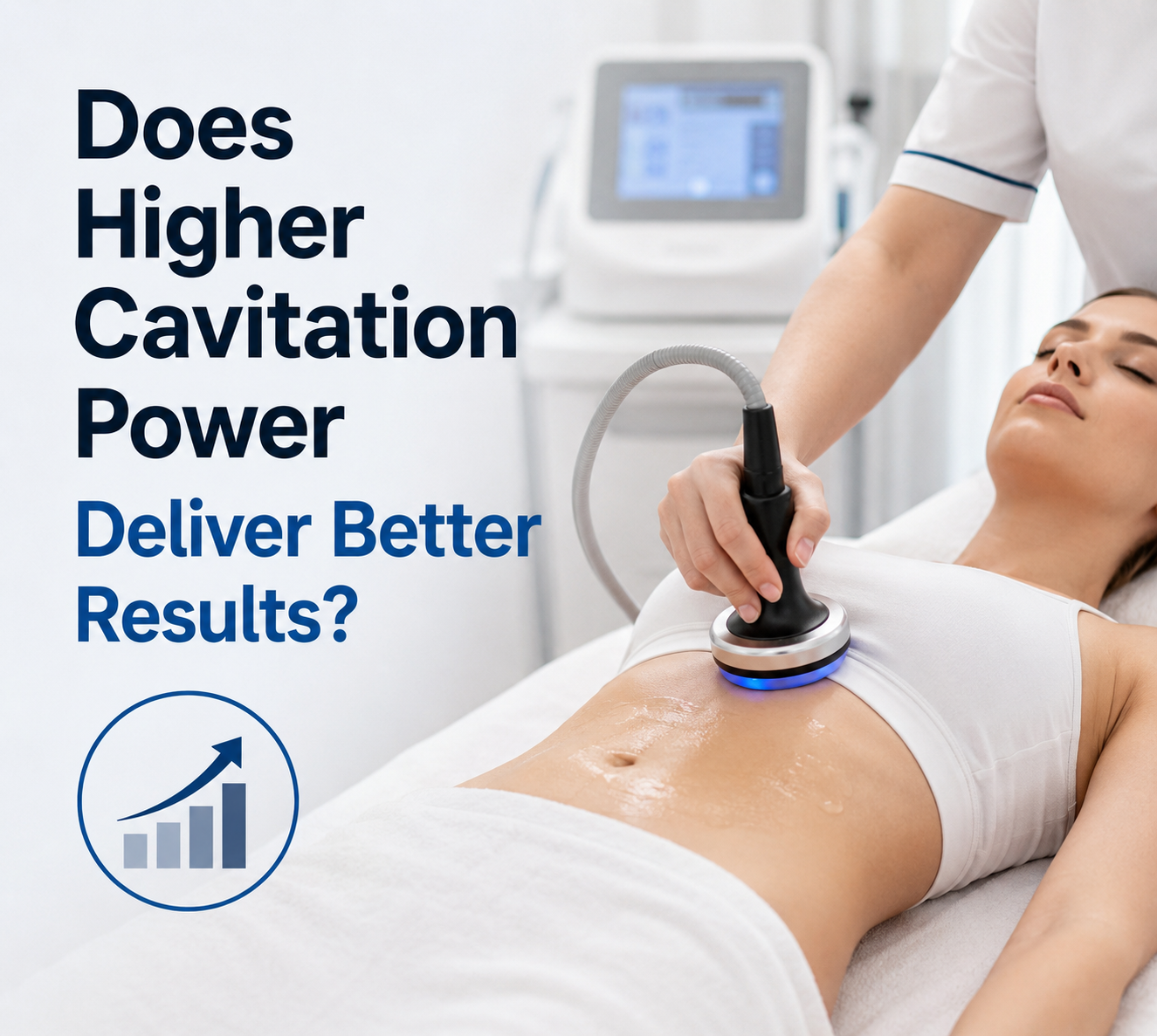
La cavitation ultrasonique agit en émettant des ondes sonores de basse fréquence dans des zones ciblées du corps. Ces ondes créent des bulles microscopiques dans le liquide interstitiel qui entoure les cellules graisseuses. L'expansion et l'implosion rapides de ces bulles génèrent une contrainte mécanique localisée qui peut rompre les membranes des cellules graisseuses. Les graisses libérées sont ensuite éliminées progressivement par les systèmes lymphatique et métabolique de l'organisme.
1.2 Que signifie réellement “ puissance supérieure ” ?
La puissance de cavitation est généralement mesurée en watts, représentant l'énergie produite par l'appareil. Un appareil de puissance plus élevée peut délivrer une énergie ultrasonore plus intense aux tissus, augmentant potentiellement l'intensité des effets de cavitation. Cependant, la puissance seule ne définit pas la performance. L'efficacité du transfert d'énergie, la stabilité de la fréquence et la conception du traitement sont des facteurs tout aussi importants qui déterminent l'efficacité de l'interaction des ultrasons avec le tissu adipeux.
2. Les avantages théoriques d'une puissance de cavitation plus élevée
2.1 Pénétration plus efficace et diffusion d'énergie plus rapide
Les appareils plus puissants pénètrent plus efficacement dans les couches profondes de tissu adipeux sous-cutané, ce qui peut être bénéfique pour les personnes présentant des dépôts graisseux plus importants. En milieu clinique, ces appareils peuvent également réduire le temps de traitement des zones étendues, améliorant ainsi l'efficacité des praticiens.
2.2 Activité de cavitation plus intense
Grâce à une puissance accrue, la formation et l'implosion des bulles peuvent se produire plus rapidement au sein des tissus ciblés. En théorie, cela pourrait favoriser la destruction des cellules graisseuses en une seule séance. C'est pourquoi les appareils à haute puissance sont souvent perçus comme plus “ performants ” ou “ efficaces ” par les consommateurs.
Cependant, bien que ces avantages existent dans des environnements contrôlés, ils ne se traduisent pas automatiquement par des résultats à long terme proportionnellement meilleurs.
3. Pourquoi une puissance supérieure n'est pas toujours synonyme de meilleurs résultats
3.1 Limitations du traitement biologique
Le corps humain a une capacité limitée à traiter et à éliminer les métabolites graisseux issus de la dégradation. Une fois les cellules graisseuses décomposées, leur contenu doit être transporté par le système lymphatique et métabolisé par le foie. Même si un appareil plus puissant libère davantage de graisses en une seule séance, le corps peut avoir des difficultés à éliminer efficacement cet excès, ce qui peut réduire l'efficacité globale ou entraîner une rétention d'eau temporaire.
3.2 L'effet des rendements décroissants
Au-delà d'un certain seuil d'énergie, l'augmentation de la puissance de cavitation n'entraîne que des améliorations de plus en plus faibles. C'est un cas classique de rendements décroissants. Au lieu d'accélérer les résultats, une énergie excessive peut simplement saturer la réponse tissulaire sans améliorer la réduction de la masse graisseuse. Dans certains cas, des traitements trop intenses peuvent même ralentir les progrès visibles en raison d'une inflammation ou d'un gonflement temporaire.
3.3 Risque accru d'inconfort et d'effets secondaires
Des réglages de puissance élevés peuvent générer une chaleur excessive ou des contraintes mécaniques dans la zone traitée. Ceci peut entraîner une gêne, des rougeurs ou une sensibilité cutanée. Bien que la cavitation soit généralement considérée comme non invasive, une utilisation inappropriée des réglages de haute intensité peut compromettre la sécurité et le confort du patient. C'est pourquoi les praticiens privilégient souvent une diffusion d'énergie contrôlée à une puissance maximale.
4. Les facteurs qui comptent plus que la puissance brute
4.1 Stabilité de fréquence et qualité du signal
La fréquence des ondes ultrasonores joue un rôle crucial dans l'efficacité de la cavitation. Les basses fréquences sont généralement plus efficaces pour cibler les tissus adipeux, tandis que des formes d'onde stables garantissent une formation de bulles homogène. Un appareil à fréquence de sortie stable est souvent plus performant qu'un appareil plus puissant dont le contrôle du signal est moins précis.
4.2 Protocole de traitement et cohérence
Les résultats dépendent davantage de séances répétées et bien espacées que de traitements uniques et intensifs. Le corps réagit mieux à un métabolisme progressif. Des traitements réguliers et modérés permettent au système lymphatique d'éliminer efficacement les déchets graisseux, ce qui se traduit par des résultats plus durables.
4.3 Technique d'application et compétences de l'utilisateur
L'utilisation de l'appareil a un impact considérable sur les résultats. Des mouvements appropriés, une application correcte du gel conducteur et un contact constant avec la peau garantissent une transmission d'énergie optimale. Même un appareil puissant sera inefficace s'il est mal utilisé, tandis qu'un appareil de puissance moyenne peut se révéler très efficace entre des mains expertes.
4.4 Ingénierie des dispositifs et efficacité énergétique
La conception interne d'un appareil de cavitation — notamment ses transducteurs, son système de refroidissement et la précision de son étalonnage — influe sur l'efficacité avec laquelle l'énergie est délivrée aux tissus. Un appareil de puissance moyenne bien conçu peut être plus performant qu'un appareil de forte puissance mal conçu, car il transfère l'énergie de manière plus constante et plus sûre.
5. Perspective pratique pour les utilisateurs et les praticiens
5.1 Choisir le juste équilibre entre pouvoir et contrôle
Lors du choix d'un appareil de cavitation, se focaliser uniquement sur la puissance (en watts) peut être trompeur. Il est préférable d'évaluer si l'appareil propose des niveaux d'intensité réglables, une fréquence de sortie stable et des mécanismes de sécurité tels que la régulation de la température. Ces caractéristiques permettent d'adapter les traitements aux différentes zones du corps et aux niveaux de sensibilité individuels.
5.2 Établir des attentes réalistes quant aux résultats
La cavitation n'est pas un phénomène rapide solution pour perdre de la graisse Il s'agit plutôt d'une méthode de remodelage corporel progressif. Les résultats dépendent du métabolisme, du mode de vie, de l'hydratation et de l'état de santé général. Combiner les traitements avec une activité physique et une alimentation saine améliore considérablement les résultats. La régularité et la modération sont généralement plus efficaces à long terme que les approches intensives et agressives.
Conclusion
Une puissance de cavitation plus élevée peut améliorer certains aspects du traitement, comme la pénétration de l'énergie et la réponse tissulaire immédiate, mais elle n'est pas le facteur déterminant pour des résultats optimaux. L'efficacité de la cavitation repose sur une combinaison équilibrée de contrôle de l'énergie délivrée, d'une technique appropriée, d'une capacité de traitement biologique adaptée et d'un calendrier de traitement régulier. En pratique, des niveaux d'énergie modérés et bien gérés produisent souvent des résultats plus stables, prévisibles et durables qu'une puissance maximale.