









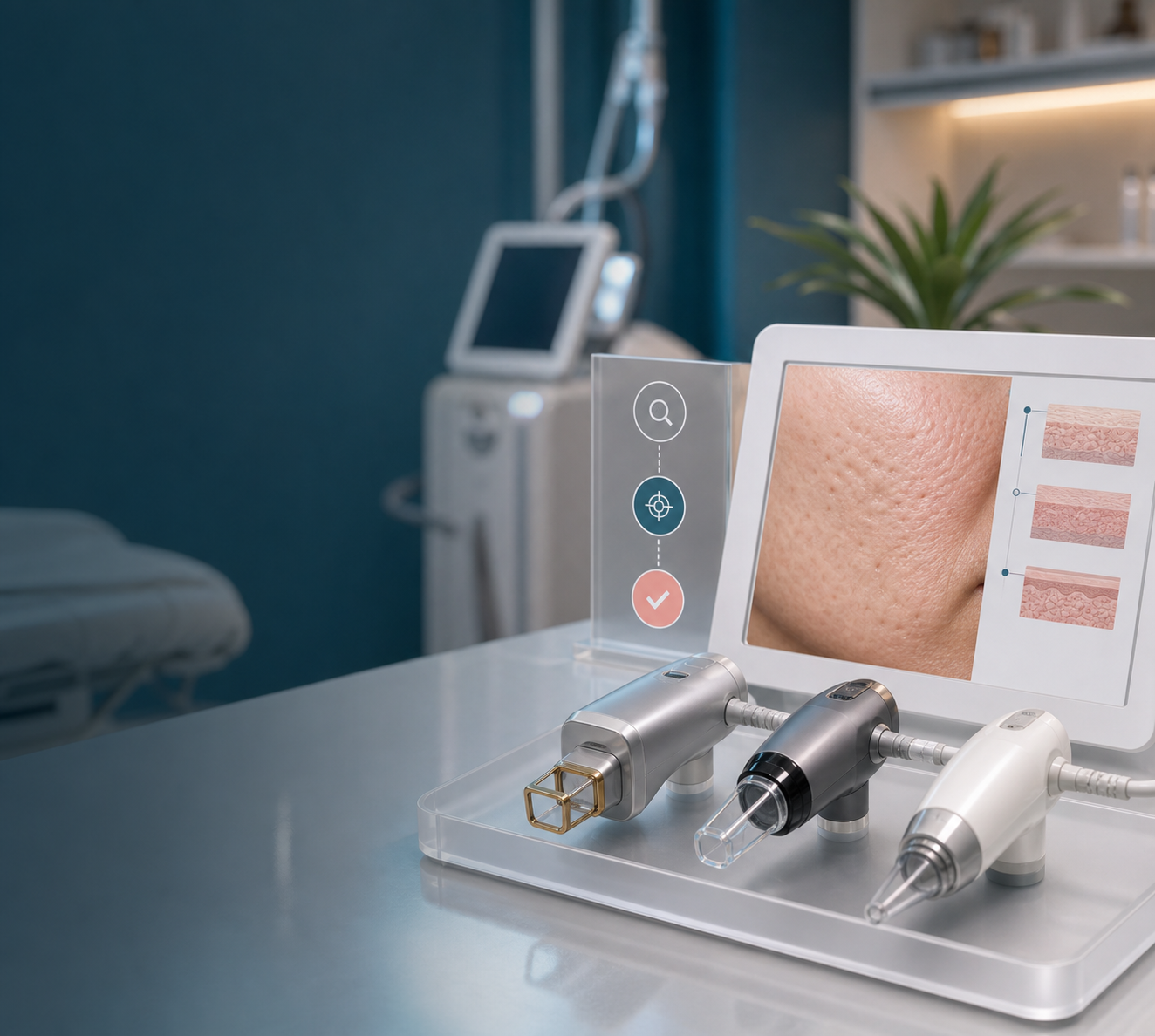
Le meilleur laser pour les cicatrices d'acné n'est pas le même pour chaque client.
Les clients posent souvent une question simple :
“ Quel laser choisir pour mes cicatrices d’acné ? ”
La réponse la plus sûre et la plus professionnelle est :
Choisissez le laser en fonction du type de cicatrice, du type de peau, de la tolérance au temps d'arrêt, de l'objectif du traitement, du budget, des antécédents médicaux et de l'expérience de la clinique ou de l'opérateur.
Dans de nombreux programmes professionnels de traitement des cicatrices d'acné, le laser CO2 fractionné est l'une des options de resurfaçage les plus efficaces, notamment pour les cicatrices atrophiques et les irrégularités de texture. Cependant, il implique généralement une période de convalescence plus longue et des soins post-opératoires plus importants.
D'autres options laser, telles que le laser fractionné Er:YAG, le laser fractionné non ablatif, le laser fractionné picoseconde ou les lasers vasculaires, peuvent être plus adaptées à certains clients en fonction de la profondeur de la cicatrice, des rougeurs, du teint de la peau et des attentes en matière de récupération.
Cet article explique comment les clients, les cliniques et les distributeurs de matériel de beauté peuvent comprendre les principales options de laser pour les cicatrices d'acné sans faire d'affirmations exagérées.
Réponse courte
| Préoccupation du client | La catégorie laser est souvent considérée | Pourquoi |
|---|---|---|
| Cicatrices d'acné atrophiques profondes et texture rugueuse | laser fractionné CO2 | Effet resurfaçant important, mais temps de convalescence et soins post-opératoires plus longs. |
| Cicatrices modérées nécessitant un resurfaçage contrôlé | Laser fractionnel Er:YAG | Le resurfaçage ablatif présente un effet thermique moindre que le CO2 dans de nombreux cas. |
| Cicatrices légères à modérées avec un temps de convalescence réduit | Laser fractionné non ablatif | Stimule le remodelage avec moins de lésions superficielles, mais peut nécessiter davantage de séances. |
| Texture, pores et cicatrices avec une préférence pour un temps de récupération plus court | Laser fractionnaire picoseconde | Effet fractionnel plus doux dans certains cas, souvent avec moins de temps d'arrêt. |
| marques d'acné rouges ou cicatrices rouges | Approche par laser vasculaire ou de type IPL | Cible la rougeur plutôt que la profondeur de la cicatrice déprimée |
| Cicatrices en pic à glace, cicatrices roulantes attachées ou cicatrices mixtes | Traitement combiné | Le laser seul pourrait ne pas suffire |
Le meilleur choix n'est souvent pas un seul laser.
De nombreux clients souffrant de cicatrices d'acné ont besoin d'un traitement combiné.
Première étape : identifier le type de cicatrice
Toutes les cicatrices d'acné ne sont pas identiques.
Avant de choisir un laser, la clinique doit identifier le type principal de cicatrice.
| Type de cicatrice | À quoi ça ressemble | Considérations relatives au choix du laser |
|---|---|---|
| cicatrices roulantes | De larges dépressions ondulées | Le laser peut améliorer la texture, mais une subcision peut être nécessaire si les cicatrices sont adhérentes. |
| cicatrices de wagon | Dépressions rondes ou carrées aux bords plus nets | Le laser fractionné CO2 ou Er:YAG peut être utile selon la profondeur. |
| cicatrices en pic à glace | fosses étroites et profondes | Le laser seul est souvent limité ; des techniques focales peuvent être nécessaires. |
| Cicatrices atrophiques mixtes | Plusieurs types de cicatrices ensemble | Le traitement combiné est fréquent |
| Marques rouges post-acnéiques | Décoloration rouge ou rose | Un traitement des rougeurs vasculaires par laser ou par lumière pourrait être plus approprié. |
| Marques brunes post-acnéiques | Hyperpigmentation plutôt qu'une véritable dépression cicatricielle | Un traitement ciblé sur la pigmentation peut être nécessaire. |
| Cicatrices surélevées ou chéloïdes | tissu cicatriciel épais et surélevé | Nécessite une évaluation professionnelle ; la logique de resurfaçage est différente. |
C’est pourquoi une clinique devrait éviter d’affirmer qu’une machine est toujours la meilleure pour tous les clients souffrant de cicatrices d’acné.
Laser fractionné CO2 : une option de resurfaçage performante
Le laser fractionné CO2 est l'une des options professionnelles les plus reconnues pour le resurfaçage des cicatrices d'acné.
On y pense souvent lorsque les clients ont :
- cicatrices d'acné atrophiques
- texture de peau irrégulière
- apparence de wagon ou de cicatrice roulante
- aspect des pores dilatés
- peau rugueuse après l'acné
- objectifs de resurfaçage et de rajeunissement
Le laser CO2 est un laser ablatif. En mode fractionné, il traite des microzones de la peau, préservant les tissus environnants pour favoriser la cicatrisation.
Cela peut favoriser le remodelage du collagène et une texture plus lisse au fil du temps.
L'Académie américaine de dermatologie note que les lasers peuvent être utilisés pour resurfacer la peau cicatrisée par l'acné et que la production de collagène et d'élastine pendant la cicatrisation peut contribuer à atténuer l'apparence des cicatrices.
Quand le laser fractionné CO2 peut être un bon choix
Le laser fractionné CO2 peut être un bon choix lorsque :
- Les cicatrices sont suffisamment visibles pour justifier une période d'arrêt de travail.
- Le client accepte les rougeurs, la desquamation et le temps de cicatrisation.
- La clinique peut fournir des conseils de suivi.
- L'opérateur est formé
- Le type de peau et le risque de pigmentation sont évalués.
- Les attentes sont réalistes
Quand le laser fractionné CO2 n'est pas forcément le premier choix
Ce n'est peut-être pas le premier choix lorsque :
- Le client ne peut accepter aucune interruption de service.
- L'acné active n'est pas contrôlée
- Le client présente un risque élevé d'hyperpigmentation post-inflammatoire.
- La cliente a des antécédents de cicatrices chéloïdes.
- La clinique manque de formation sur les lasers et de procédures de suivi post-traitement.
- Les cicatrices sont principalement des cicatrices en pic à glace qui nécessitent un traitement ciblé.
Le laser fractionné CO2 est puissant, mais la puissance implique aussi des responsabilités.
Laser fractionné Er:YAG : ablatif mais souvent mieux contrôlé
Le laser Er:YAG est une autre option de resurfaçage ablatif.
Comparé au laser CO2, le laser Er:YAG présente généralement une absorption d'eau plus importante et un effet thermique résiduel moindre dans de nombreux contextes cliniques. Ceci peut le rendre utile pour le resurfaçage avec un profil de cicatrisation différent.
Les clients peuvent envisager le laser fractionné Er:YAG lorsqu'ils souhaitent :
- soutien au resurfaçage
- amélioration de la texture
- traitement des cicatrices superficielles à modérées
- potentiellement moins de lésions thermiques que le CO2 dans des conditions appropriées
- une option professionnelle pour les cicatrices d'acné avec un plan de récupération contrôlé
Cependant, l'utilisation du laser Er:YAG nécessite toujours une formation spécifique, un suivi approprié et des attentes réalistes.
Il ne faut pas le vendre comme étant sans risque ou sans interruption de service.
Pour les cliniques, l'Er:YAG peut être présenté comme une option de resurfaçage pour les clients qui ont besoin de plus qu'un traitement non ablatif, mais qui n'ont pas forcément besoin de l'approche de resurfaçage la plus profonde de type CO2.
Lasers fractionnés non ablatifs : moins de temps d’arrêt, plus de patience
Les lasers fractionnés non ablatifs chauffent les couches profondes de la peau sans en retirer la surface, contrairement aux lasers ablatifs.
Elles sont souvent envisagées pour les clients qui souhaitent :
- moins de temps d'arrêt
- amélioration progressive
- amélioration de l'apparence des cicatrices d'acné légères à modérées
- raffinement de la texture
- soutien au remodelage du collagène
- une charge de récupération plus faible qu'avec le resurfaçage ablatif
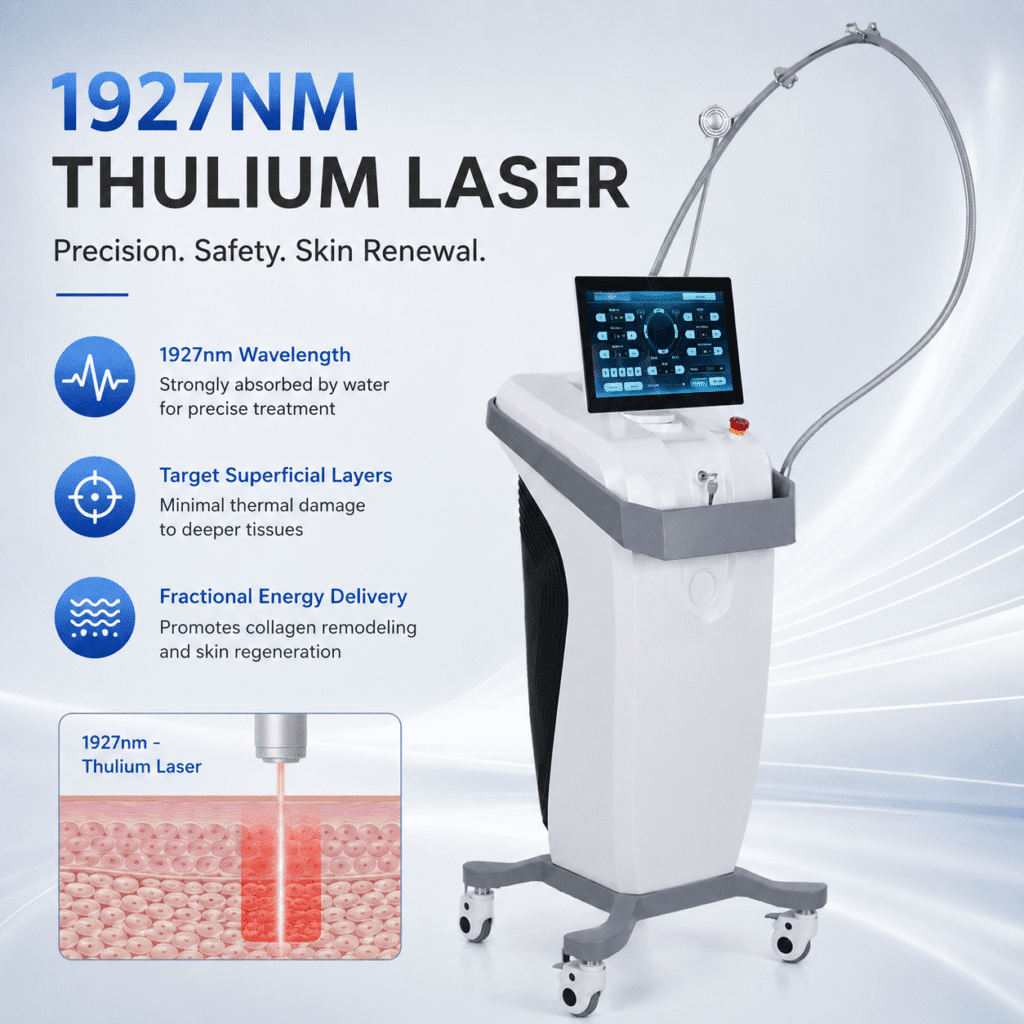
Les longueurs d'onde courantes dans cette catégorie peuvent inclure 1540 nm, 1550 nm ou des systèmes fractionnaires non ablatifs similaires en fonction de la plateforme.
En contrepartie, les résultats sont généralement plus progressifs et il peut être nécessaire de suivre davantage de séances.
Cette catégorie peut être utile pour les clients qui ne peuvent pas s'absenter du travail ou qui souhaitent une approche plus conservatrice, mais elle peut ne pas suffire pour les cicatrices profondes.
Laser fractionné picoseconde : texture et positionnement à faible temps d’arrêt
Les lasers picosecondes sont souvent connus pour les travaux liés aux pigments et aux tatouages, mais les pièces à main picosecondes fractionnées sont également utilisées par certaines cliniques pour le traitement de la texture des cicatrices d'acné et les programmes de rajeunissement.
Le traitement fractionné picoseconde peut être envisagé lorsque les clients souhaitent :
- temps d'arrêt plus court qu'avec le resurfaçage ablatif
- amélioration de la texture et de l'apparence des pores
- amélioration progressive
- options de traitement qui peuvent être plus confortables pour certains types de peau
- combinaison avec gestion des pigments ou des marques post-acnéiques
Cela peut s'avérer particulièrement intéressant pour les clients qui craignent un resurfaçage agressif ou qui ne peuvent accepter une longue convalescence.
Cependant, les clients doivent comprendre que le laser fractionné picoseconde peut ne pas offrir la même intensité de resurfaçage que le laser fractionné CO2 pour les cicatrices plus profondes.
Il est préférable de le présenter comme une option plus douce ou comme élément d'un plan combiné.
Lasers vasculaires et lumière pulsée intense (IPL) : plus efficaces pour les rougeurs que pour les cicatrices profondes ?
Certains clients disent avoir des “ cicatrices d'acné ”, mais le problème concerne en réalité les marques rouges laissées par l'acné.
Ces marques rouges sont différentes des cicatrices déprimées.
Lorsque la rougeur est le principal problème, les cliniques peuvent envisager des approches de type laser vasculaire ou IPL en fonction du cas, de l'appareil, du type de peau et du champ de pratique local.
Ces technologies ne sont pas principalement conçues pour combler les fosses profondes.
Elles peuvent être plus pertinentes pour :
- érythème post-acnéique
- cicatrice rouge
- rougeur d'aspect vasculaire
- rougeur après l'inflammation
Si un client présente à la fois des marques rouges et des cicatrices déprimées, la clinique peut utiliser une approche par étapes : d’abord calmer l’acné et les rougeurs, puis traiter la texture.
Quand le laser seul ne suffit pas
De nombreux patients souffrant de cicatrices d'acné ont besoin d'un traitement combiné.
Le laser peut ne pas suffire lorsque les cicatrices sont :
- très profond
- en forme de pic à glace
- attaché sous la peau
- mélangé en type
- associé à une acné active
- associé à une pigmentation ou à des rougeurs
- surélevé ou chéloïde
En fonction de la réglementation locale et du champ de compétences des cliniques, ces dernières peuvent envisager de combiner le laser avec :
- subcision
- micro-aiguilletage
- Micro-aiguilletage RF
- TCA CROSS
- produits de comblement
- peler
- LED ou assistance à la récupération
- Préparation de la peau de type Hydra Facial
- soins topiques post-traitement
Pour les distributeurs, c'est important car une clinique peut avoir besoin de plusieurs appareils laser, et notamment d'un programme complet pour le traitement des cicatrices d'acné.
Choisir en fonction de la tolérance au temps d'arrêt
Les temps d'arrêt constituent l'un des facteurs de décision les plus importants.
| Tolérance aux temps d'arrêt | Orientation possible |
|---|---|
| Accepter une interruption de service visible pour un resurfaçage plus résistant | Le laser fractionné CO2 ou le laser fractionné Er:YAG peuvent être envisagés. |
| Souhaite une amélioration modérée avec moins d'interruptions. | Un laser fractionné non ablatif ou des réglages fractionnés conservateurs peuvent convenir. |
| Souhaite réduire les temps d'arrêt et prendre en charge progressivement les textures | Le laser fractionné picoseconde ou des approches douces non ablatives peuvent convenir. |
| Impossible d'accepter une récupération visible | Le resurfaçage au laser n'est peut-être pas le premier choix approprié. |
Les clients ne devraient pas choisir uniquement en fonction du “ laser le plus puissant ”.”
L'option la plus efficace n'est pas forcément la meilleure si le client ne peut pas suivre les soins post-traitement.
Choisir en fonction du type de peau et du risque de pigmentation
Le type de peau est important.
Les peaux plus foncées peuvent présenter un risque plus élevé d'hyperpigmentation post-inflammatoire après un resurfaçage agressif.
Cela ne signifie pas que les personnes à la peau plus foncée ne peuvent jamais bénéficier d'un traitement laser. Cela signifie que la clinique doit être plus vigilante quant à :
- sélection de l'appareil
- paramètres énergétiques
- préparation avant traitement
- Testez les zones appropriées
- protection solaire
- soins post-traitement
- intervalle entre les séances
- Explication réaliste des risques
Pour certains clients, le laser fractionné non ablatif, le laser fractionné picoseconde ou le microneedling RF peuvent être envisagés avant un resurfaçage ablatif agressif.
Une évaluation professionnelle est essentielle.
Choisir en fonction des capacités de la clinique
Les clients ne doivent pas choisir un laser uniquement en se basant sur une publicité.
Ils devraient également évaluer le prestataire.
Les questions importantes comprennent :
- La clinique évalue-t-elle le type de cicatrice avant de recommander un traitement ?
- L'opérateur a-t-il reçu une formation sur les lasers ?
- La clinique explique-t-elle la durée de convalescence et les soins post-opératoires ?
- La clinique effectue-t-elle un dépistage des contre-indications ?
- La clinique dispose-t-elle de procédures d'urgence et de suivi ?
- La clinique présente-t-elle des résultats réalistes avant et après l'intervention ?
- La clinique évite-t-elle de faire des promesses d“” ablation complète » ?
- La clinique explique-t-elle combien de séances pourraient être nécessaires ?
Un laser moins agressif utilisé dans une clinique spécialisée peut être plus sûr qu'un laser puissant utilisé sans évaluation préalable.
Quel laser est le mieux adapté à chaque type de client ?
| Type de client | Meilleure direction de départ | Pourquoi |
|---|---|---|
| Cicatrices profondes ou roulantes, accepte les temps d'arrêt | laser fractionné CO2 | Fort potentiel de resurfaçage |
| Cicatrices modérées, demande un resurfaçage mais une convalescence contrôlée | Laser fractionnel Er:YAG | Option ablative avec profil thermique différent |
| Cicatrices légères à modérées, emploi du temps chargé | Laser fractionné non ablatif | Temps d'arrêt réduit, résultats progressifs |
| Texture, pores, marques post-acnéiques, cliente prudente | Laser fractionnaire picoseconde | Positionnement à temps d'arrêt réduit pour certains cas |
| marques d'acné rouges | Traitement vasculaire au laser ou de type IPL | Cible davantage la rougeur que la profondeur de la cicatrice. |
| cicatrices en pic à glace | plan combiné | L'utilisation du laser seul peut être limitée |
| Teint plus foncé avec problèmes de pigmentation | Sélection de lasers conservateurs ou discussion sur le MNRF | Une planification des risques liés à l'hypertension artérielle gravidique (HTAG) à moindre risque peut être nécessaire. |
| Acné active et cicatrices | Contrôler l'acné en premier | Traiter les cicatrices trop tôt peut aggraver l'inflammation ou l'insatisfaction. |
Langage marketing sûr pour les cliniques et les distributeurs
Le marketing ciblant les cicatrices d'acné doit être prudent car les clients ont souvent des attentes émotionnelles fortes.
| Évitez de dire | Alternative plus sûre |
|---|---|
| Le meilleur laser pour tous | Le meilleur choix dépend du type de cicatrice, du type de peau et de la tolérance au temps de convalescence. |
| Élimine complètement les cicatrices d'acné | Contribue à améliorer l'apparence des cicatrices d'acné |
| Réparation en une séance | Les programmes de traitement des cicatrices d'acné nécessitent souvent un traitement par étapes. |
| Aucun temps d'arrêt | La durée de convalescence varie selon le type de laser, ses réglages et la réaction de la peau. |
| Aucun risque | Les risques potentiels et les soins post-opératoires doivent être expliqués. |
| Convient à tous les types de peau | Il convient d'évaluer le type de peau et le risque de pigmentation. |
| Aucune formation requise | La formation professionnelle et la conformité locale sont importantes |
Ce langage aide les cliniques à vendre de manière responsable et réduit le risque de plaintes.
Positionnement des équipements SHEFMON
SHEFMON propose des équipements professionnels de traitement laser et cutané destinés aux distributeurs, aux cliniques et aux acheteurs de matériel de beauté.
Pour les programmes de traitement des cicatrices d'acné, les catégories de produits pertinentes peuvent inclure :
- équipement laser fractionné CO2
- équipement laser CO2 fractionnel à fibre
- équipement laser picoseconde
- Équipement RF de micro-aiguilletage MNRF
- Appareils de soin du visage Hydra et de préparation de la peau
- dispositifs de récupération et de gestion de la peau
Par exemple, les options de laser fractionné CO2 SHEFMON peuvent être positionnées pour les menus de resurfaçage professionnels, tandis que les technologies picosecondes et liées à la MNRF peuvent prendre en charge des programmes plus larges de texture, de pigmentation et de rajeunissement en fonction du modèle de service de l'acheteur.
Pour les distributeurs, la meilleure approche consiste à aider les acheteurs à choisir en fonction de :
- type de client cible
- niveau de traitement des cicatrices
- capacité de formation des opérateurs
- tolérance aux temps d'arrêt des clients locaux
- capacité de suivi
- planification des consommables et des pièces de rechange
- exigences réglementaires locales
Cela transforme la question de vente, qui ne porte plus sur “ quelle machine est la plus puissante ”, en “ quelle solution convient le mieux à votre clinique ”.”
Réponse finale
Les clients doivent choisir un laser pour les cicatrices d'acné en fonction du type de cicatrice, du type de peau, de la durée d'indisponibilité tolérée, de l'objectif du traitement et de l'expérience du praticien.
Le laser fractionné CO2 est souvent un excellent choix pour les cicatrices d'acné atrophiques appropriées et les problèmes de texture visibles, surtout lorsque le client accepte une période de convalescence et que la clinique peut fournir des soins post-opératoires professionnels.
Le laser fractionné Er:YAG peut convenir aux clients nécessitant un resurfaçage ablatif avec un profil de récupération et thermique différent.
Les lasers fractionnés non ablatifs peuvent convenir aux clients qui souhaitent une amélioration progressive avec un temps de convalescence réduit.
Les lasers fractionnés picosecondes peuvent convenir à certains clients qui souhaitent un temps de récupération plus court pour améliorer la texture et les pores, mais ils peuvent ne pas être suffisants pour les cicatrices plus profondes.
Les lasers vasculaires ou les traitements de type IPL sont plus pertinents lorsque la principale préoccupation est la rougeur plutôt que la profondeur de la cicatrice.
Pour les cicatrices profondes, mixtes, en pic à glace ou adhérentes, la meilleure solution consiste souvent en un traitement combiné plutôt qu'en l'utilisation d'un seul laser.
La recommandation la plus sûre est :
Ne choisissez pas le laser le plus puissant uniquement pour son nom. Choisissez le traitement laser le plus adapté après une évaluation de la cicatrice, une analyse du type de peau et une discussion réaliste sur la durée de convalescence, les risques et l'amélioration attendue.
FAQ
Quel est le meilleur laser pour les cicatrices d'acné ?
Il n'existe pas de laser idéal pour tous. Le laser CO2 fractionné est une option de resurfaçage efficace pour les cicatrices atrophiques qui y sont associées, mais d'autres lasers peuvent être plus adaptés en fonction du type de cicatrice, du teint et de la tolérance au temps de convalescence.
Le laser CO2 fractionné est-il plus efficace que le laser picoseconde pour traiter les cicatrices d'acné ?
Le laser fractionné CO2 est généralement plus puissant pour corriger les problèmes de texture plus profonds, tandis que le laser fractionné picoseconde peut être préférable pour une prise en charge de la texture avec un temps d'arrêt plus court dans certains cas.
Le laser Er:YAG est-il efficace contre les cicatrices d'acné ?
Le laser Er:YAG peut être utile pour les programmes de resurfaçage des cicatrices d'acné, notamment lorsqu'une clinique souhaite une option ablative avec un profil thermique différent de celui du laser CO2.
Le laser peut-il éliminer complètement les cicatrices d'acné ?
Aucun professionnel de santé responsable ne devrait promettre la disparition complète des cicatrices. Le laser peut contribuer à améliorer l'apparence des cicatrices, mais les résultats varient.
Quel laser présente le temps d'arrêt le plus court ?
Les approches fractionnées non ablatives et fractionnées picosecondes ont généralement un temps d'arrêt plus court que le resurfaçage ablatif au CO2 ou à l'Er:YAG, mais elles peuvent nécessiter plus de séances et peuvent être moins efficaces pour les cicatrices profondes.
Les lasers sont-ils sans danger pour les peaux foncées ?
Le traitement laser convient à de nombreux types de peau, mais les peaux plus foncées peuvent présenter un risque accru de pigmentation en cas de resurfaçage agressif. Une évaluation professionnelle et une planification prudente sont essentielles.
Que se passe-t-il si le client souffre d'acné active ?
Il est généralement conseillé de traiter l'acné active avant d'envisager un resurfaçage agressif des cicatrices. Un traitement trop précoce peut entraîner des irritations, des inflammations ou une insatisfaction.
Les cicatrices en pic à glace réagissent-elles bien au laser ?
Les cicatrices en pic à glace sont souvent difficiles à améliorer avec le laser seul. Des traitements combinés peuvent être nécessaires selon les cas.
Les cliniques devraient-elles n'acheter qu'un seul laser pour les cicatrices d'acné ?
Certaines cliniques commencent avec un seul appareil de base, mais de nombreux programmes performants de traitement des cicatrices d'acné combinent laser CO2, MNRF, appareils de préparation, soutien à la récupération et analyse de la peau.
Comment les distributeurs doivent-ils expliquer le traitement des cicatrices d'acné par laser ?
Les distributeurs doivent expliquer que le choix du dispositif dépend du type de cicatrice, de l'adéquation au patient, de la formation de l'opérateur, du temps d'arrêt, des soins post-opératoires et de la réglementation locale. Évitez toute promesse de résultat garanti.