









When a beauty salon introduces a new beauty equipment project, the hardest customers to convert are sometimes not new customers. They may be the old clients who have visited the salon for years, trust the beautician, and already buy regular care packages. The salon expects them to accept the new project quickly, but many of them say no.
This does not always mean the new machine has no market. In many cases, existing clients refuse because they do not understand the value, worry about safety, dislike being pushed, feel loyal to the old service, or are not ready to pay more for an uncertain result. The problem is often not the equipment itself. The problem is how the salon introduces it.
A new equipment project should not be sold as a sudden replacement for the customer’s familiar routine. It should be introduced as an upgrade path that is connected to the customer’s existing needs, trust, and long-term care plan.
Why Existing Clients May Reject New Equipment Projects
Old clients have a relationship with the salon, but that relationship can also make them cautious. They already have a service habit. If a new instrument project appears suddenly, they may feel that the salon is trying to sell more instead of caring about their real needs.
تشمل الأسباب الشائعة ما يلي:
- **They do not see the need.** The customer thinks the current facial or body care is already enough.
- **They do not understand the difference.** The new machine sounds technical, but the customer cannot connect it with a personal concern.
- **They worry about safety or discomfort.** Heat, light, suction, current, or needles may create anxiety.
- **They had a bad experience elsewhere.** A previous project may have been painful, ineffective, or oversold.
- **They are afraid of higher cost.** New equipment is often linked with higher package prices.
- **They dislike hard selling.** Old clients may become defensive if they feel their trust is being used to sell.
- **They trust the beautician, not the machine.** They may prefer manual service and feel equipment is cold or unfamiliar.
- **They do not believe one trial can show value.** If the effect is not immediate, they may think the project is unnecessary.
Understanding these reasons is important. If the salon treats resistance as a bad attitude, staff may push harder and make the customer more resistant. If the salon treats resistance as uncertainty, staff can solve it with education, experience, and a better transition path.
The Core Strategy: Transfer Trust From Old Service To New Project
Existing clients already trust something: the store, the beautician, the old package, the service atmosphere, or the results they have felt before. The goal is to transfer this trust to the new equipment project.
Do not start with the machine. Start with the customer’s current problem.
على سبيل المثال، بدلاً من قول:
We have a new RF machine. Do you want to try it?
يمكن للموظفين أن يقولوا:
You have been doing hydration and basic care with us for a long time. Recently your main concern is firmness around the jawline. Manual care can improve comfort and circulation, but it is limited for deeper firming support. We introduced this RF project as an upgrade option for clients who want stronger anti-aging management.
This connects the new project with the customer’s existing history. The customer is not being asked to buy a random new machine. The customer is being shown a logical next step.
Step 1: Segment Existing Clients Before Promotion
Not every old client should receive the same promotion. A salon should divide existing clients into groups and use different introduction methods.
Loyal Basic-Care Clients
These clients buy regular cleansing, hydration, massage, and maintenance projects. They may be price-sensitive or comfortable with old routines.
Best approach:
- Introduce low-pressure upgrade add-ons.
- Combine the new equipment with their familiar project.
- Use a small area or short session trial.
- Emphasize comfort and maintenance, not dramatic transformation.
High-Spending Anti-Aging Clients
These clients already accept higher-value projects and care about visible aging signs, contour, texture, or long-term skin management.
Best approach:
- Use analysis and comparison.
- Explain project logic and treatment course.
- Provide a premium consultation experience.
- Recommend 6 to 10 session packages if suitable.
Dormant Or Inactive Clients
These clients have not returned for a while. A new instrument project can be used as a reason to reconnect.
Best approach:
- Invite them for a skin review or member upgrade experience.
- Avoid pushing a package in the first message.
- Use a return visit benefit instead of a heavy discount.
Sensitive Or Cautious Clients
These clients ask many questions, worry about side effects, or have sensitive skin.
Best approach:
- Provide clear contraindication screening.
- Explain what the project can and cannot do.
- Offer gentle equipment categories first, such as LED, skin analysis, hydration support, or low-intensity introduction.
- تجنب المبالغة في الادعاءات.
Client segmentation prevents the salon from using one message for everyone. The more personal the recommendation feels, the lower the resistance.
Step 2: Use Consultation Before Sales
Old clients may reject new projects because the salon talks about the machine before talking about the customer’s condition. A better method is to start with consultation.
Useful consultation questions include:
- What skin or body concern has changed recently?
- Which result from your current care do you like most?
- Which problem still feels difficult to improve?
- هل سبق لك أن جربت مشاريع المعدات؟
- Did you feel comfortable or uncomfortable during previous experiences?
- Are you more concerned about comfort, effect, price, or safety?
- Would you prefer a gentle trial before deciding on a full course?
These questions help staff understand the customer’s real objection. If the customer worries about pain, a price discount will not solve the problem. If the customer worries about cost, a technical explanation will not be enough. If the customer does not see the need, staff should use analysis and comparison instead of repeating the machine function.
Step 3: Do Not Introduce Too Many Technologies At Once
Many salons make new equipment projects sound complicated. They explain RF, EMS, ultrasound, LED, HIFU, vacuum, cooling, energy levels, and multiple handles in one conversation. The customer becomes confused and chooses nothing.
For old clients, keep the first message simple.
بدلاً من قول:
This machine has RF, EMS, LED, vibration, negative pressure, and multiple treatment modes.
يقول:
For you, we only need to focus on one thing first: improving firmness around the lower face. This handle is used for that direction, and today’s trial is mainly to let you feel the comfort and understand whether it suits you.
The customer does not need to understand every function immediately. They need to understand why this project is relevant to them.
Step 4: Let Old Clients Try Through Familiar Projects
The easiest way to reduce resistance is to connect the new instrument with a project the client already accepts. This is called a transition package.
أمثلة:
- Add LED soothing support after regular cleansing.
- Add ultrasound hydration after basic facial care.
- Add RF firming to an existing anti-aging facial.
- Add EMS microcurrent around the jawline after facial massage.
- Add skin analysis before the customer’s monthly facial.
- Add body contouring experience after lymphatic body care.
This method is less threatening than asking the customer to buy a completely new course. The customer can feel the machine inside a familiar service environment. Once trust is built, the salon can recommend a separate equipment package.
Step 5: Design A Member-Only Trial Instead Of A Public Discount
Old clients may feel uncomfortable if a new project is introduced only as a cheap promotion. A public discount can make the project look low-value. A member-only trial can make it feel like a privilege.
على سبيل المثال:
- Old-client upgrade experience.
- Member skin review and equipment trial.
- VIP first experience before public launch.
- تحديث المعدات في شهر ميلادي.
- Package renewal bonus treatment.
This framing matters. The customer feels the salon is inviting them to try something new because they are valued, not because the store is desperate to sell.
The trial does not have to be free. A paid trial with a clear deduction rule often works better:
If you decide to upgrade to the course within 72 hours, today’s trial fee can be deducted from the package.
This protects the value of the project and filters customers who only want free services.
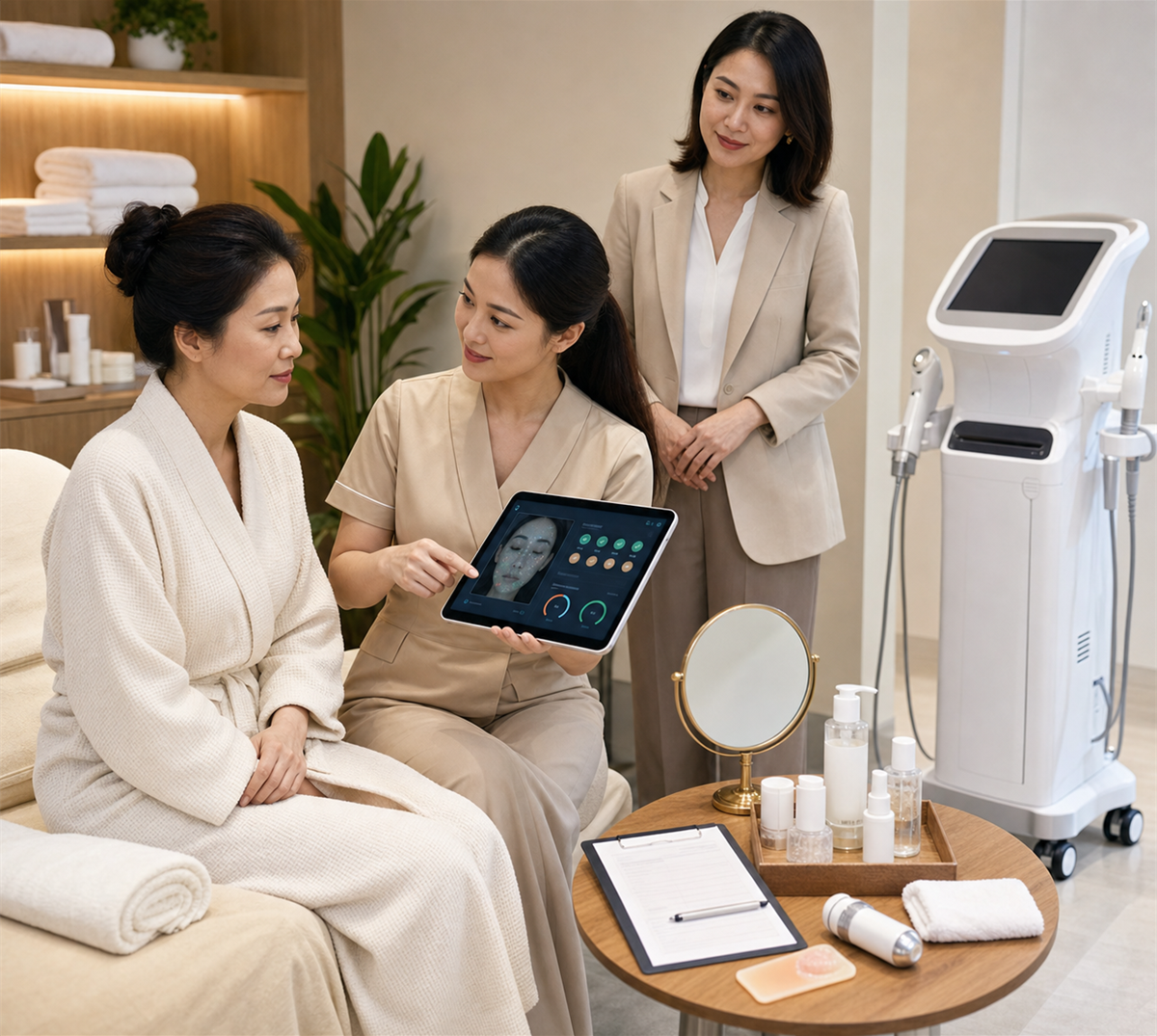
Step 6: Use Skin Analysis Or Visual Records To Create Awareness
Old clients may say they do not need the new project because they cannot see the problem clearly. Skin analyzers, photos, mirrors, measurement records, and consultation charts can help turn a vague concern into a visible discussion.
For facial projects, the salon can show:
- مستوى الترطيب.
- حالة المسام.
- نَسِيج.
- احمرار.
- خطوط دقيقة.
- Firmness concern.
- Pigmentation trend.
- Skin sensitivity signs.
For body projects, the salon can use:
- Area measurements.
- Posture or contour photos if appropriate.
- Customer self-rating.
- Clothing fit feedback.
- Lifestyle and routine discussion.
The goal is not to scare the customer. The goal is to help the customer understand why the old routine may need an upgrade.
Step 7: Use Honest Before-And-After Communication
Old clients trust the salon because they believe the salon is honest. If a new instrument project is promoted with exaggerated before-and-after images, guaranteed results, or unrealistic timelines, the salon may lose that trust.
Use careful language:
- One experience helps you understand comfort and suitability.
- Some customers may feel temporary brightness, hydration, relaxation, or firmness.
- Stable change usually needs repeated care and home maintenance.
- Results vary by skin condition, age, lifestyle, and treatment frequency.
- This project is not suitable for everyone, so we will screen first.
This kind of honest explanation may seem less aggressive, but it improves long-term trust. Old clients are more likely to buy when they feel the salon is protecting them, not pressuring them.
Step 8: Give Staff A Clear Objection Handling Script
When old clients refuse, staff often do not know how to respond. They either give up immediately or push too hard. A better approach is to identify the objection and answer calmly.
If The Client Says: I Am Fine With My Current Care
يمكن للموظفين أن يقولوا:
That makes sense. Your current care is still useful for maintenance. The reason I am mentioning this project is that your new concern is firmness, and manual care has limits in that area. You do not need to change everything. We can add one trial to your usual treatment and see whether you like the feeling.
If The Client Says: I Am Afraid It Will Hurt
يمكن للموظفين أن يقولوا:
We can start with a gentle setting and stop anytime if you feel uncomfortable. Before we begin, I will explain the normal sensation and check whether the project is suitable for you. If you prefer, we can try a small area first.
If The Client Says: I Tried Something Similar Before And It Did Not Work
يمكن للموظفين أن يقولوا:
That is useful to know. Different machines, settings, operators, and treatment plans can feel very different. I do not want to promise too much from one session. We can first check your current condition and decide whether this project is actually suitable.
If The Client Says: It Is Too Expensive
يمكن للموظفين أن يقولوا:
I understand. This project is not meant to replace every service you do. It is more suitable for the concern you want to improve most. We can start with a smaller package or combine it with your existing care plan so the budget is easier to manage.
If The Client Says: I Need To Think About It
يمكن للموظفين أن يقولوا:
Of course. I will send you today’s analysis summary and the recommended plan. If you decide within the next 72 hours, the trial fee can still be deducted. You can compare it with your current package and decide what feels right.
Scripts should sound natural, not robotic. The best staff members listen first, then answer the exact concern.
Step 9: Convert Through A Small Upgrade, Not A Big Jump
If an old client usually buys a basic facial package, asking them to immediately buy a high-priced equipment course may feel too aggressive. A small upgrade is easier.
Possible transition paths:
- Add one equipment session to an existing facial package.
- Upgrade every second visit with an equipment add-on.
- Offer a 3-session starter course before a 10-session package.
- Use a mixed package: manual care + equipment support.
- Allow membership balance to be used for part of the upgrade.
- Create a seasonal upgrade plan instead of a full-year commitment.
The salon can gradually move the customer from familiar care to equipment-based care. Once the customer feels the value, larger packages become easier to sell.
Step 10: Use Existing Client Proof Carefully
Old clients are influenced by other old clients. If the salon has real feedback from similar customers, it can be useful. However, testimonials and before-and-after examples should be honest, permission-based, and not misleading.
Good proof includes:
- Real customer feedback with permission.
- Similar age or concern group.
- Consistent photo angle and lighting.
- Explanation of treatment course length.
- بيان واضح بأن النتائج تختلف.
- Staff case notes without exaggeration.
Avoid fake reviews, over-edited photos, unclear claims, or implying that every customer will get the same outcome. Trust is the salon’s most valuable asset with old clients.
Step 11: Follow Up Without Chasing
Some old clients will not decide during the first introduction. That is normal. The salon should follow up in a helpful way, not chase aggressively.
A good follow-up can include:
- Summary of the customer’s concern.
- Why the new project was recommended.
- What the first trial can show.
- What the full course is designed to improve.
- Price and deduction rule.
- Available appointment times.
- A gentle reminder that the customer can decide after consultation.
على سبيل المثال:
Today we talked about firmness around the lower face. I recommended the RF upgrade because your current care is good for maintenance, but this area may need stronger support. You can try it together with your next facial. If you like the feeling, we can decide whether to add a small course.
This feels more respectful than repeatedly sending discount messages.
Step 12: Track Conversion By Client Type
Salons should not judge the project only by total sales. They should track which type of old client accepts the new instrument fastest.
تشمل المقاييس المفيدة ما يلي:
- Number of old clients introduced to the project.
- Number who accepted consultation.
- Number who accepted trial.
- Number who bought a starter package.
- Number who upgraded to a full package.
- Average time from first introduction to purchase.
- Main objections recorded by staff.
- Repurchase rate after first course.
- Complaint or refund rate.
This data helps the salon improve scripts, pricing, project selection, and client targeting. It also helps distributors understand which machines are easier for salons to promote to existing customers.
Project Examples For Existing Client Conversion
Basic Facial Client To Hydro Facial Upgrade
Client profile: Comes once a month for cleansing and hydration, does not buy expensive projects.
Best approach:
- Add skin analysis before the usual facial.
- Explain pore blockage and hydration needs.
- Offer a hydro facial upgrade inside the same appointment.
- Recommend a 3-session starter package.
Sales focus:
This is not a completely new routine. It is an upgraded version of the care you already trust.
Massage Client To RF Firming Upgrade
Client profile: Likes manual massage, worries about facial laxity but has not tried energy devices.
Best approach:
- Keep massage as part of the package.
- Add RF for lower face or neck area.
- Explain comfort and temperature control.
- Recommend mixed package: manual care + RF support.
Sales focus:
Manual massage is good for relaxation and circulation. RF is added to support the firmness concern you mentioned.
LED Soothing Upgrade For Sensitive Clients
Client profile: Cautious, sensitive skin, afraid of strong treatments.
Best approach:
- Start with LED light therapy or gentle equipment.
- Emphasize comfort and screening.
- Avoid high-pressure before-and-after claims.
- Offer soothing maintenance package.
Sales focus:
We are not starting with a strong project. We are choosing a gentle support project that matches your comfort level.
Skin Analyzer For High-End Clients
Client profile: Already spends well, wants professional planning.
Best approach:
- Use AI skin detection or visual analysis.
- Compare current care goals with future concerns.
- Create a customized equipment plan.
- Recommend premium course based on analysis.
Sales focus:
This is not random project selling. It is a data-supported skin management plan.
ما الذي يجب على صالونات التجميل تجنبه
Salons should avoid pushing old clients with fear-based language. Saying your skin is bad or you will age quickly if you do not buy can damage trust.
They should also avoid replacing the customer’s familiar project too suddenly. If the customer likes manual care, keep part of it and add equipment gradually.
Avoid promising one-session transformation. Many equipment projects require repeated care, proper operation, customer suitability, and realistic expectations.
Avoid giving every old client the same discount message. Personalization is the reason old clients are easier to convert than cold traffic.
Avoid training staff only on machine parameters. Staff need to understand customer psychology, objection handling, package design, and follow-up.
كيف يمكن للموزعين دعم الصالونات
Beauty equipment distributors and manufacturers can help salons convert existing clients by providing more than machine training.
تشمل خدمات الدعم المفيدة ما يلي:
- Existing client upgrade scripts.
- Client segmentation templates.
- Trial card designs for old members.
- معايير الصور قبل وبعد.
- Contraindication and suitability checklists.
- Package transition examples.
- قوالب رسائل المتابعة.
- Staff role-play training.
- حساب تكلفة المواد الاستهلاكية.
- Case studies for different salon types.
When salons know how to introduce a new machine to old clients, equipment utilization increases. Higher utilization leads to more consumable orders, better customer feedback, and stronger distributor loyalty.
التعليمات
Why do loyal salon clients refuse new equipment projects?
They may not understand the value, worry about safety or discomfort, dislike hard selling, fear higher cost, or feel satisfied with their current care. Resistance usually means uncertainty, not necessarily rejection of the salon.
Should salons give old clients free trials for new equipment?
Not always. A member-only paid trial with a deduction rule can protect project value and reduce casual no-shows. Free trials can work for VIP events, but they need clear limits and follow-up.
How can staff introduce new equipment without sounding pushy?
Staff should start from the client’s existing concern and service history, then explain why the new project is a logical upgrade. Avoid starting with machine functions or price discounts.
What if an old client says the new equipment project is too expensive?
Offer a small upgrade, starter package, mixed package, or partial use of membership balance if the salon policy allows it. The goal is to reduce the jump from old service to new package.
How long does it take old clients to accept a new project?
Some clients buy after one trial, while others need repeated education, visible case examples, or a gradual add-on experience. Salons should track consultation, trial, package purchase, and repurchase by client type.
خاتمة
When existing clients refuse to try new beauty equipment projects, salons should not immediately lower the price or push harder. They should understand the reason behind resistance, segment clients, start with consultation, connect the new project to familiar services, use honest trial design, and recommend a realistic upgrade path.
Old clients are valuable because trust already exists. The salon’s job is to transfer that trust from the old service to the new instrument project. When the transition is gentle, logical, and customer-centered, new equipment projects become easier to accept, easier to package, and easier to turn into long-term revenue.