









Share optimized solutions, professional valve knowledge and industry news
Please enter the relevant terms or keywords you need to consult, and relevant articles will appear in the search results. If you can’t find the answer you need, please feel free to contact us and we will be happy to help. Or you can directly send an email to beauty@shefmon.com
Monopolar RF vs Bipolar RF: Which Technology Should Clinics Choose?
- shefmon
Radiofrequency (RF) technology has become one of the most widely used solutions in the aesthetic and wellness industry. From skin tightening and wrinkle reduction to body contouring and tissue rejuvenation, RF treatments offer non-invasive results with minimal downtime. However, not all RF technologies work the same way. Among the most common RF systems available today are Monopolar RF and Bipolar RF. While both use radiofrequency energy to generate heat within tissues, they differ significantly in energy delivery, penetration depth, treatment applications, and business suitability. For clinics, medspas, and beauty centers looking to invest in RF equipment, understanding these differences is essential when selecting the right technology.
1. Understanding How RF Technology Works
1.1 The Basic Principle of RF Energy
Radiofrequency treatments use electromagnetic energy to generate heat within the skin and underlying tissues. This controlled heating effect can help:
- Stimulate collagen production
- Improve skin elasticity
- Enhance circulation
- Tighten loose skin
- Support body contouring procedures
The way the energy travels through tissue depends on the RF system design, which is where Monopolar and Bipolar technologies differ.
1.2 Why Energy Delivery Matters
The effectiveness of an RF treatment is heavily influenced by:
- Penetration depth
- Energy concentration
- Treatment area size
- Tissue heating pattern
Different RF configurations are designed to target different layers of tissue, making each technology suitable for specific clinical goals.
2. What Is Monopolar RF?
2.1 How Monopolar RF Works
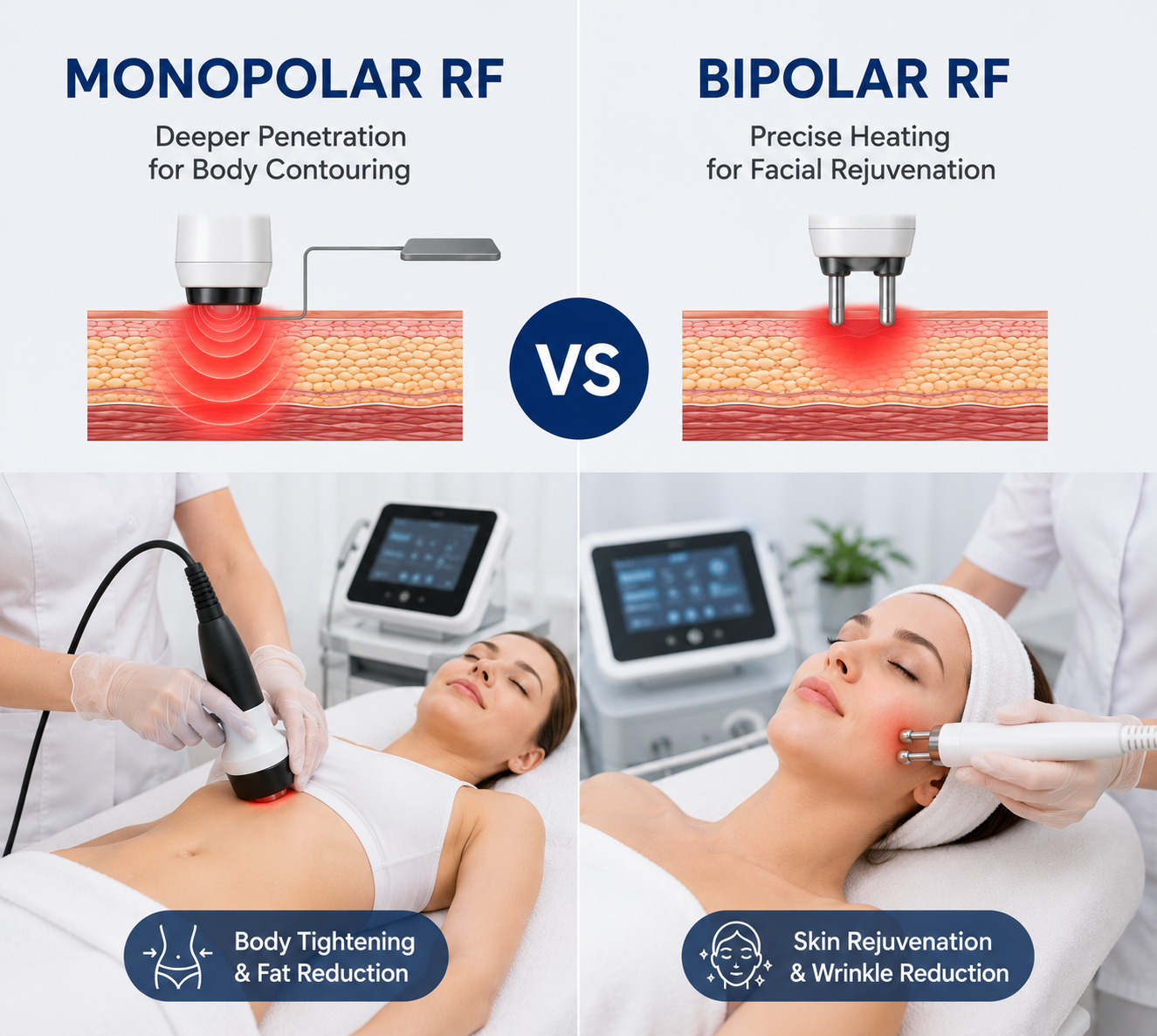
Monopolar RF uses a single treatment electrode placed on the skin while a grounding pad is positioned elsewhere on the body.
The radiofrequency energy travels from the treatment tip through deeper tissue layers before reaching the grounding pad. Because the electrical pathway is much larger, Monopolar RF can penetrate deeper than most other RF technologies.
2.2 Key Characteristics of Monopolar RF
Main advantages include:
- Deep tissue penetration
- Large treatment coverage
- Strong heating effect
- Effective collagen stimulation
This makes Monopolar RF particularly suitable for:
- Skin tightening
- Body contouring
- Fat reduction support
- Loose skin improvement
2.3 Popular Clinical Applications
Clinics often use Monopolar RF for:
- Facial lifting procedures
- Jawline tightening
- Neck rejuvenation
- Abdomen contouring
- Post-weight-loss skin tightening
The deeper penetration allows treatment energy to reach tissue layers that are difficult to target with superficial technologies.

3. What Is Bipolar RF?
3.1 How Bipolar RF Works
Bipolar RF uses two electrodes located within the same treatment handpiece.
Instead of traveling through a large section of the body, the energy flows only between these two electrodes. As a result, the treatment energy remains concentrated in a smaller and more superficial area.
3.2 Key Characteristics of Bipolar RF
Major advantages include:
- Controlled energy delivery
- Greater treatment precision
- Increased safety profile
- Comfortable treatment experience
Because energy remains localized, Bipolar RF is often preferred for delicate facial treatments.
3.3 Common Treatment Applications
Bipolar RF is frequently used for:
- Fine line reduction
- Facial rejuvenation
- Eye area treatments
- Skin texture improvement
- Mild skin tightening
Its precision makes it highly effective for smaller treatment zones that require careful energy control.
4. Monopolar RF vs Bipolar RF: The Main Differences
4.1 Treatment Depth
One of the biggest differences between the two technologies is penetration depth.
Monopolar RF:
- Reaches deeper tissue layers
- Suitable for body and facial tightening
- Stronger volumetric heating effect
Bipolar RF:
- Focuses on superficial to mid-level tissues
- Better for targeted facial treatments
- More localized heating
Clinics targeting body contouring applications often favor Monopolar RF due to its deeper reach.
4.2 Treatment Area
Monopolar RF generally covers larger treatment zones, making it ideal for:
- Abdomen
- Thighs
- Arms
- Buttocks
Bipolar RF is more suitable for:
- Face
- Around the eyes
- Neck
- Smaller treatment areas
4.3 Energy Concentration
Because Bipolar RF confines energy between two closely positioned electrodes, it provides:
- More focused heating
- Better precision
- Greater operator control
Monopolar RF distributes energy over a larger pathway, creating broader tissue heating.
4.4 Client Comfort
Modern systems from both categories can be comfortable when used correctly. However, Bipolar RF is often perceived as slightly more comfortable because the energy remains closer to the skin surface.
Monopolar RF may generate stronger thermal sensations due to deeper tissue heating.
5. Which Technology Produces Better Skin Tightening?
5.1 Monopolar RF for Significant Tightening
For clients experiencing moderate to severe skin laxity, Monopolar RF often delivers stronger tightening effects because it targets deeper structural tissues.
This makes it particularly useful for:
- Aging skin
- Loose body skin
- Postpartum treatments
- Weight-loss patients
5.2 Bipolar RF for Skin Quality Improvement
Bipolar RF excels at improving:
- Skin texture
- Fine wrinkles
- Surface firmness
- Overall skin appearance
For younger clients seeking preventative anti-aging treatments, Bipolar RF may be sufficient.
6. Business Considerations for Clinics
6.1 Understanding Your Target Market
Before investing in RF equipment, clinics should evaluate their primary treatment demand.
If clients frequently request:
- Body contouring
- Skin tightening
- Fat reduction support
Monopolar RF may provide broader treatment capabilities.
If the focus is mainly:
- Facial rejuvenation
- Anti-aging treatments
- Skin maintenance programs
Bipolar RF may be the better choice.
6.2 Treatment Menu Expansion
Many modern aesthetic clinics choose devices that combine multiple RF technologies.
This allows practitioners to:
- Treat a wider range of concerns
- Customize protocols
- Increase service diversity
- Improve equipment utilization
Offering both deep and superficial RF treatments can create additional revenue opportunities while improving treatment flexibility.
7. Future Trends in RF Technology
The latest generation of RF devices increasingly combines Monopolar RF with Bipolar RF, Vacuum Therapy, EMS, or Microneedling technologies.
These hybrid systems aim to:
- Enhance treatment results
- Improve patient comfort
- Increase clinic profitability
- Expand treatment indications
As competition grows within the aesthetic industry, multifunction platforms are becoming more attractive than single-technology devices.
Conclusion
Both Monopolar RF and Bipolar RF offer valuable benefits, but they serve different treatment goals. Monopolar RF is generally better for deeper tissue heating, skin tightening, and body treatments, while Bipolar RF excels in precise facial rejuvenation and surface-level skin improvement. For clinics, the best choice depends on client demand, treatment focus, and business objectives. In many cases, a system that incorporates both technologies can provide the greatest flexibility and long-term value.