






요약 보고서
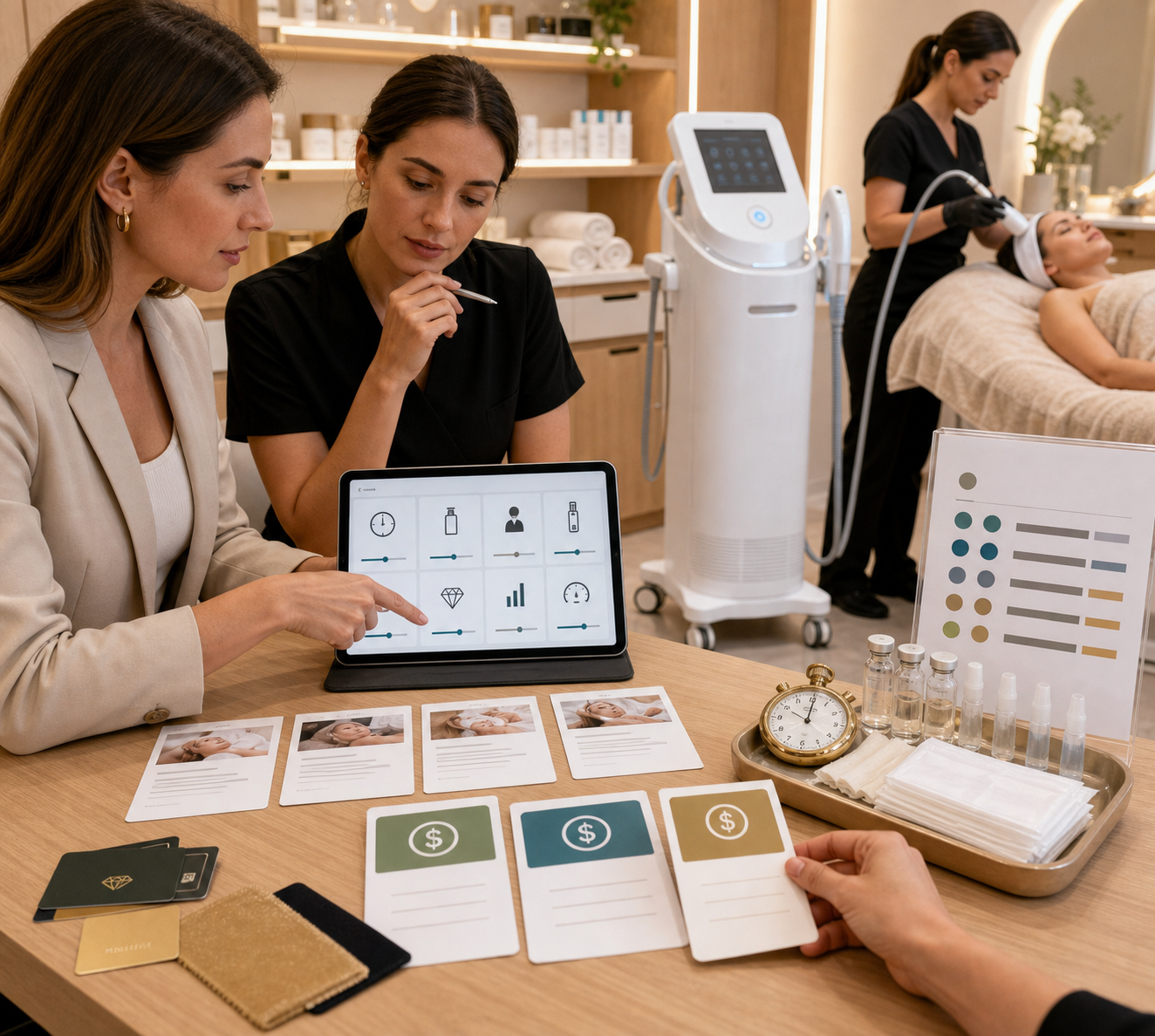
Beauty equipment project pricing should not be guessed from the machine price alone. A suitable price depends on customer demand, local spending power, competitor pricing, treatment time, consumable cost, staff cost, room utilization, equipment investment, project positioning, and package strategy.
As a practical reference for many beauty salons:
- Skin analysis: free to USD 30 as a consultation tool, or included in packages.
- LED add-on: USD 15 to USD 50 per session, depending on positioning.
- Hydro facial or small bubble care: USD 40 to USD 120 per session.
- Basic multifunction facial upgrade: USD 50 to USD 150 per session.
- EMS or microcurrent facial: USD 60 to USD 180 per session.
- RF firming facial: USD 80 to USD 250 per session.
- Hair removal: USD 30 to USD 500 per session depending on body area.
- Body contouring or body firming: USD 100 to USD 400 per session, with courses often priced higher.
- High-end anti-aging or advanced energy-based projects: pricing may be much higher, but must match local regulations, customer acceptance, staff skill, and treatment credibility.
These are reference ranges, not fixed rules. A community salon, new salon, high-end skin management center, medical aesthetic support setting, and body management center should not use the same price table.
가장 간단한 공식은 다음과 같습니다.
Minimum price = Direct variable cost + Required contribution per treatment
A stronger pricing formula is:
Recommended price = Direct variable cost + Staff cost + Room cost + Equipment depreciation + Maintenance reserve + Desired profit margin + Brand value premium
The salon should also calculate:
치료당 순기여도 = 치료 비용 – 직접 변동 비용
투자 회수 기간(개월) = 총 초기 투자액 / 월별 순수익
The best price is not the highest price customers can be forced to pay. It is the price that customers understand, staff can explain, and the salon can repeat profitably.
1. Why Beauty Equipment Project Pricing Is Difficult
Beauty equipment project pricing is difficult because the salon is not selling only machine time. It is selling a complete experience that may include consultation, assessment, cleaning, equipment operation, consumables, masks, massage, aftercare, follow-up, and trust.
Many salons make one of two mistakes:
- They price too low because they are afraid customers will not accept the new project.
- They price too high because the machine was expensive and the supplier promised high profit.
Both can create problems.
If pricing is too low, the salon may get bookings but weak profit. Staff may also treat the machine as a free add-on, which makes customers undervalue it.
If pricing is too high, customers may try once but not return. Staff may need to over-explain or overpromise, which can damage trust.
The right price should balance customer value and salon profit.
2. 간략한 답변
How much should a beauty salon charge for equipment projects?
A practical answer is:
- Basic add-ons: USD 10 to USD 50
- Basic facial equipment projects: USD 40 to USD 120
- Mid-level firming, hydration, LED, EMS, and multifunction projects: USD 60 to USD 180
- RF and anti-aging projects: USD 80 to USD 250
- Hair removal projects: USD 30 to USD 500 depending on area
- Body contouring projects: USD 100 to USD 400 per session
- Course packages: usually priced by 3, 5, 6, 8, or 10 sessions with a moderate package benefit
- Memberships: usually monthly, quarterly, or annual, based on repeat maintenance value
But the final price should be set only after checking:
- Local competitor pricing
- Target customer spending power
- 치료 기간
- 소모품 비용
- 직원 비용
- 객실 수용 인원
- Equipment investment
- 프로젝트의 독창성
- Expected monthly bookings
- Package conversion
- Customer retention potential
Price is a business calculation, not only a menu number.
3. Start With Customer Acceptance
The first pricing question is not how much the machine costs. It is how much the local customer is willing to pay for the care goal.
미용실에서는 다음 사항을 조사해야 합니다.
- What customers already pay for basic facials
- What customers pay for premium facials
- What competitors charge for similar equipment projects
- What price range customers accept for course packages
- Whether customers prefer single sessions or packages
- Whether the area has high, middle, or budget spending behavior
- Whether the salon already has customer trust
예:
If local customers usually pay USD 40 to USD 60 for a facial, launching a USD 220 equipment facial may be difficult unless the salon has strong positioning and strong consultation.
If customers already pay USD 120 to USD 180 for premium anti-aging care, an RF or EMS upgrade package may be easier to sell.
Pricing must match the market the salon actually serves.
4. Competitor Pricing Is A Reference, Not A Rule
Competitor research is important, but salons should not copy prices blindly.
Competitor price depends on:
- 브랜드 포지셔닝
- 위치
- 직원 기술
- Equipment quality
- 치료 시간
- 소모품
- 패키지 디자인
- Discount strategy
- Customer base
- Rent and labor cost
If a competitor charges low prices, it may mean they have lower costs, poor margins, heavy promotions, or weak positioning. Copying their price may damage profit.
If a competitor charges high prices, it may mean they have stronger brand trust, better consultants, higher-income customers, or more complete service packaging. Copying their price without matching value may reduce conversion.
Use competitor pricing to understand the market range, then set your own price from value and cost.
5. Calculate Direct Cost Per Treatment
Every project has direct cost.
Direct costs may include:
- 혈청
- 젤라틴
- Mask
- 팁
- 필터
- 병
- 카트리지
- 일회용 시트
- Gloves
- Towels
- 청소용품
- Aftercare product
- 직원 위원회
- 결제 처리 수수료
- Consumable loss
예:
- Hydro facial serum and consumables: USD 8
- Mask and disposable supplies: USD 6
- Staff commission: USD 10
- Cleaning and other direct costs: USD 3
- Total direct cost: USD 27
If the treatment price is USD 68:
Net contribution = USD 68 – USD 27 = USD 41
This net contribution must be high enough to support rent, management, machine depreciation, marketing, and profit.
6. Include Treatment Time And Room Capacity
Time is part of pricing.
Two projects may have the same consumable cost but very different room time.
예:
- LED add-on: 15 to 20 minutes
- Hydro facial: 45 to 60 minutes
- RF facial: 60 to 90 minutes
- Hair removal small area: 15 to 30 minutes
- Body contouring: 45 to 90 minutes
If a body treatment takes 90 minutes, it must be priced high enough to justify the room and staff time. If not, the salon may earn less than it would from multiple shorter facial services.
Useful calculation:
Revenue per treatment hour = Treatment price / Total service time in hours
A USD 80 treatment that takes 40 minutes may be more efficient than a USD 150 treatment that takes two hours.
Pricing should protect room productivity.
7. Add Equipment Depreciation And Maintenance
A salon should not ignore machine depreciation.
A simple depreciation estimate:
Monthly equipment cost = Total machine investment / Expected useful months
그 다음에:
Equipment cost per treatment = Monthly equipment cost / Expected monthly treatments
예:
- Machine investment: USD 6,000
- Expected use period: 36 months
- Monthly equipment cost: USD 167
- Expected monthly treatments: 40
- Equipment cost per treatment: about USD 4.20
This does not mean the price must increase by only USD 4.20. It means the salon should know how much machine investment is being used in each treatment.
Maintenance reserve should also be included, especially for devices with handpieces, filters, cartridges, cooling systems, probes, or energy output modules.
8. Price By Project Value, Not Only Cost
Cost is the floor. Value is the ceiling.
A project with USD 15 in direct cost may be priced at USD 50, USD 100, or USD 200 depending on:
- 고객 문의
- Perceived value
- Salon brand positioning
- Service environment
- Staff expertise
- 치료 경험
- 경쟁사 가격
- 패키지 디자인
- Trust and results expectation
For example, LED may be a low-cost add-on in a basic salon, but part of a premium recovery package in a high-end skin management center. RF may be a moderate facial upgrade in one salon and a premium anti-aging course in another.
Pricing should reflect the complete project, not only machine output.
9. Price Basic Add-Ons
Basic equipment add-ons help increase average ticket size without making customers commit to a full project.
Common add-on price range:
- USD 10 to USD 50
Suitable add-ons include:
- LED calming step
- 산소 스프레이
- Cold hammer
- 피부 분석
- 수분 마스크
- 목 관리 업그레이드
- Eye care upgrade
- Small RF jawline add-on
- EMS 윤곽 추가 기능
Add-ons should be simple.
예:
- 기본 페이셜: 50달러
- LED calming add-on: USD 20
- Neck RF add-on: USD 35
- Skin analysis add-on: USD 15
The add-on must have a clear name and value. Do not create too many add-ons, or staff will struggle to explain them.
10. Price Skin Analysis
Skin analysis pricing depends on how the salon uses it.
일반적인 옵션:
- Free for first consultation
- Free with course package
- USD 10 to USD 30 as standalone analysis
- Included in membership
- Included before and after a course
Skin analysis often creates more value as a conversion tool than as a direct paid service.
권장 구조:
- First analysis: included with consultation
- Recheck: included in course or membership
- Standalone skin report: paid
This avoids making customers feel charged before trust is built while still giving the analyzer business value.
11. Price Hydro Facial And Small Bubble Projects
Hydro facial, water oxygen, and small bubble projects are usually high-frequency basic to mid-level services.
Common price range:
- USD 40 to USD 120 per session
Typical package structures:
- Trial: USD 29 to USD 59
- Standard treatment: USD 50 to USD 90
- Premium upgrade: USD 80 to USD 150
- 5-session monthly package: moderate discount
- Membership: one monthly cleansing and hydration service
Pricing should consider consumables, suction tips, serums, masks, treatment time, staff commission, and local facial pricing.
These projects are often suitable for community salons, new salons, and skin management centers because customers understand cleansing and hydration easily.
12. Price LED Light Therapy Projects
LED is often priced as an add-on or support package.
Common price range:
- Add-on: USD 15 to USD 50
- Standalone session: USD 30 to USD 80
- Course package: priced by 5, 6, or 10 sessions
Suitable package structures:
- LED calming add-on after facial
- LED acne support course
- LED 조명과 수분 공급 마스크 세트
- Monthly LED maintenance membership
LED alone may be hard to price too high unless the salon has strong positioning. It often works better when paired with cleansing, acne care, hydration, or recovery support.
13. Price EMS And Microcurrent Projects
EMS and microcurrent projects can be priced as facial upgrades or course packages.
Common price range:
- USD 60 to USD 180 per session
Package structures:
- Pre-event facial: single session
- EMS contour add-on: USD 20 to USD 60
- 5-session facial contour package
- Monthly facial fitness membership
- EMS plus RF premium course
Pricing should reflect treatment time, staff skill, customer sensation, gel cost, and package explanation.
These projects usually need good consultation because customers may not understand the feeling or purpose at first.
14. Price RF Beauty Projects
RF projects often support higher-ticket anti-aging and firming services.
Common price range:
- USD 80 to USD 250 per session
Package structures:
- RF trial: lower first-time price
- Standard RF facial
- RF 플러스 EMS 업그레이드
- RF neck and jawline package
- 6-session firming course
- Monthly maintenance after course
Pricing logic:
- RF should not be priced like a basic cleansing step.
- It needs staff training and expectation management.
- Course packages often make more sense than one-time sessions.
- Price should reflect treatment area and service time.
Avoid claims such as guaranteed lifting or permanent wrinkle removal.
15. Price Hair Removal Projects
Hair removal pricing depends heavily on body area, device type, local regulation, treatment time, and competitive pressure.
Common session price range:
- Small area: USD 30 to USD 100
- Medium area: USD 80 to USD 250
- Large area: USD 150 to USD 500
예:
- Underarm: lower price, high conversion
- Upper lip or chin: small area package
- Half leg or full leg: higher price
- Back or chest: higher price
- Bikini area: depends on local rules, staff training, and privacy standards
Course structures:
- 6회 세션 패키지
- 8-session area package
- 다중 영역 패키지
- 해당되는 경우 연간 유지보수 계획
Hair removal pricing should include safety steps, consultation, skin type assessment, eye protection, aftercare, device maintenance, and possible local licensing requirements.
Avoid unsupported permanent claims unless allowed and substantiated in the market.
16. Price Body Contouring And Body Firming Projects
Body projects often have higher price potential but also higher time and expectation-management requirements.
Common price range:
- USD 100 to USD 400 per session
Course packages may range widely depending on area, machine type, session count, and salon positioning.
패키지 예시:
- 단일 신체 부위 시험
- 8-session waist and abdomen course
- RF 바디 퍼밍 패키지
- Body contouring plus manual care
- Multi-area body management plan
- Monthly maintenance after course
Pricing should reflect:
- 치료 부위 크기
- 치료 시간
- 기술 유형
- 직원 기술
- 룸 타임
- 소모품
- Course duration
- 고객 기대치
- 지역 대회
Body projects should not be sold with guaranteed fat loss claims. Results vary and may depend on customer condition, lifestyle, and treatment suitability.
17. Price High-End Anti-Aging Projects
High-end anti-aging equipment can support premium pricing, but only when the salon has the right customer base and professional consultation.
High-end projects may include:
- RF premium course
- Advanced ultrasound care
- HIFU-related services where permitted
- Premium skin analyzer-led treatment plan
- Neck and jawline anti-aging program
- Multi-step energy-based facial program
Pricing may be much higher than basic facial care, but the salon must consider:
- 지역 규정
- 운영자 자격
- Device classification
- Treatment risk
- 고객 기대치
- 직원 교육
- Evidence and claim limits
- Complaint and refund risk
High price requires high trust and high service discipline.
18. Set Trial Prices Carefully
Trial prices help new customers experience equipment projects.
But trial prices should not destroy the standard price.
Good trial pricing:
- Limited to first-time customers
- Limited to launch period
- Lower than standard price but not extremely low
- Does not include every premium step
- Has a follow-up plan
- Leads to a course or membership option
예:
- Standard hydro facial: USD 68
- Trial price: USD 39
- 5-session package: USD 295
Poor trial pricing:
- Standard price USD 120, trial price USD 9 forever
Extreme trial pricing may attract discount seekers and make serious package conversion harder.
19. Price Course Packages
Course packages should create commitment and repeat visits.
Common methods:
- 3회 수업으로 구성된 입문 과정
- 5회 세션 유지 보수 과정
- 6회 세션으로 구성된 집중 교육 과정
- 8회 시술로 구성된 바디 또는 제모 코스
- 10-session long-term plan
Discount range should be moderate. Instead of huge discounts, use added value:
- 피부 분석 검토
- Member price for add-ons
- Aftercare sample
- 우선 예약
- Progress report
- One low-cost support step
예:
- RF 페이셜 1회 시술: 120달러
- 6-session course at USD 588
- Per-session package price: USD 98
- Included: one skin analysis review
This makes the package attractive without destroying the standard price.
20. Price Membership Packages
Memberships are best for repeat maintenance projects.
Suitable membership services:
- 월간 클렌징 및 수분 공급
- 월간 LED 지원
- 분기별 피부 분석
- 계절성 피부 관리
- 회원 전용 RF 업그레이드
- Maintenance after an anti-aging course
예:
- Monthly skin management membership: USD 99
- Includes one hydro facial, one LED add-on, and member pricing on RF upgrade
Membership pricing should protect profit. Do not include too many free services with high staff time or high consumable cost.
21. Use Three Price Levels
A simple salon menu should often have three levels:
- 기초적인
- 치받이
- 프리미엄
예:
- Basic cleansing facial: USD 50
- Hydro facial upgrade: USD 88
- Premium skin management facial with analysis and LED: USD 128
This makes customer choice easier.
Three-level pricing works because:
- The basic price attracts first-time or budget customers
- The upgrade price increases average ticket size
- The premium price supports higher-value customers
Avoid menus with too many similar prices and unclear differences.
22. Match Price To Salon Positioning
A community salon, new salon, high-end skin center, and medical aesthetic support setting should not price the same project the same way.
Community salon:
- Moderate pricing
- Strong membership value
- Simple project names
- Repeat maintenance packages
New salon:
- Trial offers
- Starter courses
- Basic equipment packages
- Avoid overpricing before trust is built
High-end skin management center:
- Higher consultation value
- Premium package names
- 피부 분석 및 진행 상황 추적
- Stronger course pricing
Body management center:
- Area-based pricing
- 코스 패키지
- 진행 상황 검토
- Strong expectation management
The price should match brand, service, and customer base.
23. Avoid Random Discounting
Random discounting damages price trust.
피하다:
- 저렴한 가격으로 상시 체험 가능
- Different staff giving different prices
- 표준 가격 없음
- Big discounts with no reason
- 무료 머신 스텝 영구 사용
- Repeated emergency promotions
Better discount logic:
- First-time trial
- Course package benefit
- Member-only upgrade
- 시즌 캠페인
- 추천 보상
- Renewal benefit
- Add-on instead of cash discount
Discounts should have a strategy.
24. Use A Price Floor
A price floor is the lowest price the salon can accept without losing money or weakening the project.
Price floor should include:
- Direct consumables
- 직원 비용
- 일회용품
- 룸 타임
- 기계 감가상각
- 유지 준비금
- 결제 수수료
- Minimum profit contribution
If a promotion goes below the price floor, the salon should treat it as a marketing cost and limit it carefully.
No project should stay below the price floor for long.
25. Use A Price Ceiling
A price ceiling is the highest price customers can accept while still feeling the project is worth it.
Price ceiling depends on:
- Customer income
- 고객 신뢰
- 지역 대회
- Salon brand strength
- 프로젝트의 독창성
- Staff consultation skill
- Visible service value
- 치료의 편안함
- Package results expectation
If the salon prices above the ceiling, customers may not complain directly, but they may stop returning.
The right price sits between price floor and price ceiling.
26. Test Prices During Launch
When launching a new equipment project, salons can test price acceptance for 30 to 60 days.
길:
- 체험 예약
- Standard treatment bookings
- 코스 패키지 변환
- 고객 이의 제기
- 직원 전환율
- 재예약
- 환불
- 불만사항
- 순기여
- 장비 사용
If many customers try but few buy courses, the issue may be price, script, expectation, treatment experience, or follow-up.
If staff constantly discount to close sales, the official price may be too high or value explanation may be weak.
If bookings are full but profit is low, price may be too low.
27. Price Examples By Salon Type
Example: community salon
- Basic facial: USD 45
- Hydro facial upgrade: USD 78
- LED add-on: USD 18
- Monthly skin membership: USD 89
- RF firming course: USD 480 for 6 sessions
Example: high-end skin management center
- Skin analysis consultation: included with premium plan
- Hydro facial premium care: USD 120
- RF facial: USD 180
- RF plus EMS course: USD 900 for 6 sessions
- Premium membership: USD 199 per month
Example: body management center
- Body trial: USD 99
- Single body session: USD 180
- 8-session body course: USD 1,200
- Multi-area package: custom quotation
- Maintenance membership: USD 150 to USD 300 per month
These examples are for structure, not universal pricing.
28. How Distributors Can Help Salons Price Projects
Beauty equipment distributors can increase customer satisfaction by helping salons build pricing tools.
유용한 지원 사항은 다음과 같습니다.
- 가격 산정 워크시트
- Competitor price research template
- Cost per treatment calculator
- Course package examples
- Membership templates
- Trial offer script
- Staff objection handling script
- ROI 계산기
- Launch campaign calendar
- Price floor calculation sheet
Distributors who help salons price and launch projects are more valuable than distributors who only deliver machines.
29. Common Pricing Mistakes
흔히 저지르는 실수는 다음과 같습니다.
- Pricing only by machine cost
- Copying competitors blindly
- 소모품 무시
- Ignoring staff time
- Ignoring room capacity
- Giving free machine steps forever
- Creating too many price options
- No course package strategy
- Extreme trial discounts
- No follow-up after trial
- Overpricing without enough trust
- Underpricing high-value projects
- Not tracking net contribution
- Using exaggerated claims to justify high prices
Good pricing is disciplined, not random.
30. 최종 실전 답변
What price is suitable for beauty equipment projects?
For many salons, basic add-ons may be USD 10 to USD 50, common facial equipment projects may be USD 40 to USD 150, RF or EMS anti-aging projects may be USD 80 to USD 250, hair removal may be USD 30 to USD 500 by area, and body contouring may be USD 100 to USD 400 per session.
But these are only reference ranges.
The salon should calculate the final price from:
- Direct cost
- 직원 시간
- 치료 기간
- 객실 수용 인원
- Equipment depreciation
- 유지 준비금
- Local customer acceptance
- Competitor price band
- 브랜드 포지셔닝
- Package conversion
- 재예약 가능성
A suitable price is one that customers can understand, staff can explain, and the salon can deliver profitably over time.
결론
Beauty equipment project pricing should be based on both market value and cost structure.
A salon should first research local customer acceptance and competitor price bands. Then it should calculate consumables, staff cost, room time, equipment depreciation, maintenance, and desired net contribution. After that, it can design a price ladder with trial price, standard single treatment, upgrade package, course package, and membership option.
The right price is not always the lowest price or the highest price. It is the price that fits the salon’s positioning, supports customer trust, protects profit, and encourages repeat visits.
If a salon can explain the project clearly, deliver a consistent experience, track customer response, and avoid random discounting, equipment pricing becomes a growth tool rather than a guessing game.
자주 묻는 질문
How much should a beauty salon charge for equipment projects?
Many salons price basic equipment add-ons at USD 10 to USD 50, facial equipment projects at USD 40 to USD 150, RF or EMS projects at USD 80 to USD 250, hair removal by area at USD 30 to USD 500, and body contouring at USD 100 to USD 400 per session.
Should beauty equipment pricing be based on machine cost?
Machine cost is only one factor. Pricing should also include consumables, staff cost, treatment time, room capacity, maintenance, local customer acceptance, competitor pricing, brand positioning, and desired profit.
Should salons offer trial prices for new equipment?
Yes, but trial prices should be limited and not too low. A trial should introduce value and lead to a suitable course or membership, not train customers to wait for discounts.
How should salons price equipment course packages?
Course packages can be priced with a moderate discount or added value such as skin analysis, aftercare, priority booking, or a low-cost add-on. Avoid extreme discounts that destroy the standard price.
How should salons price LED add-ons?
LED add-ons are often priced around USD 15 to USD 50 depending on salon positioning and package design. LED may sell better as part of acne support, calming care, hydration facial, or membership packages.
How should salons price RF beauty projects?
RF projects are often priced around USD 80 to USD 250 per session, with 5 or 6-session courses for firming and anti-aging care. Pricing should reflect treatment time, staff skill, customer demand, and local competition.
What pricing mistakes should salons avoid?
Salons should avoid random discounts, free machine steps forever, ignoring consumable costs, copying competitors blindly, overpricing without trust, underpricing high-value projects, and making exaggerated claims to justify high prices.