









Contrôle qualité SHEFMON : Le guide complet pour garantir des normes haut de gamme en matière d’équipement de beauté
Pourquoi le contrôle qualité est important dans l'industrie des équipements de beauté
En matière d'équipement esthétique, la qualité n'est pas un simple atout : elle est le fondement même de la confiance. Imaginez investir des milliers d'euros dans une machine qui tombe en panne en plein soin. Non seulement cela nuit à votre réputation, mais cela peut aussi engendrer des risques pour la sécurité et des problèmes juridiques. C'est pourquoi le contrôle qualité est si crucial dans le secteur des technologies esthétiques, notamment pour les appareils professionnels comme les appareils HIFU, les lasers et les systèmes de remodelage corporel.
Un équipement de mauvaise qualité peut entraîner des résultats inconstants, des pannes, voire des blessures. Dans un marché concurrentiel où les cliniques et les salons misent fortement sur la satisfaction client, un seul appareil défectueux peut nuire durablement à la crédibilité d'une marque. C'est pourquoi les principaux fabricants s'attachent à mettre en place des systèmes de contrôle qualité rigoureux afin d'éliminer les défauts avant même que les produits n'arrivent chez le client.
Pour des entreprises comme SHEFMON, le contrôle qualité est une priorité absolue à chaque étape de la production. De la réception des matières premières à l'usine jusqu'à l'inspection finale avant expédition, chaque étape est conçue pour garantir fiabilité, sécurité et performance. Cette approche systématique protège non seulement l'utilisateur final, mais renforce également les partenariats à long terme avec les distributeurs, les cliniques et les clients OEM du monde entier.
Aperçu du système de contrôle qualité de SHEFMON
SHEFMON a mis au point un système de contrôle qualité complet et à plusieurs étapes qui garantit que chaque produit répond aux normes internationales les plus strictes. Il ne s'agit pas seulement de contrôler le produit fini, mais de maîtriser la qualité à chaque étape de la fabrication. D'après des données récentes de l'entreprise, ce système comprend des inspections à la réception des matières premières, aux différentes étapes de la production, à l'assemblage, aux tests finaux et même à la vérification avant expédition. .
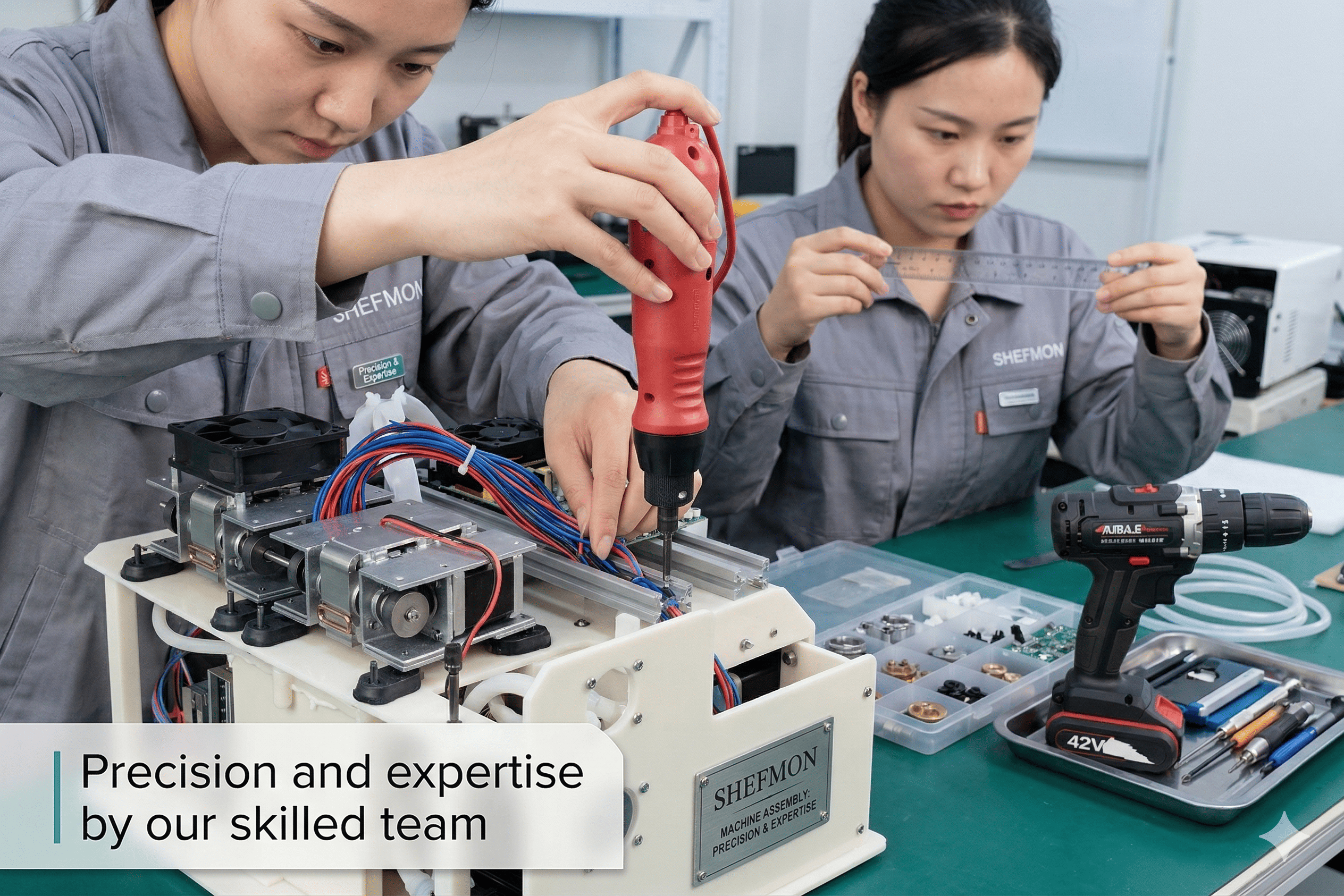
Au cœur de ce système se trouve une équipe d'ingénieurs et d'inspecteurs du contrôle qualité hautement qualifiés. Ces professionnels sont spécialisés dans différentes étapes de la production, des tests électroniques aux inspections structurelles. Leur expertise leur permet de déceler les moindres anomalies, qui pourraient passer inaperçues dans des systèmes moins rigoureux, mais qui risqueraient de devenir des problèmes majeurs par la suite.
Ce qui rend ce système particulièrement efficace, c'est son approche par étapes. Au lieu de s'appuyer sur un seul point d'inspection, SHEFMON utilise de multiples points de contrôle tout au long du cycle de production. Ainsi, les défauts sont détectés précocement, ce qui réduit les déchets et assure un flux de production plus fluide. C'est comme disposer de plusieurs filets de sécurité : si un problème passe inaperçu, un autre point de contrôle le détectera avant qu'il ne prenne de l'ampleur.
Contrôle qualité à réception (IQC) : Inspection des matières premières
Tout commence par les matières premières. Si la base est défectueuse, le produit final le sera aussi, aussi sophistiqué que soit le processus de fabrication. C'est pourquoi SHEFMON accorde une importance capitale au contrôle qualité à réception (IQC), afin de garantir que seules des matières premières de haute qualité intègrent la chaîne de production.
Les matières premières telles que les boîtiers en plastique, les composants métalliques et les pièces électroniques font l'objet d'un contrôle rigoureux. Ces contrôles ne se limitent pas à l'inspection visuelle ; ils comprennent des tests fonctionnels pour vérifier les spécifications de performance. Par exemple, les inspecteurs évaluent la précision des capteurs et le fonctionnement des moteurs dans les plages de vitesse définies. Même des écarts mineurs peuvent entraîner le rejet du produit.
Les critères d'inspection sont stricts. Les matériaux doivent être exempts de rayures, de rouille, de déformations et de dommages liés à l'emballage. Les paramètres de performance sont généralement autorisés uniquement dans une plage de tolérance étroite, souvent de ±5% par rapport aux spécifications de conception. Si un lot ne répond pas à ces normes, il est immédiatement isolé et retourné au fournisseur.
Cette approche proactive permet d'éviter l'introduction de matériaux défectueux dans la production, ce qui représente un gain de temps, une réduction des coûts et la garantie d'un produit final conforme aux normes les plus exigeantes. C'est un peu comme la construction d'une maison : si l'on utilise des briques solides dès le départ, l'ensemble de la structure est plus fiable.
Contrôle qualité en cours de production (IPQC) : Surveillance de la production
Une fois les matériaux inspectés, ils passent en phase de production, où le contrôle qualité en cours de production (IPQC) prend le relais. Cette étape consiste à surveiller le processus de fabrication en temps réel, afin de garantir que chaque composant est correctement assemblé et fonctionne comme prévu.
L'un des aspects les plus critiques de cette étape est le test des cartes de circuits imprimés. SHEFMON effectue l'inspection 100% des cartes de circuits imprimés, vérifiant leur fonctionnalité et réalisant des contrôles techniques pour garantir leur fiabilité. Ceci est essentiel car la carte de circuit imprimé est en quelque sorte le “ cerveau ” de tout appareil de beauté.
Lors de l'assemblage, les inspecteurs portent une attention particulière aux détails qui peuvent paraître insignifiants, mais qui sont en réalité essentiels à la sécurité et à la durabilité. Par exemple, la colle doit être appliquée uniformément, sans bulles, et le câblage doit respecter un espacement adéquat (généralement d'au moins 3 mm) afin d'éviter les interférences électriques et la surchauffe. Ces détails peuvent faire toute la différence entre un appareil qui dure des années et un appareil qui tombe en panne prématurément.
En cas de problème détecté en production, les unités concernées sont renvoyées pour être retravaillées. Dans les cas les plus graves, la production peut être totalement interrompue afin d'identifier et de résoudre la cause profonde du problème. Ceci permet de s'assurer que les problèmes ne sont pas seulement corrigés temporairement, mais éliminés à la source.
Contrôle qualité final (CQF) : Tests de produits
Une fois l'assemblage terminé, les produits passent à l'étape du contrôle qualité final (CQF), où ils subissent des tests complets. C'est à ce stade que tout est évalué : l'apparence, la fonctionnalité et les performances globales.
Les tests d'aspect garantissent que le produit est aussi performant qu'esthétique. Les inspecteurs vérifient la consistance de la peinture, la régularité de la surface et l'uniformité de la couleur. Des tests de durabilité, tels que des tests d'adhérence et de résistance au frottement, sont également réalisés afin de s'assurer que les revêtements résistent à une utilisation régulière. .
Les tests fonctionnels sont tout aussi rigoureux. Chaque machine est mise sous tension et testée pendant au moins 30 minutes afin de vérifier son bon fonctionnement. Les inspecteurs vérifient si l'appareil réagit correctement, change de mode en douceur et maintient une puissance de sortie constante. Toute fluctuation doit rester dans des limites strictes, souvent inférieures à ±2%.
Cette étape constitue le dernier filtre avant l'emballage des produits. Seuls les appareils ayant réussi tous les tests sont autorisés à l'expédition, garantissant ainsi aux clients la réception d'un équipement fonctionnant exactement comme prévu.
Tests de sécurité et conformité
La sécurité n'est pas une option, elle est obligatoire. Les appareils de beauté comportent souvent des systèmes électriques, une production d'énergie et un contact direct avec le corps humain, ce qui fait des tests de sécurité une priorité absolue.
SHEFMON effectue de nombreux tests de sécurité, notamment des tests d'étanchéité, des contrôles de protection contre les fuites et des mesures de résistance de mise à la terre. Par exemple, la résistance de mise à la terre doit généralement rester inférieure à 0,1 Ω pour garantir une sécurité électrique optimale. Ces tests assurent la sécurité des appareils pour les opérateurs et les clients.
Outre les tests internes, les produits doivent être conformes aux normes de certification internationales telles que CE, FDA, RoHS et ISO 13485. Ces certifications sont reconnues mondialement et attestent que l'équipement répond à des exigences strictes en matière de sécurité et de qualité.
Voici un bref comparatif des principales certifications :
| Certification | But | Importance |
|---|---|---|
| CE | Conformité européenne en matière de sécurité | Nécessaire pour le marché de l'UE |
| FDA | Approbation des dispositifs médicaux aux États-Unis | Garantit la sécurité et l'efficacité |
| RoHS | Restriction des substances dangereuses | Protection de l'environnement |
| ISO 13485 | gestion de la qualité des dispositifs médicaux | Référence mondiale en matière de qualité |
Contrôle de la qualité de l'emballage et de l'expédition
Même le meilleur produit peut être endommagé s'il n'est pas correctement emballé. C'est pourquoi SHEFMON intègre des contrôles d'emballage et d'expédition à son système de contrôle qualité.
Avant l'expédition, chaque produit est inspecté afin de vérifier que tous les accessoires, manuels et composants sont inclus. L'emballage est contrôlé pour sa solidité et son exactitude, garantissant ainsi la protection des articles pendant le transport. .
L'étiquetage est également vérifié afin de garantir sa conformité aux exigences d'expédition internationales. Cela inclut les étiquettes des produits, les numéros de série et la documentation. Ces détails peuvent paraître mineurs, mais ils jouent un rôle crucial dans la logistique et la satisfaction client.
Tests continus et stabilité à long terme
L'une des caractéristiques marquantes du processus de contrôle qualité de SHEFMON est le test continu. Au lieu de se fier uniquement à des tests à court terme, les appareils sont soumis à un fonctionnement prolongé — parfois jusqu'à 24 heures — afin de garantir leur stabilité à long terme. .
Ce processus, souvent appelé “ test de vieillissement ”, permet de déceler des défauts cachés qui pourraient passer inaperçus lors de tests plus courts. C'est comme entreprendre un long voyage en voiture plutôt que de simplement faire le tour du pâté de maisons : on a ainsi plus de chances de déceler d'éventuels problèmes.
En identifiant ces problèmes cachés au plus tôt, SHEFMON garantit la fiabilité de ses produits en conditions réelles, réduisant ainsi le risque de défaillances après livraison.
Équipements de pointe utilisés dans les tests de qualité
Le contrôle qualité ne repose pas uniquement sur le personnel, mais aussi sur les outils. SHEFMON utilise des équipements de test avancés, tels que des multimètres, des oscilloscopes et des wattmètres numériques, pour mesurer les performances avec précision. .
Ces outils permettent aux inspecteurs d'évaluer avec précision la stabilité électrique, la constance du courant de sortie et les paramètres de sécurité. Par exemple, les oscilloscopes peuvent détecter les irrégularités du signal susceptibles de révéler des problèmes sous-jacents, tandis que les wattmètres garantissent le fonctionnement des appareils dans les limites de sécurité.
L'utilisation de technologies de pointe garantit que les tests sont non seulement exhaustifs, mais aussi cohérents et reproductibles, réduisant ainsi le risque d'erreur humaine.
Amélioration continue et gestion des défauts
Le contrôle qualité n'est pas une action ponctuelle, mais un processus continu. SHEFMON collecte en permanence des données sur les défauts, analyse les tendances et met en œuvre des améliorations pour prévenir les problèmes récurrents. .
Cette approche fondée sur les données permet à l'entreprise d'affiner ses processus au fil du temps. Par exemple, si un composant particulier échoue fréquemment aux contrôles qualité, l'équipe des achats peut collaborer avec les fournisseurs pour améliorer la qualité ou trouver des solutions de rechange.
Les retours clients jouent également un rôle essentiel. En étant à l'écoute de ses clients et en intégrant leurs suggestions au développement de ses produits, SHEFMON s'assure que ces derniers évoluent pour répondre aux exigences changeantes du marché.
Avantages du système de contrôle qualité de SHEFMON
Alors, qu'est-ce que cela signifie pour les clients ? En clair, c'est la tranquillité d'esprit. Les acheteurs peuvent avoir la certitude que chaque produit a été rigoureusement testé et répond à des normes élevées en matière de sécurité et de performance.
Les avantages vont au-delà de la fiabilité. Un système de contrôle qualité rigoureux renforce également la réputation de la marque, réduit les retours et améliore la satisfaction client. Sur un marché mondial concurrentiel, ces atouts peuvent faire toute la différence.
Pour les distributeurs et les cliniques, travailler avec un fabricant qui privilégie le contrôle de la qualité signifie moins de problèmes, de meilleurs résultats et une croissance commerciale plus forte.
Conclusion
Le système de contrôle qualité de SHEFMON illustre parfaitement comment des processus rigoureux permettent d'obtenir des produits de qualité supérieure. En combinant des inspections à plusieurs étapes, des équipements de test de pointe, un personnel qualifié et des stratégies d'amélioration continue, l'entreprise garantit que chaque appareil répond aux normes internationales de sécurité et de performance.
De l'inspection des matières premières à l'expédition finale, chaque étape est rigoureusement contrôlée afin d'éliminer les défauts et de garantir une qualité constante. Cet engagement protège non seulement les utilisateurs finaux, mais renforce également les partenariats à long terme avec nos clients du monde entier.
FAQ
1. Qu'est-ce qui rend le système de contrôle qualité de SHEFMON unique ?
Elle utilise un processus d'inspection en plusieurs étapes qui couvre les matières premières, la production, les tests finaux et l'expédition, garantissant ainsi la détection précoce des défauts.
2. Comment SHEFMON garantit-il la sécurité de ses produits ?
Grâce à des tests de sécurité rigoureux tels que des contrôles d'étanchéité, de protection contre les fuites et de conformité aux normes CE, FDA et ISO.
3. Pourquoi l'inspection des matières premières est-elle importante ?
Cela empêche les matériaux défectueux d'entrer en production, garantissant ainsi une meilleure qualité globale du produit.
4. Qu'est-ce qu'un test de vieillissement dans le contrôle qualité ?
Cela implique de faire fonctionner les appareils en continu (jusqu'à 24 heures) pour détecter les défauts cachés et assurer une stabilité à long terme.
5. SHEFMON respecte-t-il les normes internationales ?
Oui, nos produits sont conformes aux certifications internationales telles que CE, FDA, RoHS et ISO 13485, garantissant ainsi leur acceptation dans le monde entier.