


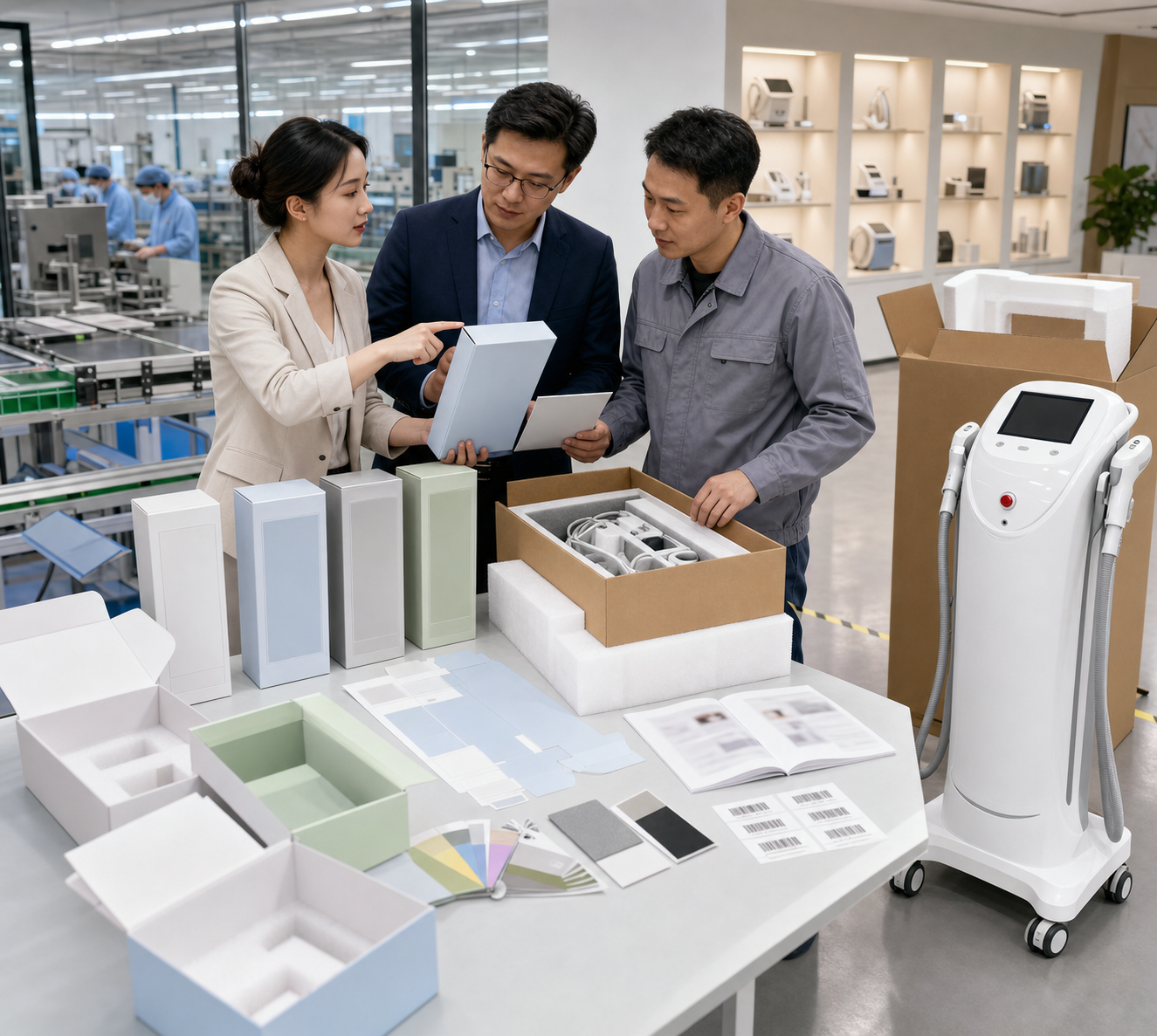
Resumen ejecutivo
Yes, many beauty equipment manufacturers can support distributors in customizing their own brand packaging. This is usually called private label, OEM packaging, branded packaging, or distributor brand customization. The customized content may include the logo on the machine, color box design, outer carton label, user manual, warranty card, product sticker, QR code, barcode, product brochure, training material, and sometimes the device interface or startup screen.
However, brand packaging customization is not just a design service. Once a distributor sells beauty equipment under its own brand, it may take on more responsibility for product claims, labeling, customer service, warranty, after-sales, import documents, trademark risk, platform listing content, and target-market compliance.
The safest approach is to treat packaging customization as a structured project. Distributors should confirm product model, MOQ, design files, logo ownership, package materials, label content, country of origin marking, manual language, warranty terms, certificate coverage, regulatory responsibility, and after-sales process before production.
For low-risk salon equipment and basic beauty devices, brand packaging is usually easier. For higher-risk products such as laser, IPL, strong RF, focused ultrasound, body contouring, tattoo removal, high-claim anti-aging devices, AI skin analyzers, or devices sold in regulated markets, packaging changes require more careful review.
The core principle is simple: custom packaging can help distributors build a brand, but the packaging must match the real product, real documents, real market rules, and real service ability.
1. La respuesta corta
Beauty equipment distributors can often customize their own brand packaging if the manufacturer provides OEM or private-label support.
Common customization options include:
- Distributor logo on the machine
- Distributor logo on the color box
- Custom product name
- Custom product label
- Custom user manual
- Tarjeta de garantía personalizada
- Custom outer carton label
- Custom packing list
- Custom QR code
- Custom barcode
- Custom brochure
- Custom training material
- Custom language version
- Custom product video cover
- Custom product page content
But not every order is suitable for customization. The manufacturer may require a minimum order quantity, extra design cost, mold cost, printing cost, longer lead time, and written approval of artwork before production.
2. What Does Brand Packaging Customization Mean?
Brand packaging customization means the product is sold under the distributor’s brand identity instead of only the factory’s generic brand.
Puede incluir:
- Visual identity: logo, color, fonts, box style, graphic design
- Product identity: product name, model name, series name, SKU
- Legal identity: manufacturer, distributor, importer, responsible party, country of origin
- Sales identity: selling points, project positioning, brochure, QR code, website
- Service identity: warranty card, service phone, after-sales process, user support
- Compliance identity: warnings, labels, symbols, certificates, manual content
The visual side attracts customers. The legal and service side protects the business.
3. OEM, ODM, Private Label, And Packaging Customization Are Different
These terms are often mixed together, but they are not exactly the same.
OEM usually means the manufacturer produces according to the buyer’s brand or specifications. The distributor may use its own logo, packaging, and product name.
ODM usually means the manufacturer provides the product design and the distributor sells it under its own brand, sometimes with appearance, function, or packaging changes.
Private label usually means the distributor sells an existing manufacturer product under the distributor’s brand.
Packaging customization can be narrower. It may only change the box, manual, label, or branding materials while the machine itself stays unchanged.
Distributors should clarify which model applies because responsibility, MOQ, pricing, document changes, and lead time may differ.
4. Which Distributors Are Suitable For Custom Brand Packaging?
Custom packaging is suitable for distributors who want to build long-term brand value rather than only resell generic machines.
It is especially suitable for:
- agentes regionales
- Mature distributors
- Salon equipment wholesalers
- Private-label sellers
- Cross-border sellers
- Chain salon suppliers
- Escuelas de formación
- Online store operators
- Local service companies
- Distributors with their own customer base
- Distributors planning repeat orders
It may not be ideal for a beginner who has not tested the product or market yet. New distributors should usually test the model first, confirm demand, check quality, and then customize packaging after repeat sales become realistic.
5. Why Distributors Want Their Own Brand Packaging
Brand packaging can help distributors:
- Improve brand recognition
- Reduce direct price comparison
- Generar confianza en el cliente
- Support regional agency positioning
- Improve professional image
- Create a consistent product line
- Support online sales
- Support salon franchise customers
- Strengthen private-label value
- Improve repeat purchase recognition
- Make warranty and after-sales easier to manage
Generic machines are easy to compare by price. Branded packaging can help the distributor sell a complete product and service system.
6. What Manufacturers Usually Can Customize
Manufacturers may offer different customization levels.
Basic customization:
- Logo sticker
- Logo on machine shell
- Logo on color box
- Tarjeta de garantía personalizada
- Custom user manual cover
- Custom outer carton label
Medium customization:
- Full color box design
- Custom product name
- Custom label artwork
- Custom manual content
- Custom QR code
- Custom barcode
- Custom video cover
- Custom sales brochure
- Custom screen language
Advanced customization:
- Custom interface
- Custom startup logo
- Custom product color
- Custom accessory set
- Custom packaging structure
- Custom software report template
- Custom product series design
- Custom OEM model
- Exclusive regional packaging version
The more customization is requested, the higher the MOQ, cost, and preparation time may be.
7. MOQ Is Usually The First Practical Barrier
Minimum order quantity is one of the most important questions.
Manufacturers may allow:
- Low MOQ for logo sticker
- Moderate MOQ for printed color box
- Higher MOQ for custom manual
- Higher MOQ for custom shell printing
- Higher MOQ for custom color
- Higher MOQ for software or interface customization
- Very high MOQ for mold or structural changes
New distributors should not assume every customization is available for one or two units. For small trial orders, it may be better to use neutral packaging or simple brand stickers first.
8. Custom Packaging Cost Structure
Custom packaging may include several costs:
- Logo design adjustment
- Box design
- Manual layout
- Translation
- Printing plate cost
- Color proofing
- Sample packaging cost
- Barcode application cost
- Product photography
- Video material editing
- Packaging material upgrade
- Inner foam or molded tray cost
- Extra carton label cost
- Storage cost for custom packaging
Distributors should ask whether these costs are one-time fees, per-unit costs, or included after a certain order quantity.
9. Artwork Files Must Be Production-Ready
Manufacturers usually need clear artwork files before printing.
Los archivos útiles incluyen:
- Vector logo file
- Brand color values
- Font files or font names
- Nombre del producto
- Model name
- Company name
- Sitio web
- QR code
- Barcode
- User manual text
- Warning text
- Country of origin statement
- Warranty statement
- Importer or distributor information
- Required symbols
Design files should be checked carefully. A typo on packaging can affect every unit in the order.
10. Keep Product Model And Brand Model Clear
A distributor may want to rename a factory model under its own brand. That can be useful, but the internal model reference must remain clear.
Maintain a model mapping file:
- Factory model number
- Distributor brand model number
- Nombre del producto
- SKU
- Batch number
- Serial number rule
- Versión de embalaje
- Versión manual
- Versión del software
- Certificate documents
- Lista de piezas de repuesto
This prevents confusion in warranty, spare parts, repeat orders, and document checks.
11. Trademark Ownership Comes Before Packaging
Before printing a brand name or logo on packaging, distributors should check trademark ownership.
USPTO trademark guidance explains that a business name, logo, or slogan used to identify goods or services may be a trademark and can be protected through the federal registration process in the United States.
Para los distribuidores, esto significa:
- Do not use another brand’s name or logo.
- Check whether the brand is available in the target market.
- Register or protect the trademark where business scale justifies it.
- Confirm who owns the logo design.
- Confirm whether the manufacturer can use the logo only for your orders.
- Put brand-use permission in writing.
Trademark risk can turn packaging customization into a legal dispute if ignored.
12. Country Of Origin Marking Cannot Be Ignored
Custom brand packaging does not erase the real manufacturing origin.
For products imported into the United States, country of origin marking rules are important. CBP country of origin marking rules under 19 CFR Part 134 require imported goods to be properly marked unless an exception applies.
Los distribuidores deben confirmar:
- Country of origin statement
- Whether it must appear on the product, package, or both
- Language requirements
- Whether “Made in” wording is correct
- Whether final assembly changes origin
- Whether outer cartons also need origin labels
- Whether platform product pages must show origin
Do not use misleading origin language. If a product is manufactured in China, custom U.S., EU, or local brand packaging should not suggest it is made somewhere else unless legally supported.
13. Be Careful With Made In USA Or Local Origin Claims
Origin claims are sensitive.
The FTC’s Made in USA guidance states that unqualified U.S.-origin claims should be used only when the product is all or virtually all made in the United States.
For distributors, this means an imported beauty device should not be promoted as “Made in USA” just because the distributor is a U.S. company, the package is designed in the U.S., or the brand is registered in the U.S.
Safer wording may be:
- Designed by [brand], manufactured in [country]
- Distributed by [company]
- Manufactured for [brand]
- Imported by [company]
The exact wording should be reviewed for the target market.
14. CE Marking And EU Distributor Responsibilities
For products sold in the European Economic Area, CE-related responsibility must be handled carefully.
The European Commission explains that importers and distributors help ensure that only compliant products bearing CE marking are placed on the EEA market, and that they must have knowledge of legal requirements and make sure products they distribute or import meet them.
If a distributor markets a product under its own name or trademark in the EU, the responsibility may become more serious. In many CE marking contexts, a party that markets a product under its own name or trademark may take on manufacturer-like responsibilities.
For EU custom packaging, confirm:
- Whether CE marking applies
- Whether the EU Declaration of Conformity remains valid
- Whether the brand name change affects the technical file
- Whether importer information is required
- Whether authorized representative information is required
- Whether manual language matches destination country rules
- Whether labels, warnings, and symbols are correct
- Whether MDR applies to aesthetic devices without medical purpose
Do not assume a generic CE file automatically covers every private-label version.
15. FDA Device Labeling Considerations For U.S. Sales
For beauty equipment that is a medical device or may be treated as a medical device in the United States, label and labeling rules matter.
FDA device labeling guidance explains that medical device labeling regulations are found in multiple parts of Title 21 of the CFR. Under 21 CFR 801.1, the label of a device in package form must conspicuously specify the name and place of business of the manufacturer, packer, or distributor.
For distributors using private-label packaging, this means label identity should be reviewed carefully.
Controlar:
- Nombre del producto
- Uso previsto
- Manufacturer, packer, distributor, or importer name
- Business address where required
- Warnings
- Contraindicaciones
- Instrucciones de uso
- Número de serie
- UDI where applicable
- FDA registration, listing, clearance, or approval claims where applicable
- Whether the brand owner is changing labeling responsibility
This is especially important for devices with medical-like claims, high energy, skin treatment functions, or U.S. import plans.
16. FDA Registration Or Listing Is Not FDA Approval
Private-label packaging often creates marketing temptation. Some distributors want to print FDA-related claims on the box.
FDA’s registration and listing database notes that registration of a device establishment, assignment of a registration number, or listing of a medical device does not denote FDA approval of the establishment or its products.
Therefore:
- Do not print “FDA approved” unless the product is actually FDA approved.
- Do not treat FDA registration as FDA approval.
- Do not print misleading FDA certificates.
- Do not use FDA logos inappropriately.
- Keep the exact regulatory status clear.
Misleading packaging claims can create regulatory and customer trust risk.
17. Cosmetic Consumables Need Their Own Label Review
Some beauty equipment packages include serums, gels, masks, liquids, or skincare consumables.
If cosmetic products are bundled, cosmetic labeling rules may apply. FDA cosmetic labeling guidance explains that cosmetics distributed in the United States must comply with FDA labeling regulations under the Federal Food, Drug, and Cosmetic Act and the Fair Packaging and Labeling Act, and FDA describes labeling as labels and other written, printed, or graphic matter on or accompanying a product.
For consumables, check:
- Ingredient list
- Net contents
- Responsible company
- Warnings
- Directions
- País natal
- Batch or lot number
- Expiry or shelf life
- Cosmetic claims
- Language requirements
Do not assume that device packaging rules cover skincare consumables.
18. Packaging Claims Must Match Product Evidence
Customized packaging often includes marketing claims. These claims must be realistic.
Evite afirmaciones sin fundamento, tales como:
- Permanent anti-aging
- Curar el acné
- Eliminar las cicatrices por completo
- Pérdida de grasa garantizada
- Efecto del tratamiento médico
- Seguro para todos
- Sin riesgo
- Instant lifting for all users
- FDA approved when not true
- EU approved when not true
FTC health product and advertising guidance supports the need for truthful, not misleading, and properly supported claims. Packaging is advertising. It should not promise more than the product can support.
19. Certificates May Need To Be Updated After Rebranding
A common mistake is assuming that factory certificates automatically support all private-label packaging.
Before rebranding, check whether documents mention:
- Original manufacturer name
- Original brand
- Modelo de producto
- Product photo
- Etiqueta del producto
- Manual
- Packaging artwork
- Uso previsto
- Especificaciones técnicas
- Test sample
If the private-label version changes model number, label, claims, manual, accessories, software, product color, or structure, the distributor should confirm whether existing reports still apply.
For high-risk or regulated products, ask a compliance professional before printing packaging.
20. User Manual Localization Is Part Of Packaging
Custom packaging should include a usable manual in the target market language.
A good manual should include:
- Product introduction
- Function description
- Accesorios
- Pasos de operación
- advertencias de seguridad
- Contraindicaciones cuando corresponda
- Limpieza y mantenimiento
- Solución de problemas
- Códigos de error
- Storage instructions
- Contacto de garantía
- Manufacturer or distributor information
Poor translation can create customer complaints and safety risk. Do not only translate the box while leaving the manual confusing.
21. Warranty Card And After-Sales Information Should Be Clear
A customized package should clearly explain after-sales support.
Incluir:
- Período de garantía
- Warranty scope
- Exclusions
- Service contact
- Serial number field
- Purchase date field
- Proceso de reparación
- Replacement policy
- Spare parts policy
- Customer support QR code
If the distributor’s brand is on the package, customers will usually contact the distributor first. The distributor must be ready to support the product.
22. Packaging Must Protect The Product
Brand design should not weaken protection. Beauty equipment may include screens, handpieces, pumps, glass bottles, cables, lenses, lamps, or fragile shells.
Packaging should protect:
- Main unit
- Piezas de mano
- Cables
- Botellas
- Pantallas
- Accesorios
- Consumibles
- Consejos de tratamiento
- Printed documents
Controlar:
- Outer carton strength
- Inner foam or molded tray
- Protección contra la humedad
- Drop resistance
- Accessory separation
- Shipping label position
- Gross weight and carton size
- Pallet loading plan where needed
Nice packaging is useless if the machine arrives damaged.
23. Color Box, Outer Carton, And Product Label Are Different
Distributors should review each packaging layer.
Color box:
- Brand image
- Nombre del producto
- Características clave
- Product photo
- QR code
- Basic warnings
- País natal
- Barcode
Outer carton:
- Número de modelo
- Cantidad
- Peso bruto
- Net weight
- Carton size
- Shipping marks
- Fragile label
- País natal
- Batch or order code
Product label:
- Modelo de producto
- Tensión nominal
- Fuerza
- Número de serie
- Manufacturer or distributor information where required
- Safety marks where applicable
- Warning symbols where applicable
Each layer has a different purpose.
24. Barcode, QR Code, And Traceability
Custom packaging should support traceability.
Useful traceability tools include:
- SKU code
- Barcode
- QR code
- Batch number
- Número de serie
- Warranty registration code
- Código antifalsificación
- Product manual download link
- Training video link
- After-sales form link
Traceability helps manage warranty, inventory, complaints, repeat orders, and counterfeit control.
25. Online Sales Need Extra Packaging Planning
If the distributor sells online, packaging must support product pages, returns, shipping, and customer service.
Online packaging should consider:
- Product page images
- Unboxing experience
- Shipping damage reduction
- Return label process
- User manual access
- Customer service QR code
- Review request card
- Warranty registration
- Platform barcode requirements
- Fulfillment warehouse label rules
For live commerce or short video sales, the package also becomes part of the content experience.
26. Overseas Sales Need Localized Packaging
For cross-border sales, packaging must fit local rules and buyer expectations.
Controlar:
- Idioma
- Voltage and plug information
- País natal
- Importer information
- Warning symbols
- Product claims
- Manual requirements
- Barcode system
- Local address where required
- Recycling symbols where applicable
- Privacy notice for digital devices
- Platform listing consistency
Do not use one universal package for every market if local requirements differ.
27. AI Skin Analyzer Packaging Needs Data Notes
AI skin analyzers are not only hardware. They may involve software accounts, cloud storage, images, customer data, and privacy notices.
Packaging or documentation should explain:
- Software access
- Account setup
- Almacenamiento de datos
- Image handling
- Privacy policy
- Report limitations
- Política de actualización
- Subscription fees where applicable
- Customer consent process where needed
If the distributor brands an AI analyzer, it must understand who controls the software and data relationship.
28. High-Energy Device Packaging Needs More Caution
Laser, IPL, strong RF, focused ultrasound, body contouring, tattoo removal, and similar devices need more careful packaging review.
Packaging may need:
- Etiquetas de advertencia
- Eye protection instructions
- Contraindicaciones
- Treatment restrictions
- Declaración de uso profesional, cuando corresponda.
- Training requirement
- Model-specific manuals
- Certificate references
- Regulatory status review
- Import document support
Do not simplify high-energy device packaging into a beauty-style color box only.
29. Private Label Can Create Channel Differentiation
A distributor with private-label packaging can reduce direct comparison with generic sellers.
Las ventajas incluyen:
- More professional brand image
- Stronger customer memory
- Better control of pricing
- Better matching with local market
- Easier salon trust building
- More consistent product line
- Better support for training and after-sales
- Higher resale value
However, branding does not fix poor product quality. The product itself must be stable before brand investment.
30. Do Not Customize Before Testing The Product
New distributors should test the machine before printing packaging.
A good process is:
1. Request product documents.
2. Order a sample.
3. Test machine function.
4. Test salon response.
5. Check after-sales support.
6. Confirm spare parts.
7. Review claims and documents.
8. Place a small batch order if possible.
9. Customize packaging after the model proves stable.
This avoids printing a large quantity of branded packages for a product that later fails quality or market tests.
31. What To Confirm With The Manufacturer
Before starting brand packaging, ask:
- What customization options are available?
- What is the MOQ for each option?
- What is the extra cost?
- What artwork file format is needed?
- Can you provide a packaging dieline?
- How long does design proofing take?
- Can you make a sample box?
- Who checks label accuracy?
- Can the logo be printed on the machine?
- Can the interface show our brand?
- Can the user manual be customized?
- Can warranty cards show our service contact?
- Do existing certificates still apply?
- Can you provide private-label authorization?
- Who owns the final design files?
Written confirmation prevents disputes.
32. What To Include In A Private-Label Agreement
A private-label agreement should include:
- Modelo de producto
- Custom brand name
- Trademark ownership
- Logo use permission
- Packaging design responsibility
- Cantidad mínima de pedido
- Precio
- Plazo de entrega
- Artwork approval process
- Label content responsibility
- Compliance responsibility
- Certificate and document responsibility
- Quality standard
- Términos de garantía
- Soporte de repuestos
- After-sales responsibility
- Territory
- Online sales rules
- Confidentiality
- Non-compete or exclusivity where applicable
- Defect handling
- Termination terms
Packaging customization should be managed as a business agreement, not only a printing request.
33. How To Avoid Packaging Disputes
Common packaging disputes include:
- Wrong logo color
- Wrong model number
- Wrong language
- Missing origin marking
- Misleading claim
- Incorrect certificate statement
- Poor box material
- Damaged goods in shipping
- Manufacturer using the distributor’s brand for others
- Distributor using unapproved claims
- Certificate no longer matching packaging
Para evitar disputas:
- Approve digital artwork
- Approve printed sample
- Keep written records
- Use a version number
- Confirm label text
- Confirm packaging material
- Confirm origin marking
- Confirm inspection before shipment
- Photograph finished packaging before delivery
Never skip proof approval.
34. Custom Packaging For Small Orders
Small distributors can still customize in lighter ways.
Low-MOQ options may include:
- Brand sticker on box
- Tarjeta de garantía personalizada
- Custom thank-you card
- Custom QR code insert
- Custom manual cover
- Local language insert
- Branded outer sleeve
- Distributor service label
These options help build brand identity without committing to large printed packaging orders.
35. Custom Packaging For Mature Distributors
Mature distributors can build a more complete brand system.
Las opciones incluyen:
- Full custom color box
- Product series design
- Unified brand manual style
- Branded product labels
- Custom product photography
- Custom training cards
- Custom warranty registration
- Código antifalsificación
- Regional packaging versions
- OEM model naming system
- Premium packaging materials
This is suitable when the distributor has stable volume and repeat customers.
36. Custom Packaging For Online Sellers
Online sellers need packaging that supports customer confidence and content.
Useful elements include:
- Clear product name
- Strong product photo
- Short feature list
- QR code for video instructions
- Easy warranty registration
- Return and support instructions
- Compact shipping size
- Durable protective packaging
- Barcode for warehouse systems
- Review and service card
Online packaging should reduce customer confusion and returns.
37. Custom Packaging For Salon Equipment Agents
Salon agents should focus packaging on professional trust.
Useful elements include:
- Professional brand design
- Treatment project name
- Guía de funcionamiento
- Training QR code
- Maintenance card
- Tarjeta de garantía
- Lista de piezas de repuesto
- Distributor service contact
- Certificate folder link
- Salon project brochure
For salon equipment, packaging is not only for display. It supports training and after-sales.
38. Red Flags Before Customizing Packaging
Tenga cuidado si:
- The manufacturer refuses to provide documents
- The product sample has not been tested
- The MOQ is too high for your market stage
- The supplier cannot provide packaging proofs
- The certificate does not match the product
- The supplier wants to print unsupported claims
- The supplier cannot confirm country of origin marking
- The supplier does not allow inspection
- The supplier has no spare parts
- The supplier may sell your branded package to others
- The warranty terms are unclear
- The product is high-risk but labels are treated casually
Do not invest in branding before the supply chain is reliable.
39. Practical Custom Packaging Workflow
A safe workflow:
1. Choose a tested product model.
2. Confirm market demand.
3. Confirm manufacturer OEM or private-label support.
4. Check MOQ and cost.
5. Verify trademark availability.
6. Confirm target market labeling requirements.
7. Prepare artwork files.
8. Review product claims.
9. Confirm country of origin marking.
10. Confirm certificate and document coverage.
11. Approve digital packaging artwork.
12. Approve printed sample.
13. Confirm production batch.
14. Inspect finished packaging.
15. Archive artwork and document versions.
16. Track customer feedback and warranty issues.
This process protects both brand image and business risk.
40. Final Checklist Before Printing
Before printing custom packaging, confirm:
- Product sample is approved
- Factory model and brand model are mapped
- Trademark ownership is clear
- Logo file is correct
- Box dieline is approved
- Manual language is approved
- Product label is approved
- Country of origin is correct
- Claims are supported
- Warnings are included where needed
- Warranty contact is correct
- QR code works
- Barcode works
- Certificate wording is accurate
- CE, FDA, FCC, RoHS, or other marks are used correctly
- Packaging material protects the machine
- Printed sample is approved
- MOQ and delivery time are written
If these points are not ready, do not print.
Conclusión
Beauty equipment distributors can customize their own brand packaging when the manufacturer supports OEM, ODM, or private-label cooperation. Custom packaging can improve brand image, reduce direct price comparison, support salon trust, and help distributors build a long-term product line.
But custom packaging also increases responsibility. Distributors must check trademark ownership, label content, country of origin marking, target-market rules, certificates, product claims, warranty, after-sales, and document consistency.
For new distributors, the best approach is to test the product first and begin with low-MOQ branding such as stickers, inserts, warranty cards, and QR codes. For mature distributors, full color boxes, custom manuals, branded labels, anti-counterfeit codes, and product series design can create stronger market differentiation.
The best private-label packaging is not only beautiful. It is accurate, compliant, protective, traceable, and connected to real after-sales service.
Preguntas frecuentes
Can beauty equipment distributors customize their own brand packaging?
Yes. Many manufacturers support private label, OEM packaging, custom logo, custom color box, custom manual, warranty card, QR code, barcode, and distributor brand labels.
Is there usually a MOQ for custom beauty equipment packaging?
Yes. Simple logo stickers may have a low MOQ, while printed color boxes, custom manuals, shell printing, custom colors, software customization, or molded packaging usually require higher MOQ.
Should new distributors customize packaging immediately?
Usually not. New distributors should first test product quality, salon demand, after-sales support, spare parts, and documents. They can start with simple branding before full packaging customization.
What should be checked before printing private-label packaging?
Distributors should check trademark ownership, product model, label text, country of origin, claims, warnings, warranty contact, certificates, manual language, packaging materials, barcode, QR code, and target-market rules.
Can a distributor put its own brand on a CE or FDA-related product?
It may be possible, but the distributor must confirm whether existing documents still apply and whether brand or label changes create new responsibilities. FDA registration or listing should not be described as FDA approval.
Does custom packaging hide the real country of origin?
No. Custom brand packaging does not change the real manufacturing origin. Imported goods may need proper country of origin marking depending on the target market.
What is the lowest-risk way to start private labeling?
The lowest-risk way is to use a tested product model, start with small-batch branding such as stickers, custom warranty cards, QR code inserts, or local language manuals, and move to full custom packaging after repeat orders are stable.