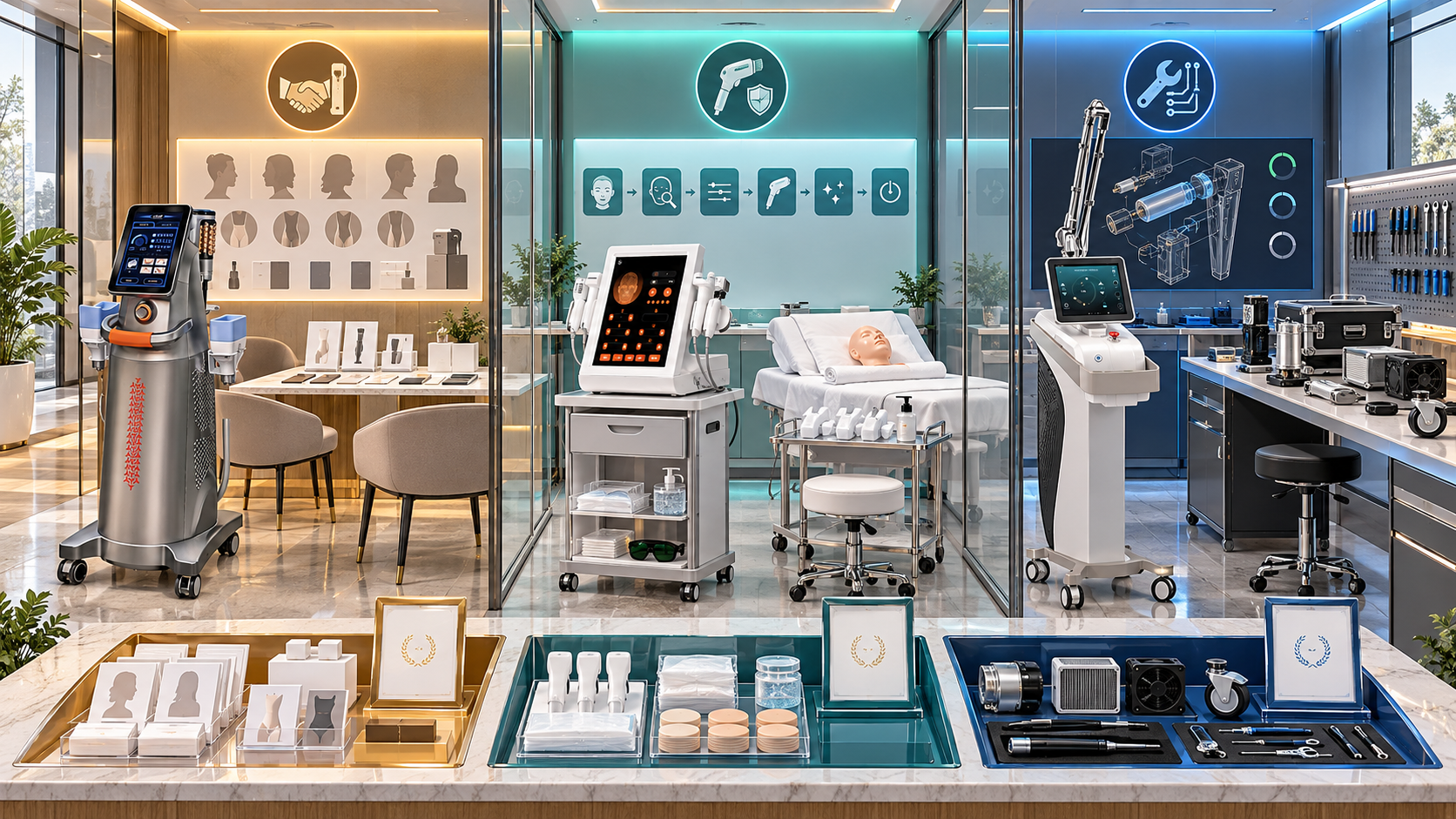
Beauty device training often fails because three different jobs are placed in one course. A sales representative needs to match products to buyers and describe verified configurations. An operator needs to deliver an approved service on an exact device. A technical person needs to maintain, diagnose, or service equipment within a defined technical boundary. These roles may discuss the same model, but they do not need the same knowledge, practice, access, or assessment.
Separating the training tracks helps distributors, salons, skin clinics, med spas, body studios, and multi-location groups prevent overpromising, unauthorized operation, and uncontrolled repair. This guide shows how to build distinct sales, operator, and technical programs for SHEFMON facial, body, RF-microneedling, HIFU, and laser devices while keeping the three teams connected through shared product data and escalation rules.
Zusammenfassung
- Define sales, operator, and technical training by the tasks each role must perform, not by one generic product presentation.
- Sales training should cover buyer fit, device categories, verified configurations, service-menu positioning, commercial boundaries, and accurate handoff.
- Operator training should cover the exact device, service, room, client pathway, controls, monitoring, cleaning, documentation, and stop conditions.
- Technical training should separate user care, approved first-line support, qualified service work, and return-to-service authority.
- Course attendance does not automatically grant independent operation, assessor status, technical access, or permission to approve protocols.
- Use shared model and configuration data, then provide different materials, scenarios, assessments, and access for each track.
- Do not allow sales staff to promise clinical outcomes, universal eligibility, unsupported compatibility, service times, or unverified support conditions.
- Do not allow operators to open equipment or perform internal work unless a separate technical permission covers the task.
- Record training by person, role, model, configuration, curriculum version, assessment, scope, limitations, and review date.
- Update all three tracks when products, configurations, documents, services, local requirements, or support procedures change.
1. Start with Three Different Business Outcomes
Each track should produce a different result.
| Training track | Required business outcome | Evidence of success |
|---|---|---|
| Sales | The person can identify a buyer’s needs, present the correct device category and verified configuration, set accurate expectations, and transfer the enquiry cleanly | Accurate product selection, complete qualification notes, controlled claims, and fewer quotation corrections |
| Operator | The person can perform a named service on an exact configuration within approved professional, site, and procedure boundaries | Competency assessment, supervised evidence where required, valid authorization, and complete service records |
| Technical | The person can perform defined maintenance or support tasks, isolate issues, preserve evidence, escalate correctly, and complete approved verification | Task-specific technical assessment, service records, correct component control, and documented release authority |
If one course claims to create all three outcomes without separate practice and assessment, the scope is probably unclear.
2. Use a Shared Product-Data Foundation
The three tracks need one controlled source for basic product facts.
Shared fields can include:
- official model and category;
- configuration and revision;
- installed handles, applicators, modules, cartridges, tips, or needle heads;
- standard, optional, and conditional items;
- voltage, plug, room, and utility profile where relevant;
- current product documents;
- approved market and professional-use positioning;
- compatible consumables and replacement components;
- lifecycle and support status;
- current contact and escalation route.
The shared foundation prevents sales, operator, and technical teams from describing different versions of the same device. Their courses should then branch into role-specific content.
3. Define Sales Training by Buyer Decisions
Sales training prepares a person to guide a business buyer through category and configuration selection. It should not train them to imitate a treatment professional or technical specialist.
Sales staff should learn how to:
- identify the buyer type, location, current services, staff, rooms, and business stage;
- distinguish facial, hair-removal, rejuvenation, HIFU, RF-microneedling, and body-care categories;
- connect device functions to a clear service-menu role;
- explain standard, optional, and special-order configuration elements accurately;
- identify consumables and ongoing support dependencies;
- ask about local professional and premises requirements without giving unqualified legal advice;
- compare compact, growth, advanced, single-category, and multi-service packages;
- capture voltage, language, room, delivery, training, and documentation requirements;
- avoid unsupported performance, revenue, safety, certification, or compatibility claims;
- transfer technical, professional, or protocol questions to the correct team.
The sales outcome is a complete and accurate buyer requirement, not permission to operate the device.
4. Keep Sales Training Away from Clinical Decisions
Sales staff can explain the intended product category and the questions a qualified buyer should review. They should not independently decide whether a particular client is suitable, prescribe a service, or give an operating parameter.
Create clear escalation rules for questions about:
- client suitability and contraindications;
- professional scope;
- treatment-area selection;
- parameter choice;
- adverse reactions;
- medication or medical history;
- combined services;
- protective equipment;
- infection-control workflow;
- post-treatment management;
- local licensing or clinical supervision.
An accurate response can be: “That question needs review by the appropriately qualified professional using the exact device documentation and local requirements.”
5. Teach Sales Teams to Qualify the Buyer
A strong sales discovery form should capture:
- buyer type: salon, med spa, skin clinic, body studio, distributor, or multi-site group;
- target service category;
- current equipment and service gaps;
- expected appointment pattern;
- intended staff roles and current training status;
- professional and premises conditions already confirmed;
- treatment-room size and utilities;
- required handles, functions, and consumables;
- preferred service tier and expansion plan;
- expected delivery and launch timing;
- language and document needs;
- technical-support and stock expectations;
- questions still requiring verification.
Sales staff should mark Unknown or Verification Required rather than complete missing fields with assumptions.
6. Define Operator Training by Device and Service
Operator training prepares a person to deliver a defined service. It should be tied to an exact device, configuration, site, room, and professional scope.
The curriculum can include:
- model and installed-unit identity;
- device function and service purpose;
- relevant principles at the depth needed for safe use;
- client consultation and escalation boundaries;
- professional eligibility and supervision conditions;
- approved service sequence;
- handle, applicator, cartridge, tip, or needle-head selection;
- room and utility checks;
- parameter or protocol controls;
- client monitoring and stop conditions;
- cleaning, disinfection, storage, and waste handling;
- consumable traceability;
- treatment and booking records;
- fault reporting and device holds;
- follow-up and aftercare duties within the operator’s scope.
Operator training is not complete when the person can navigate the screen. Competency must include the full service workflow.
7. Separate Operator Training from Authorization
Training provides learning evidence. Authorization is the business decision that permits the person to perform specific work.
Before independent operation, verify as applicable:
- local professional, licensing, premises, insurance, and supervision requirements;
- course completion;
- practical assessment;
- required supervised practice;
- genaues Modell und Konfiguration;
- service and function scope;
- site and room induction;
- protocol version;
- access, login, key, and booking permissions;
- effective and review dates;
- exclusions and escalation conditions.
One operator may hold different permissions for different functions on a multifunction platform. Keep these differences visible.
8. Define Technical Training by Task Boundary
“Technical training” is too broad unless tasks are separated.
Use at least three bands:
User care
Approved daily checks, external cleaning, consumable changes, simple visual inspection, and correct fault reporting. These tasks may be part of operator training.
First-line technical support
Approved non-invasive diagnostics, evidence collection, connection checks, controlled replacement of designated user-serviceable items, software or setup checks, and escalation. The person needs a separate technical scope even if they are also an operator.
Qualified service work
Internal access, electrical or energy-system work, controlled component replacement, advanced diagnosis, calibration or verification where applicable, and repair documentation. These tasks require the appropriate technical role, documents, tools, and authorization.
Return-to-service approval should also be defined separately. The person completing a repair may not be the only required approver.
9. Create a Technical Escalation Ladder
The technical program should teach when to stop rather than encouraging broad experimentation.
| Ebene | Example responsibility | Stop or escalation condition |
|---|---|---|
| Operator observation | Record symptoms, codes, timing, conditions, and approved basic checks | Any unresolved warning, damage, abnormal heat, output concern, leakage, or repeated error |
| First-line support | Confirm identity, configuration, connections, user-serviceable items, documents, and evidence | Internal access, uncertain compatibility, controlled settings, or unresolved fault |
| Qualified technical service | Perform only the approved diagnostic or service procedure for the exact model and revision | Missing procedure, tool, component evidence, technical competence, or verification method |
| Release authority | Review completed work, required tests, records, room readiness, and operating handover | Incomplete verification, unresolved risk, or missing professional approval |
Never use sales urgency or booked appointments to bypass the escalation ladder.
10. Show What Each Track Must Not Do
Exclusions make a curriculum usable.
Sales exclusions
- no client diagnosis or treatment selection;
- no unverified parameter advice;
- no unsupported compatibility statement;
- no guaranteed outcome, revenue, payback, delivery, or service response;
- no promise that a device is permitted for every buyer or market;
- no claim that course attendance creates legal eligibility.
Operator exclusions
- no work outside the named device-service scope;
- no unapproved protocol creation;
- no internal technical access;
- no bypass of warnings, interlocks, holds, or room controls;
- no substitution of unverified components or consumables;
- no independent training or assessment of others without separate appointment.
Technical exclusions
- no client-service decisions outside the person’s professional role;
- no repair without the correct model, revision, procedure, tools, and parts;
- no sharing of components based on visual similarity;
- no return to service from a power-on check alone;
- no modification outside the approved configuration.
11. Build Three Separate Learning Paths
Each path can share an introduction, then use its own sequence.
Sales path
Category overview → buyer discovery → configuration reading → service-menu fit → claim boundaries → quotation handoff → objection scenarios → assessed buyer conversation.
Operator path
Eligibility review → device theory → room setup → service procedure → supervised practice → cleaning and records → abnormal-response scenarios → competency assessment → authorization decision.
Technical path
Technical prerequisite review → device architecture → identity and revision control → diagnostic evidence → task-specific service procedure → component control → verification → documentation → technical authorization.
Do not let a single final quiz certify all three paths.
12. Assign Different Assessments
| Track | Useful assessment formats | What should cause reassessment or failure |
|---|---|---|
| Sales | Buyer discovery role-play, configuration exercise, claim review, quotation handoff | Invented fact, wrong configuration, unsupported promise, missed professional or room dependency |
| Operator | Knowledge check, room walkthrough, simulation, observed service, documentation review | Out-of-scope action, missed stop condition, unverified component, unsafe workflow, incomplete record |
| Technical | Identity exercise, diagnostic scenario, task demonstration, component verification, return-to-service record | Wrong model or revision, unauthorized internal work, incompatible part, incomplete verification, missing evidence |
Assessment criteria should name critical errors and required evidence. Completion time alone is not proof of competence.
13. Design Role-Specific Materials
Sales teams need concise buyer-facing tools. Operators and technical staff need controlled working documents.
Sales materials
- category map;
- buyer-profile questions;
- verified product summary;
- Konfigurationsblatt;
- service-menu positioning guide;
- claim and comparison boundaries;
- quotation-input checklist;
- escalation contacts.
Operator materials
- approved user instructions;
- room and pre-use checklist;
- service procedure;
- consultation and consent workflow;
- cleaning and consumable guide;
- monitoring and stop-condition card;
- treatment-record template;
- fault-report form.
Technical materials
- exact model and revision tree;
- controlled technical documents;
- diagnostic checklist;
- component and compatibility records;
- tools and test requirements;
- service-report template;
- verification and release checklist;
- escalation and logistics process.
Do not place restricted technical documents in an unrestricted sales folder.
14. Control Training Content by Version
Every course and assessment should name:
- track;
- model and configuration;
- curriculum version;
- source documents and revisions;
- language;
- trainer or assessor;
- delivery date;
- participant;
- modules completed;
- assessment result;
- permitted scope, if any;
- limitations and open actions;
- next review date.
When a product page, handle package, component, service procedure, or support route changes, identify which track needs an update. A new optional handle may affect sales configuration training, operator competency, and technical compatibility records in different ways.
15. Keep Train-the-Trainer Scope Specific
A sales trainer, operator trainer, and technical trainer are different appointments.
Verify that the trainer:
- is competent in the track being delivered;
- uses current controlled materials;
- knows the permitted audience;
- understands what the course does and does not authorize;
- can assess the required skill where assessment is included;
- documents questions that need escalation;
- does not expand the scope informally;
- receives updates when devices or procedures change.
An excellent technical specialist may not be prepared to assess client-service competence. A strong operator may not be qualified to teach internal diagnostics. A successful salesperson should not approve clinical or technical performance.
16. Connect the Tracks Through Formal Handoffs
Information should move between teams through records rather than informal messages.
Sales-to-operator handoff
Transfer the exact ordered configuration, buyer’s planned services, staff profile, room, utilities, training needs, language, documents, consumables, and unresolved professional questions.
Operator-to-technical handoff
Transfer the installed-unit identity, configuration, symptom, date, conditions, error codes, evidence, approved checks, affected function, and current device hold.
Technical-to-operator handoff
Transfer work completed, component identity, verification results, remaining restrictions, cleaning or setup needs, and return-to-service status.
Technical-to-sales handoff
Share controlled information about support scope, lead-time dependencies, configuration limits, and recurring buyer questions without exposing restricted procedures.
17. Apply Access Controls to the Training Tracks
Training scope should match system access.
Beispiele hierfür sind:
- sales access to current product and quotation data, not treatment or restricted service records;
- operator access to approved device modes, client records, room resources, and service documents for their scope;
- technical access to assigned cases, controlled diagnostics, parts records, and service documentation;
- assessor access limited to the competencies they can verify;
- separate administrator permission for changing training status;
- expired or suspended access removed promptly;
- audit history preserved.
A certificate in a shared folder cannot prevent a person from using an unauthorized mode. Connect training records to operational controls where possible.
18. Separate the Tracks for A0648 Facial Equipment
Der SHEFMON A0648 hydro microdermabrasion machine is presented as a multifunction facial platform.
A0648 sales training
Cover the facial-salon buyer profile, multifunction service-menu role, installed tools, room and workflow questions, opening consumables, and configuration handoff. Sales staff should not give client-specific suction or service instructions.
A0648 operator training
Cover the buyer’s exact tool set, approved facial services, client monitoring, suction and comfort within the procedure, tips, solutions, containers, tubing, cleaning, flushing, stock records, and hold conditions.
A0648 technical training
Cover identity, fluid and suction-path evidence, designated user-serviceable items, connection checks, pump or internal-work boundaries, component compatibility, leak escalation, and required verification after technical work.
One person can complete more than one A0648 path, but each outcome should be assessed and recorded separately.
19. Separate the Tracks for B0155 Body Equipment
Der SHEFMON B0155 body-care system is described with handles for body and smaller-area applications.
B0155 sales training
Teach buyer fit, handle-package questions, body-studio room planning, service-tier positioning, appointment-capacity assumptions, and the need to confirm the final configuration.
B0155 operator training
Teach only the approved applicators and services, room and client positioning, operating workflow, monitoring, cleaning, storage, package records, and stop conditions.
B0155 technical training
Teach configuration identity, applicator and connection evidence, approved checks related to cables, connectors, vacuum, rollers, RF, or physical condition for the confirmed setup, and the boundary between handle replacement and internal service.
Do not use experience with one B0155 applicator as evidence for all operator or technical functions.
20. Separate the Tracks for A0152 RF Microneedling
Der SHEFMON A0152 RF-microneedling page lists working-handle choices and several needle-head formats.
A0152 sales training
Cover professional buyer qualification, exact handle choice, needle-head formats, consumable planning, room and staff questions, documentation needs, and the boundary between product information and professional service decisions.
A0152 operator training
Cover verified eligibility, installed handle, approved needle-head and service scope, consultation, consent, room and infection-control workflow, protocol boundaries, monitoring, single-use handling, records, follow-up, and stop conditions.
A0152 technical training
Cover unit and handle identity, connection and recognition evidence, approved diagnostics, component boundaries, needle-head compatibility data, software or setup checks where applicable, technical escalation, and verification.
General microneedling learning does not replace A0152 configuration-specific operator or technical assessment.
21. Separate the Tracks for A0204 HIFU
Der SHEFMON A0204 focused HIFU system has a configuration structure involving handles, optional modules, and cartridge groups.
A0204 sales training
Teach staff to capture the buyer’s intended service category, professional conditions, required handle or module, cartridge needs, room, opening stock, and future expansion without quoting the full option list as one standard package.
A0204 operator training
Teach the installed configuration only: approved service, handle, cartridge family, professional pathway, consultation, protocol boundary, cartridge status, monitoring, room, records, cleaning, and exclusions.
A0204 technical training
Teach configuration and revision control, handle and cartridge recognition, use-status evidence, approved connection checks, error capture, designated component boundaries, technical service procedure, and return-to-service verification.
Training on one A0204 handle or cartridge family should not authorize every optional module.
22. Separate the Tracks for A0426 Diode Laser
Der SHEFMON A0426 diode laser lists choices involving wavelength arrangement, handle power, and spot size.
A0426 sales training
Cover hair-removal business models, exact configuration capture, room and electrical questions, operator and local eligibility, package demand, support dependencies, and careful claims. Sales staff should not prescribe client parameters.
A0426 operator training
Cover the verified model and handle, professional and facility requirements, restricted-area controls, approved protective eyewear, client assessment boundary, hair-removal service scope, cooling, contact, protocol limits, monitoring, stop conditions, records, and incident response.
A0426 technical training
Cover unit and handle identity, wavelength and configuration records, cooling and electrical evidence, approved diagnostics, component boundaries, warning and error capture, technical service controls, and functional verification before release.
Experience with another laser does not automatically satisfy any of these A0426-specific paths.
23. Build a Distributor Training Architecture
A distributor may need all three programs but should assign different people or permissions.
Useful roles include:
- category sales specialist;
- configuration and quotation reviewer;
- product trainer;
- operator-training coordinator;
- technical intake specialist;
- qualified service technician;
- parts and compatibility controller;
- training-record owner.
A small distributor can combine roles when competence is verified, but the records and task boundaries should stay separate. This prevents one person’s broad title from becoming unlimited authority.
24. Build a Salon or Clinic Training Architecture
A buyer may receive product information and basic onboarding, then needs its own local training and authorization system.
The business should decide:
- which staff need category awareness only;
- who may present services during consultation;
- who may prepare rooms and equipment;
- who may train under supervision;
- who may operate independently;
- who can assess competency;
- who manages daily checks and consumables;
- who receives technical support instructions;
- who may perform designated technical tasks;
- who approves return to bookings.
Sales scripts for reception and consultation teams should remain separate from device-operation permissions.
25. Coordinate Training Across Multiple Locations
Central teams can standardize materials, while each site confirms its own equipment and room conditions.
Schiene:
- person and home site;
- additional approved sites;
- sales regions or buyer segments;
- device model and configuration by branch;
- operator service and room scope;
- local technical responsibilities;
- trainer and assessor scope;
- course and procedure versions;
- local professional requirements;
- review, suspension, and transfer history.
Do not assume a course transfers automatically when the receiving branch has a different configuration, room, support route, or service menu.
26. Train Around the Product-Launch Timeline
Sequence the tracks so sales does not begin before facts are controlled and operators do not receive clients before readiness is complete.
- Confirm product and configuration data.
- Release the sales course and buyer-qualification form.
- Control quotation and claim language.
- Confirm the buyer’s final configuration and site needs.
- Prepare operator curriculum for that configuration.
- Prepare technical intake, component, and support records.
- Deliver room, device, and operator onboarding.
- Complete competency assessment and authorization.
- Confirm technical escalation and return-to-service routes.
- Open the service menu only after required readiness checks.
A launch date should not substitute for an unfinished operator or technical process.
27. Set Different Refresh and Update Triggers
Sales training needs an update when product positioning, configuration, pricing inputs, claims, documents, or target buyers change.
Operator training needs review when the device, handle, service, protocol, room, client pathway, professional status, or recency changes.
Technical training needs review when revisions, components, service procedures, tools, diagnostic steps, software, verification methods, or escalation routes change.
An incident or recurring mistake may affect more than one track. For example, repeated incorrect component quotations can require sales and parts-data updates; repeated installation errors can require operator, technical, and handoff changes.
28. Measure Each Track Differently
Useful sales measures include:
- complete buyer-qualification records;
- quotation corrections caused by configuration error;
- unsupported claim findings;
- technical questions escalated correctly;
- order-to-installed-configuration accuracy.
Useful operator measures include:
- competency completion;
- valid authorization coverage;
- documentation quality;
- out-of-scope bookings;
- cleaning and consumable compliance;
- stop-condition and escalation performance.
Useful technical measures include:
- cases with complete device identity and evidence;
- correct first-line resolution;
- unnecessary component dispatches;
- compatibility errors;
- repeat cases after service;
- complete verification and release records.
Do not compare the tracks using one course-completion percentage alone.
29. Avoid Training Records That Hide Scope
“Product training completed” is not enough. The record should show:
- sales, operator, or technical track;
- person and role;
- model, configuration, and revision;
- modules completed;
- functions or tasks assessed;
- delivery and assessment method;
- outcome;
- permitted scope and exclusions;
- trainer and assessor;
- source documents;
- effective and review dates;
- later updates, suspension, or transfer.
Archive prior versions so the business can understand what information was current when a quotation, service, or repair occurred.
30. Common Training-Separation Errors
- Using one product webinar for sales, operation, and technical service.
- Letting a strong salesperson demonstrate treatments without operator authorization.
- Letting an experienced operator open equipment or approve repairs.
- Giving technical staff authority over client selection without the required professional role.
- Teaching every optional function even when the buyer did not order it.
- Sharing restricted service documents across all teams.
- Assessing sales knowledge with device-operation questions only.
- Assessing operators with a short quiz and no practical observation.
- Assessing technical staff without model and revision control.
- Treating a trainer title as unlimited assessor authority.
- Updating one training track while the other two retain outdated facts.
- Recording attendance without scope, evidence, or limitations.
31. Three-Track Training Checklist
- Sales, operator, and technical outcomes are defined separately.
- All tracks use the same controlled model and configuration data.
- Sales training covers buyer fit, service-menu role, configuration, claims, and handoff.
- Operator training covers the exact device, service, room, professional scope, workflow, monitoring, and records.
- Technical training separates user care, first-line support, qualified service, and release authority.
- Each track has written exclusions and escalation rules.
- Assessments reflect the real tasks for each role.
- Training attendance is not treated as automatic authorization.
- Trainers and assessors have track-specific appointments.
- Role-specific materials and access controls are in place.
- Sales-to-operator and operator-to-technical handoffs use structured records.
- Multifunction devices are taught by the ordered and approved configuration.
- Multi-location transfers include site and room review.
- Product, protocol, component, and support changes trigger the correct updates.
- Records identify track, person, model, version, assessment, scope, and review date.
- Metrics measure accuracy, competency, and service quality rather than attendance alone.
Häufig gestellte Fragen
1. Can the same person complete sales, operator, and technical training?
Yes, if the person meets the prerequisites and completes each track’s learning, assessment, and authorization process. The scopes should remain separate in the record so one completed course does not imply every permission.
2. Is product knowledge training the same as sales training?
Product facts are one part of sales training. Sales staff also need buyer discovery, category selection, configuration capture, claim boundaries, quotation handoff, and escalation skills.
3. Does operator training allow staff to repair a beauty device?
No. Operator training can include approved user care and fault reporting. Internal diagnostics, component replacement, repair, and return-to-service approval require separately defined technical permission.
4. Should technical staff learn how the service is delivered?
They need enough approved workflow context to understand operating conditions, reproduce a reported issue safely when permitted, and communicate with operators. This does not grant client-service authority.
5. Should sales staff attend operator demonstrations?
They can observe an approved demonstration to understand workflow and buyer needs, but observation does not authorize operation or client-specific advice. The demonstration should use controlled language and respect professional and site rules.
6. How should multifunction beauty devices be taught?
Use the exact ordered configuration. Sales staff learn how to present and quote the selected functions, operators learn only approved services and functions, and technical staff learn the relevant configuration, components, diagnostics, and boundaries.
7. Is a training certificate enough for independent operation?
Not by itself. The business should also confirm local eligibility, practical competency, exact device-service scope, site and room readiness, supervision conditions, access controls, and formal authorization.
8. How often should the three training tracks be updated?
Use track-specific review dates and event triggers. Product and claim changes affect sales; device, protocol, or recency changes affect operators; revision, component, tool, or service-procedure changes affect technical staff.
9. What should distributors provide to salon buyers?
Provide controlled product and configuration information, the agreed training scope, user documents, consumable and support relationships, and clear escalation contacts. The salon or clinic must connect this information to its own professional, site, competency, and authorization requirements.
10. When should SHEFMON be involved in training design?
Contact SHEFMON when current model facts, configuration choices, installed handles or applicators, cartridge or needle-head relationships, consumables, product documents, first-line support boundaries, or the available product-training scope needs confirmation.
Abschluss
Sales, operator, and technical training should share accurate product data while producing different competencies. Sales teams help buyers choose and specify equipment. Operators deliver approved services on exact configurations. Technical personnel maintain and support equipment within controlled task boundaries. Combining these outcomes in one undifferentiated course makes permissions difficult to understand and records difficult to trust.
Define separate paths, materials, assessments, exclusions, access, and update triggers. Connect the tracks through structured handoffs, then record exactly what each person can present, operate, assess, maintain, or service. This creates a clearer route from product selection to reliable daily use and controlled support.
Erkunden Sie die SHEFMON Schönheitsgeräte-Kategorien oder Kontaktieren Sie SHEFMON with your buyer types, staff roles, installed models, configurations, services, and support responsibilities to discuss the product information and training scope required for each track.