









Choosing a professional diode laser hair removal machine supplier is not only a price decision. It is a business risk decision. A diode laser hair removal machine may become one of the most profitable devices in a salon, clinic, spa, or distribution business, but only if the supplier can support stable performance, compliant documentation, safe operation, training, spare parts, and long-term after-sales service.
Many buyers make the same mistake: they compare machine appearance, handle count, watt number, and factory price, then choose the cheapest option. This may look attractive at the beginning, but it can become expensive later. A weak supplier may provide unclear certificates, unstable energy output, poor cooling, short handle life, slow response, limited spare parts, no real training, or marketing claims that cannot be used safely in the buyer’s target market.
A professional supplier should help buyers answer practical questions:
- Is the machine suitable for my target customers and service menu?
- Can the supplier provide documents for the exact model I am buying?
- Is the laser safety system designed properly?
- Are the parameters real, usable, and consistent?
- Can staff be trained to operate the machine correctly?
- What happens if the handle, screen, power supply, or cooling system fails?
- Can I get spare parts and consumables after one or two years?
- Can the supplier support OEM, ODM, private label, or regional distribution?
- Can the supplier help me promote the project without exaggerated claims?
The best supplier is not always the cheapest one. The best supplier is the one that reduces your risk while helping you turn the machine into repeatable revenue.
Understand What You Are Buying
A diode laser hair removal machine is not a simple beauty device. It is a light-based energy device that uses laser output to target hair follicles and support hair reduction services. Depending on the country, intended use, claim, user group, and machine configuration, it may fall under medical device, radiation-emitting product, workplace safety, consumer safety, or advertising rules.
This is why supplier selection must start with compliance and use scenario, not only appearance.
Before contacting suppliers, define:
- Your country or sales market
- Whether the machine will be used in a medical clinic, beauty salon, spa, or home-use setting
- Whether you need professional-use or home-use equipment
- Whether you need diode laser only or combined wavelengths
- Whether you will sell under the supplier’s brand or your own brand
- Whether you need OEM, ODM, private label, or distributor authorization
- Whether you will promote permanent hair reduction, long-term hair reduction, or general hair removal support
- Whether local law allows your business type to operate the device
If the supplier cannot discuss these questions, they may only be selling hardware, not supporting your business.
Match The Supplier To Your Business Model
Different buyers need different suppliers.
Beauty Salons And Spas
Salons and spas need a supplier that can provide easy operation, customer communication scripts, project pricing suggestions, staff training, maintenance guidance, and fast after-sales support. A salon usually does not have an in-house engineer, so the supplier must make operation and troubleshooting simple.
Kliniken für medizinische Ästhetik
Clinics need stronger documentation, clinical-use clarity, safety training, treatment protocol support, device classification review, and possibly proof of regulatory clearance or registration depending on market. A clinic should be especially careful with claims, indications, contraindications, and operator qualification.
Distributors And Regional Agents
Distributors need stable production capacity, wholesale price structure, territory policy, spare parts supply, technical training, marketing material, model differentiation, and support for multiple customer types. The supplier must be able to handle repeat orders, not only one sample order.
OEM And Private Label Buyers
OEM buyers need branding flexibility, packaging support, language localization, manual customization, compliance review, barcode and serial number traceability, quality control documents, and clarity on which certificates can legally apply to private label versions.
The right supplier should fit your sales model, not just your budget.
Verify The Supplier’s Identity
Before comparing machines, verify who the supplier actually is. In the beauty equipment industry, some sellers present themselves as manufacturers but are trading companies. Some trading companies are reliable and professional, but buyers should know the difference.
Überprüfen:
- Legal company name
- Business license
- Werksadresse
- Office address
- Betriebsjahre
- Hauptproduktkategorien
- Exportmärkte
- Factory ownership or production partnership
- Quality management certificates
- Product registration or listing records where applicable
- Customer references
- After-sales team structure
- Engineering team capability
Ask whether the company is:
- The legal manufacturer
- A contract manufacturer
- A brand owner
- An export trading company
- A distributor of another manufacturer
- An OEM service provider
The answer matters because warranty responsibility, document validity, technical support, and private label rights may depend on the real manufacturer.
Do Not Rely On Certificate Pictures Alone
Certificate images are easy to send and easy to misunderstand. A professional buyer should verify documents against the exact model, manufacturer name, intended use, and sales market.
Anfrage:
- Full certificate copy, not only a screenshot
- Name des Zertifikatsinhabers
- Product model covered
- Product category or scope
- Issue date and expiry date
- Testing laboratory or notified body information where applicable
- Report number
- Standard tested
- Produktfotos im Bericht
- Rating plate or label information
- User manual linked to the tested model
- Declaration of conformity where applicable
- Registration or listing database link where applicable
Important: FDA establishment registration or device listing does not mean FDA approval of the product. FDA databases themselves caution that registration, registration numbers, or device listing do not denote approval. If a supplier says “FDA approved”, ask whether they mean FDA-cleared 510(k), FDA establishment registration, laser product report, device listing, or something else. These are not the same.
Check Target Market Compliance
A diode laser hair removal machine may face different requirements in different markets. Do not assume that a certificate for one region allows sales in another.
Vereinigte Staaten
Buyers should consider whether the product is a medical device, whether a 510(k) clearance may be required for the intended use, whether the manufacturer is registered and the device is listed where applicable, and whether laser product performance standards apply. Laser products sold in the United States may also need to comply with FDA radiation-emitting product requirements such as 21 CFR Parts 1000 through 1040.
For professional buyers, the practical step is to ask for official database records, 510(k) number where applicable, device listing information, laser product compliance documents, product report status, labeling, user manual, and intended-use wording.
europäische Union
In the EU, some aesthetic products without an intended medical purpose can fall under the Medical Device Regulation framework when they have similar risk profiles to medical devices. Annex XVI includes certain aesthetic device categories, including equipment intended to be used to remove body hair with high-intensity electromagnetic radiation such as lasers and IPL equipment. Buyers should ask whether the device has proper MDR-related conformity assessment, CE marking, declaration of conformity, notified body involvement where required, and technical documentation support.
China
In China, certain light-based hair removal products may be regulated as medical devices depending on technology type, intended use, and classification. Buyers should check NMPA classification, registration status, production license, and device registration certificate where required. Do not rely only on marketplace claims.
Other Markets
For Canada, Australia, the UK, the Middle East, Southeast Asia, Latin America, and other regions, requirements may differ. A good supplier should be able to tell you which markets they have actually sold into, which documents they can provide, and which claims they cannot support.
If the supplier says “one certificate works everywhere”, treat that as a warning sign.
Evaluate Laser Safety Design
Diode laser hair removal machines can involve high-powered light energy. Supplier selection must include laser safety, not only treatment speed.
Ask about:
- Laser class
- Key switch
- Emergency stop button
- Standby mode
- Ready indicator
- Emission indicator
- Foot pedal or trigger control design
- Interlock design where applicable
- Protective eyewear specifications
- Optical density of eyewear
- Warnhinweise
- Sicherheitshinweise im Benutzerhandbuch
- Treatment room safety recommendations
- Operator training content
- Maintenance safety instructions
Professional suppliers should take eye and skin exposure risk seriously. If a supplier cannot explain protective eyewear, warning labels, or operator safety, they are not professional enough for laser equipment.
Understand Core Technical Parameters
Many buyers focus only on the watt number. This is too simple. A diode laser hair removal machine’s real value depends on how parameters work together.
Key parameters include:
- Wellenlänge
- Laserleistung
- Fluence or energy density
- Impulsbreite
- Frequency or repetition rate
- Spotgröße
- Kühlsystem
- Griffdesign
- Energiestabilität
- Beam uniformity
- Behandlungsarten
- Skin type settings
- Shot count or handle life
- Continuous working time
- Cooling recovery time
- Power supply stability
- Machine weight and mobility
- Noise and heat management
A supplier should be able to explain what each parameter means in real treatment use. If the supplier only repeats “high power, painless, best effect”, ask for test data and technical details.
Wavelength Options: 808 nm, 755 nm, 1064 nm
Many diode laser hair removal machines are marketed as 808 nm, 755 nm plus 808 nm plus 1064 nm, or multi-wavelength systems. Buyers should understand the positioning.
808 nm is commonly used in diode hair removal machines and is often marketed as a balanced wavelength for professional hair reduction services. 755 nm is often positioned for finer and lighter hair types in some systems, while 1064 nm is often positioned for deeper penetration and darker skin type considerations in professional settings. Actual suitability depends on device design, settings, operator skill, skin type, hair type, and local regulations.
Do not buy multi-wavelength only because the sales brochure sounds stronger. Ask:
- Are all wavelengths real diode outputs or marketing labels?
- What is the power distribution by wavelength?
- Is the handle tested for mixed wavelength output?
- What skin and hair types does the supplier recommend for each mode?
- What training is provided for wavelength selection?
- What claims are supported by evidence and allowed in your market?
Multi-wavelength can be valuable, but only if the supplier can explain it clearly.
Cooling System Is Critical
Cooling is one of the most important parts of diode laser hair removal customer experience. Poor cooling can cause discomfort, reduce treatment confidence, and increase service complaints.
Überprüfen:
- Contact cooling type
- Sapphire tip quality
- TEC cooling performance
- Water cooling design
- Air cooling support
- Compressor cooling if included
- Minimum temperature claim and actual operating condition
- Cooling stability during long sessions
- Alarm system for water flow or temperature
- Handle condensation control
- Wartungsanforderungen
- Recommended room temperature
Ask the supplier to show a real continuous working test. A machine that cools well for five minutes may not perform the same during a busy salon day.
Compare Handle Quality
The handle is the part staff use every day. If the handle is heavy, hot, unstable, or easy to break, the whole machine becomes difficult to sell as a service project.
Überprüfen:
- Griffgewicht
- Grip comfort
- Kabelflexibilität
- Spotgröße
- Sapphire contact surface
- Trigger position
- Schussanzahl
- Wiederbeschaffungskosten
- Garantieumfang
- Repair method
- Whether the diode stack is replaceable
- Whether the supplier stocks handles
- Whether one machine can support multiple handle sizes
For distributors, handle supply is especially important. A supplier that cannot provide replacement handles quickly may create serious after-sales pressure.
Ask For Real Output And Stability Testing
Marketing power and real output are not always the same. Ask the supplier how they test energy output and stability.
Hilfreiche Fragen:
- What equipment is used to test laser output?
- Is each machine tested before shipment?
- Is there a final inspection report for the specific serial number?
- What is the acceptable tolerance range?
- Is energy output stable during continuous operation?
- Is spot energy uniform?
- How is the laser module aged before shipment?
- Can the supplier provide test videos or factory inspection records?
Professional suppliers should have a quality control process that is more detailed than “we test everything.”
Review Treatment Speed And Practical Throughput
Treatment speed affects salon revenue. But speed must be evaluated together with comfort, cooling, and safety.
Fragen:
- What is the maximum frequency?
- At what energy level can that frequency be used?
- What is the practical frequency for legs, arms, underarms, bikini, face, and back?
- How long can the machine work continuously?
- Does performance drop during long sessions?
- Does cooling remain stable at higher frequency?
- Can one therapist comfortably operate the handle for long appointments?
A supplier may advertise high frequency, but the real question is whether the machine can maintain usable settings during actual service.
Evaluate User Interface And Operation Logic
A professional diode laser machine should be easy for trained staff to operate. A confusing interface increases the chance of wrong settings and poor customer experience.
Überprüfen:
- Sprachoptionen
- Screen clarity
- Skin type setting
- Hair type setting
- Treatment area presets
- Manual mode
- Professional mode
- Parameter lock
- User permissions
- Shot counter
- Service reminders
- Fehlercodes
- Maintenance alerts
- Training mode if available
For export buyers, language localization matters. If the machine will be sold in Spanish, Arabic, French, Russian, Portuguese, or another language market, ask whether the supplier can localize interface, manual, labels, and packaging.
Inspect Build Quality
Build quality affects safety perception and service life.
Inspect:
- Shell material
- Wheels and mobility
- Handle holder strength
- Screen mount
- Cable connection
- Water tank design
- Belüftung
- Filter access
- Internal wiring organization
- Power socket quality
- Emergency stop button feel
- Label quality
- Verpackungsschutz
- Shipping stability
If possible, request an internal structure video or factory inspection video. A professional supplier should not be afraid to show the inside of the machine in a controlled way.
Ask About Manufacturing Quality Control
A professional supplier should have documented quality control steps.
Ask about:
- Wareneingangsprüfung
- Laser module supplier control
- Power supply inspection
- Cooling system testing
- Water leakage testing
- Elektrische Sicherheitsprüfung
- Aging or burn-in testing
- Output energy testing
- Final function test
- Cosmetic inspection
- Packing inspection
- Serial number traceability
- Nonconforming product handling
Quality control is especially important for buyers placing repeat orders. A sample machine may perform well, but bulk machines must be consistent.
Check Warranty Terms In Detail
Die Garantiebedingungen sollten vor der Zahlung klar und deutlich schriftlich festgehalten werden.
Bestätigen:
- Full machine warranty period
- Garantiezeitraum
- Laser module warranty period
- Screen warranty period
- Power supply warranty period
- Cooling system warranty period
- Whether shipping cost is covered
- Whether labor cost is covered
- Whether remote diagnosis is included
- Whether replacement parts are free during warranty
- What conditions void the warranty
- Whether water quality, room temperature, or wrong operation affects coverage
- Ansprechzeit
- Repair turnaround time
- Spare machine or spare handle options
Do not accept a vague sentence like “one year warranty” without details. Laser equipment after-sales issues often happen in specific components, so the warranty must be component-specific.
Confirm Spare Parts Supply
A machine may work well for the first months, but the business depends on long-term parts availability.
Ask for spare parts list:
- Handpiece
- Sapphire tip
- Diode laser module
- Water pump
- Wassertank
- Filter
- Flow sensor
- Temperature sensor
- Stromversorgung
- Bildschirm
- Main board
- Trigger button
- Foot pedal
- Schutzbrille
- Kabel
- Sicherungen
Fragen:
- Welche Teile sind auf Lager?
- Which parts require production?
- What is the price list?
- What is the lead time?
- Can distributors keep spare parts locally?
- Sind die Teile modellübergreifend kompatibel?
- Will the supplier notify buyers before model changes?
A supplier that cannot provide spare parts is not a professional long-term partner.
Evaluate Training Support
Training should cover more than turning the machine on and off.
A professional training package should include:
- Gerätevorstellung
- Laser safety
- Customer suitability screening
- Contraindication awareness
- Skin type and hair type explanation
- Parameter selection logic
- Treatment area workflow
- Customer comfort communication
- Pre-treatment preparation
- Nachbehandlung
- Reinigung und Instandhaltung
- Fehlerbehebung
- Notfallmaßnahmen
- Marketing and project design
- Verkaufsleitfäden für Mitarbeiter
Training formats may include online video, live video call, PDF manual, in-person training, distributor training camp, certification course, or recurring update sessions.
For distributors, ask whether the supplier can train your team so you can train local salon customers.
Ask For Service Protocols And Contraindication Guidance
A supplier should not simply say “it is easy to use.” They should provide service protocols and caution guidance.
Bitten Sie um:
- Pre-treatment consultation form
- Skin type screening form
- Hair color and hair thickness assessment
- Treatment area checklist
- Contraindication reminder
- Patch test or test spot guidance where appropriate
- Parameter starting suggestions
- Nachsorgeanweisungen
- Customer consent template
- Incident reporting procedure
The exact content should be reviewed according to local regulations and professional qualification requirements. But a supplier that has no protocol documents creates more risk for the buyer.
Review Marketing Support
A professional supplier should help buyers promote the hair removal project in a realistic and compliant way.
Nützliche Marketingunterstützung umfasst:
- Produktfotos
- Kurzvideos
- Treatment room videos
- Project posters
- Bildunterschriften für soziale Medien
- FAQ-Skripte
- Customer consultation scripts
- Price package examples
- Before and after case guidance
- Seasonal promotion plans
- Membership upgrade suggestions
- Distributor catalog files
- Website product descriptions
- Claim wording reminders
Be careful if the supplier only provides extreme before and after images or exaggerated slogans. Good marketing materials should help sell the project while protecting the buyer from misleading claims.
Ask About OEM And ODM Capability
If you want private label or regional distribution, OEM and ODM capability matters.
Bestätigen:
- Minimum order quantity
- Logoanpassung
- Anpassung der Gehäusefarbe
- Anpassung der Schnittstellensprache
- Verpackungsanpassung
- Manuelle Anpassung
- Label customization
- Model name customization
- Software changes
- Hardware changes
- Exclusive model possibility
- Certificate coverage for private label
- Ownership of design changes
- Mold cost
- Sample approval process
- Produktionsvorlaufzeit
Important: changing a product name, label, intended use, software, hardware, packaging, or manual may affect compliance in some markets. Do not assume the original certificate automatically covers all private label versions.
Compare Price With Total Cost
The cheapest machine may not have the lowest total cost. A professional buyer should compare total cost over the expected business life of the machine.
Enthalten:
- Maschinenpreis
- Shipping cost
- Einfuhrzölle
- Certification or registration cost
- Schulungskosten
- Spare handle cost
- Verbrauchsmaterial
- Wartung
- Repair shipping
- Downtime cost
- Kosten für Marketingmaterialien
- Warranty exclusions
- Mitarbeiterschulungszeit
- Ersatzteile
- Local technical support
A cheaper machine that breaks often, has weak cooling, or cannot support treatment volume may cost more than a higher-priced professional machine.
Request A Sample Test Or Demonstration
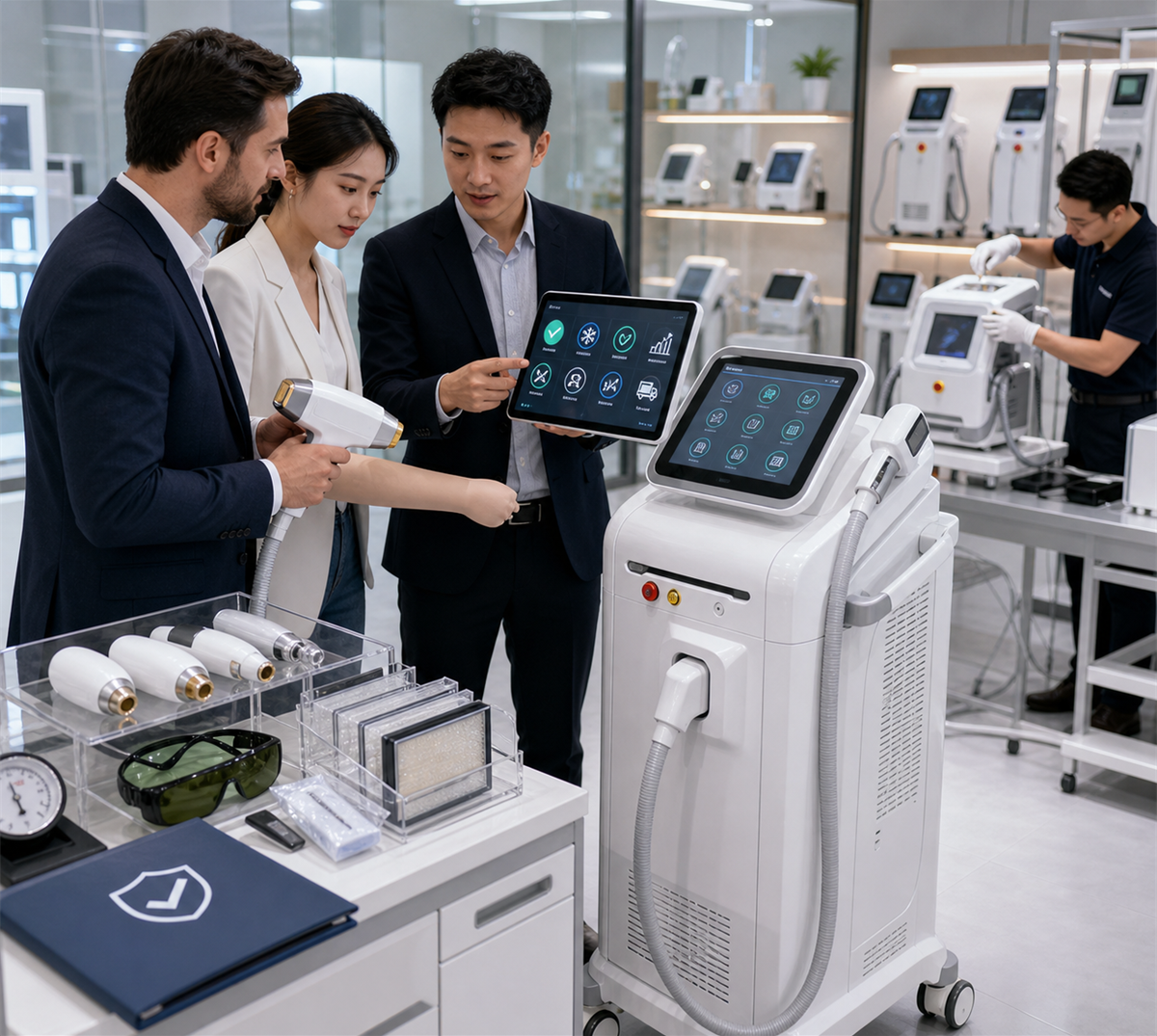
Before placing a large order, request a sample machine, live demonstration, or third-party inspection.
During testing, check:
- Verpackungsqualität
- Setup time
- Schnittstellensprache
- Kühlleistung
- Handle comfort
- Behandlungsmodus-Logik
- Geräuschpegel
- Error alarms
- User manual clarity
- Accessories included
- Eyewear quality
- Power plug and voltage match
- Continuous operation stability
- Supplier response during setup
For distributors, test the machine the same way your customers will use it. If your staff cannot explain it confidently, your salon customers may struggle too.
Ask For Customer References
A professional supplier should be able to provide some proof of market experience, while respecting customer confidentiality.
Bitten Sie um:
- Exportmärkte
- Distributor references
- Salon or clinic case studies
- Training photos or videos
- Trade show history
- Repeat order examples
- After-sales response examples
- Product update history
Do not rely only on polished showroom videos. Ask practical questions about failure rates, spare part lead time, and repeat orders.
Check Communication Quality
Supplier communication before payment often predicts after-sales service after payment.
Auswerten:
- Reaktionsgeschwindigkeit
- Technical accuracy
- Willingness to answer details
- Document organization
- Honesty about limitations
- Clear quotation
- Clear payment terms
- Clear delivery schedule
- Ability to explain compliance differences
- Ability to support your language and time zone
Warnzeichen:
- They avoid technical questions
- They only push discounts
- They cannot provide full documents
- They claim every certificate covers every market
- They promise impossible effects
- They say training is unnecessary
- They cannot explain warranty details
- They pressure you to pay before answering basic questions
Understand Delivery And Packaging
Diode laser machines are not small accessories. Shipping protection matters.
Bestätigen:
- Produktionsvorlaufzeit
- Packing method
- Wooden case or reinforced carton
- Shock protection
- Feuchtigkeitsschutz
- Accessories packing list
- Shipping terms
- Incoterms
- Versicherung
- Customs documents
- Spannungs- und Steckerprüfung
- Serial number record
- Installation guidance after arrival
- Damage claim procedure
Ask the supplier what happens if the machine arrives damaged. This should be written before shipment.
Check Import And Customs Risk
For international buyers, import risk can be significant. A supplier may be able to export, but the buyer still needs to import legally.
Fragen:
- Can the supplier provide commercial invoice, packing list, HS code suggestion, certificate of origin, and shipping documents?
- Does the product need local registration before import?
- Are laser devices restricted in your market?
- Are medical device import permits required?
- Does the label meet local language requirements?
- Are power and electrical safety requirements met?
- Can the supplier support customs questions?
Do not assume that because a supplier can ship, the machine can legally enter and be sold in your market.
Build A Supplier Scorecard
A scorecard helps buyers compare suppliers objectively.
Suggested scoring categories:
- Company credibility: 10 points
- Regulatory documentation: 15 points
- Laser safety design: 15 points
- Technical performance: 15 points
- Cooling and handle quality: 10 points
- Quality control process: 10 points
- Warranty and spare parts: 10 points
- Training and protocols: 10 points
- Marketing and distributor support: 5 points
Do not let price dominate the scorecard. Price matters, but a laser machine is a long-term service tool. Safety, reliability, and support matter more.
Key Questions To Ask A Diode Laser Supplier
Vor der Bestellung fragen Sie bitte:
- Are you the legal manufacturer or a trading company?
- What exact model will be shipped?
- What wavelengths are included?
- What is the real laser output and how is it tested?
- What is the fluence range?
- What is the pulse width range?
- What is the spot size?
- What is the maximum frequency at usable energy?
- Welches Kühlsystem wird verwendet?
- What is the handle life?
- Welche Teile sind von der Garantie abgedeckt?
- Can you provide the user manual before payment?
- Can you provide official certificate copies?
- Are certificates linked to this exact model?
- Can I verify registration or clearance in an official database?
- What safety labels and eyewear are included?
- Welche Schulungen werden angeboten?
- What spare parts are in stock?
- What is the repair process?
- What marketing materials do you provide?
- Do you support OEM or private label?
- What changes may affect compliance?
- What happens if the machine is damaged during transport?
The way the supplier answers these questions is often more important than the answers themselves.
Red Flags
Avoid or investigate carefully if a supplier:
- Uses “FDA approved” without explaining whether it is clearance, registration, listing, or another status
- Sends certificate screenshots but refuses full documents
- Cannot match certificates to the exact model
- Claims the device can be sold legally in every country
- Promises permanent results for everyone
- Says no training is needed
- Has no spare parts price list
- Cannot provide a user manual
- Cannot explain cooling performance
- Cannot show quality control testing
- Offers unusually low prices with no warranty detail
- Changes model names frequently
- Avoids written terms
- Provides only stock photos
- Cannot explain laser safety features
- Has no real after-sales team
One red flag does not always mean the supplier is bad, but several red flags together should stop the purchase.
How Salons Should Choose
For salons, the most important supplier qualities are:
- Safe and stable machine operation
- Comfortable customer experience
- Einfache Mitarbeiterschulung
- Clear consultation and aftercare materials
- Reliable warranty
- Schneller technischer Support
- Project promotion support
- Realistic pricing and package guidance
A salon should not buy a complicated machine only because it has many functions. Choose a model that staff can operate confidently and customers can understand.
How Distributors Should Choose
For distributors, the most important supplier qualities are:
- Stable bulk quality
- Clear wholesale pricing
- Model differentiation
- Territory protection or channel policy
- Ersatzteilversorgung
- Technical training for your team
- Fast response to customer issues
- OEM support
- Marketingmaterialien
- Compliance documentation
- Produktionskapazität
A distributor should think beyond the first order. The question is whether the supplier can support repeat sales and customer service for years.
How Clinics Should Choose
For clinics, the most important supplier qualities are:
- Strong regulatory documentation
- Clear intended use
- Treatment protocol support
- Laser safety training
- Clinical-use support where appropriate
- Professional service records
- Wartungsplan
- Qualified after-sales response
- Evidence-based claims
Clinics should involve regulatory, clinical, or technical professionals before purchasing if the device is used in a regulated medical aesthetic setting.
Build A Trial Launch Plan After Purchase
Choosing a supplier is only the first step. After receiving the machine, the buyer should launch the project carefully.
Steps:
- Inspect the machine on arrival
- Record serial number and accessories
- Check shipping damage
- Complete installation guidance
- Test cooling and basic operation
- Zugpersonal
- Prepare customer consultation forms
- Prepare consent and aftercare forms
- Create service menu and package pricing
- Run internal trial sessions where appropriate
- Marketinginhalte erstellen
- Open limited trial appointments
- Kundenfeedback verfolgen
- Review performance after 30 days
A professional supplier should support this launch process.
Häufig gestellte Fragen
Is 808 nm the best wavelength for diode laser hair removal?
808 nm is widely used in diode laser hair removal machines, but “best” depends on skin type, hair type, treatment area, device design, settings, cooling, and operator skill. Multi-wavelength systems may be useful, but only if the supplier can explain the real output and training logic.
Ist die FDA-Registrierung dasselbe wie die FDA-Zulassung?
No. FDA establishment registration or device listing does not mean FDA approval. Buyers should verify the exact regulatory status, such as 510(k) clearance where applicable, device listing, laser product compliance, and intended-use wording.
What documents should I request before ordering?
Request the full certificate copies, test reports, user manual, product label, declaration of conformity where applicable, warranty terms, packing list, inspection report sample, registration or database links where applicable, and model-specific technical specifications.
Should I choose the cheapest diode laser supplier?
Usually not. The lowest price can bring higher risk if the supplier has weak cooling, unstable output, poor warranty, no spare parts, limited training, or unclear certificates. Compare total cost and business risk.
How important is cooling?
Cooling is extremely important. It affects comfort, treatment confidence, session speed, and customer satisfaction. Buyers should test cooling during continuous operation, not only during a short demonstration.
Do I need OEM or private label support?
Salons usually do not need OEM support. Distributors, brand owners, and regional agents may need it. If you plan to sell under your own brand, confirm certificate scope, label rules, manual customization, warranty responsibility, and minimum order quantity.
What after-sales support should a professional supplier provide?
A professional supplier should provide training, remote troubleshooting, spare parts, repair instructions, warranty support, maintenance guidance, software or error code help, and clear response time.
Can diode laser hair removal machines be sold in every country with CE or FDA documents?
No. Requirements differ by market. CE documents, FDA records, NMPA registration, and other market documents are not interchangeable. Buyers should verify local compliance before importing or selling.
Abschluss
Choosing a professional diode laser hair removal machine supplier requires more than comparing price and machine appearance. Buyers should evaluate supplier identity, documentation, target market compliance, laser safety, real technical performance, cooling, handle quality, quality control, warranty, spare parts, training, marketing support, OEM capability, and communication quality.
A good supplier helps you reduce risk and build a profitable hair removal project. A weak supplier may leave you with a machine that is difficult to operate, hard to repair, risky to promote, and expensive to maintain. The professional choice is to buy from a supplier that can support the whole business cycle, from documentation and delivery to staff training, customer trust, after-sales service, and repeat revenue.