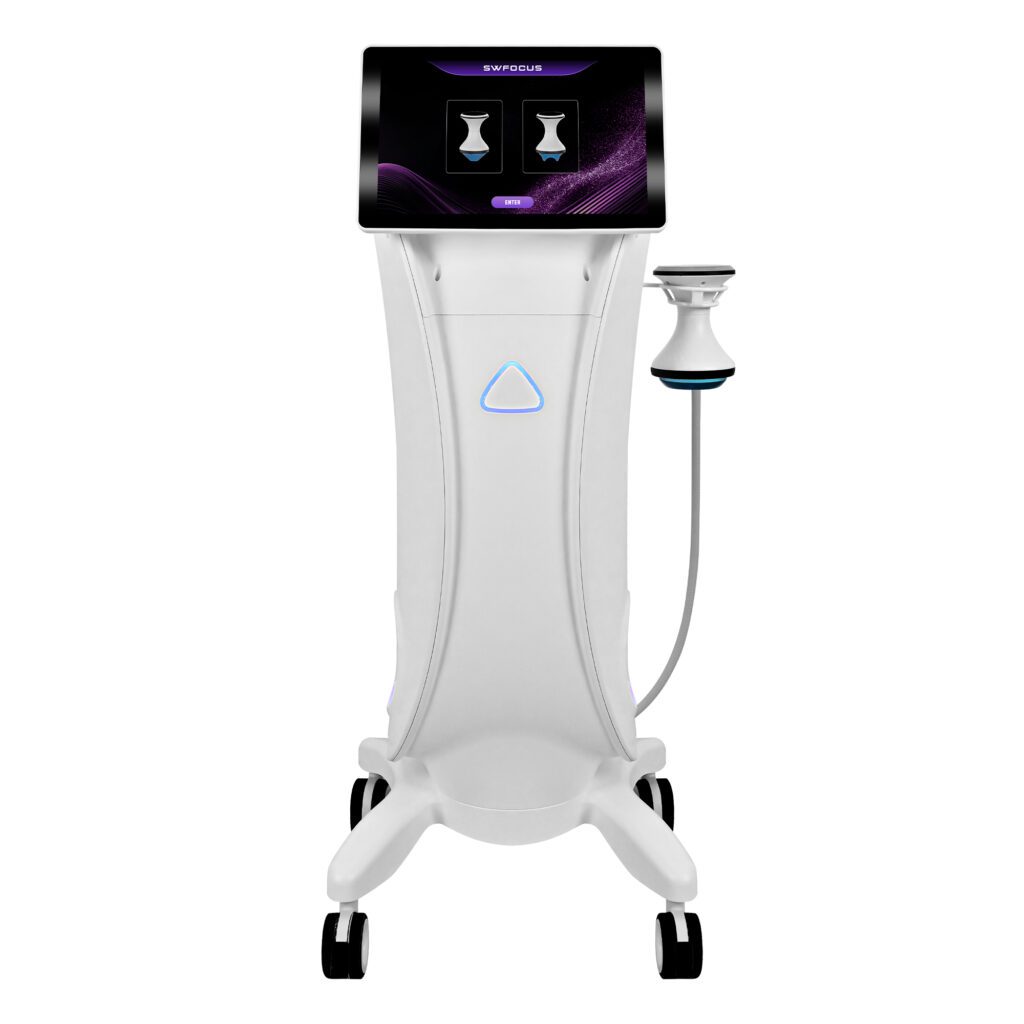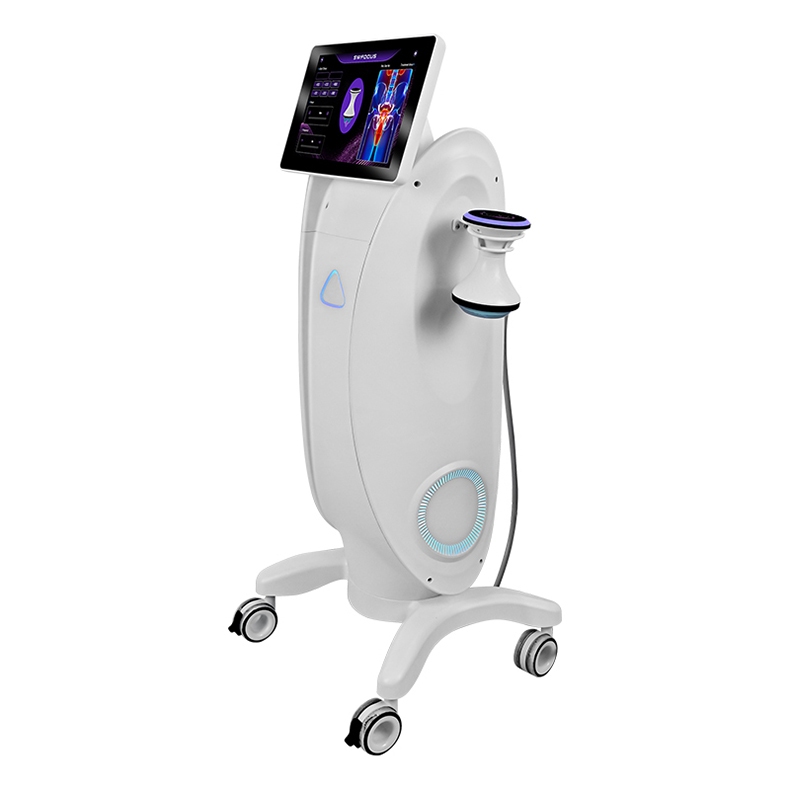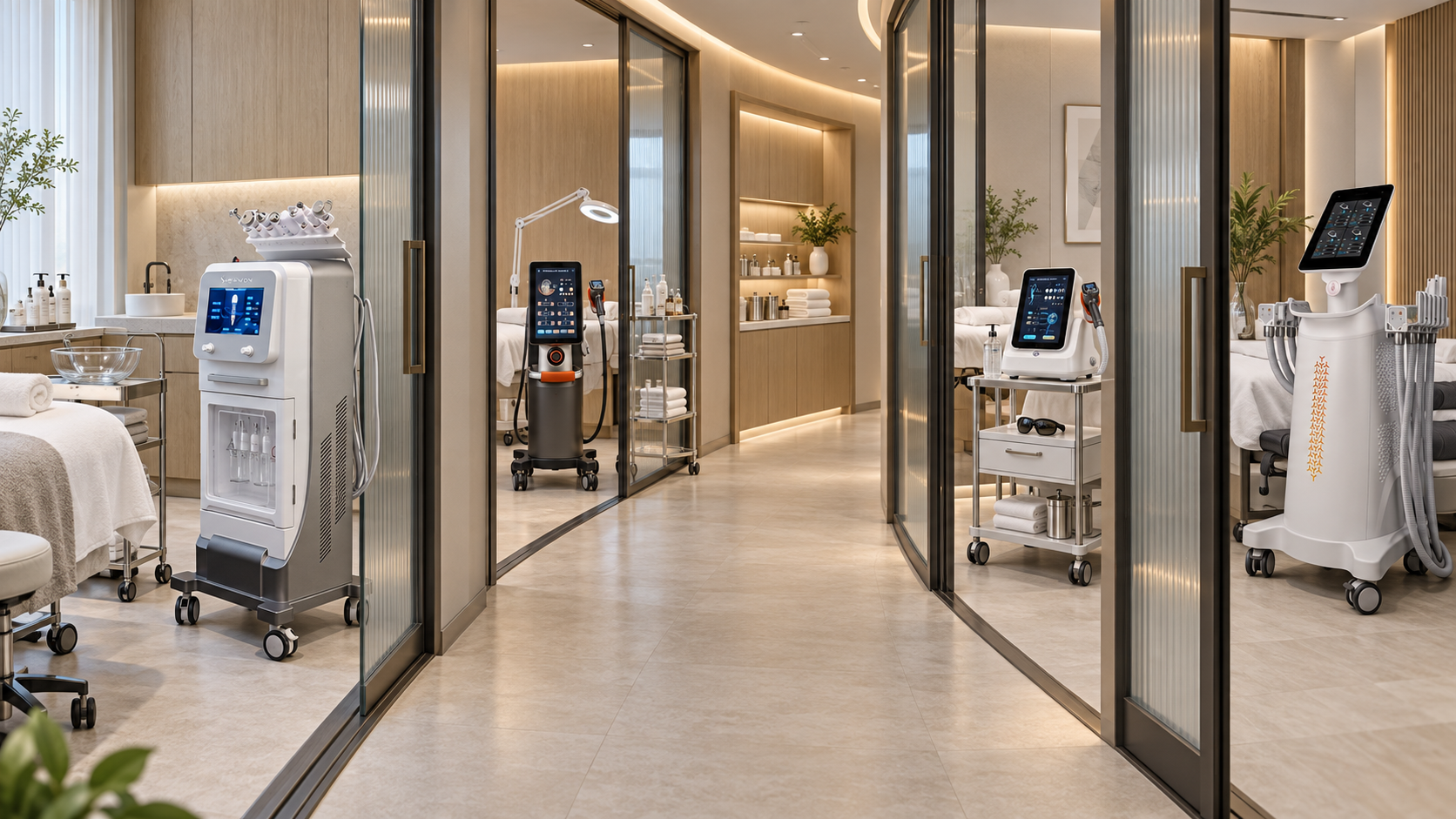
An aesthetic center with several treatment rooms can offer more service categories, run appointments in parallel, and separate routine care from specialist procedures. Those advantages appear only when every room has a defined role. Filling each room with several machines often creates duplicated menus, crowded storage, idle devices, and operators who are scheduled for technologies they are not authorized to use.
The portfolio should be planned across the whole center. One room may carry high-frequency facial maintenance, another may support controlled hair reduction, and another may handle body services. A separate facial-technology or advanced-procedure room should be added when demand, staff, facilities, and governance justify it.
This guide maps selected SHEFMON Schönheitsgeräte to treatment-room roles and explains how two-room, three-room, four-room, and five-room centers can allocate devices without turning every room into the same general-purpose space.
Zusammenfassung
- Treat each treatment room as a capacity unit with one primary service role.
- Allocate devices according to verified demand, authorized staff, room suitability, appointment length, turnover, and downtime risk.
- A0648 can anchor a high-use facial-maintenance room, while A0272-F can support a separate consultation-led facial-technology room.
- A0423 should be planned as a controlled hair-reduction room rather than moved between general rooms for convenience.
- B0155 can support a multifunction body-care room; A0241 belongs in a separate muscle-focused service category even if the two use one body room in scheduled blocks.
- A0152 RF microneedling belongs in an advanced procedure room only when professional scope, hygiene, single-use stock, sharps, documentation, aftercare, and escalation are ready.
- Fix devices in rooms when utilities, control, setup, weight, maintenance access, or consistent workflow make movement impractical.
- Share a device only when transport, setup, storage, cleaning, utilities, authorization, and changeover remain controlled.
- Buy a duplicate device after the current room or device has sustained qualified demand and measurable capacity limits, not simply because another room is empty.
- Use room utilization, service completion, operator coverage, reset time, downtime, referral loss, and quality indicators to guide expansion.
1. Give Every Room a Primary Business Role
A room role should describe the client goal and operating workflow, not just the machine placed inside it.
| Room role | Core service direction | Representative SHEFMON model | Main capacity question |
|---|---|---|---|
| Facial maintenance room | Reinigung, Peeling, Ausreinigung und feuchtigkeitsspendende Pflege | A0648 Hydro-Mikrodermabrasion | Can this room carry repeat facial demand with complete cleaning and restocking? |
| Facial technology room | Consultation-led facial tone and technology services | A0272-F Gesichts-EMS/RF | Is demand strong enough to separate technology appointments from routine facials? |
| Hair-reduction room | Controlled, area-based professional hair reduction | A0423 Diodenlaser | Can the room and authorized team support the laser workflow consistently? |
| Multifunction body room | Selected mechanical and device-based body care | B0155 Desktop Endos Velapro | Which handles and services will be active, and how long does turnover take? |
| Muscle-service room | Muscle-focused body category | A0241 EMS/RF-Plattform | Does a separate room improve applicator setup, privacy, and program capacity? |
| Advanced procedure room | Professionally governed RF microneedling pathway | A0152 RF microneedling | Are procedure governance and room controls ready for regular use? |
A room may support secondary services, but its primary role should remain obvious to scheduling staff, operators, and clients.
2. Start with a Center-Wide Demand Map
Review demand before assigning devices. Separate:
- enquiries from qualified consultations;
- initial interest from completed services;
- one-time campaigns from repeat demand;
- requests by service area and goal;
- demand that current operators and rooms can legally and competently serve;
- appointments lost because of capacity from appointments lost because the client was unsuitable;
- demand for a new category from demand for more capacity in an existing category.
An empty fourth room does not prove the center needs a fourth device category. It may be more valuable as a consultation, review, overflow, or staff-training room until the business has evidence for expansion.
3. Audit Room Capability Before Assigning Equipment
This article focuses on portfolio allocation, but every allocation depends on the room being suitable. Record:
- usable space and the full working area around the bed and device;
- delivery access, doors, fixed furniture, and maintenance access;
- verified electrical and environmental conditions;
- water, filling, emptying, or cooling workflow where relevant;
- privacy, changing, controlled access, and photography needs;
- clean stock, used items, consumables, handles, applicators, and protective equipment;
- cleaning, waste, laundry, or sharps processes as applicable;
- authorized staff and hours of coverage;
- setup, service, documentation, aftercare, and reset time.
Use the more detailed facility process in a dedicated room-planning review before installation. Device allocation should never override a room limitation.
4. Make A0648 the Anchor of a Facial-Maintenance Room
Die jetzige Produktseite A0648 presents a nine-function hydradermabrasion platform and emphasizes cleansing, exfoliation, extraction, and hydration. This gives a multi-room center a clear routine-facial anchor.
A dedicated A0648 room can support:
- Essentielle Reinigungsgesichtsbehandlung;
- Hydration-Focused Facial;
- Gesichtspflege-Testbericht.
The operational advantage is repeatability. The room can keep approved solutions, tips, filters, cleaning supplies, and documentation close to the point of use. The team should still confirm the delivered functions and publish only the services supported by the actual configuration and trained workflow.
Do not use the room as overflow storage for unrelated devices. A high-use facial room loses capacity when every available surface holds accessories from other departments.
5. Add A0272-F When Facial Technology Deserves Its Own Capacity
Der A0272-F page describes facial electrical stimulation combined with RF. Its appointment flow differs from A0648 wet facial maintenance.
Create a separate facial-technology room when:
- qualified enquiries regularly compete with facial-maintenance bookings;
- authorized staff can cover both rooms;
- the service has a clear consultation, placement, accessory, settings, cleaning, and review process;
- a dedicated setup reduces changeover and booking errors;
- the menu can explain facial maintenance and facial technology as different choices.
If demand is still limited, A0272-F may use a compatible facial room in controlled time blocks. The schedule must include a full changeover, and the room must not present A0272-F as an automatic upgrade to every facial.
6. Reserve a Controlled Room for A0423 Hair Reduction
Die jetzige A0423 listing shows 755, 810, and 1064 nm arrangements, an optional 940 nm option, multiple spot-size choices, and several cooling elements. The exact delivered wavelength, handle, spot size, power, cooling system, voltage, and standard or optional items must be reconciled across the quotation, packing list, manual, and acceptance record.
The hair-reduction room should have:
- controlled access appropriate to the exact system and local requirements;
- suitable protective eyewear and authorized operators;
- a bed position that supports the areas offered by the menu;
- access to the console, handle, cooling and water systems, and maintenance points;
- settings, area, operator, response, aftercare, and follow-up records;
- cleaning, inspection, fault, and unexpected-response procedures;
- appointment blocks that include preparation, documentation, and reset.
A0423 is usually a stronger candidate for a fixed room than a mobile shared-device policy. Moving a laser console between general rooms can introduce access, setup, inspection, cable, cooling, maintenance, and authorization problems.
7. Use B0155 for a Defined Multifunction Body Room
Der Produktseite B0155 lists a larger body vacuum roller, a smaller face/arm/neck roller, rotating handles, RF-related functions, light, and 80K cavitation. A multi-room center can use this range to create a body-care room, but the service list should begin with selected functions.
The room may offer:
- Body Care Consultation;
- Targeted Mechanical Body Care;
- another documented, function-specific service after its client selection, contact materials, handling, cleaning, and records are ready.
Multifunction equipment can improve room coverage while increasing accessory and training demands. Assign handle storage, cleaning status, compatible contact materials, maintenance, and operator permissions explicitly. Avoid unsupported medical, detoxification, rehabilitation, pain-relief, metabolic, lymphatic, and weight-loss claims.
8. Separate A0241 Muscle Services from General Body Care
Der A0241 page presents electromagnetic muscle stimulation with RF and identifies areas such as the abdomen, buttocks, arms, and thighs.
The center can place A0241 in:
- a dedicated muscle-service room when demand and staffing justify fixed capacity; or
- a compatible body room in scheduled blocks when applicator storage, electrical verification, bed access, cleaning, privacy, and changeover are controlled.
Keep its menu separate from B0155. Use entries such as Muscle Service Consultation, Muskelfokussiertes Körpertraining, Und Programmüberprüfung under the center’s approved process.
The online product page contains inconsistent configuration language, so design the room and menu around the delivered applicators confirmed in the final documents. Avoid exercise-equivalent, fixed-course, universal-safety, and weight-loss promises.
9. Use A0152 Only in a Prepared Advanced Procedure Room
Der A0152 page lists computerized depth control, a 1-to-7 mm depth profile plus an additional heat profile, 12-pin, 24-pin, 40-pin, and nano heads, and selectable handle configurations.
The device may have a desktop format, but the service process determines the room. An advanced room needs:
- qualified assessment, operator scope, and appropriate oversight;
- procedure hygiene and controlled access;
- the exact handle and compatible-head configuration;
- single-use inventory and lot tracking where applicable;
- sharps handling and disposal;
- consent, settings, area, photography, aftercare, and follow-up records where applicable;
- a complication and professional-escalation pathway;
- secure storage and technical-support arrangements.
Do not open the room merely to create a premium category. Confirm intended use, device status, permitted areas, professional requirements, parameters, and facility obligations in the destination market.
10. Choose Which Devices Stay Fixed
Use a fixed-room policy when a device has one or more of these characteristics:
- controlled room access is part of the operating system;
- power, water, cooling, drainage, ventilation, or environmental checks are tied to the room;
- the console is difficult to move without risk to components or calibration;
- multiple handles, applicators, or consumables require stable storage;
- setup and acceptance checks would be repeated after every move;
- treatment-area positioning has been validated in one layout;
- movement would interrupt maintenance or inspection controls;
- the device is used often enough that mobility adds no scheduling value.
A0423 is generally suited to a fixed controlled room. A0648 often benefits from a stable facial-maintenance setup. B0155 and A0241 may also be fixed when their accessories and body-room layout are used frequently.
11. Use Shared Devices Only Under a Written Movement Policy
A device should move between rooms only if the supplier instructions, center procedures, insurance, local requirements, and physical design allow it.
The policy should define:
- which rooms are approved;
- who may move and reconnect the device;
- how the route, thresholds, lifts, and doorways are managed;
- shutdown, transport, start-up, and pre-use checks;
- how cables, hoses, handles, applicators, and fluid systems are secured;
- room utilities and environment checks;
- cleaning before and after movement;
- where accessories and consumables remain;
- how location is updated in the device register;
- what fault or impact requires quarantine and technical review.
If the policy is longer and riskier than the capacity benefit, keep the device fixed and schedule clients into the appropriate room.
12. Decide When a Room Can Carry Two Service Categories
| Compatibility factor | Suitable for controlled sharing | Reason to separate |
|---|---|---|
| Ziel des Kunden | Services are distinct but easy to schedule and explain | Menus become confusing or one is treated as an automatic upgrade |
| Staff | The correct authorized operator covers each block | General room access permits unqualified setup or use |
| Hygiene | A complete changeover restores the required condition | Wet work, procedure hygiene, sharps, or waste routes conflict |
| Utilities | Both devices fit verified power and environmental conditions | One device requires a different controlled installation |
| Lagerung | Accessories remain closed, labeled, and separated | Handles, solutions, tips, or applicators are mixed |
| Capacity | Sharing improves utilization without delays | Repeated setup and reset reduce usable appointment time |
| Aufzeichnungen | Each service keeps its own assessment and device fields | Staff reuse a generic form and lose traceability |
A0648 and A0272-F may share a facial room in separate blocks. B0155 and A0241 may share a suitably configured body room. A0423 and A0152 require a higher level of room-specific review before any sharing decision.
13. Avoid Duplicating the Same Service Across Every Room
Multiple treatment rooms do not need identical device lists. Duplication can be justified for a high-demand anchor service, but it can also hide weak room planning.
Before ordering a second unit, check:
- sustained qualified demand by day and hour;
- room and device utilization after setup and reset are included;
- operator coverage during the constrained periods;
- whether the bottleneck is the device, room, consultation process, staffing, or cancellations;
- downtime and maintenance history;
- lost bookings and waiting time for appropriate clients;
- whether a second configuration would complicate training, components, service cards, and support;
- whether moving low-demand appointments to another time would solve the problem.
Duplicate the workflow only when the center can also duplicate its quality controls.
14. Build a Capacity Model for Every Room
Use a complete room block:
Room block = assessment or preparation + setup + service + documentation + aftercare + cleaning + inspection + restocking
Then calculate:
- available room hours;
- authorized operator hours;
- device availability after maintenance and known downtime;
- number of complete room blocks that fit safely;
- demand by service and area;
- utilization during peak and off-peak periods;
- cancellations, late arrivals, overruns, and room conflicts;
- time lost to moving equipment or finding accessories.
The lowest of room, staff, and device capacity is the practical limit. Buying another machine will not increase capacity if the real constraint is staffing or room reset.
15. Match Scheduling Rules to Room Roles
| Room type | Booking gate | Main scheduling rule |
|---|---|---|
| Gesichtspflege | Approved routine booking or consultation according to policy | Protect cleaning and solution-restocking time between appointments |
| Facial technology | Technology consultation before the first approved service | Schedule authorized staff and correct accessories |
| Haarreduktion | Area-specific consultation and approval | Match room, operator, configuration, area duration, and controlled reset |
| Multifunktionale Körperpflege | Body consultation before selected function | Book the correct handle and allow contact-material and accessory cleanup |
| Muscle services | Muscle-service assessment | Reserve applicators, placement time, review tasks, and an authorized operator |
| Advanced procedure | Professional approval where required | Protect procedure-room time, single-use stock, records, aftercare, and escalation capacity |
Online booking should not allow clients to select an advanced device or occupied specialist room without the required gate.
16. Use Room Ownership Without Creating Staff Silos
Assign one operational owner to every room. That person or role monitors:
- device readiness and open faults;
- room-specific stock and expiry or lot controls where relevant;
- cleaning and reset completion;
- current service cards and documentation;
- operator authorization;
- maintenance, support, and downtime;
- recurring booking or workflow problems.
Other authorized operators may work in the room, but ownership ensures that shared responsibility does not become missing responsibility.
17. Centralize Bulk Stock and Keep Working Stock at Room Level
The center can centralize purchasing while issuing controlled working stock to each room.
| Central store | Behandlungsraum |
|---|---|
| Bulk approved consumables and replacements | Small working quantity for scheduled services |
| Receiving, lot or expiry checks where relevant, and reorder management | Point-of-use identity and status control |
| Quarantine area for damaged, returned, or unverified items | Clearly separated clean, opened, used, and waste items |
| Spare components held under documented conditions | Only components approved for the room’s device configuration |
| Center-wide cleaning and maintenance stock | Model-specific items needed for daily checks and reset |
Do not distribute similar-looking tips, heads, contact products, or applicators interchangeably. Every room should be able to trace its items back to the correct model and service.
18. Plan for Device Downtime Across Several Rooms
A multi-room center needs a service-continuity plan. For each room, decide:
- which bookings stop when the device is unavailable;
- whether another room has the same verified model and configuration;
- whether moving appointments is possible without bypassing room controls;
- who contacts affected clients and what wording is used;
- how the fault is recorded, reported, and quarantined;
- which components or settings must be checked after service;
- who approves return to use;
- whether temporary capacity changes affect follow-up or waiting lists.
Do not substitute a different technology simply to preserve the booking. A replacement service needs its own suitability decision and client agreement.
19. Connect the Rooms Through One Client Journey
The center can use one reception and client identity while keeping room decisions separate.
A connected journey can include:
- general goal capture at reception;
- booking into the appropriate room-specific consultation;
- technology-specific assessment by the responsible team;
- room, device, operator, component, and service documentation;
- department-specific aftercare and follow-up;
- a recorded referral if the client raises a different goal;
- separate assessment before another room or device is booked.
Room-to-room navigation is an operational convenience. It does not establish that several devices should be used in one visit or sequence.
20. Two-Room Device Plan
| Zimmer | Geräteausrichtung | Service coverage |
|---|---|---|
| Zimmer 1 | A0648 | High-frequency facial maintenance and reviews |
| Zimmer 2 | Choose A0423, B0155, A0241, or A0272-F according to the strongest qualified demand | One differentiated specialist category |
This plan suits a growing salon or clinic that wants breadth without placing several specialist systems into one overflow room. The second device should follow demand, staff readiness, and room suitability.
21. Three-Room Device Plan
| Zimmer | Geräteausrichtung | Service coverage |
|---|---|---|
| Zimmer 1 | A0648 | Gesichtspflege |
| Zimmer 2 | A0423 | Controlled hair reduction |
| Zimmer 3 | B0155 or A0241 | Multifunction body care or muscle-focused services |
This layout gives the center three clear service families. If facial-technology demand grows, A0272-F can use compatible scheduled blocks or become the next dedicated room.
22. Four-Room Device Plan
| Zimmer | Geräteausrichtung | Service coverage |
|---|---|---|
| Zimmer 1 | A0648 | Gesichtspflege |
| Zimmer 2 | A0272-F | Facial technology |
| Zimmer 3 | A0423 | Haarreduktion |
| Zimmer 4 | B0155 or A0241 | One defined body category |
The fourth room reduces facial changeovers and gives the center a clear facial, hair, and body structure. Do not add both body platforms automatically; choose the one that fits documented demand.
23. Five-Room Advanced Device Plan
| Zimmer | Geräteausrichtung | Service coverage |
|---|---|---|
| Zimmer 1 | A0648 | Routine facial maintenance |
| Zimmer 2 | A0272-F | Facial technology |
| Zimmer 3 | A0423 | Haarreduktion |
| Zimmer 4 | B0155 or A0241 | Defined body pathway |
| Zimmer 5 | A0152 | Separately governed advanced procedure services |
The fifth room represents a change in governance, not merely another device purchase. Open it only when professional requirements, procedure hygiene, stock, documentation, aftercare, and escalation are complete.
24. Expand from Four Rooms Without Filling Every Space
A center with six or more rooms may gain more from duplicating its proven anchor service than from adding a new technology category. Possible uses for an additional room include:
- a second A0648 room when facial-maintenance demand and operator coverage are consistently constrained;
- a consultation and review room that keeps specialist devices available for approved services;
- a second body room after B0155 or A0241 demand has been separated clearly;
- an overflow room for compatible low-setup services;
- a training, photography, or documentation space within the center’s lawful workflow;
- a future room held for an advanced category after governance is ready.
Unused capacity can be intentional. It gives the business room to test demand without overcrowding existing services.
25. Review Multi-Room Performance Monthly
| Metrisch | Decision it supports |
|---|---|
| Qualified demand by room role | Whether the portfolio matches client goals |
| Complete room utilization | Whether capacity includes setup, documentation, and reset |
| Authorized operator coverage | Whether staff or equipment is the real constraint |
| Consultation-to-approved-service flow | Whether the correct clients reach each room |
| Declines and deferrals | Whether the center respects independent suitability decisions |
| Downtime and fault recurrence | Whether maintenance or replacement needs attention |
| Stock-outs and component errors | Whether room-level inventory is controlled |
| Late starts and overruns | Whether appointment blocks match the workflow |
| Complaints and unexpected responses | Whether quality controls need review |
| Lost bookings during peak periods | Whether duplication or schedule changes are justified |
Revenue per room can be included, but it should not replace quality, authorization, and capacity measures.
26. How Distributors Should Build a Multi-Room Proposal
Ask the buyer for:
- the number, dimensions, utilities, and intended use of each room;
- current devices and service categories;
- qualified demand and planned client groups;
- staff qualifications and hours of authorized coverage;
- country and local facility constraints;
- preferred room roles and launch sequence;
- consumable, component, training, maintenance, warranty, and support needs.
Then provide a room-by-room proposal containing:
- representative model and exact base configuration;
- optional components listed separately;
- room role and non-overlapping service purpose;
- installation, storage, cleaning, and maintenance inputs;
- operator and documentation expectations;
- a fixed, shared, or future-device recommendation;
- staged purchasing rather than an oversized all-room bundle.
The proposal should state which facts require local professional or regulatory verification.
27. Multi-Room Selection Mistakes to Avoid
- Giving every room the same vague “facial and body” role.
- Buying one device for every empty room before demand is measured.
- Moving laser or procedure devices between rooms without a controlled policy.
- Duplicating a machine when staffing is the actual bottleneck.
- Treating A0648 and A0272-F as interchangeable facial services.
- Presenting B0155 and A0241 under one generic slimming menu.
- Using a desktop format as proof that A0152 fits a routine room.
- Filling rooms with handles and accessories that are not part of an approved service.
- Sharing consumables or contact products because they look similar.
- Ignoring setup, records, cleaning, restocking, and maintenance in capacity calculations.
- Substituting another device during downtime without a new suitability decision.
- Adding an advanced room before professional governance is ready.
28. Multi-Room Device Checklist
Before approving the portfolio, confirm that:
- every room has one primary service role;
- each device matches verified demand and a distinct client goal;
- room suitability has been assessed for the delivered configuration;
- devices have a documented fixed or shared-location policy;
- staff authorization covers the exact models and services scheduled;
- booking gates match routine, specialist, and advanced workflows;
- room blocks include setup, documentation, aftercare, cleaning, and restocking;
- clean, used, damaged, single-use, and bulk stock are controlled appropriately;
- central inventory and room-level stock records agree;
- every device has an owner, maintenance plan, and downtime route;
- duplicate purchases are supported by sustained capacity evidence;
- room-to-room referrals lead to separate assessment;
- advanced services have the required professional, hygiene, record, and escalation systems;
- the monthly dashboard includes demand, utilization, staffing, downtime, quality, and lost bookings;
- the next room remains flexible until the center has evidence for its role.
Häufig gestellte Fragen
1. How many beauty devices should be placed in each treatment room?
There is no universal number. Use the smallest device set that supports the room’s primary role without compromising movement, storage, cleaning, maintenance, authorization, or menu clarity. One well-used anchor device can be more effective than several underused consoles.
2. Which device should anchor the first facial room?
A0648 can provide a practical facial-maintenance foundation through cleansing and hydration-oriented services. The center should confirm its delivered functions, solutions, tips, filters, cleaning process, and trained menu before launch.
3. When should A0272-F receive a separate room?
Give it dedicated capacity when qualified facial-technology demand regularly competes with maintenance bookings, authorized staff can cover both rooms, and the separate setup reduces changeovers and service confusion.
4. Can A0423 move between several treatment rooms?
The center should generally plan a fixed, controlled laser room unless the exact device instructions, local requirements, utilities, access controls, transport route, inspection process, and technical guidance support movement. Convenience alone is not enough.
5. Should a body room use B0155 or A0241?
Choose B0155 for selected multifunction body care and A0241 for a muscle-focused category. Base the decision on client goals, staff competency, room setup, delivered configuration, appointment flow, and documented demand.
6. Can B0155 and A0241 share one body room?
They may use separate scheduled blocks when the room supports both devices, components remain separated, utilities are verified, changeovers are complete, and operators are authorized for the exact service.
7. When should a center buy a duplicate device?
Buy a duplicate after measuring sustained qualified demand, complete room utilization, operator coverage, waiting time, lost bookings, downtime, and the actual bottleneck. Do not duplicate equipment when staffing, consultation, or reset time is limiting capacity.
8. Does a desktop device always work well in a shared room?
No. Desktop size does not describe the trolley, handles, consumables, hygiene, waste, storage, professional scope, or room controls. A0152 is a clear example: its RF microneedling pathway requires advanced procedure governance.
9. How should an aesthetic center use an extra empty room?
It can use the room for consultations, reviews, compatible overflow, staff training, documentation, or future expansion. Assigning a temporary low-risk operational role may be better than buying a device before demand is proven.
10. What information should a buyer send SHEFMON for a multi-room recommendation?
Send room plans and utilities, current devices, desired service families, client demand, staff qualifications, country, preferred configurations, storage and consumable needs, maintenance expectations, and the staged opening plan.
Abschluss
Beauty devices should be distributed across multiple treatment rooms according to service role, demand, staffing, room capability, turnover, and quality controls. A0648 can anchor facial maintenance, A0272-F can support a separate facial-technology room, A0423 can establish a controlled hair-reduction room, and B0155 or A0241 can define the body category. A0152 belongs in a separately prepared advanced procedure room.
Start with clear room roles, keep specialist workflows distinct, and measure complete capacity before adding or duplicating equipment. A flexible unused room is more valuable than a crowded room filled with devices the center cannot support consistently.
Erkunden SHEFMON Schönheitsgeräte oder Kontaktieren Sie SHEFMON with your room plan, staff profile, current services, demand, and preferred launch sequence to compare current configurations.