





Teilen Sie optimierte Lösungen, professionelles Ventilwissen und Branchenneuigkeiten
Geben Sie die relevanten Begriffe oder Schlüsselwörter ein, die Sie benötigen. Die entsprechenden Artikel werden in den Suchergebnissen angezeigt. Sollten Sie die gewünschte Antwort nicht finden, kontaktieren Sie uns gerne. Wir helfen Ihnen gerne weiter. Oder senden Sie direkt eine E-Mail an beauty@shefmon.com
755 nm vs. 808 nm vs. 1064 nm: Welche Laserwellenlänge eignet sich am besten zur Haarentfernung?
- shefmon
Laser-Haarentfernung hat sich zu einer der am weitesten verbreiteten ästhetischen Behandlungen zur langfristigen Haarreduktion entwickelt. Unter den modernen Geräten dominieren drei Wellenlängen den Markt: 755 nm, 808 nm und 1064 nm. Jedes dieser Verfahren interagiert unterschiedlich mit Melanin, Hauttiefe und Follikelstruktur, was sich direkt auf Sicherheit, Effizienz und Eignung für verschiedene Hauttypen auswirkt. Das Verständnis dieser Unterschiede ist entscheidend für die Wahl des richtigen Systems, insbesondere bei Mehrwellenlängen-Diodenplattformen wie modernen Dreiwellenlängengeräten, die alle drei Ausgänge kombinieren.
1. Laserwellenlängen und ihre Funktionsweise verstehen
1.1 Das Prinzip der selektiven Photothermolyse
Die Laserhaarentfernung basiert auf einem Verfahren namens selektive Photothermolyse. Dabei wird Laserenergie vom Melanin im Haarschaft absorbiert und in Wärme umgewandelt. Diese Wärme schädigt den Haarfollikel und verlangsamt oder verhindert so das zukünftige Haarwachstum. Die Wirksamkeit dieses Verfahrens hängt maßgeblich von der Wahl der Wellenlänge ab, da diese bestimmt, wie tief das Licht eindringt und wie stark es vom Melanin absorbiert wird.
1.2 Warum die Wellenlänge wichtiger ist als die Leistung allein
Unterschiedliche Wellenlängen verhalten sich im Hautgewebe unterschiedlich. Kürzere Wellenlängen absorbieren mehr Melanin, dringen aber weniger tief ein, während längere Wellenlängen tiefer eindringen, aber weniger selektiv absorbiert werden. Dieser Kompromiss erklärt, warum es keine universell “beste” Wellenlänge gibt. Vielmehr erfüllt jede Wellenlänge je nach Hautton, Haardicke und Behandlungsbereich eine spezifische Funktion.
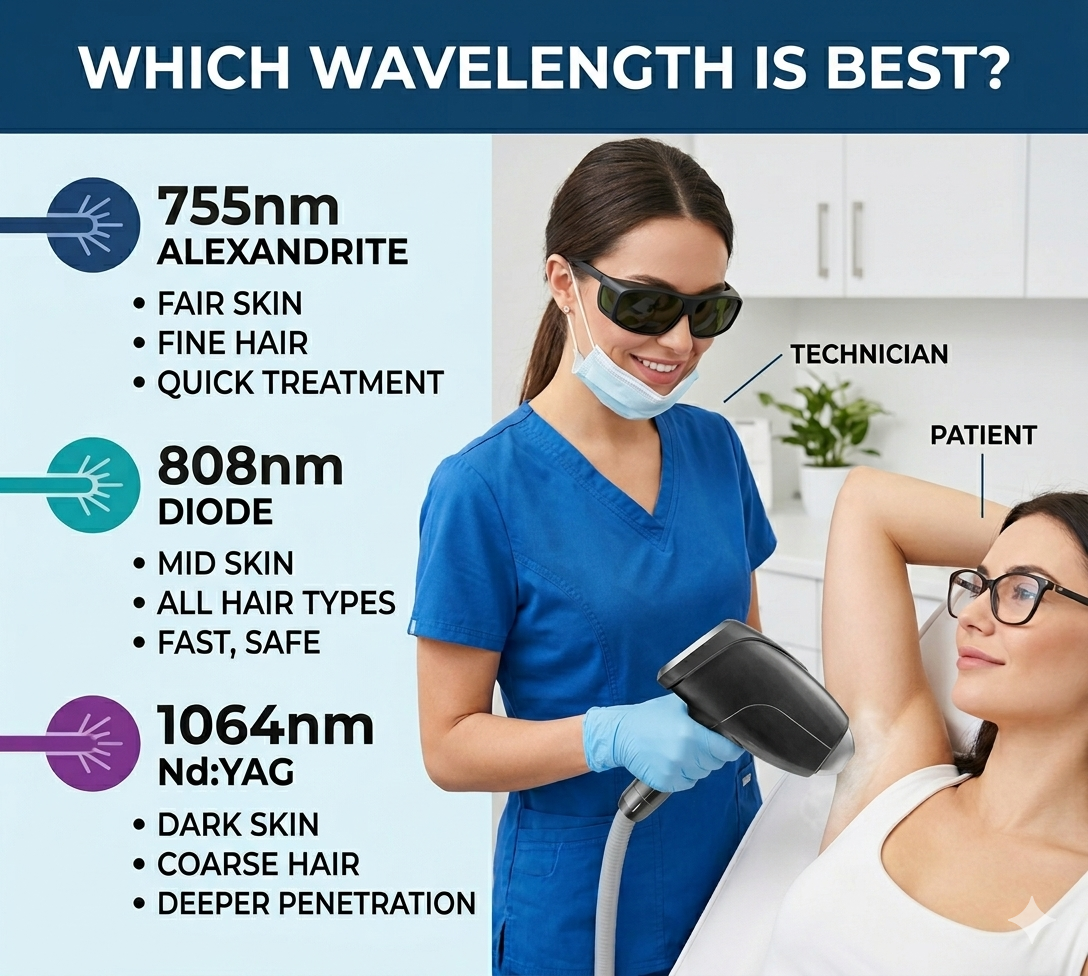
2. 755 nm (Alexandrit): Hohe Absorption für feines Haar
2.1 Starke Melaninbindung, aber geringe Penetration
Die Wellenlänge von 755 nm wird von Melanin stark absorbiert und ist daher besonders wirksam bei der Behandlung von feinem und hellem Haar. Ihre Eindringtiefe ist jedoch relativ gering, was bedeutet, dass sie hauptsächlich oberflächliche Haarfollikel beeinflusst.
Dadurch eignet es sich besonders für:
- Helle Haut (Fitzpatrick I–III)
- Feine Gesichtsbehaarung
- Kleinere, empfindliche Behandlungsbereiche
2.2 Vorteile und Einschränkungen
Der Hauptvorteil der 755-nm-Well-Lampe liegt in ihrer hohen Wirksamkeit an oberflächlichen Haarfollikeln, wodurch oft weniger Sitzungen für eine sichtbare Pigmentreduktion erforderlich sind. Da sie jedoch stark mit dem epidermalen Melanin interagiert, besteht bei dunkleren Hauttypen ein höheres Risiko für Hautirritationen oder Hyperpigmentierung. Aus diesem Grund wird sie seltener als alleinige Behandlungsoption für universelle Anwendungen eingesetzt.
3. 808 nm (Diode): Der ausgewogene “Goldstandard”
3.1 Optimales Gleichgewicht zwischen Tiefe und Sicherheit
Die Wellenlänge von 808 nm gilt weithin als Goldstandard bei Diodenlaser-Haarentfernungssystemen. Sie bietet eine ausgewogene Kombination aus Melaninabsorption und Eindringtiefe und erreicht typischerweise 3–5 mm in die Haut – ausreichend, um die Haarzwiebel und den Haarfollikel effektiv zu behandeln.
Es eignet sich für:
- Fitzpatrick-Hauttypen I–V
- Mitteldickes bis grobes Haar
- Große Behandlungsbereiche wie Beine, Arme und Rücken
3.2 Warum 808 nm die am häufigsten verwendete Wellenlänge ist
Da 808 nm ein optimales Verhältnis von Sicherheit und Effizienz bietet, ist es die vielseitigste Option in der klinischen Praxis. Es liefert konsistente Ergebnisse bei einer breiten Patientengruppe und eignet sich daher ideal für kommerzielle und medizinische ästhetische Geräte. In vielen modernen Diodenplattformen dient 808 nm als Kernwellenlänge, um die herum weitere Wellenlängen hinzugefügt werden.
4. 1064 nm (Nd:YAG): Tiefenpenetration für dunklere Hauttöne
4.1 Geringste Melaninabsorption, aber größte Reichweite
Die Wellenlänge von 1064 nm dringt von den dreien am tiefsten ein und erreicht typischerweise 5–7 mm oder mehr in die Dermis. Sie weist jedoch die geringste Melaninabsorption auf, was bedeutet, dass sie Haarfollikel weniger effizient direkt erwärmt, aber für dunklere Hauttypen deutlich sicherer ist.
Es wird üblicherweise verwendet für:
- Fitzpatrick-Hauttypen IV–VI
- Grobes, tief verwurzeltes Haar
- Empfindliche oder risikoreiche Hautpartien
4.2 Sicherheitsorientiertes Design
Da 1064 nm einen Großteil des epidermalen Melanins durchdringt, verringert es das Risiko von Verbrennungen oder Pigmentveränderungen bei dunklerer Haut deutlich. Aufgrund der geringeren Absorptionseffizienz können jedoch mehr Behandlungssitzungen erforderlich sein, um ähnliche Ergebnisse wie mit kürzeren Wellenlängen zu erzielen.
5. Mehrwellenlängensysteme: Warum Geräte 755 + 808 + 1064 nm kombinieren
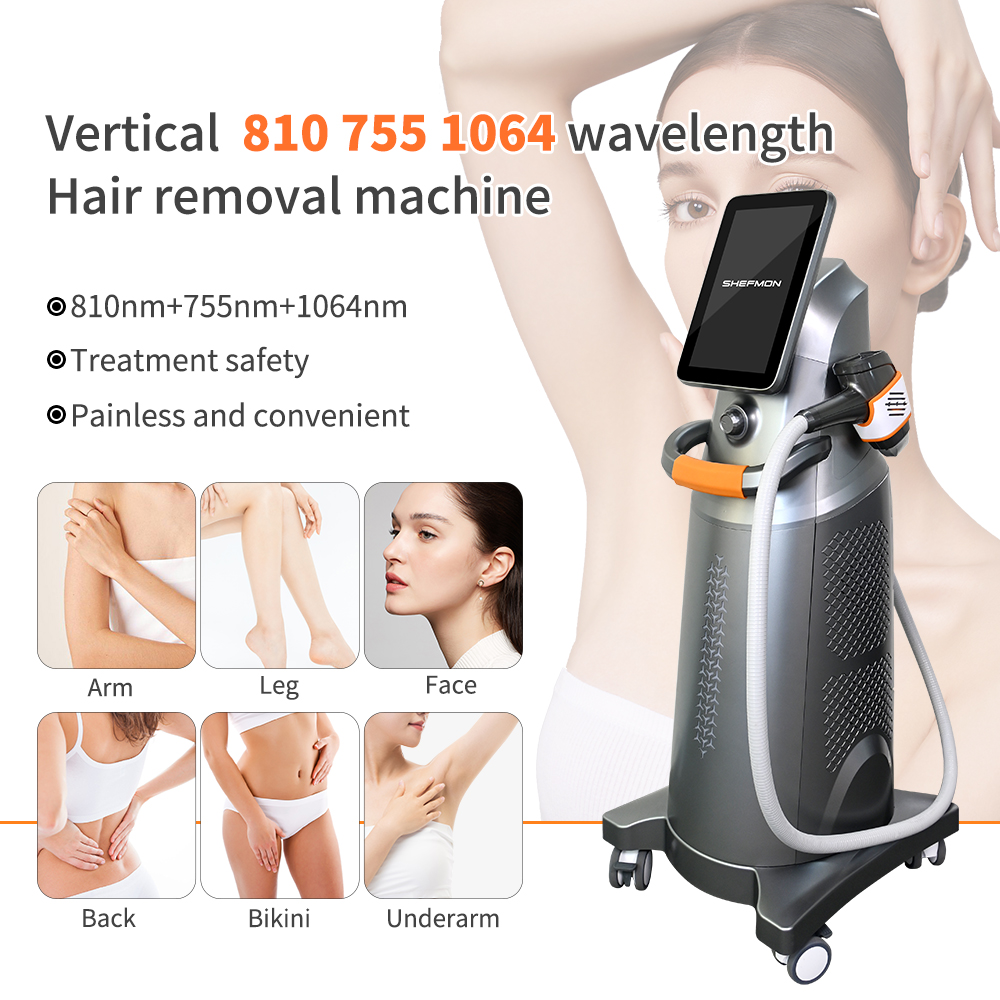
5.1 Funktionsweise von Dreiwellenlängenmaschinen
Moderne Diodenlasersysteme, wie zum Beispiel fortschrittliche Multiwellenlängenplattformen Ähnlich wie bei Geräten mit vergleichbarer Dreifachwellenlängen-Technologie werden alle drei Wellenlängen in einem einzigen Handstück kombiniert. Dies ermöglicht es dem Anwender, die Behandlung dynamisch an Hautton und Haarbeschaffenheit anzupassen.
5.2 Klinische Vorteile von Kombinationssystemen
Durch die Kombination von Wellenlängen können diese Systeme Folgendes erreichen:
- Gleichzeitig verschiedene Follikeltiefen ansprechen
- Verbesserung der Behandlungsvielfalt für alle Hauttypen
- Verringert den Bedarf an mehreren separaten Geräten
- Steigerung der Gesamteffizienz klinischer Arbeitsabläufe
Dieser Ansatz ist besonders in heterogenen Märkten nützlich, in denen Kliniken ein breites Spektrum an Hauttönen und Haartypen behandeln.
6. Welche Wellenlänge ist am besten geeignet?
6.1 Es gibt keine eindeutig “beste” Option
Es gibt keinen universellen Gewinner unter 755 nm, 808 nm und 1064 nm. Vielmehr dient jede Wellenlänge einem spezifischen klinischen Zweck:
- 755 nm: Am besten geeignet für feines Haar und helle Haut
- 808 nm: Beste Gesamtbalance und allgemeine Verwendung
- 1064 nm: Am besten geeignet für dunkle Haut und tiefe Haarfollikel
6.2 Praktische Empfehlung
In der Praxis, 808 nm ist oft die effizienteste Standardwahl., 755 nm und 1064 nm dienen der Feinabstimmung der Ergebnisse auf die individuellen Bedürfnisse des Kunden. Daher erfreuen sich moderne Diodensysteme mit drei Wellenlängen zunehmender Beliebtheit – sie ermöglichen eine flexible, personalisierte Behandlung anstelle eines standardisierten Ansatzes.
Abschluss
Die Wahl zwischen 755 nm, 808 nm und 1064 nm hängt nicht von der stärksten Wellenlänge ab, sondern davon, das passende Energieprofil für den jeweiligen Haut- und Haartyp zu finden. 755 nm bietet Präzision für oberflächliche, feine Härchen, 808 nm bietet die beste Balance für die meisten Kundinnen und Kunden, und 1064 nm gewährleistet Sicherheit und Wirksamkeit bei tiefer liegenden Haarfollikeln und dunkleren Hauttönen. In der Praxis kombinieren die modernsten Systeme alle drei Wellenlängen, sodass Anwenderinnen und Anwender Sicherheit und Ergebnisse in einer Vielzahl von Behandlungsszenarien optimieren können.