ملخص تنفيذي
The beauty equipment market is highly competitive, but distributors still have room to differentiate. The key is to stop competing only on low price and build advantages that salons actually value: suitable product selection, clear project packaging, strong training, reliable after-sales service, spare parts supply, realistic claims, documents, local customer cases, content education, and long-term salon support.
Most price wars happen because distributors sell similar machines with similar photos, similar slogans, and similar promises. If a customer cannot see a difference, the only thing left to compare is price. Differentiation begins when the distributor gives salons a reason to choose them beyond the machine itself.
The most effective differentiation strategies include focusing on a target salon segment, building a layered product portfolio, specializing in selected categories, offering project packages instead of single machines, providing ROI tools, creating salon training systems, stocking spare parts locally, controlling advertising claims, supporting short video and livestream education, building private-label packaging, and tracking customer success after sale.
For beauty equipment distributors, differentiation is not one action. It is a system. The distributor must decide who to serve, what problem to solve, how to prove value, how to support customers, and how to protect trust after the first sale.
The core rule is simple: do not sell the same machine in the same way as everyone else.
1. Competition Is High, But Opportunity Still Exists
Beauty equipment competition is intense because product information spreads quickly, factories launch similar models, online platforms make prices transparent, and many new agents enter the market with low-price offers.
However, high competition does not mean there is no opportunity. Market growth still supports demand for salon equipment, skin management tools, non-invasive aesthetic projects, beauty devices, and professional beauty services. Growth attracts more sellers, but it also creates space for distributors who can serve salons better.
The real question is not whether the market is crowded. The real question is whether a distributor can offer something salons cannot easily get from a cheaper seller.
2. Why Price Wars Happen
Price wars usually happen when distributors have weak differentiation.
Common causes include:
- Selling the same popular models as everyone else
- Using manufacturer photos with no local content
- Offering no training beyond basic operation
- Providing no project packaging
- Having no clear target customer segment
- Competing only through discounts
- Not stocking spare parts
- Having no local service advantage
- Making the same exaggerated claims as competitors
- Lacking documents and certificate explanations
- Not building customer cases
- Not following up after sale
When the customer sees no clear value difference, price becomes the deciding factor.
3. Differentiation Starts With Market Positioning
The U.S. Small Business Administration explains that market research helps businesses find customers and competitive analysis helps businesses find a unique position. This logic applies directly to beauty equipment distribution.
A distributor should first answer:
- Which salon segment do we serve best?
- Which customer pain point do we solve?
- Which product categories do we understand deeply?
- Which competitors are strong locally?
- Which competitor weaknesses can we exploit?
- What value do we provide beyond product price?
- Why should a salon buy from us instead of another supplier?
Without positioning, the distributor becomes a general reseller. General resellers are easy to replace.
4. Choose A Clear Target Salon Segment
Different salons need different equipment and support. A distributor that tries to sell every product to every salon often becomes unfocused.
Target segments may include:
- Community beauty salons
- Small skin management studios
- Mid-range facial salons
- High-end skin management centers
- Hair removal studios
- Body management centers
- مراكز التعافي بعد الولادة
- Private care centers
- مراكز السبا والعافية
- Med spas or aesthetic clinics where allowed
- صالونات التجميل التابعة لسلاسل تجارية
- مدارس التدريب
- Online resellers
Each segment needs a different product mix, price band, training level, service model, and sales message.
5. Differentiate By Product Portfolio
A strong distributor does not simply sell random machines. It builds a portfolio that fits customer needs.
A balanced product portfolio can include:
- Traffic products: easy-to-sell basic machines that open customer relationships.
- Profit products: models with stronger margin and project value.
- Premium products: high-end devices that raise brand image.
- Repeat products: consumables, tips, filters, gels, accessories, and spare parts.
- Strategic products: regional agency models, OEM models, or exclusive versions.
- Education products: skin analyzers and consultation tools that help salons sell projects.
This structure helps the distributor serve different salon budgets without losing focus.
6. Differentiate By Category Specialization
Some distributors become stronger by specializing in one or two categories.
أمثلة:
- Skin management equipment specialist
- RF anti-aging equipment specialist
- Hydro facial and cleansing project specialist
- LED light therapy project specialist
- Hair removal equipment specialist
- Body management equipment specialist
- AI skin analyzer specialist
- Salon starter package specialist
Specialization helps the distributor explain products better, create deeper training, understand after-sales issues, and build authority in that category.
7. Differentiate By Project Packaging
Salons do not only buy equipment. They buy projects that can create revenue.
Project packaging can include:
- Project name
- Target customer group
- Treatment process
- مدة العلاج
- Suggested price range
- Course package design
- Consumables required
- Staff operation steps
- Customer consultation script
- محتوى وسائل التواصل الاجتماعي
- Contraindications where applicable
- Before-and-after policy
- Follow-up schedule
A distributor who sells “one hydro facial project package” is more valuable than a distributor who only sells “one hydro facial machine.”
8. Differentiate By ROI Support
Salon owners want to know whether the machine can make money.
A distributor can provide simple ROI tools:
- Machine purchase cost
- سعر العلاج
- تكلفة المواد الاستهلاكية لكل علاج
- Staff labor cost
- مدة العلاج
- Expected monthly customer count
- Course package price
- Payback period
- تكلفة الصيانة
- Upgrade plan
This helps salons make decisions based on business logic instead of guessing.
9. Differentiate By Training
Training is one of the strongest differentiation tools in beauty equipment distribution.
Useful training includes:
- Product operation training
- Treatment protocol training
- Staff safety training
- Project packaging training
- Customer consultation training
- Sales script training
- التدريب على الصيانة
- Troubleshooting training
- Claim control training
- Salon launch training
Many salons hesitate to buy equipment because they worry staff cannot sell or operate the project. A distributor with training ability reduces that fear.
10. Differentiate By After-Sales Service
After-sales service is where many cheap competitors fail.
Strong after-sales can include:
- Written warranty terms
- Local response time
- مخزون قطع الغيار
- Repair videos
- Technician support
- Remote troubleshooting
- تتبع الرقم التسلسلي
- Maintenance reminders
- Consumable reorder reminders
- Staff retraining
- Project launch follow-up
For salons, fast support is worth money. A machine that is slightly cheaper but cannot be repaired quickly can become more expensive in real business.
11. Differentiate By Spare Parts And Consumables
Long-term parts and consumable supply is a serious competitive advantage.
Distributors can differentiate by offering:
- مخزون قطع الغيار المحلي
- Transparent spare parts price list
- Consumable supply plan
- Filter and tip reorder reminders
- Handpiece replacement options
- Maintenance packages
- Emergency repair support
- Discontinued model support plan
If competitors only sell machines and disappear after delivery, parts and consumables become a trust-building weapon.
12. Differentiate By Quality Control
Customers are tired of low-quality equipment and unstable suppliers. Distributors can differentiate through quality control.
Quality control can include:
- Supplier verification
- Model-specific document review
- اختبار العينة
- Batch inspection
- Pre-shipment inspection
- التفتيش الوارد
- Serial number records
- Failure rate tracking
- Approved sample standard
- Component change notice
This gives salon customers confidence that the distributor is not selling random low-cost stock.
13. Differentiate By Compliance And Documents
Many beauty equipment buyers are confused by CE, FDA, FCC, RoHS, ISO, NMPA, test reports, and registration documents.
A distributor can stand out by explaining documents accurately:
- What each document means
- Which model it covers
- Which market it supports
- Whether it is a test report, certificate, declaration, registration, listing, clearance, or approval
- Whether claims are supported
- Whether target-market rules need review
FDA states that aesthetic devices may be regulated depending on intended use and whether they affect the structure or function of the body. Distributors who understand intended use, labeling, and claim risk can protect salons from unsafe or misleading sales language.
14. Differentiate By Claim Control
Some competitors sell with exaggerated promises. A better distributor can differentiate through honest and compliant claims.
تجنب الادعاءات غير المدعومة مثل:
- رفع مضمون
- علاج حب الشباب
- فقدان الدهون بشكل دائم
- إزالة الندوب تمامًا
- عكس الشيخوخة
- آمن للجميع
- لا توجد آثار جانبية
- FDA approved when only registered or listed
- Medical-grade results without support
FTC health product guidance supports the principle that health-related product claims should be truthful, not misleading, and supported. For beauty equipment distributors, responsible claims can be a trust advantage.
15. Differentiate By Local Customer Cases
Generic factory cases may not persuade local salons. Local cases are more powerful.
A useful local case should show:
- نوع الصالون
- Customer problem
- Equipment chosen
- Project package
- Training process
- Launch plan
- Service price
- آراء العملاء
- Repeat purchase or consumable use
- Lessons learned
Do not exaggerate results. A modest, real case often builds more trust than an unrealistic success story.
16. Differentiate By Local Service Speed
Local service speed can beat lower online prices.
Distributors can offer:
- Local demo
- خدمة التوصيل المحلية
- Local installation
- Local training
- Local spare parts
- Local technician support
- Same-week follow-up
- Faster response than factory-only sellers
Beauty salons care about downtime. If a machine stops working during peak business, local support becomes very valuable.
17. Differentiate By Content Education
Short videos, articles, livestreams, webinars, and social media can help distributors educate salons before selling.
Useful content topics include:
- How to choose beauty equipment models
- How salons calculate ROI
- How to avoid low-quality equipment
- How to compare RF and EMS
- How to package hydro facial projects
- How to use skin analyzers for consultation
- What certificates to check before buying
- How after-sales parts and consumables work
- How to handle customer doubts about results
Educational content creates authority. It also gives sales teams more leads and warmer conversations.
18. Differentiate By Livestream And Short Video Strategy
Many distributors post product videos, but few use content strategically.
A stronger strategy includes:
- Product demo videos
- Salon project packaging videos
- Real training clips
- Before-purchase checklist videos
- Maintenance tutorials
- FAQ clips
- Live Q and A sessions
- Online training events
- Lead capture forms
- Follow-up consultation
For B2B salon equipment, short video and livestreaming should often be used for education, trust building, lead collection, and demo booking, not only direct checkout.
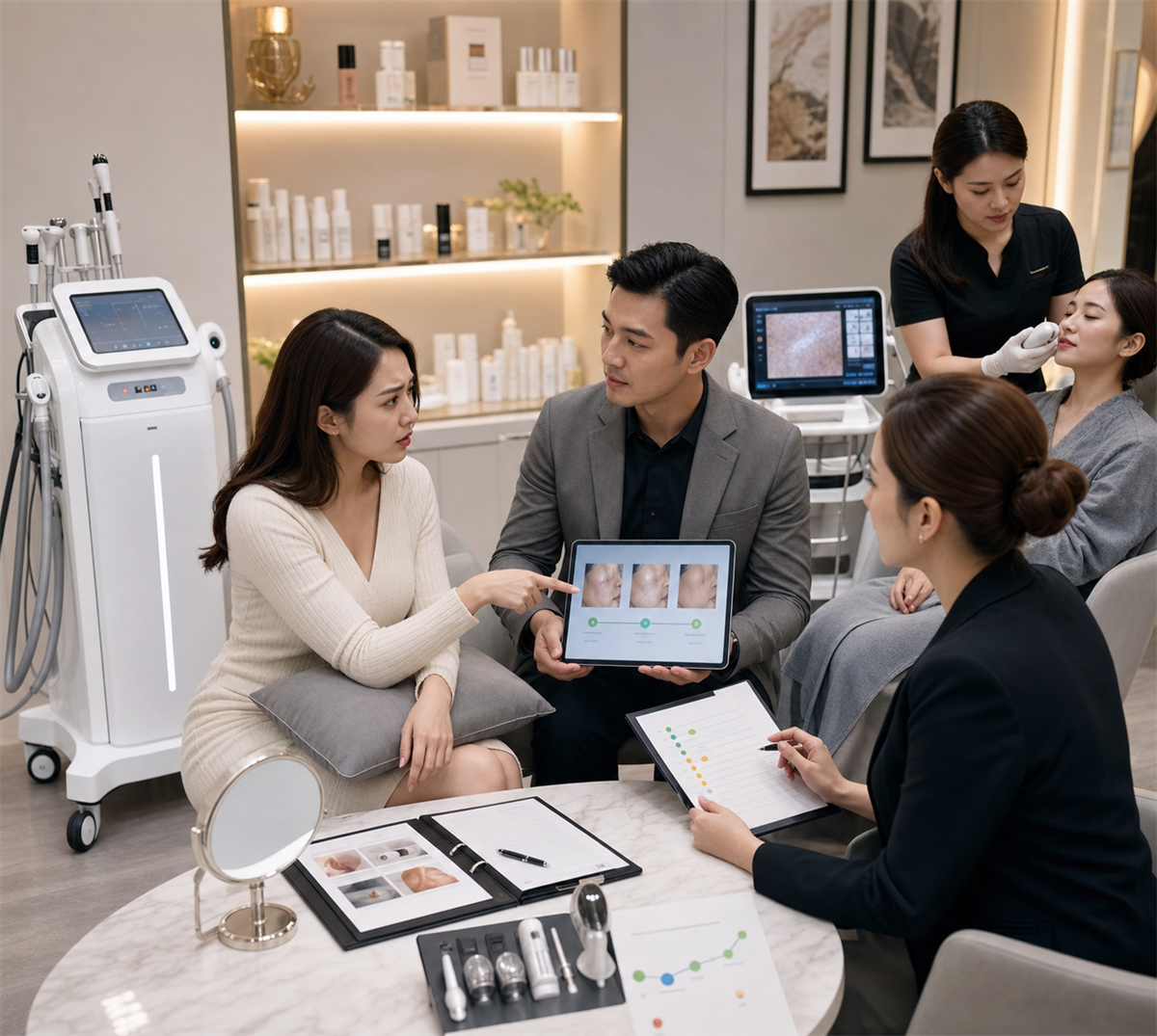
19. Differentiate By Consultative Sales
Consultative sales means diagnosing salon needs before recommending equipment.
Ask salon owners:
- Which projects sell best now?
- Which projects have low profit?
- Which customer group do you want to attract?
- What equipment do you already have?
- What customer complaints do you hear?
- What price range can your customers accept?
- من سيقوم بتشغيل الآلة؟
- What staff training is needed?
- What result expectations must be controlled?
The distributor who asks better questions often wins more trust than the distributor who sends a catalogue first.
20. Differentiate By Pricing System
Differentiation does not mean selling cheap. It means pricing clearly.
A professional distributor should have:
- Retail price guidance
- Wholesale price system
- سعر الوكيل الإقليمي
- Package price
- Demo unit price
- Consumable price
- Spare parts price
- Training package price
- Maintenance package price
- Promotional rules
Clear pricing protects margin and reduces channel conflict.
21. Differentiate By Private Label Or Brand Packaging
Private label can help distributors reduce direct comparison with generic sellers.
Brand differentiation may include:
- Distributor logo
- التعبئة والتغليف حسب الطلب
- Custom warranty card
- Local language manual
- QR code training library
- Branded project brochure
- Product series naming
- Anti-counterfeit code
- Local after-sales contact
However, branding should come after product quality and demand have been tested. A branded low-quality machine only damages the distributor faster.
22. Differentiate By Data And CRM
Many distributors lose customers because they do not track leads and after-sales data.
Useful data includes:
- Salon lead source
- First contact date
- Interest category
- Demo status
- Quote status
- Objections
- Order value
- Machine serial number
- Warranty period
- Consumable reorder date
- Repair history
- رضا العملاء
- Referral source
CRM data helps the distributor sell more precisely and follow up at the right time.
23. Differentiate By Consumable And Repeat Revenue Strategy
A strong distributor does not end the relationship after the machine sale.
Repeat revenue can come from:
- نصائح
- الفلاتر
- جل
- Serums
- الخراطيش
- أغطية للاستخدام مرة واحدة
- قطع اليد
- خدمات الصيانة
- Training upgrades
- Project refresh packages
Consumable strategy keeps the distributor connected to salons and creates regular cash flow.
24. Differentiate By Payment And Financing Options
Some salons want to buy but worry about cash flow.
Distributors can consider:
- Deposit plus balance
- Installment plans where legal and manageable
- Leasing partners
- Demo-to-purchase plan
- Trade-in plan
- Starter package pricing
- Upgrade plan
- Bundle pricing
Payment support should be controlled carefully. The distributor should protect cash flow and write terms clearly.
25. Differentiate By Trade-In And Upgrade Programs
Many salons already own old machines. A trade-in or upgrade program can help convert them.
Options include:
- Old machine evaluation
- Discount toward new model
- Upgrade from basic to premium
- Consumable bundle upgrade
- Replacement handpiece package
- Staff retraining
- New project launch support
This strategy is useful when the market is saturated with outdated or low-quality machines.
26. Differentiate By Demo And Training Center
A physical demo or training center can create trust.
يمكن استخدامه من أجل:
- عروض توضيحية للمنتجات
- Salon owner workshops
- Staff operation training
- Project packaging classes
- New product launch events
- Distributor recruitment
- Local case filming
- After-sales troubleshooting
Not every distributor needs a large showroom. Even a small professional demo room can be powerful if it is used consistently.
27. Differentiate By New Salon Starter Packages
Newly opened salons often need guidance. A distributor can build starter packages instead of selling single devices.
A starter package can include:
- Hydro facial or small bubble machine
- جهاز تحليل البشرة الأساسي
- جهاز العلاج بالضوء LED
- Entry RF or EMS facial device
- المواد الاستهلاكية
- تمرين
- Service menu suggestions
- Launch promotion copy
- ROI sheet
- Warranty and after-sales plan
This is easier for new salons to understand than a long equipment catalogue.
28. Differentiate By High-End Salon Solutions
High-end skin management centers need more than basic products.
They may value:
- Premium device design
- Advanced RF or anti-aging systems
- تحليل الجلد بالذكاء الاصطناعي
- Professional LED systems
- High-end hydro facial systems
- وثائق كاملة
- Strong treatment protocols
- Staff certification-style training
- Premium project menu design
- Better after-sales response
For high-end salons, distributor professionalism is part of the sale.
29. Differentiate In Hair Removal And Body Management Categories
Hair removal and body management categories can be competitive and high-risk.
يمكن أن يأتي التمايز من:
- Strong cooling and comfort explanation
- Handpiece life transparency
- التدريب على السلامة
- Customer screening tools
- Parameter protocols
- Spare parts and lamp supply
- Claim control
- Proper documents
- Local service support
- Project pricing guides
Do not compete only by energy claims or low price. In high-energy categories, trust and support matter more.
30. Differentiate With AI Skin Analyzer Services
AI skin analyzers can help distributors differentiate because they connect equipment sales with consultation and data.
Use them to support:
- Salon customer consultation
- Treatment recommendation
- تتبع ما قبل وما بعد
- Customer education
- Project package sales
- Membership retention
- Cross-selling other machines
Distributors should also explain privacy, data storage, report limitations, and software support.
31. Differentiate With Manufacturer Selection
The distributor’s supplier system is part of differentiation.
Choose manufacturers that provide:
- جودة منتج ثابتة
- Model-specific documents
- Sample testing support
- مواد تدريبية
- مواد التسويق
- قطع غيار
- المواد الاستهلاكية
- دعم الضمان
- الحماية الإقليمية
- دعم الشركات المصنعة للمعدات الأصلية أو العلامات التجارية الخاصة
- Fast communication
- Product upgrade roadmap
A weak manufacturer makes differentiation difficult because the distributor has little to build on.
32. Differentiate With Regional Agency Strategy
Regional agency can create differentiation if it includes real support.
Useful elements:
- Territory protection
- Product exclusivity
- Regional price policy
- دعم التسويق
- Lead sharing
- دعم التدريب
- Demo unit support
- دعم قطع الغيار
- Sales target agreement
- Online channel rules
Do not accept regional agency only in name. It should create actual business protection.
33. Differentiate With Partnerships
Beauty equipment distributors can build partner networks.
Useful partners include:
- Beauty training schools
- Skincare brands
- Salon consultants
- Local beauty associations
- Interior designers for salons
- Spa product suppliers
- شركاء التمويل
- Influencers in the beauty industry
- Chain salon managers
- Beauty educators
Partnerships help the distributor reach salons through trusted channels.
34. Differentiate Through Customer Success
Customer success means helping salons succeed after buying.
مسار:
- Did the salon launch the project?
- Did staff complete training?
- Did customers accept the price?
- Did consumables reorder?
- Did the machine have downtime?
- Did the salon sell course packages?
- Did the salon request another model?
- Did the salon refer other customers?
Distributors who measure customer success can improve product selection and sales support.
35. Differentiate By Refusing Poor-Fit Products
Not every product should be sold.
Avoid products that have:
- No stable demand
- No clear documents
- Poor sample testing
- Weak spare parts
- High repair risk
- Unsupported claims
- Unclear target customer
- Too much price competition
- No manufacturer support
- Poor project packaging potential
Saying no to weak products is part of differentiation. It protects the distributor’s reputation.
36. Differentiation Mistakes To Avoid
تشمل الأخطاء الشائعة ما يلي:
- Calling every product exclusive
- Copying factory slogans
- Competing only with discounts
- Promising unrealistic effects
- Selling too many unrelated models
- Ignoring local salon demand
- Building private label before testing quality
- Posting content without lead follow-up
- Offering training but not delivering it
- Treating after-sales as a cost instead of an advantage
- Ignoring documentation and compliance
- Letting every salesperson use different claims
Weak differentiation creates confusion. Strong differentiation creates trust.
37. A 90-Day Differentiation Plan
Days 1 to 15:
- Analyze local competitors.
- Choose target salon segments.
- Identify competitor weaknesses.
- Select core product categories.
- Remove weak models from the list.
Days 16 to 30:
- Build project packages.
- Prepare ROI sheets.
- Create training materials.
- Confirm spare parts and warranty terms.
- Build a claim control guide.
Days 31 to 60:
- Launch educational short videos.
- Visit target salons.
- Run demo sessions.
- جمع الاعتراضات.
- Build first local case.
Days 61 to 90:
- Create referral program.
- Track customer success.
- Stock critical consumables.
- Improve pricing system.
- Package a starter solution and premium solution.
This plan helps the distributor move from random selling to structured differentiation.
38. Differentiation Scorecard
Distributors can rate themselves from 1 to 5 in these areas:
- Target salon clarity
- Product portfolio focus
- Category expertise
- تغليف المشروع
- ROI support
- نظام التدريب
- After-sales response
- مخزون قطع الغيار
- Consumable strategy
- Document explanation
- Claim control
- Local cases
- Content education
- CRM follow-up
- الحماية الإقليمية
- Private-label readiness
- Customer success tracking
Low scores show where the distributor should improve first.
39. Final Checklist
To differentiate in a competitive beauty equipment market, confirm:
- The target customer segment is clear.
- The product portfolio is focused.
- The distributor can explain project value.
- ROI tools are prepared.
- Staff training is available.
- After-sales process is written.
- Spare parts and consumables are planned.
- Claims are realistic and supported.
- Documents can be explained accurately.
- Local cases are being collected.
- Short video content educates, not only advertises.
- Pricing system protects margin.
- CRM follow-up is organized.
- Manufacturer support is reliable.
- Weak products are removed.
If these pieces are in place, the distributor is no longer competing only on price.
خاتمة
Beauty equipment market competition is intense, but distributors can still differentiate by building a stronger value system around the product.
The best distributors do not only sell machines. They help salons choose suitable models, package profitable projects, train staff, communicate results responsibly, calculate ROI, handle after-sales, reorder consumables, and upgrade over time.
Differentiation comes from focus, service, proof, and execution. A distributor that understands its target salons, controls product quality, provides training, stocks parts, explains documents, creates content, and follows up after sale can compete even in a crowded market.
In beauty equipment distribution, low price may win attention. But trust, project success, and long-term service win the customer.
التعليمات
How can beauty equipment distributors differentiate in a competitive market?
They can differentiate through target salon positioning, focused product portfolio, project packaging, ROI support, training, after-sales service, spare parts, consumables, compliance explanation, local cases, content education, private label, and customer success tracking.
Why do beauty equipment distributors fall into price wars?
Price wars happen when distributors sell similar products with similar materials, similar claims, weak service, no training, no project packaging, and no clear difference beyond price.
What is the strongest differentiation strategy for new distributors?
New distributors should focus on a clear salon segment, start with practical products, provide project packages, offer training, respond quickly after sale, and build local customer cases before expanding to more categories.
How can after-sales service become a differentiation advantage?
After-sales service differentiates distributors through local repair, spare parts stock, warranty clarity, technician support, maintenance reminders, consumable supply, and fast response when salons have problems.
Can private label help distributors differentiate?
Yes, private label can reduce direct price comparison and improve brand recognition. But distributors should test product quality, documents, after-sales, and market demand before investing in custom packaging.
Should distributors specialize or sell many categories?
Specialization often works better for differentiation. Distributors can become known for skin management, RF anti-aging, hydro facial projects, LED therapy, hair removal, body management, AI skin analyzers, or salon starter packages.
How can content help beauty equipment distributors stand out?
Educational content helps distributors build authority. Useful topics include equipment selection, ROI calculation, project packaging, after-sales, certificate checks, claim control, and salon operation tips.