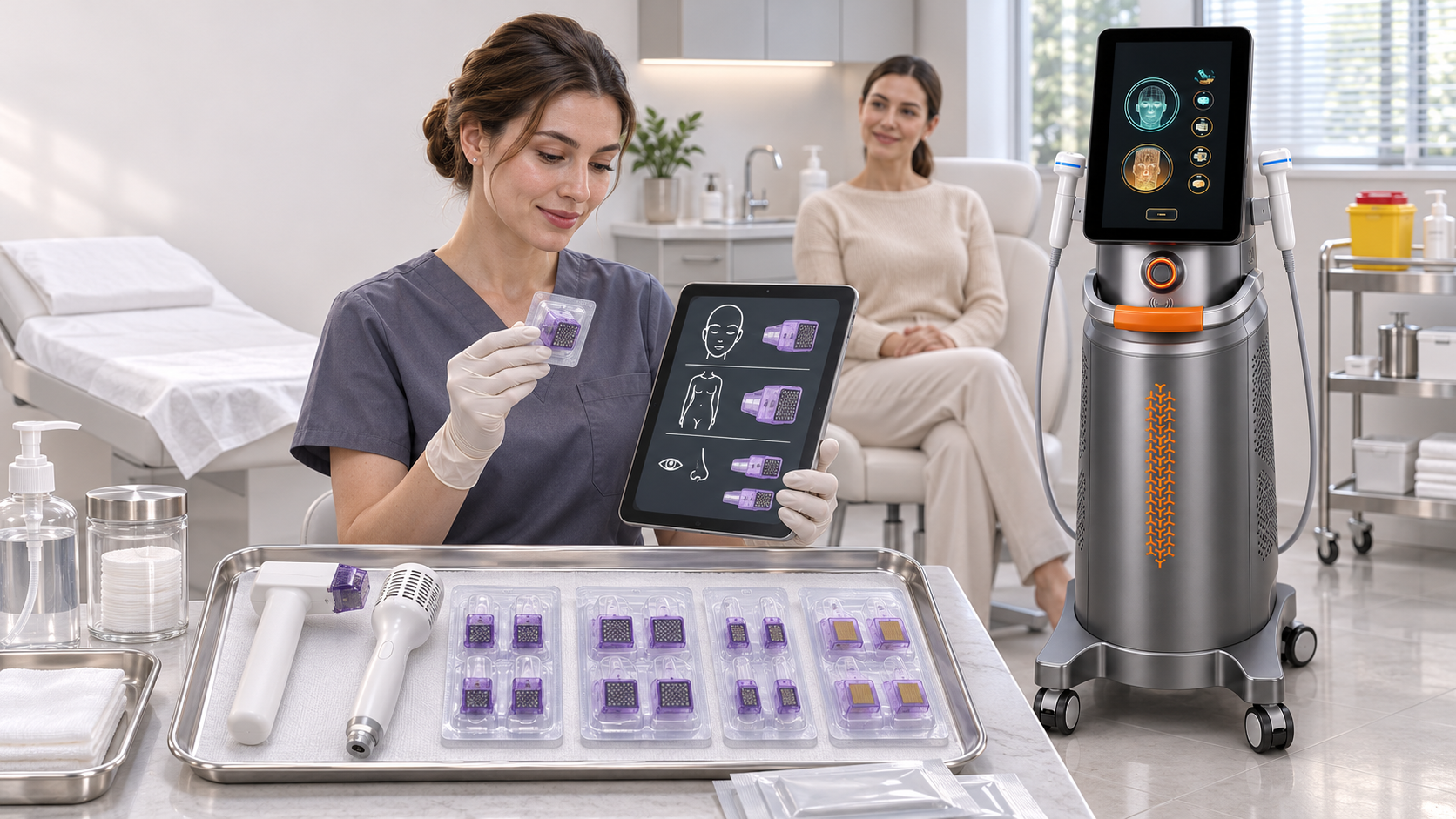
Choosing an A0157 tip is not a matter of selecting the largest needle count for the body and the smallest count for the face. The provider must first decide whether RF microneedling is authorized and appropriate, map the exact anatomical area, assess tissue and skin risk, confirm the cartridge’s intended use, and then select a tip that supports controlled coverage without exceeding the provider’s training or the device labeling.
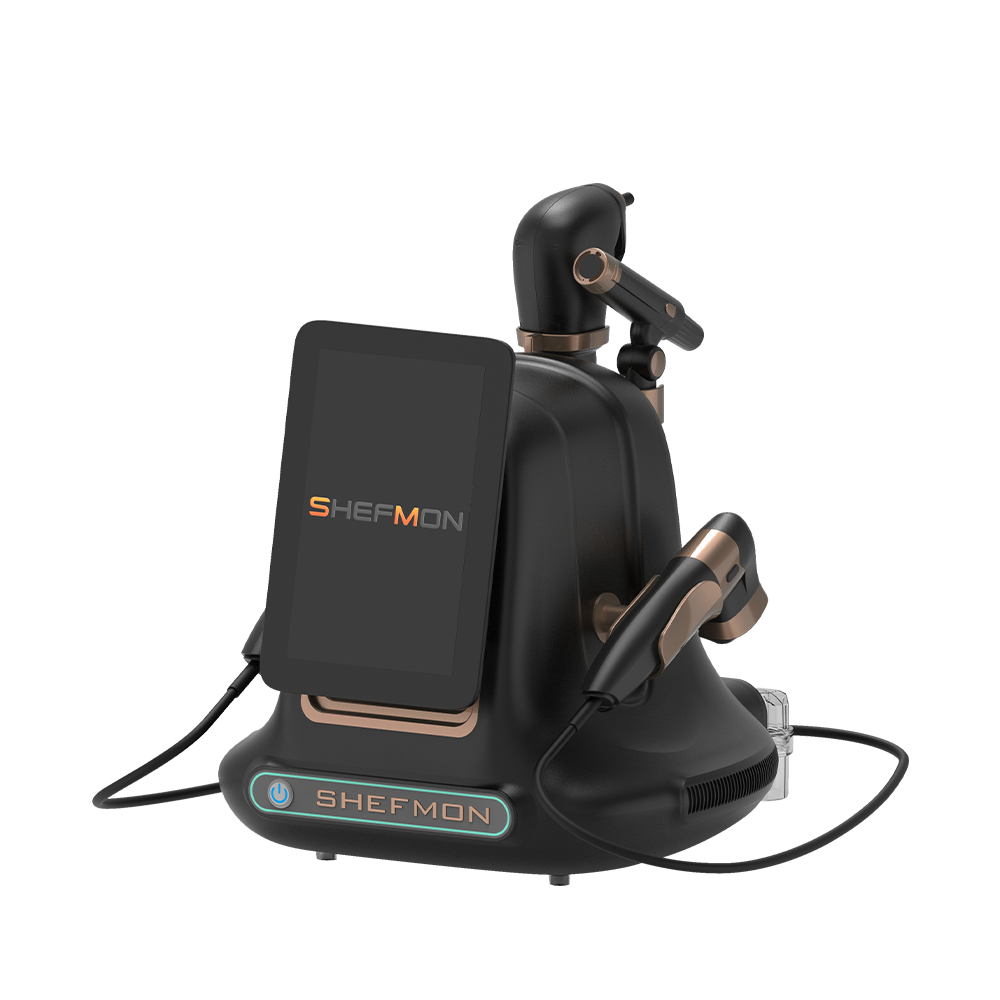
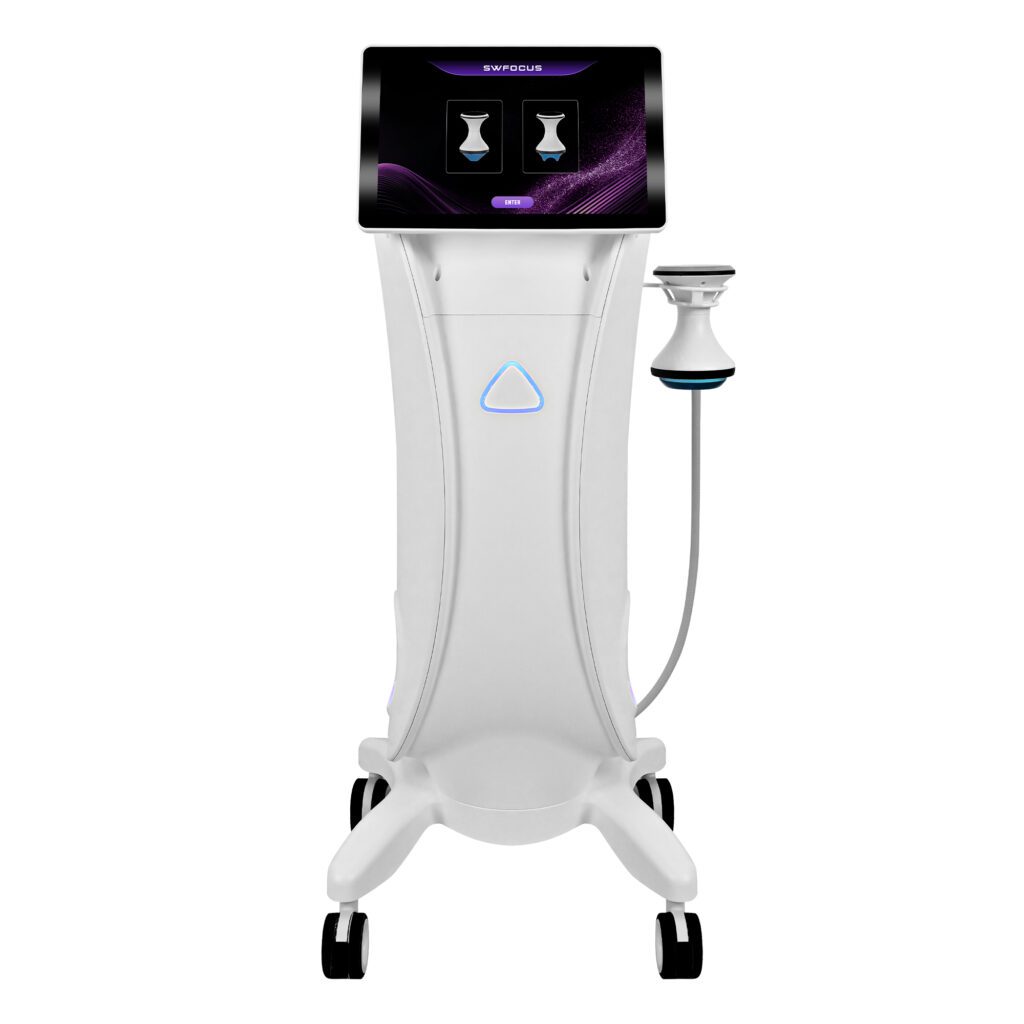
현재 SHEFMON A0157 product page lists four tip directions: Prime 12 pins, Resurfacing 24 pins, Body 40 pins, and a nanocrystalline or nano head described for sensitive-skin positioning. It also lists computerized depth control, a 1–7mm depth profile, an additional thermal profile, and face, eyes, neck/throat, arms/legs, and body as target directions.
Those product-page labels help buyers understand the configuration, but they are not area-specific treatment protocols. The page does not state each cartridge’s sterile status, single-use labeling, needle geometry, RF delivery pattern, packaging validity, or approved parameter range by anatomical zone. Those details must be confirmed for the delivered configuration before client use.
요약 보고서
- Treat 12P, 24P, 40P, and nano as four different workflow tools, not four intensity levels.
- Use 12P as the first configuration to review for smaller or anatomically constrained areas, subject to labeling and training.
- Use 24P as the first configuration to review for broader facial resurfacing-style coverage, not as a universal full-face default.
- Use 40P as the first configuration to review for larger body-area coverage, only where the manual permits the area and depth.
- Confirm whether the nano head penetrates skin, delivers RF, is sterile, and is single-use; do not assume “nano” means risk-free.
- “Sensitive area” is an anatomical and clinical risk category, not a reason to use a low setting and proceed.
- Do not treat eyelids, the lash margin, lips, mucosa, thyroid region, intimate tissue, or another high-risk zone unless the exact device labeling, local law, and professional training specifically support it.
- Use a new, sterile cartridge for each client and each session when required by the cartridge instructions and applicable regulation; never clean and reuse a single-use needle cartridge.
- Record tip type, lot, expiry, area, settings, passes, response, and disposal.
- Keep depth and RF energy selection separate from tip count. More pins do not automatically mean deeper, stronger, or better treatment.
1. Understand What the A0157 Page Actually Confirms
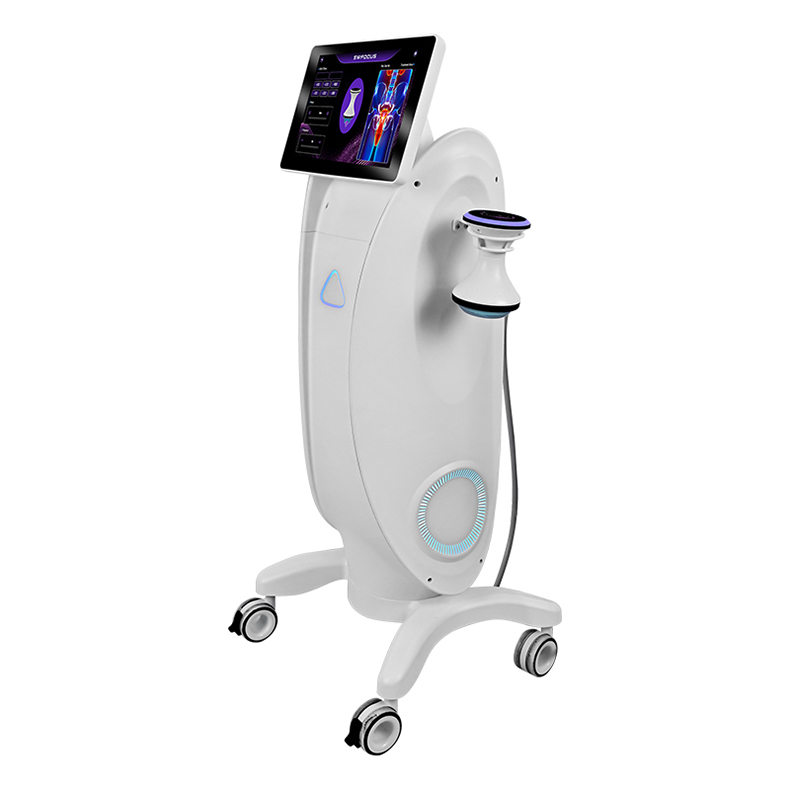
The A0157 is a vertical MNRF Depth 8 system. The public product page currently lists:
- Prime 12-pin tip;
- Resurfacing 24-pin tip;
- Body 40-pin tip;
- nanocrystalline or nano head for sensitive-skin positioning;
- computerized treatment depth;
- 1–7mm depth profile;
- an additional 1mm thermal profile;
- an isolated 0.5mm conductive-tip statement;
- face and body handpiece positioning;
- optional working-handle configurations.
These are configuration facts, not permission to use every tip at every listed depth on every body site. The number of pins describes the cartridge array. It does not define the needle diameter, exposed electrode length, insulation pattern, insertion force, delivered RF distribution, or safe depth for a particular anatomical area.
Clinics comparing the model with other systems can review the 셰프몬 MNRF 마이크로니들링 카테고리, which currently lists both A0157 and A0152. The final tip protocol must still come from the A0157 instructions and formal training for the delivered handpiece.
2. Treat RF Microneedling as a Medical Procedure Where Applicable
미국 식품의약국(FDA)의 2025년 10월 RF 마이크로니들링 안전 정보 reports serious complications with certain uses, including burns, scarring, fat loss, disfigurement, and nerve damage. It describes RF microneedling as a medical procedure and recommends a licensed healthcare provider with training and experience.
Regulation varies by country and region, but the operating principle is broadly useful: a tip-selection chart cannot substitute for professional authorization, anatomy knowledge, infection control, client assessment, and complication management.
Before offering A0157 services, document:
- who may assess and treat clients;
- which indications and anatomical areas are authorized locally;
- which A0157 cartridges are supplied and legally usable;
- how sterile cartridges are received, stored, opened, traced, and discarded;
- who selects depth, RF energy, pulse pattern, and passes;
- which areas require medical oversight or are excluded;
- the post-procedure and adverse-event pathway.
3. Tip Count, Depth, and RF Energy Are Separate Decisions
Providers should not use these concepts interchangeably.
| 결정 | What it changes | What it does not prove |
|---|---|---|
| Tip configuration | Array size, contact footprint, pin count, and likely coverage pattern | That a larger count is safer, deeper, or more effective |
| Mechanical depth | How far the needle mechanism is set to enter, as permitted by labeling | The actual tissue layer in every person or area |
| RF 설정 | Thermal energy delivered through the electrode system | That more heat produces a better result |
| Pass pattern | Coverage, overlap, and cumulative exposure | That repeated treatment is appropriate for every skin response |
| Anatomical area | Tissue thickness, mobility, vascular and nerve risk, bone proximity, and healing context | That the same face or body setting can be copied across clients |
A 40-pin tip can cover a broader footprint, but that does not authorize a deeper setting. A 12-pin tip may help access a smaller zone, but it does not make that zone low-risk. The provider must choose the cartridge first for geometry and intended use, then choose depth and RF parameters independently under the approved protocol.
4. Quick A0157 Tip-Selection Matrix
| Tip listed by SHEFMON | First area direction to review | Operational advantage | 주요 주의사항 |
|---|---|---|---|
| 12P Prime | Smaller facial zones and precise, constrained coverage | Smaller array can support controlled placement where a large footprint is impractical | Precision does not remove risk near nerves, vessels, bone, eyes, lips, or scars |
| 24P Resurfacing | Broader facial texture or resurfacing-style zones | More coverage than 12P for suitable facial areas | Do not make it the automatic full-face tip or assume all zones use one depth |
| 40P Body | Larger, flatter body areas | Broader coverage and workflow efficiency for permitted body services | Large footprint, tissue thickness, laxity, scars, stretch marks, sensation, and anatomy still require area mapping |
| Nano head | Superficial or sensitive-skin positioning only if confirmed | May support a separate non-needle or shallow-contact workflow depending on the supplied head | Confirm penetration, RF delivery, sterile status, single-use status, and intended area; “nano” is not a safety claim |
This matrix helps shortlist a cartridge. It is not a treatment prescription and does not contain depth, power, pulse, or pass recommendations.
5. Selecting A0157 Tips for the Face
The face should be divided into anatomical zones rather than treated as one flat surface.
12P for smaller or constrained facial zones
The product page labels 12P as “Prime.” It is the first cartridge to review when the provider needs a smaller footprint and more deliberate placement. Examples may include selected areas around the mouth, along contour transitions, or on limited scars where the manual and professional assessment support treatment.
The 12P tip should not be described as an “eye tip” or “lip tip” unless the delivered labeling explicitly uses that description. Small size does not authorize use on mobile eyelid tissue, the lash line, the vermilion lip, mucosa, or another excluded structure.
24P for broader facial coverage
The page labels 24P as “Resurfacing.” It is the first cartridge to review for suitable cheek, forehead, jawline, or other broader facial zones where the operator wants a more efficient coverage pattern than 12P.
The face still needs zone-specific planning. Forehead, cheek, temple, nose, upper lip, jawline, and neck do not have identical tissue thickness, mobility, vascularity, or underlying anatomy. The provider should not select one depth and RF setting merely because the same 24P cartridge remains attached.
40P is not automatically a facial efficiency upgrade
SHEFMON identifies 40P as the body tip. Do not move it to the face simply to reduce treatment time unless the delivered instructions and training explicitly support the exact area and application. A larger array can make contact and overlap harder to control on curved or narrow facial surfaces.
Nano requires a separate workflow definition
The page calls the nano option a “nanocrystalline head” or “nano needles for sensitive skin.” Before placing it in a facial menu, confirm whether it penetrates living skin, whether it delivers RF, which handpiece it fits, whether it is sterile or single-use, and what client outcome it is intended to support.
Do not call nano “RF microneedling without needles” unless the supplied instructions say so. Do not use it to push cosmetics, drugs, vitamin solutions, or blood products into skin without specific authorization. The FDA’s microneedling device information notes that microneedling devices have not been authorized for delivery of cosmetics, topical medications, vitamin solutions, drugs, or blood products into the skin.
6. Selecting A0157 Tips for the Body
The current A0157 page lists the 40P cartridge for body positioning and lists body, arms, and legs among target directions. A body service still needs a precise map.
When 40P is the first tip to review
40P may fit larger, relatively broad areas when:
- the exact area is within the device labeling and provider’s scope;
- the surface allows even cartridge contact;
- tissue thickness and underlying structures have been assessed;
- scars, stretch marks, pigmentation, vascular features, sensation, and healing history have been reviewed;
- the provider can control overlap and cumulative thermal exposure;
- the clinic has enough sterile cartridges and time for the planned coverage.
When a smaller tip may be more practical
A 12P or 24P cartridge may be considered for a small body scar, a narrow transition, or an irregular surface if the manual supports that use. The selection should be based on controllable contact and anatomy, not on a belief that body treatment always requires 40 pins.
Body areas that need stronger exclusion rules
Do not treat over or near a high-risk structure simply because the skin surface appears suitable. Create explicit policies for:
- active infection, rash, wound, or impaired healing;
- suspicious lesion, mole, or undiagnosed mass;
- keloid or problematic scar history;
- implanted medical device or metal in or near the intended field where relevant;
- altered sensation or neuropathy;
- significant vascular concern;
- recent surgery, injectable, energy procedure, radiation, or trauma;
- pregnancy or breastfeeding where the labeling, medication, or local policy excludes treatment;
- areas close to major nerves, superficial vessels, glands, breast tissue, genital tissue, mucosa, or other structures outside the approved indication.
The provider should postpone or refer rather than compensate for uncertainty with a smaller tip or lower setting.
7. Define “Sensitive Area” Before Choosing a Tip
Sensitive can mean several different things:
- thin or mobile tissue;
- proximity to bone, nerve, vessel, eye, gland, or mucosa;
- high pigmentation or increased post-inflammatory pigment risk;
- reduced sensation or unpredictable feedback;
- a history of strong inflammatory response;
- recent treatment or impaired barrier;
- a psychologically intimate or privacy-sensitive body site;
- “sensitive skin” reported by the client without a diagnosis.
These categories do not share one tip or one protocol. A client who reports sensitive skin on the cheek is different from treatment near the eye. A nano head may be relevant to the first situation if supported by labeling; it does not authorize the second.
Use three possible outcomes for sensitive areas:
- Proceed with an approved cartridge and area-specific protocol.
- Modify the treatment plan or select a non-needling alternative.
- Do not treat and obtain specialist assessment or refer.
8. Special Boundaries for Eye, Lip, Neck, and Other Delicate Zones
The A0157 page includes “eyes” and “neck/throat” in its broad target-area text. That wording is not sufficiently specific to authorize every tissue in those regions.
Periorbital area
Confirm the exact permitted boundary around the orbital rim, eyelid, lash margin, and eye. The operator needs anatomy training and eye-area instructions for the delivered handpiece. Do not infer that a 12P or nano tip makes mobile eyelid tissue suitable.
Perioral area
Distinguish skin around the mouth from the vermilion lip and oral mucosa. Do not cross into mucosa unless the device has explicit labeling and the provider is authorized for that procedure.
목과 목구멍
Map the intended lateral or posterior skin area and identify structures that the protocol excludes. “Neck/throat” on a product page should not be interpreted as permission to treat directly over the thyroid, airway, major vessels, or every anterior-neck location.
Intimate or breast areas
Do not use the face/body/nano tip matrix as an intimate-treatment protocol. These areas require specific labeling, professional scope, privacy, consent, safeguarding, and complication pathways. If the A0157 configuration is not explicitly approved for the area, exclude it.
9. Confirm Cartridge Sterility and Single-Use Status
The A0157 public page lists tip types but does not state sterile packaging, sterilization method, expiry, or single-use status. The clinic should obtain written documentation for each cartridge SKU.
The FDA advises providers not to reuse microneedling cartridges and tells clients to ask whether a new cartridge is used for each patient and each treatment session, including repeat sessions for the same patient. Reuse can transfer infectious agents.
Before opening a cartridge, verify:
- correct A0157 SKU and handpiece compatibility;
- tip type and pin count;
- intact sterile barrier, if supplied sterile;
- sterilization marking and method where applicable;
- lot or batch number;
- 만료일;
- no moisture, puncture, crushing, or seal failure;
- storage within specified conditions.
Open the package in front of the client when appropriate to the clinic policy. After use, dispose of the cartridge immediately in the locally required sharps container. Do not recap, clean, soak, autoclave, save for the same client, or return it to the tray.
If SHEFMON cannot provide sterile/single-use documentation for a needle cartridge intended to penetrate skin, the clinic should not use that cartridge until the matter is resolved under local device and infection-control requirements.
10. Use a Tip-Selection Decision Process
Step 1: Confirm authorization
Verify that the provider, device configuration, indication, and area are permitted in the destination market.
Step 2: Confirm the service objective
Define the concern and expected cosmetic outcome without promising scar removal, permanent tightening, or uniform results.
Step 3: Map the anatomical zone
Mark treatment boundaries and exclusion areas. Note tissue thickness, mobility, bone proximity, scars, pigmentation, sensation, lesions, vessels, and recent procedures.
Step 4: Screen the client
Review medical history, medications, bleeding risk, immune status, diabetes control, active infection, inflammatory skin conditions, herpes history, keloid history, pigmentation risk, pregnancy, allergies, previous procedures, and healing history as required by the manual and local clinical policy.
Step 5: Select the cartridge by footprint and intended use
Choose 12P, 24P, 40P, nano, or no treatment. Do not use pin count as a shortcut for depth.
Step 6: Verify the individual cartridge
Check SKU, packaging, sterility, lot, expiry, compatibility, and traceability before opening.
Step 7: Select depth and RF settings separately
Use the A0157 instructions, formal training, client-specific assessment, and the qualified provider’s protocol. The product page’s maximum depth and power are equipment capabilities, not starting parameters.
Step 8: Reassess after each zone
Review tissue response, client feedback, contact, cartridge performance, and device messages before moving to a new area or changing depth.
11. Tip Selection by Practical Scenario
| 대본 | First configuration to review | 왜 | When to stop or choose another plan |
|---|---|---|---|
| Small, well-defined facial zone | 12P | Smaller footprint may support precise placement | Area is too close to an excluded structure, skin is unstable, or labeling is unclear |
| Broad cheek or forehead zone | 24P | Resurfacing label and broader facial coverage | Curvature, thin tissue, pigmentation risk, or reaction requires zone modification |
| Large, flat body zone | 40P | Body label and broader coverage | Contact is uneven, anatomy is uncertain, sensation is impaired, or area is not authorized |
| Superficial sensitive-skin service | Nano, only after configuration confirmation | Separate surface-level workflow may be appropriate | Penetration/RF/sterility status is unclear or skin is actively irritated |
| Periorbital or perioral skin | 12P or nano only if specifically permitted | Smaller footprint may improve control | Eyelid, lash line, lip, mucosa, or safe boundary is not defined |
| Narrow body scar or irregular surface | 12P or 24P if labeled | A smaller footprint may fit the geometry better than 40P | Scar type, healing, keloid risk, or underlying structure is uncertain |
This table does not authorize an indication or specify a depth. The appropriate choice may be not to treat.
12. Do Not Use Tip Selection to Justify Aggressive Coverage
Common errors include:
- choosing 40P to finish faster even when full contact is difficult;
- choosing 12P near the eye and assuming the smaller array removes anatomical risk;
- using nano on inflamed or compromised skin because it sounds gentle;
- selecting the maximum depth because the body area looks thick;
- repeating passes because the first pass produced little visible reaction;
- changing the cartridge without updating the depth and RF plan;
- using one cartridge across multiple clients or saving it for the same client;
- combining MNRF with topical drugs, PRP, peels, laser, or other energy procedures without separate authorization and protocol.
The cartridge is one part of a larger dose and safety decision. Tissue response depends on geometry, depth, RF delivery, contact, overlap, passes, anatomy, client factors, and aftercare.
13. Build Tip Traceability Into the Room Workflow
Set up three cartridge zones:
- Sterile stock: closed, dry, protected, organized by SKU and expiry.
- Current client: one verified cartridge package placed on the clean procedural tray.
- Used sharps: point-of-use sharps container that does not require carrying an exposed cartridge across the room.
Do not store loose cartridges in drawers. Use first-expire-first-out stock rotation and quarantine damaged, expired, wet, unlabelled, or recalled items.
For each session, record:
- A0157 serial or asset ID;
- handpiece used;
- tip type and pin count;
- cartridge SKU, lot, and expiry;
- sterile barrier check;
- anatomical area and boundaries;
- depth and RF settings by zone;
- pass pattern and changes;
- client response and endpoint;
- adverse event or stop reason;
- cartridge disposal.
14. Cleaning the Reusable Handpiece Without Reusing the Cartridge
Remove and discard the cartridge according to its instructions before reprocessing the reusable handpiece. Prevent blood, fluid, or product from entering the handpiece connection.
Follow the A0157 manual for:
- removal sequence;
- barrier use;
- cleaning agent;
- disinfectant compatibility;
- contact time;
- parts that must remain dry;
- 구성 요소 중 어느 하나라도 물에 담글 수 있는지 여부;
- drying, inspection, and storage.
Do not spray liquid into the cartridge socket or electrical connection. Do not use an ultrasonic cleaner, autoclave, or immersion process on the handpiece unless the manufacturer explicitly permits it.
15. Consent and Aftercare Must Match the Selected Area
Consent should explain:
- the selected area and cartridge;
- why that cartridge was chosen;
- expected procedure sensations and short-term response;
- material risks and area-specific concerns;
- alternative options, including no treatment;
- that results vary and may require more than one procedure;
- photography and data choices;
- post-procedure care and urgent contact route.
Aftercare should follow the treating clinician’s protocol and product labeling. The FDA notes that skin may be more sensitive to sun and to products such as retinol, glycolic acid, menthol, capsaicin, or alcohol after microneedling. Do not use the microchannels as a reason to apply an unapproved cosmetic, drug, vitamin solution, or blood product.
Provide a written route for unexpected pain, increasing redness, blistering, pigment change, infection signs, weakness, numbness, contour change, delayed healing, or another concerning symptom.
16. Adverse Events That Require Escalation
Stop and follow the clinical escalation plan for:
- unexpected severe pain or radiating sensation;
- burning, blistering, charring, or marked swelling;
- persistent bleeding or hematoma;
- sudden blanching or unusual color change;
- motor change, weakness, numbness, or suspected nerve involvement;
- signs of infection or herpes reactivation;
- delayed healing, ulceration, worsening scar, or significant pigment change;
- unexpected fat or contour change;
- cartridge breakage, bent needles, incomplete deployment, or device fault.
The FDA safety communication specifically identifies serious reported complications with certain RF microneedling uses. Clinics should know the local device-incident and adverse-event reporting requirements and should retain the cartridge lot and device records needed for investigation.
17. Buyer Checklist for A0157 Tips and Consumables
Before ordering the A0157, request written confirmation of:
- exact 12P, 24P, 40P, and nano cartridge SKUs;
- which handpiece accepts each cartridge;
- needle material, geometry, insulation, and conductive portion;
- whether the nano head penetrates and whether it delivers RF;
- sterile status and sterilization method;
- single-use labeling;
- package integrity requirements and shelf life;
- minimum order and replacement supply;
- authorized indications and anatomical areas by cartridge;
- parameter ranges and exclusions by area;
- handpiece cleaning and disinfection;
- sharps and cartridge disposal;
- training, competency, warranty, and incident support;
- device registration or market documents needed in the buyer’s country.
Do not build a service menu around a tip name until these documents are available.
자주 묻는 질문
1. What A0157 tip is best for the face?
There is no single best full-face tip. The 12P tip is the first to review for smaller or constrained zones, while 24P is the first to review for broader facial resurfacing-style coverage. The provider must still plan each facial zone separately.
2. Is 40P only for the body?
SHEFMON labels 40P as the body tip. Use it only on areas and with protocols supported by the delivered instructions and professional training. Do not move it to the face merely to increase coverage speed.
3. Does a higher pin count mean a stronger treatment?
No. Pin count describes the cartridge array. Mechanical depth, RF setting, pulse pattern, overlap, passes, tissue contact, and anatomy are separate variables.
4. Is the nano head needle-free?
The public page calls it a nanocrystalline or nano head but does not provide enough detail to determine penetration or RF delivery. Obtain the cartridge instructions before marketing it as needle-free, non-invasive, or suitable for sensitive skin.
5. Can 12P be used around the eyes?
Only within the precise periorbital boundaries allowed by the device labeling, local scope, and the provider’s anatomy training. A smaller tip does not make the eyelid, lash margin, or eye itself suitable.
6. Can one cartridge be saved for the same client’s next session?
No. The FDA advises using a new cartridge for each client and each treatment session, including repeat treatment of the same client. A used needle cartridge should be discarded in the appropriate sharps container.
7. Can the nano head be used on irritated skin?
Not automatically. “Sensitive” does not mean actively inflamed, infected, wounded, sunburned, or recently treated skin. The provider should assess, postpone, modify, or refer as appropriate.
8. Should the body always be treated at a deeper setting than the face?
No universal rule should be applied. Depth depends on the exact area, tissue, indication, cartridge, client, labeling, and trained provider’s assessment. Maximum device depth is not a body-treatment recommendation.
9. Can serum or PRP be applied through A0157 microchannels?
Do not assume so. The FDA states that microneedling devices have not been authorized to deliver cosmetics, topical medications, vitamin solutions, drugs, or blood products into the skin. Any combination requires specific legal and clinical authorization.
10. What should a buyer confirm about A0157 tips before purchase?
Confirm SKUs, compatibility, needle design, nano-head behavior, sterile and single-use status, shelf life, packaging, authorized areas, parameter guidance, disposal, replacement supply, training, and local market documentation.
결론
A0157 tip selection starts with anatomy, authorization, and treatment purpose—not pin count. The 12P, 24P, 40P, and nano configurations can support different footprints and workflows, but none of them removes the need for qualified assessment, sterile single-use consumables, area-specific settings, continuous monitoring, and complication planning.
For face, body, and sensitive areas, the safest tip choice is the one whose intended use, sterile status, cartridge compatibility, and anatomical boundaries are fully documented. When those details are missing, the correct decision is to postpone the procedure rather than improvise.
현재 상황을 검토하세요 SHEFMON A0157 product page 그리고 셰프몬에게 연락하세요 to confirm cartridge SKUs, sterility, single-use labeling, nano-head function, supported areas, parameter training, cleaning, replacement supply, and regulatory documents.