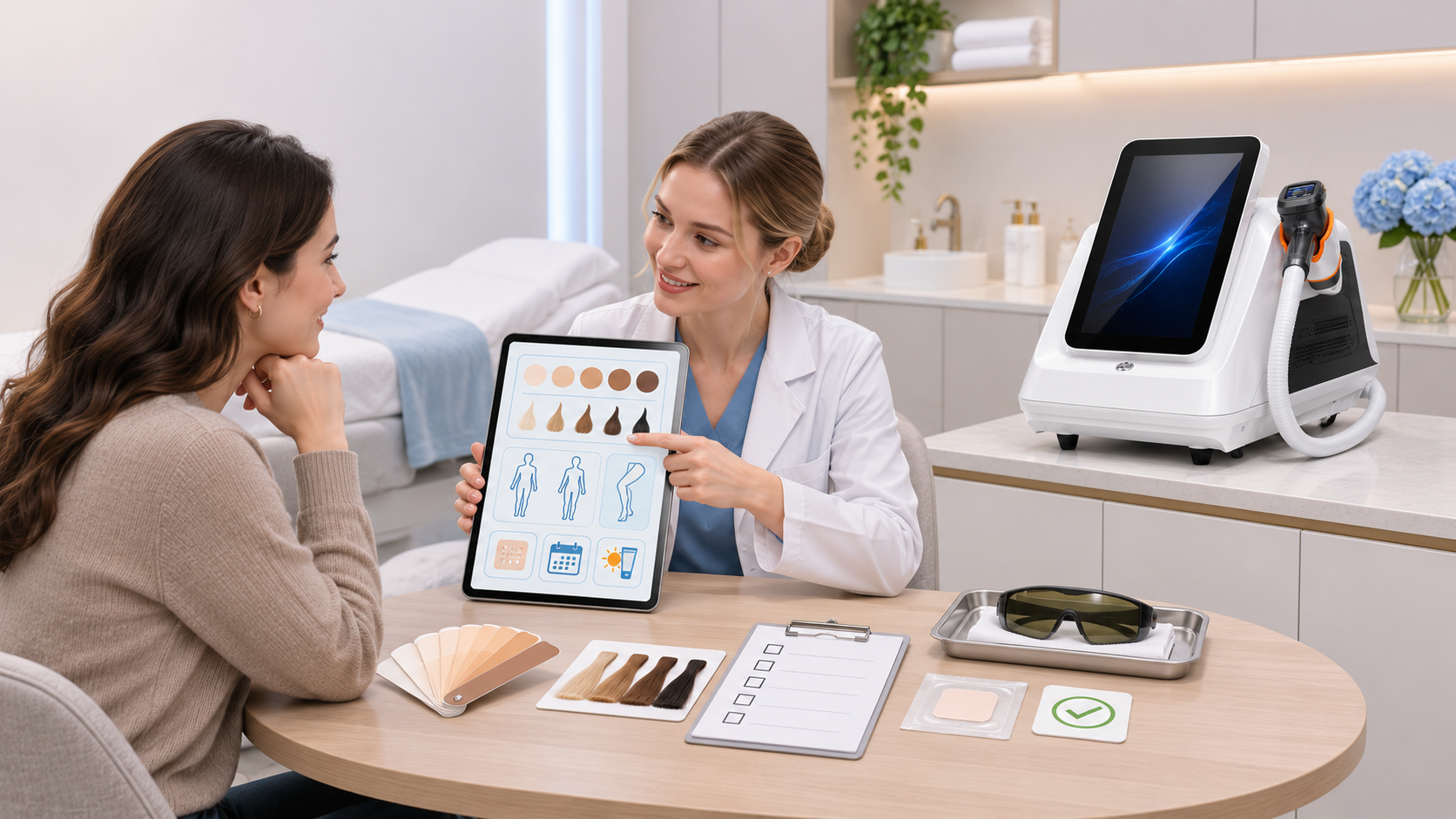
A new hair-removal client should not move directly from an online booking to the A0423 treatment bed. The first appointment must establish what the client wants, whether the hair and skin are suitable for laser reduction, whether recent tanning, medication, skin disease, or previous procedures change the risk, and whether the clinic should treat, test, postpone, request medical clearance, or refer.
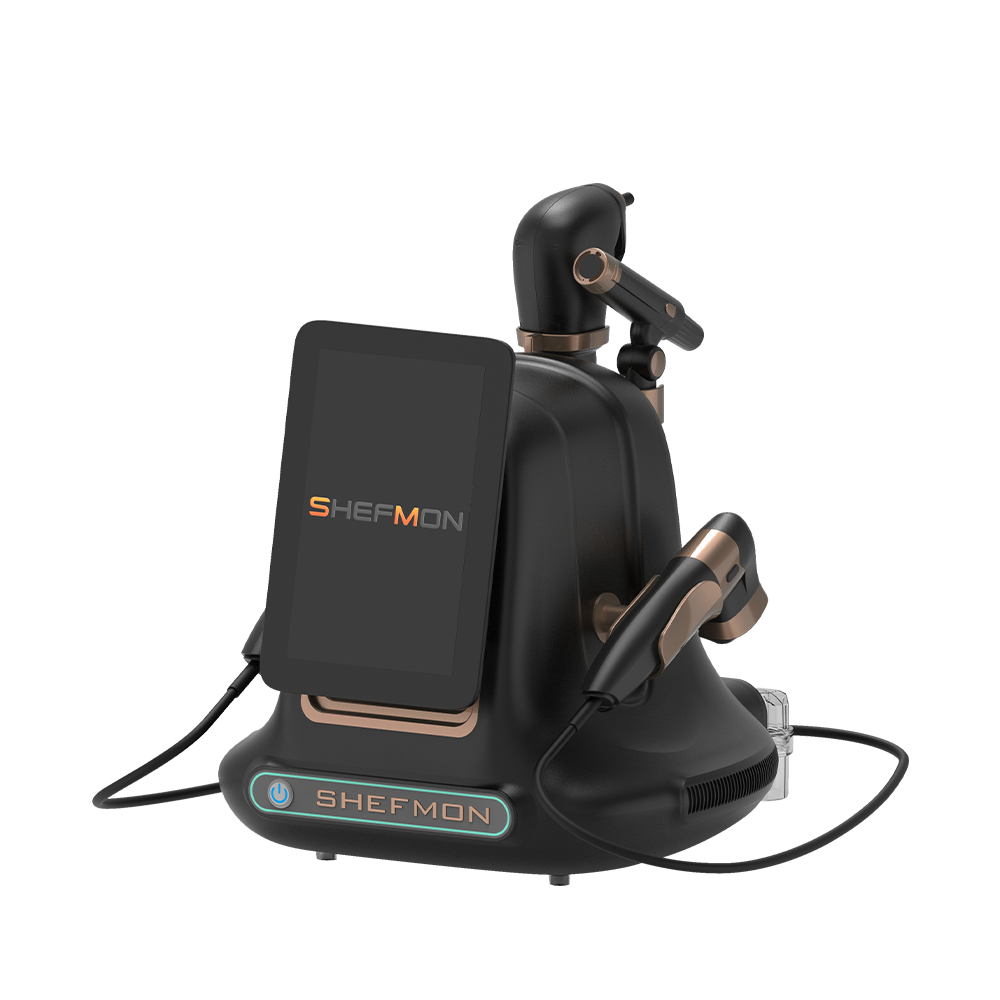
Die jetzige SHEFMON A0423 product page lists 755nm, 810nm, 940nm, and 1064nm wavelength positioning, 600W or 1200W handpiece options, three spot-size options, contact cooling, water and semiconductor cooling, and touchscreen operation. These choices give trained providers configuration flexibility. They do not make the same setting suitable for every skin tone, hair color, body area, or new client.
This guide organizes a first-client consultation for professional salons, laser studios, med spas, and clinics operating within local law. It does not provide fluence, pulse-width, repetition-rate, or treatment-interval prescriptions. The current A0423 manual, delivered configuration, professional training, and local authorization must control those decisions.
Zusammenfassung
- Treat the first appointment as a suitability decision, not a sales formality.
- Confirm the exact treatment area, client goal, previous hair-removal method, and expected outcome.
- Assess current visible skin tone, tanning and sun exposure, hair color, density, coarseness, and contrast.
- Ask about all medications, supplements, photosensitizing products, isotretinoin history, skin disease, scarring, herpes, recent procedures, and previous laser reactions.
- Map tattoos, permanent makeup, pigmented lesions, wounds, infection, and other areas that must be avoided or medically assessed.
- Explain that light, white, gray, or red hair may respond poorly because laser hair reduction depends on an appropriate target.
- Use a test spot when required by labeling, regulation, clinic policy, skin profile, medication history, area, or operator judgment; do not invent a universal observation period.
- Protect everyone in the laser room with wavelength-appropriate eyewear and control room entry.
- Give five possible outcomes: proceed, test first, postpone, obtain clearance, or decline/refer.
- Record the delivered handpiece configuration, selected area, skin and hair observations, test spot, consent, photos, planned settings, and follow-up.
1. Define the Consultation Outcome Before the Client Arrives
The consultation should end with one documented outcome:
- Suitable to proceed under the approved protocol.
- Suitable for a test spot before full treatment.
- Postpone because of a temporary issue, such as recent tanning, active irritation, incompatible hair-removal preparation, or unresolved product use.
- Request medical or prescribing-professional clearance because a medication, condition, or recent procedure cannot be cleared within the operator’s scope.
- Decline or refer because the hair, area, skin condition, expectations, or professional boundary makes A0423 inappropriate.
This prevents the consultation from becoming a scripted path toward payment. A responsible clinic expects some new clients not to start immediately.
2. Confirm the A0423 Configuration Used by the Clinic
The product page presents several options. Before writing the consultation form, the clinic must know what it actually owns.
Aufzeichnen:
- Modell- und Seriennummer;
- Wellenlängenkonfiguration;
- whether 940nm is included or optional in the delivered handpiece;
- handpiece power option;
- available spot size or sizes;
- cooling configuration and contact surface;
- software version and preset labels;
- protective eyewear optical-density and wavelength specifications;
- handpiece service life, maintenance, and replacement process;
- voltage, water-system, and pre-use checks;
- current manual and local market documentation.
Do not tell a client that the clinic will select among four independent wavelengths unless the delivered A0423 configuration actually allows that selection. A combined multi-wavelength handpiece and separate wavelength modes are not the same workflow.
Buyers comparing related models can review SHEFMON’s Kategorie Haarentfernung, which currently lists A0423 and A0426.
3. Use a Private, Structured First-Client Journey
A practical new-client flow is:
- Collect limited pre-visit information.
- Verify identity, age, consent capacity, and treatment-area privacy needs.
- Clarify the client’s goal and treatment history.
- Review health, medication, sun, skin, and procedure history.
- Examine and document the proposed area.
- Assess hair characteristics and realistic laser target potential.
- Identify exclusions, referral needs, and protective measures.
- Explain the A0423 process, risks, alternatives, and limitations.
- Decide whether a test spot or full treatment is appropriate.
- Document consent, photos, plan, aftercare, and follow-up.
Sensitive-area consultations should occur in a private room. The client should choose whether a support person is present, subject to safeguarding policy. The clinic should offer a chaperone where appropriate and explain who will see or touch the treatment area before clothing is adjusted.
4. Collect Only Useful Pre-Visit Information
The booking form can ask:
- proposed area;
- whether this is the first laser hair-removal experience;
- recent tanning, sunburn, or use of sunless tanning products;
- current medication or recent medical treatment;
- active skin irritation, infection, wound, or outbreak in the area;
- previous reaction to laser, IPL, waxing, or hair-removal products;
- preferred contact method and accessibility needs.
Do not ask the client to make a medical suitability decision online. “No contraindications” is not an adequate intake question. The qualified operator must review details privately.
5. Clarify the Client’s Goal and Expectations
Ask the client what reduction means to them:
- fewer coarse hairs;
- slower or patchier regrowth;
- less frequent shaving;
- management of ingrown-hair appearance;
- reduction in a specific area;
- maintenance after previous laser treatment.
Explain that laser is generally positioned for long-term hair reduction rather than guaranteed permanent removal of every hair. Response depends on hair pigment, thickness, growth cycle, skin pigment, body area, hormones, previous methods, settings, and adherence to the plan.
Die Amerikanische Akademie für Dermatologie laser hair-removal FAQs explains that results vary and that multiple treatments may be required. Avoid guaranteeing a session count or maintenance-free result during the first consultation.
6. Assess Hair Before Assessing Machine Settings
Document the untreated or recently regrown hair where possible:
- color;
- coarseness;
- density;
- distribution;
- depth impression;
- body area;
- signs of irritation or ingrown hairs;
- recent shaving, trimming, waxing, threading, plucking, epilation, or depilatory use.
Laser hair reduction depends on an appropriate light-absorbing target. White and gray hair generally lack useful melanin, and very light blond or red hair may respond poorly or unpredictably. Do not sell a course simply because the A0423 page uses broad “all hair colors” language.
If hair growth is sudden, rapidly increasing, unusually patterned, or accompanied by other symptoms, the consultation should include an appropriate medical-referral discussion rather than a promise that laser will solve the cause.
7. Assess Current Skin, Not Only a Stored Skin-Type Label
A Fitzpatrick phototype or another classification can support communication, but it should not replace direct assessment.
Aufzeichnen:
- natural baseline skin tone as reported and observed;
- current visible pigmentation;
- recent tan or sunburn;
- sunless tanner, bronzer, or tinted product;
- freckles, lentigines, moles, birthmarks, tattoos, and permanent makeup;
- redness, inflammation, rash, infection, broken skin, or active cold sore;
- scar and keloid history;
- history of post-inflammatory hyperpigmentation or hypopigmentation;
- sensitivity and healing after previous procedures.
Do not select a wavelength or preset from ethnicity alone. People with similar identity or baseline phototype can have different current tans, pigment patterns, medication histories, hair targets, and treatment risks.
8. Ask About Sun, Tanning, and Heat Exposure
Recent tanning changes the relationship between hair pigment and skin pigment and can increase the risk of an unwanted skin response. Ask specifically about:
- outdoor sun exposure;
- tanning beds or lamps;
- sunburn;
- vacation or outdoor work;
- self-tanning products;
- planned high-sun events after treatment.
The AAD’s laser hair-removal preparation guidance tells clients to disclose a recent tan, avoid tanning, avoid sunless tanners, and protect skin from the sun. The clinic should set its postponement and pre-care periods from the treating professional’s protocol, device labeling, and local rules rather than copying an arbitrary number from marketing material.
9. Review Medication, Supplements, and Recent Care
Ask for all prescription medicines, over-the-counter medicines, supplements, topical products, and recent changes. The operator should not ask only, “Are you taking photosensitizing medication?” because clients may not know which products qualify.
Pay particular attention to:
- isotretinoin and other acne treatment;
- antibiotics and other potentially photosensitizing drugs;
- anticoagulants or products affecting bruising;
- immunosuppressive treatment;
- hormonal treatment;
- topical retinoids, exfoliating acids, bleaching products, or irritating actives;
- anesthetic allergy if topical numbing is within scope;
- recent steroid, chemotherapy, radiotherapy, or other specialist care;
- medication prescribed for a skin condition in the area.
Do not create a universal medication stop list. The clinic should never tell a client to stop prescribed medication without the prescribing professional. When compatibility is unclear, postpone and request appropriate clearance.
10. Review Medical and Skin History
The manual and local clinical policy should determine the final screen. A consultation commonly needs to cover:
- pregnancy or breastfeeding policy;
- seizure or light-triggered seizure history;
- diabetes and healing concerns;
- immune suppression;
- bleeding or clotting disorder;
- active cancer or current cancer treatment;
- implanted electronic or medical devices where relevant;
- active infection or fever;
- eczema, psoriasis, vitiligo, dermatitis, or another skin condition;
- herpes or cold-sore history;
- keloid or abnormal scarring;
- current suspicious lesion or changing mole;
- reduced sensation or neuropathy;
- previous burns, blistering, pigment change, paradoxical hair growth, or scarring after light-based treatment.
The consultation form should not turn these answers into automatic diagnosis. It should route the client to proceed, test, postpone, clearance, or referral.
11. Ask About Previous Hair-Removal and Laser Experience
Dokumentieren:
- previous device type if known;
- Behandlungsbereich;
- approximate date of the last session;
- settings or clinic record if available;
- immediate and delayed skin response;
- hair reduction achieved;
- adverse effects;
- reason for changing provider;
- recent waxing, threading, plucking, epilation, depilatory cream, or shaving.
Do not assume that tolerance of IPL or another diode laser proves tolerance of A0423. Wavelength configuration, spot size, pulse, cooling, technique, maintenance state, and skin condition may differ.
Hair removed from the root may reduce the target available to laser. The provider should give a preparation plan based on the approved protocol, without imposing an unverified universal waiting period.
12. Map the Exact Treatment Area and Exclusions
Use a body diagram and, with separate consent, standardized photographs. Mark:
- treatment boundaries;
- right or left side;
- tattoos and permanent makeup;
- moles, dark lesions, birthmarks, or suspicious areas;
- wounds, irritation, bruising, or infection;
- scars and recent procedure sites;
- areas with reduced sensation;
- areas that cannot be safely accessed or protected;
- intimate boundaries and client privacy preferences.
Do not fire the A0423 directly over tattoos, permanent makeup, or pigmented lesions unless the exact device labeling and qualified professional’s protocol explicitly support that application. A dark target can absorb laser energy unexpectedly. Suspicious lesions should be medically assessed, not concealed with a laser-service note.
13. Assess Face and Hormone-Influenced Areas Carefully
Facial hair can be fine, mixed in color, hormonally influenced, or close to pigment and sensitive structures. Before accepting a facial hair-removal package:
- confirm the hair is a plausible laser target;
- distinguish terminal coarse hair from fine vellus hair;
- document hormonal or medical history within scope;
- discuss realistic reduction and maintenance;
- define the boundary around eyebrows, eyes, nostrils, lips, ears, and hairline;
- discuss the possibility of unexpected or paradoxical hair response where relevant to the provider’s training and consent policy.
Do not laser eyebrows or work near the eye merely because the spot size is small. Ocular protection and device-specific exclusion zones must control.
14. Explain Eye Protection and Laser-Room Controls
Everyone in the treatment room must use protective eyewear appropriate to the delivered wavelength or wavelength range. Ordinary sunglasses, cosmetic eye shields, or eyewear designed for another laser are not substitutes.
Die Konsultation sollte Folgendes erläutern:
- why the client must keep approved eyewear in place;
- that the operator and any authorized observer also require protection;
- that room entry is controlled while the laser is enabled;
- that reflective jewelry or objects may need to be removed or controlled;
- how intimate-area privacy and chaperone access will be managed without compromising laser safety.
The AAD notes that laser treatment should occur in a room set up for the procedure and that everyone in the room must wear protective eyewear. Verify the eyewear optical density and wavelength coverage for the actual A0423 handpiece, not merely the model family.
15. Decide Whether a Test Spot Is Needed
A test spot can help the provider evaluate contact, cooling, immediate skin response, client sensation, and delayed response before treating a larger area. It may be required by local regulation, device labeling, insurer policy, clinic protocol, or professional judgment.
Consider a test spot when:
- the client is new to laser;
- the clinic is treating a new area;
- the skin is darker, recently changed, or has a history of pigment response;
- the client has a previous adverse reaction;
- medication or product history has been cleared but warrants caution;
- the operator is using a new handpiece, configuration, or approved protocol;
- the hair/skin contrast or treatment endpoint is uncertain.
Document the exact site, configuration, spot size, settings, cooling, number of pulses, immediate response, client feedback, and review outcome. Follow the approved observation period. Do not promise that a normal test spot eliminates the possibility of a later adverse event.
16. Separate Consultation Consent From Treatment Consent
The client should not sign one broad form that combines consultation, treatment, photography, marketing, and data sharing.
Treatment consent should cover:
- the selected area;
- expected process and sensations;
- realistic reduction rather than guaranteed permanent removal;
- need for a course and possible maintenance;
- common expected short-term responses;
- possible burns, blistering, infection, scarring, pigment change, herpes reactivation, and other material risks relevant to the area and client;
- eye protection and room rules;
- alternative hair-removal methods and no treatment;
- right to stop and ask questions;
- aftercare and urgent contact route.
Use separate voluntary choices for clinical photography, marketing images, testimonial use, reminder messages, and communication with another provider.
17. Give Clear Pre-Treatment Instructions
Provide written instructions tailored to the client and planned date. They may include:
- avoid tanning and sunless tanning as directed;
- use sun protection according to professional advice;
- follow the clinic’s permitted shaving or trimming instructions;
- avoid waxing, plucking, threading, or epilation for the period stated by the approved protocol;
- arrive with the area clean and free from deodorant, fragrance, makeup, oil, or active product if instructed;
- report medication, illness, rash, cold sore, sun exposure, or skin changes before arrival;
- do not apply numbing cream unless the treating provider has specifically approved the product and method.
Do not advise the client to stop medication or apply an anesthetic casually. These decisions may require a licensed prescriber and can alter the client’s ability to report excessive heat or pain.
18. Document a New-Client A0423 Plan
The first-client record should include:
- identity, age and consent status;
- operator and professional role;
- client goal and proposed area;
- hair color, coarseness, density, distribution, and removal history;
- baseline and current visible skin tone;
- tan, sun exposure, and sunless-tanner history;
- relevant medical, medication, skin, scarring, and procedure history;
- tattoos, lesions, scars, wounds, and excluded zones;
- photographs and consent status;
- exact A0423 handpiece, wavelength configuration, and spot size available;
- test-spot decision and record;
- proceed, test, postpone, clearance, or referral outcome;
- consent and information provided;
- pre-care, planned date, and follow-up.
When treatment begins, add the device serial number, handpiece ID, settings, cooling, area map, pulse count if available, endpoint, skin response, and aftercare.
19. Use Neutral Scripts for Difficult Consultation Outcomes
When the hair is unlikely to respond well
“The hair in this area has limited pigment, so a diode laser may not provide the reduction you expect. We do not recommend selling a course until the provider has discussed alternatives with you.”
When the client is recently tanned
“Your current skin color is different from your baseline, which can change laser risk. We will postpone and reassess after the interval set by our clinical protocol.”
When medication needs clarification
“We cannot confirm compatibility within this consultation. Please do not stop the medication. We will postpone and request guidance from the prescribing professional if appropriate.”
When a lesion needs assessment
“This area needs medical assessment before laser. We will exclude it and postpone treatment if we cannot create a safe boundary.”
These scripts keep the decision professional without diagnosing or blaming the client.
20. Consultation Checklist for Staff
Identity and goals
- Verify identity, age, consent capacity, area, goal, privacy, and chaperone preferences.
- Confirm whether the client understands reduction, courses, and maintenance.
Hair and skin
- Record hair color, coarseness, density, distribution, and previous removal.
- Record baseline and current skin tone, tan, sunburn, pigment, scars, lesions, and irritation.
Health and treatment history
- Review medication, supplements, topical actives, medical conditions, pregnancy policy, herpes, scarring, healing, and previous procedures.
- Review previous laser or IPL response.
Laser safety
- Confirm exact A0423 handpiece configuration, room readiness, cooling, and wavelength-appropriate eyewear.
- Map tattoos, permanent makeup, lesions, and excluded areas.
Decision and records
- Select proceed, test, postpone, clearance, or refer.
- Complete separate treatment, photography, communication, and marketing choices.
- Provide written preparation and aftercare information.
21. Buyer Checklist for a Consultation-Led A0423 Service
Before launching, confirm with SHEFMON:
- exact wavelength arrangement and whether 940nm is included;
- handpiece power and spot size supplied;
- correct fluence and pulse units in the final manual;
- skin-type and area-specific training materials;
- test-spot guidance;
- cooling and contact procedure;
- optical-density and wavelength range required for eyewear;
- eye-area and tattoo exclusion zones;
- contraindications, precautions, and expected endpoints;
- water-system checks and handpiece maintenance;
- fault, burn, and adverse-event response;
- warranty, spare parts, shot-life verification, and service support;
- documents required for the destination country.
The public page’s technical fields and universal-suitability claims should not be copied directly into a client protocol. Confirm the final delivered specification in writing.
Häufig gestellte Fragen
1. Can a new client receive A0423 treatment on the consultation day?
Only if local rules, device labeling, clinic policy, full screening, consent, room safety, and any test-spot requirements permit it. Some clients should be tested, postponed, cleared, or referred instead.
2. What should the operator assess first: skin type or hair type?
Both are essential. The operator should document current skin pigment and tanning as well as hair color, coarseness, density, area, and recent removal method before choosing any setting.
3. Does A0423 work on white or gray hair?
White and gray hair generally lack the melanin target needed for laser hair reduction. Very light blond or red hair may also respond poorly. The clinic should not sell a course without realistic assessment.
4. Is 1064nm automatically safe for every dark-skinned client?
No. Wavelength is only one factor. Current skin tone, tanning, area, hair, pulse, cooling, operator skill, medical history, and device configuration all affect suitability and risk.
5. Why ask about medication if treatment is only on the skin?
Some medicines and topical products can affect light sensitivity, healing, bruising, or skin response. The clinic should review all products and seek professional clearance when compatibility is uncertain.
6. Must every new client have a test spot?
Follow local regulation, the A0423 instructions, insurer requirements, and clinic protocol. A test spot is especially relevant when response is uncertain, but no universal observation period should be invented.
7. Can the laser be fired over a tattoo or permanent makeup?
Do not assume so. Pigment may absorb laser energy and create an unwanted response. Map and exclude these areas according to the device labeling and qualified provider’s protocol.
8. What eyewear is required for A0423?
Everyone in the controlled room needs eyewear whose optical density and wavelength coverage match the actual delivered handpiece. Ordinary sunglasses or eyewear for another laser are not sufficient.
9. Should the client stop prescribed medication before treatment?
The clinic should not tell a client to stop prescribed medicine without guidance from the prescribing professional. Postpone and request clarification when needed.
10. What must be documented after the first consultation?
Document hair and skin assessment, tanning, medication and health history, previous treatment, mapped exclusions, A0423 configuration, test-spot decision, consent, photographs, outcome, preparation instructions, and follow-up plan.
Abschluss
The A0423 consultation is the control point for the entire hair-removal course. A qualified provider should determine whether the hair offers a realistic target, whether the current skin condition and health history allow treatment, which areas must be excluded, whether a test spot is required, and whether the appropriate outcome is to proceed, postpone, seek clearance, or refer.
Multi-wavelength positioning and strong cooling do not replace individual assessment. A consultation-led service protects the client, helps the operator select a defensible protocol, and prevents the clinic from selling unsuitable courses based on broad marketing claims.
Überprüfen Sie die aktuelle SHEFMON A0423 product page Und Kontaktieren Sie SHEFMON to confirm the delivered wavelength configuration, handpiece, spot size, laser eyewear requirements, test-spot guidance, contraindications, manual, training, and technical support.