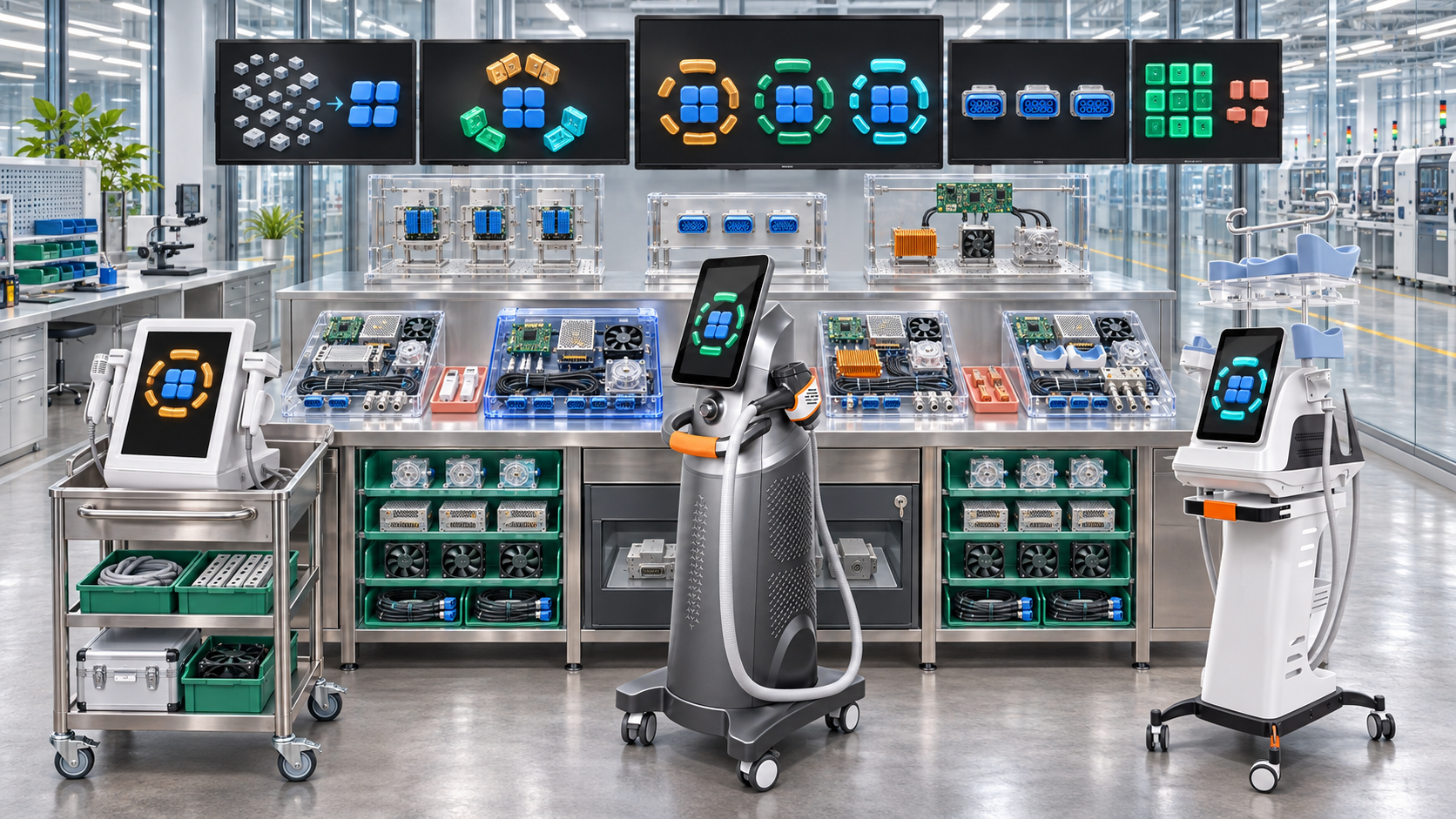
Beauty device portfolios often become complex one small decision at a time. A new market asks for another plug. A distributor requests a different display. A supplier offers a slightly cheaper pump. One model uses a new connector, another receives a custom control board, and a third keeps an older handle because service stock already exists. Each decision may be reasonable alone, yet the portfolio gradually accumulates duplicate parts, software builds, suppliers, work instructions, tests, labels, service kits, and compatibility questions.
Shared components can reduce this complexity, but only when they replace genuine duplication and operate within controlled requirements. Simply forcing one part into many products can move complexity into software, adapters, oversized hardware, exceptions, and field-service risk.
This guide explains how beauty device factories can use shared components to simplify product structures, sourcing, production, quality control, configuration, and after-sales support. It focuses on measurable complexity reduction rather than pursuing a high common-parts percentage as an isolated target.
Zusammenfassung
A practical complexity-reduction program should:
- Measure complexity before standardizing. Count active parts, revisions, suppliers, variants, software builds, tests, documents, service items, and exceptions.
- Separate customer variety from internal complexity. Buyers can receive meaningful options while the factory reuses stable internal modules.
- Find duplicate functions, not only duplicate descriptions. Different part numbers may perform the same job, while identical names can hide different requirements.
- Use controlled reuse classes. Distinguish portfolio-common parts, shared infrastructure modules, category-family parts, and model-specific content.
- Standardize interfaces before modules. Stable mechanical, electrical, thermal, fluid, communication, and software boundaries enable future simplification.
- Rationalize parts through evidence. Select a preferred part only after requirements, suppliers, validation, production, service, and lifecycle impacts are reviewed.
- Simplify configuration and BOM logic. One shared module should not create uncontrolled option combinations or duplicate 100% BOMs.
- Reduce operational artifacts. Common parts should eliminate redundant inspections, fixtures, software loaders, work instructions, packaging, and spare identities where justified.
- Control concentration and change risk. A defect or shortage in one shared part can affect many models.
- Track net complexity. Savings are real only when exceptions, adapters, regression tests, obsolete stock, and service burden also decline.
The objective is not maximum commonality. It is the lowest sustainable complexity that still supports product performance, market needs, serviceability, and differentiation.
1. What Product Complexity Means for Beauty Devices
Product complexity includes more than the number of models in a catalog. It appears across:
- part numbers and revisions;
- suppliers and manufacturing sites;
- product variants and option combinations;
- hardware and software configurations;
- handles, applicators, accessories, and consumables;
- regional cords, labels, languages, and manuals;
- BOMs and work instructions;
- fixtures, tests, and calibration methods;
- packaging structures;
- service parts and tools;
- warranty and installed-base records; and
- exceptions, deviations, and custom customer content.
A portfolio with ten models can be simpler than one with four models if the ten use stable modules and the four contain many undocumented differences.
2. Separate External Variety from Internal Complexity
External variety is what the buyer sees: model position, treatment functions, handle package, language, region, branding, and commercial bundle. Internal complexity is what the factory must source, build, verify, stock, document, and support.
The goal is often to preserve valuable external variety while reducing unnecessary internal variation. For example:
- several product workflows can use one approved display platform;
- several regional offers can share one core machine and differ late in cords, labels, manuals, or software language;
- several models can use one power-entry family while retaining technology-specific power conversion;
- several treatment packages can use a stable console with controlled handle modules; and
- several service procedures can use common diagnostics while keeping model-specific acceptance limits.
Variety should remain where customers value it or technical requirements demand it. Hidden duplication should not remain merely because it has always existed.
3. Identify the Main Sources of Complexity
| Complexity source | Typical symptom | Possible shared-component response |
|---|---|---|
| Duplicate parts | Similar pumps, fans, displays, fasteners, or cables have separate part numbers | Compare requirements and select preferred parts where truly interchangeable |
| Uncontrolled variants | Each market or customer receives a copied BOM | Use a common base with controlled regional or customer overlays |
| Supplier fragmentation | Similar components come from many suppliers and sites | Consolidate approved sources while protecting continuity |
| Software proliferation | Nearly identical hardware uses many full software builds | Share platform services and separate controlled product parameters |
| Production duplication | Each model has unique fixtures and tests | Reuse module tests and fixtures within defined interfaces |
| Service proliferation | Every model has separate spare identities for similar modules | Create common service assemblies where compatibility is proven |
| Documentation duplication | Manuals and instructions repeat common content with inconsistent edits | Use controlled common modules plus product-specific sections |
| Packaging variation | Similar products use unrelated materials and pack methods | Standardize materials and design rules while validating model-specific packs |
The response should remove the root cause, not only rename parts.
4. Establish a Complexity Baseline
Before rationalization, record:
- active products, variants, configurations, and options;
- active part numbers and revisions;
- duplicate or near-duplicate component families;
- approved manufacturers, sites, and suppliers;
- software builds and parameter packages;
- work instructions, fixtures, tests, and calibration methods;
- packaging BOMs;
- service parts and tools;
- inventory value and slow-moving stock;
- engineering changes and exceptions;
- quality and service issues linked to configuration mistakes; and
- staff time spent maintaining variants.
Use one defined period and lifecycle scope. Obsolete parts retained only for legacy service should not be mixed with active production complexity without labeling their role.
5. Build a Complexity Map by Product Family
A useful map places products on one axis and component or process domains on the other. Domains can include:
- enclosure and mechanical structure;
- power entry and conversion;
- display and computing;
- Steuerelektronik;
- cooling and thermal management;
- fluid and vacuum;
- motors and motion;
- treatment-energy generation;
- Griffe und Applikatoren;
- Software und Sprache;
- Verpackung; und
- service tools.
Mark each domain as common, shared by a subset, category-specific, model-specific, or custom. This reveals where complexity is concentrated and where rationalization can produce the greatest operational value.
6. Use Four Reuse Classes
Portfolio-common parts
The same controlled part is valid across several categories or families. Candidates may include selected fasteners, power-entry parts, displays, fans, standard cables, wheels, packaging materials, or generic service tools.
Shared infrastructure modules
A module supports several products within a defined capacity and interface envelope. Examples may include computing, communication, diagnostic, or base power modules.
Category-family parts
The part is common within facial, hair-removal, or body equipment but remains bounded by category-specific loads and interfaces.
Model-specific parts
The item provides necessary performance, differentiation, calibration, treatment function, or customer content for one product or configuration.
This structure reduces pressure to make every repeated component universal.
7. Rationalize by Function, Not Name
Start with functional groups such as:
- air movement;
- low-voltage power;
- touch display;
- liquid pumping;
- vacuum generation;
- temperature sensing;
- cable interconnection;
- mechanical support;
- motion; and
- treatment output.
For each group, compare requirements, actual use, supplier data, failures, and lifecycle status. Two items with different descriptions may be interchangeable. Two items with the same description may differ in materials, firmware, tolerance, rating, or process.
The outcome can be:
- retain both parts;
- select one preferred part;
- create a common higher-level assembly;
- retain separate parts but standardize the interface;
- redesign future products around one family; or
- postpone consolidation until evidence improves.
8. Create a Preferred-Part Library
A preferred-part library can include:
- internal part number and revision;
- controlled specification;
- approved manufacturers, sites, and suppliers;
- operating envelope;
- approved product families;
- Lebenszyklusstatus;
- criticality and supply risk;
- incoming and production controls;
- software or calibration dependencies;
- service identity;
- alternate-source status; and
- Eigentümer und Datum der Überprüfung.
New designs should check this library before creating a part. Engineers can still request a new item when requirements justify it, but the exception should be documented.
9. Use New-Part Introduction Gates
Before approving a new part number, ask:
- Does an approved part already meet the requirement?
- Can the requirement be adjusted without reducing product value or safety?
- Is the difference visible and valuable to the customer?
- Does the new part need unique software, tooling, inspection, packaging, or service support?
- Is the supplier stable and lifecycle appropriate?
- What existing inventory could become obsolete?
- Can the new function be handled by configuration or software?
- Will the part become a standard option, a category part, or a customer-specific item?
The gate should prevent casual duplication without blocking necessary innovation.
10. Standardize Interfaces before Forcing Common Modules
Interface standards can cover:
- mounting points and envelopes;
- connector families and keying;
- voltage and current ranges;
- grounding and protection;
- communication protocols;
- module identification;
- cooling, airflow, pressure, vacuum, and flow;
- software services and data structures;
- calibration ownership;
- diagnostics; and
- service access.
Stable interfaces let different modules coexist without requiring immediate full commonality. They also make future consolidation or alternate sourcing easier.
11. Prevent Common Connectors from Creating Wrong Combinations
Connector standardization can reduce part numbers but increase misconnection risk. Use:
- mechanical keying;
- color and label coding;
- unique pin assignments where needed;
- electronic module identity;
- software whitelists;
- power disabled until recognition;
- configuration rules; and
- production and service verification.
The same connector shell should not imply that every facial, laser, RF, vacuum, or body applicator is interchangeable.
12. Simplify the BOM Architecture
A complexity-reducing BOM can use:
- shared subassemblies with controlled revisions;
- model-specific parent BOMs;
- a configurable 150% family structure;
- exact 100% production BOMs;
- regional overlays;
- customer delta BOMs;
- common packaging materials with model-specific pack BOMs; and
- service BOMs linked to production structures.
Do not reduce part numbers by placing many unrelated alternatives under one ambiguous BOM line. The production order must still resolve to an exact, buildable configuration.
13. Consolidate Hardware without Creating Hidden Variants
A common board, display, power module, or pump may still require different populated components, firmware, calibration, brackets, or connectors. Decide whether these differences need:
- separate part numbers;
- separate revisions;
- a common blank item plus controlled final configuration;
- a shared assembly with product-specific software; or
- completely separate modules.
If the warehouse cannot distinguish two versions that production and service must treat differently, the apparent simplification creates hidden complexity.
14. Use Software to Absorb Variation Carefully
Software can reduce hardware variants through controlled:
- language packages;
- model identity;
- enabled features;
- parameter ranges;
- Grifferkennung;
- regional units;
- user-interface workflow; and
- diagnostic functions.
However, one software build with hundreds of conditional branches can become more complex than several bounded applications. Separate common platform services, product logic, configuration data, and language content. Test every supported combination and prevent unauthorized feature activation.
15. Postpone Differentiation
Build a common base, then apply approved differences after the customer order is known. Late-stage differences can include:
- software profile and language;
- regional cord and plug;
- labels and manuals;
- Paket handhaben;
- accessories and opening consumables;
- logo and interface artwork; and
- carton marks.
Postponement reduces finished-goods variants but requires accurate configuration records and final verification. It should not become uncontrolled rework on completed devices.
16. Reduce Supplier Complexity without Creating Dependency
Consolidating similar parts can reduce:
- supplier qualification workload;
- purchase orders;
- MOQ fragmentation;
- incoming inspection plans;
- supplier corrective actions;
- inventory buffers; and
- contract administration.
It can also increase dependence on one supplier or site. For high-impact shared parts, consider second sources, reserved capacity, tooling strategy, sub-tier visibility, change notification, and lifecycle plans.
Supplier-count reduction should not be measured without continuity and concentration metrics.
17. Pool Demand and Inventory
Shared components can combine demand across models and improve forecast stability. Benefits can include:
- fewer low-volume stock pools;
- lower total safety stock;
- faster inventory turnover;
- fewer shortages caused by fragmented stock;
- better purchasing leverage; and
- simpler service inventory.
The factory still needs allocation rules during shortage. Common inventory may be required for production, warranty, service, demonstrations, and several product categories simultaneously.
18. Eliminate Duplicate Inspections and Tests
When one component or module is truly shared, factories may reuse:
- incoming inspection methods;
- supplier data review;
- fixtures;
- module functional tests;
- software-loading tools;
- calibration equipment;
- workmanship criteria; and
- traceability fields.
Product-level testing should remain specific to the complete facial, hair-removal, or body device. A common module test does not prove every system interaction.
19. Simplify Work Instructions and Training
Common modules can support reusable instruction sections for:
- receiving and storage;
- assembly and handling;
- connector installation;
- Software wird geladen;
- module test;
- troubleshooting;
- replacement; and
- packaging.
Use controlled common content referenced by product-specific instructions. Avoid copying the same steps into many documents, where later edits can diverge.
Training can use shared foundations plus category- and model-specific modules.
20. Simplify Packaging Materials without Assuming One Package
Standardizing carton grades, foam materials, bags, labels, straps, pallets, and document sleeves can reduce suppliers and stock. The complete package still depends on product mass, geometry, center of gravity, handles, accessories, fragility, and transport profile.
Use common materials and design rules, then maintain model-specific pack arrangements and evidence. One carton size for every device can waste space or provide inadequate protection.
21. Reduce Service Complexity
Shared, verified service assemblies can reduce:
- spare-part identities;
- local stock;
- technician training;
- diagnostic tools;
- replacement instructions;
- return packaging; and
- obsolescence exposure.
Service compatibility should identify model, hardware revision, software range, serial range, calibration, and required adapter. A common production component is not automatically a universal service part.
22. Use Common Diagnostic Infrastructure
Factories can simplify support through shared:
- error-code framework;
- event logging;
- module identification;
- programming adapters;
- diagnostic software;
- test connectors;
- remote-support data; and
- service-record fields.
Product-specific fault logic and acceptance limits should remain controlled. A common diagnostic tool should recognize the exact model and prevent incorrect programming or tests.
23. Simplify Documentation through Modular Content
Documentation can separate:
- common safety and handling content;
- shared installation steps;
- regional legal or commercial content;
- model-specific operation;
- handle- or module-specific instructions;
- software-version-specific screens; and
- service-only procedures.
Modular content reduces repeated editing while preserving correct product identity. Published manuals should still appear coherent to the user and not expose irrelevant modules.
24. Quantify the Cost of Complexity
Complexity cost can include:
- engineering maintenance;
- Lieferantenqualifizierung;
- procurement transactions;
- MOQ and safety stock;
- warehouse space;
- obsolete inventory;
- production changeover;
- fixtures and tests;
- software regression;
- quality escapes;
- Schulung und Dokumentation;
- service stock;
- incorrect orders and shipments; and
- delayed launches or changes.
These costs are distributed across departments and may not appear in the component purchase price. The business case should compare total lifecycle cost before and after consolidation.
25. Account for the Cost of Commonality
Shared components also create costs:
- higher specification or capacity than some products need;
- redesign and validation;
- larger defect or shortage impact;
- portfolio-wide regression testing;
- coordinated change timing;
- old-version transition;
- service compatibility obligations; and
- dependency on one supplier or technology.
Net complexity reduction equals the artifacts and decisions removed minus the exceptions and coordination newly created.
26. Use a Part-Rationalization Workflow
- Select a component family with visible duplication.
- Collect current requirements, suppliers, volumes, costs, failures, and lifecycle status.
- Compare operating envelopes and interfaces.
- Identify preferred-part candidates.
- Assess product, production, software, quality, packaging, and service impact.
- Define evidence and pilot plan.
- Approve the preferred part and exact applicability.
- Plan effectivity, old-stock disposition, and data updates.
- Verify first production and field performance.
- retire duplicate items only after dependencies are resolved.
Do not delete old part numbers before installed-base and historical traceability needs are protected.
27. Prioritize the Highest-Value Opportunities
Good early targets often combine:
- several duplicate part numbers;
- meaningful total volume;
- stable requirements;
- low customer-visible differentiation;
- manageable validation;
- supplier or inventory benefit;
- service simplification; and
- low risk of creating a portfolio-wide single point of failure.
Avoid beginning with the most safety- or performance-sensitive treatment component simply because its purchase value is high.
28. Use a Phased Implementation Plan
Phase 1: Clean the data
Standardize descriptions, manufacturers, revisions, units, and where-used records. Identify obvious duplicate records.
Phase 2: Consolidate low-risk parts
Address standard hardware, packaging materials, approved cables, and other well-understood items.
Phase 3: Standardize interfaces and infrastructure
Align displays, computing, power-entry, communication, diagnostics, and selected modules where requirements support reuse.
Phase 4: Redesign product families selectively
Use new model releases or planned upgrades to migrate category-level modules.
Phase 5: Govern future complexity
Use preferred-part libraries, new-part gates, variant governance, and lifecycle reviews to prevent complexity from returning.
29. Manage Existing Inventory and Installed Units
Consolidation can leave duplicate inventory and older devices. Decide whether old parts will be:
- consumed in named models;
- reserved for service;
- reworked;
- returned to suppliers;
- transferred to another location;
- accepted under controlled deviation; or
- scrapped.
Maintain compatibility for installed units. A new common part may need an adapter, software update, service kit, or separate successor identity for older revisions.
30. Govern Shared-Component Changes
A change to a shared part should trigger:
- portfolio-level where-used analysis;
- review by every dependent product owner;
- software and configuration assessment;
- shared and product-specific verification;
- inventory and effectivity planning;
- service and installed-base review;
- document and training updates; and
- post-change monitoring.
One product team should not approve a change that silently affects unrelated models.
31. Prevent Obsolescence from Recreating Complexity
When a preferred part becomes obsolete, teams may quickly select different replacements for each model. This restores the original fragmentation.
Use a coordinated response:
- assess total where-used scope;
- compare one portfolio successor with category-specific successors;
- preserve common interfaces;
- qualify alternates early;
- coordinate software and service changes;
- manage final buys; and
- document when separate replacements are technically necessary.
The new solution should simplify the future without forcing an inappropriate universal part.
32. Example: Simplifying an A0648-Type Facial Platform
Der SHEFMON A0648 9-in-1 diamond hydro microdermabrasion machine is a multifunction facial platform with multiple working elements and fluid- or vacuum-related operation.
A proposed complexity review could examine duplicate display modules, power-entry parts, fans, standard cables, fasteners, bottles, tubing sizes, seals, filters, connectors, and packaging materials. It could also define common fluid-path kits, diagnostic tools, and service assemblies where flow, vacuum, materials, cleaning, and compatibility align.
Treatment handles and function-specific components should remain separate when performance, software, contact, or service requirements differ. This is an illustrative method, not a claim about SHEFMON’s confidential architecture.
33. Example: Simplifying an A0426-Type Hair-Removal Platform
Der SHEFMON A0426 diode laser hair-removal machine publishes wavelength, handle-power, spot-size, cooling, voltage, and language choices.
A proposed program could standardize selected power-entry items, display hardware, computing services, fans, fasteners, regional overlays, diagnostic tools, and packaging materials. It could rationalize handle connectors, cooling modules, and control boards only within verified power, flow, thermal, software, and calibration envelopes.
Wavelength, treatment handpiece, optical, output, and calibration content should retain precise configuration identities. Complexity reduction should make supported combinations clearer, not collapse them into an ambiguous laser package.
34. Example: Simplifying a B0155-Type Body Platform
Der SHEFMON B0155 desktop body platform is presented with multiple handles and functions involving vacuum, rollers, RF-related operation, light, and cavitation.
A proposed review could rationalize display hardware, control infrastructure, power-entry parts, selected fans, standard cables, fasteners, packaging materials, diagnostics, and service-record fields. Within the body category, motor, bearing, roller, vacuum, cable, and connector families may also offer consolidation opportunities when loads and duty cycles align.
Applicator-specific output, geometry, motion, software, and service requirements should remain controlled. One common connector should not permit every handle to operate on every console revision.
35. Control OEM/ODM Complexity
Der SHEFMON OEM/ODM service overview describes customization areas such as exterior design, internal layout, airflow, wiring, handpiece connections, fluid or air pathways, language, and branding.
To prevent custom work from rebuilding complexity:
- define a protected common core;
- separate cosmetic, commercial, and technical customizations;
- use approved option libraries;
- assign unique part numbers only where needed;
- create customer delta BOMs;
- apply MOQ and lifecycle rules;
- restrict custom parts to named customers until standard adoption is approved;
- preserve service compatibility where possible; and
- review whether repeated custom requests justify a standard option.
A custom logo should not create a unique internal technical architecture.
36. Assign Complexity Ownership
| Rolle | Main responsibility |
|---|---|
| Portfolio owner | Sets complexity goals and protects product differentiation |
| Component or platform owner | Maintains preferred parts, requirements, interfaces, and roadmap |
| Product engineering | Confirms application-specific performance and boundaries |
| Configuration management | Controls part identities, BOMs, variants, and where-used data |
| Beschaffung und Lieferantenqualität | Consolidates suppliers while managing continuity and changes |
| Manufacturing engineering | Simplifies assembly, fixtures, work, tests, and changeover |
| Software owner | Controls shared services, builds, parameters, and regression |
| Quality and validation | Confirms evidence, risk, traceability, and product-level acceptance |
| Serviceinhaber | Controls spare identities, compatibility, tools, and installed-base impact |
No single department sees the complete cost of complexity. Cross-functional ownership is necessary.
37. Measure Net Complexity Reduction
Nützliche Maßnahmen sind unter anderem:
- active production part numbers;
- parts per product family;
- duplicate or near-duplicate items;
- approved suppliers and sites;
- BOMs and active configuration combinations;
- software builds and parameter packages;
- fixtures and test programs;
- work instructions and document modules;
- service parts and tools;
- inventory turns and obsolete stock;
- configuration errors;
- shared-part defect or shortage impact;
- engineering changes per model; and
- exceptions created by standardization.
Report both reductions and concentration risk. A lower part count is not a success if one failure now stops the entire portfolio.
38. Common Complexity-Reduction Failures
Using part-count reduction as the only target
This can encourage ambiguous BOM lines, oversized components, and hidden variants.
Selecting a common part by purchase price
Validation, software, inventory, service, and concentration costs may exceed the saving.
Combining parts before requirements are understood
Different loads, materials, interfaces, or duty cycles can make apparent duplicates non-interchangeable.
Moving complexity into software
One hardware platform with uncontrolled conditional logic can be harder to test and support.
Standardizing connectors without compatibility controls
Wrong modules become physically attachable.
Deleting old identities too early
Historical and installed-base traceability is lost.
Ignoring supplier concentration
One shortage or quality issue affects many products.
Allowing OEM exceptions to bypass the common core
One-off designs accumulate until the preferred-part strategy no longer matters.
39. Shared-Component Complexity Checklist
- Product complexity is measured across parts, suppliers, variants, software, tests, documents, packaging, and service.
- Customer-visible variety is separated from internal complexity.
- A product-family complexity map identifies common, subset, category, model, and custom content.
- Parts are rationalized by function and requirements, not description alone.
- A preferred-part library has controlled specifications, suppliers, lifecycle, and applicability.
- New-part introduction requires a duplicate and lifecycle check.
- Mechanical, electrical, thermal, fluid, communication, software, and service interfaces are standardized where valuable.
- Common connectors cannot enable unsupported operation.
- BOM architecture produces exact buildable configurations.
- Hardware consolidation does not hide programming, calibration, or bracket differences.
- Software absorbs variation only through controlled builds and parameter packages.
- Late differentiation has configuration records and final verification.
- Supplier consolidation includes second-source and concentration planning.
- Shared demand has inventory and shortage-allocation rules.
- Common inspections, fixtures, tests, and instructions are actually retired or reused.
- Service parts, tools, diagnostics, and compatibility are simplified with evidence.
- Business cases include validation, regression, obsolete stock, and lifecycle cost.
- Existing inventory and installed-unit compatibility receive transition plans.
- Shared-part changes and obsolescence receive portfolio-level review.
- Metrics show net complexity reduction and the risk newly concentrated.
Häufig gestellte Fragen
1. Does using more shared parts always reduce product complexity?
No. A shared part can create adapters, software branches, exceptions, oversized hardware, regression tests, or service confusion. Complexity falls only when total operational artifacts and decisions are reduced.
2. Which components are usually good first targets?
Selected standard hardware, packaging materials, power-entry items, displays, fans, cables, wheels, software services, diagnostic tools, and stable infrastructure modules may be good candidates when requirements align.
3. Should treatment handles be standardized across all beauty devices?
Usually not universally. Handles differ in energy, cooling, contact, motion, software, calibration, cleaning, and service requirements. Standard interfaces or category families may be safer than one universal handle.
4. What is a preferred-part library?
It is a controlled list of approved components with specifications, suppliers, operating envelopes, product applicability, lifecycle status, quality controls, and ownership. New designs check it before creating another part.
5. Can software eliminate hardware variants?
Software can control language, parameters, enabled functions, and workflow, but only within a hardware platform designed for those uses. Excessive conditional logic can create new testing and service complexity.
6. How should factories handle old parts after consolidation?
Use controlled dispositions such as consumption in named models, service reservation, supplier return, rework, transfer, or scrap. Preserve historical compatibility and traceability for installed devices.
7. How can factories measure complexity reduction?
Track active parts, suppliers, BOMs, variants, software builds, tests, documents, service items, inventory, errors, exceptions, and concentration impact before and after the change.
8. Can one common component create more supply risk?
Yes. Pooling demand can improve leverage and stock efficiency, but one supplier disruption or defect can affect many models. Second sources, allocation, monitoring, and recovery plans may be needed.
9. How should OEM customization fit a shared-component strategy?
Protect the common core, use approved option libraries, isolate customer-specific deltas, define lifecycle and MOQ, and prevent one-off parts from entering the standard portfolio without formal approval.
10. When should two similar parts remain separate?
Keep them separate when performance, safety, materials, interfaces, duty cycle, software, calibration, market evidence, service, or lifecycle needs differ enough that one common part would add risk or hidden complexity.
Abschluss
Shared beauty device components can reduce product complexity when they remove genuine duplication across parts, suppliers, BOMs, software, production, quality, documentation, packaging, and service. The work begins with a reliable baseline, functional comparison, preferred-part governance, and stable interfaces rather than a blanket part-count target.
The strongest programs preserve customer-valued variety while simplifying the internal system. They use exact configuration rules, late differentiation, modular documentation, shared tests, controlled service compatibility, and coordinated lifecycle decisions. They also account for supplier concentration, portfolio-wide change impact, and the possibility that standardization creates new exceptions.
SHEFMON offers professional beauty devices across facial, hair-removal, body, and multifunction categories. Buyers can explore SHEFMON professional beauty machines, überprüfen Sie es Übersicht der Qualitätskontrolle, erfahren Sie mehr über OEM/ODM-Anpassung, oder Kontaktieren Sie SHEFMON to discuss standard and customized equipment configurations.